


This article is part of: World Economic Forum Annual Meeting
- The metaverse has the potential to be a revolutionary, inclusive technology.
- To fulfil this potential, it needs to be widely affordable and accessible.
- Privacy and information protection will also be essential to inspire trust and encourage participation.
Many organizations are betting big on the metaverse, which allows people to interact with others in a computer-generated, multidimensional and multisensory virtual environment. I expect it to have a multi-trillion-dollar market impact, with billions of users in the coming decade. This next generation of the internet has the power to reshape the way that businesses and consumers engage, transact, socialize, work and learn together.
The broad acceptance and sustained success of the metaverse lies not so much in the required investments in technology and infrastructure but in our ability to develop the space in an inclusive way. Here are five ways to turn the exciting promise of the metaverse into real-life benefits.The metaverse has the potential to be a revolutionary, inclusive technology. To fulfil this potential, it needs to be widely affordable and accessible. Privacy and information protection will also be essential to inspire trust and encourage participation.
1. Focus on purpose
The real metaverse opportunity lies in creating meaningful and inclusive experiences at the intersection of the physical and digital worlds. It can open new ways to form communities, solve problems and create value, from socializing with friends and family to on-the-job training, telemedicine, banking or shopping. As organizations move to define their role in the metaverse, they should look beyond pursuing new revenue streams and understand their brand purpose of being there: to give consumers, employees and citizens a reason to join in.
For example, the COVID-19 pandemic has accelerated hybrid working, and the metaverse’s immersive technologies can encourage new forms of virtual employee engagement and productivity. It also allows employers to deliver lower-cost and higher-quality workforce education and training programs in simulated environments. In a construction setting, engineers can more easily collaborate around the world to accelerate the building of infrastructure in remote locations.
2. Make it equitable
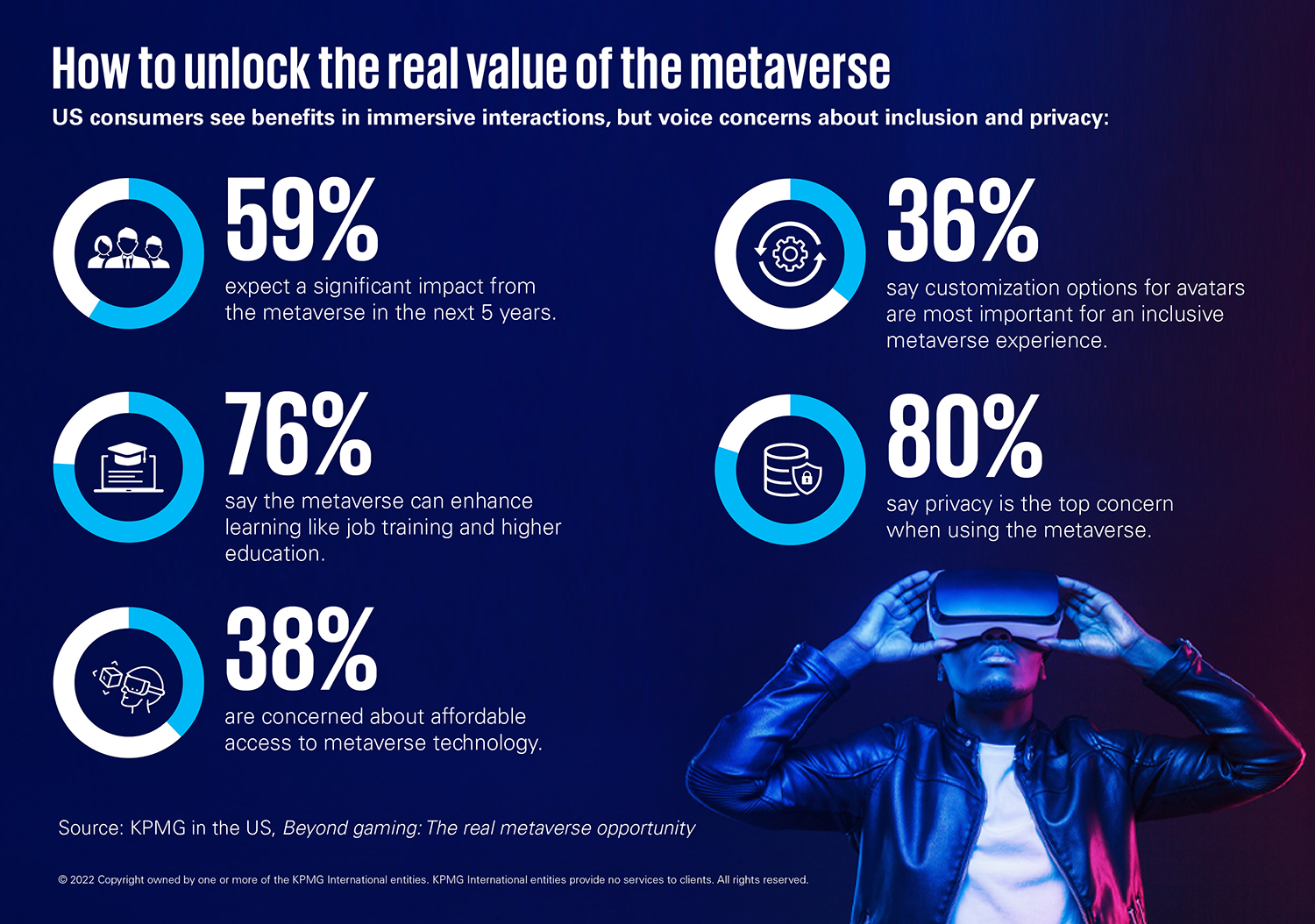
Organizations should look at how they can make sure metaverse-related technologies aren’t cost-prohibitive. A recent survey by KPMG in the US has found that 38% of consumers are concerned about affordable access to metaverse technology. We need low-cost connectivity to ensure broad adoption; if not, we’ll run the risk of creating a homogenous platform that’s open only to those who have the means to connect.
Technology economics show that, as adoption increases, costs inevitably drop, and today’s reality of $100 computers and low-cost software has helped unlock digital access for a broader set of consumers. But it took time. Meanwhile, high infrastructure and hardware costs to access the metaverse risk deepening the digital divide between richer early adopters and those with limited resources. As the space grows, it may come down to governments and multinationals to help to subsidize the necessary technologies to secure equitable adoption.
3. Make it accessible
When organizations design their metaverse experiences, it’s important to make accessibility one of the value drivers. The metaverse can give people the freedom to explore the world on their own terms and could be revolutionary, just as hybrid working has revolutionized workplace accessibility. The metaverse already holds tremendous potential to revolutionize the way people with disabilities engage, transact, socialize and work. This includes securing jobs previously inaccessible in the physical world; attending concerts, theatre performances and exhibitions via digital environments; and accessing education without needing to visit physical campuses.
Organizations should work closely with disability experts and advocates to embed accessibility at the core of designing applications and services in the metaverse. This can help to eliminate barriers and level the playing field to build virtual-reality spaces that are open to all.
4. Make it inclusive
“If you build it, they will come,” may not hold up in the metaverse if users don't see themselves represented. 36% of US consumers say customization options for avatars are most important for an inclusive metaverse experience. Users want the freedom to present themselves in different ways and expect to be able to pick from an avatar library that’s as diverse as the physical world. And innovators in the metaverse ecosystem are already creating digital personas that are nearly indistinguishable from real life.
The metaverse is at an early stage in its development, and it’s important to recognize and incorporate foundational elements of inclusion, diversity and equity, such as broad representation and making experiences and opportunities relevant and valuable for all groups. If developed thoughtfully and deliberately, it has the potential to become a truly inclusive space.
DISCOVER
What is the World Economic Forum doing about the metaverse?
Experts believe that the metaverse will come to represent the next major computing platform, transforming consumer experience and business models across industries.
Fashion brands are one example. Over years, apparel companies have perfected the design, manufacture, and distribution of clothing to anticipate consumers’ wants and needs in line with seasonal changes. But today, most of their revenue is surpassed by the $3bn worth of sales of digital cosmetic items in Fortnite, which have a cultural significance that extends far into the physical world.
This is one of the economic opportunities of the metaverse - the possibility to “assetize” digital content, creating a framework of digital ownership for users. If it is replicated at scale and across sectors, then entire industries will be reshaped by changes to their traditional value chains.
However, the promise relies on the advancement of several key technologies, including augmented, virtual and mixed reality (collectively known as XR), as well as blockchain, connected devices and artificial intelligence. How should these be governed in a way that promotes their economic upsides while protecting individuals’ safety, security and privacy?
The World Economic Forum is bringing together leading voices from the private sector, civil society, academia and government to address this precise question. Over the next year, it will curate a multistakeholder community focusing on metaverse governance and economic and social value creation.
It will recommend regulatory frameworks for good governance of the metaverse and study how innovation and value creation can be strengthened for the benefit of society. Updates will be published on the World Economic Forum website on a regular basis.
5. Build trust
It will be increasingly critical to address and alleviate concerns around privacy and information protection. Privacy and protecting personal information were the most significant concerns among US consumers, at 80% and 79% respectively. It’s important to make sure everyone feels secure to encourage participation. What’s more, industry leaders know that security, compliance and regulatory issues are among the biggest challenges in trying to deploy or build technologies, applications or experiences related to the metaverse.
Secure, connected wallets and blockchain-verified avatars will help verify and protect users’ identities and digital assets. But much like today’s cybersecurity challenges, there are similar opportunities for threats and bad actors to penetrate virtual worlds and take advantage of vulnerabilities in these emerging spaces. It will be imperative to use advanced artificial intelligence (AI) technology to power these worlds and detect threats. KPMG in the US, for example, is developing technology and services that help protect AI systems against threats that target the way they learn and execute tasks.
Nowhere does the intersection of technology, enterprises and individuals hold greater opportunity than in the metaverse. It is still in its infancy, and we hold the key to unlock its promise—if we can build it in a way that is inclusive and welcoming to all.
Read more: https://www.weforum.org/agenda/2023/01/5-ways-shape-inclusive-metaverse-davos2023/


All Comments