

Cointime

Download App
iOS & Android

The AI Universe Gateway Is About to Open: KeyFlow Official DApp to Launch Global Public Beta and Genesis Registration on July 29

Connecting AI-driven real-world business operations with an on-chain settlement closed loop, empowering everyone to unlock the wealth key to the AI Universe.
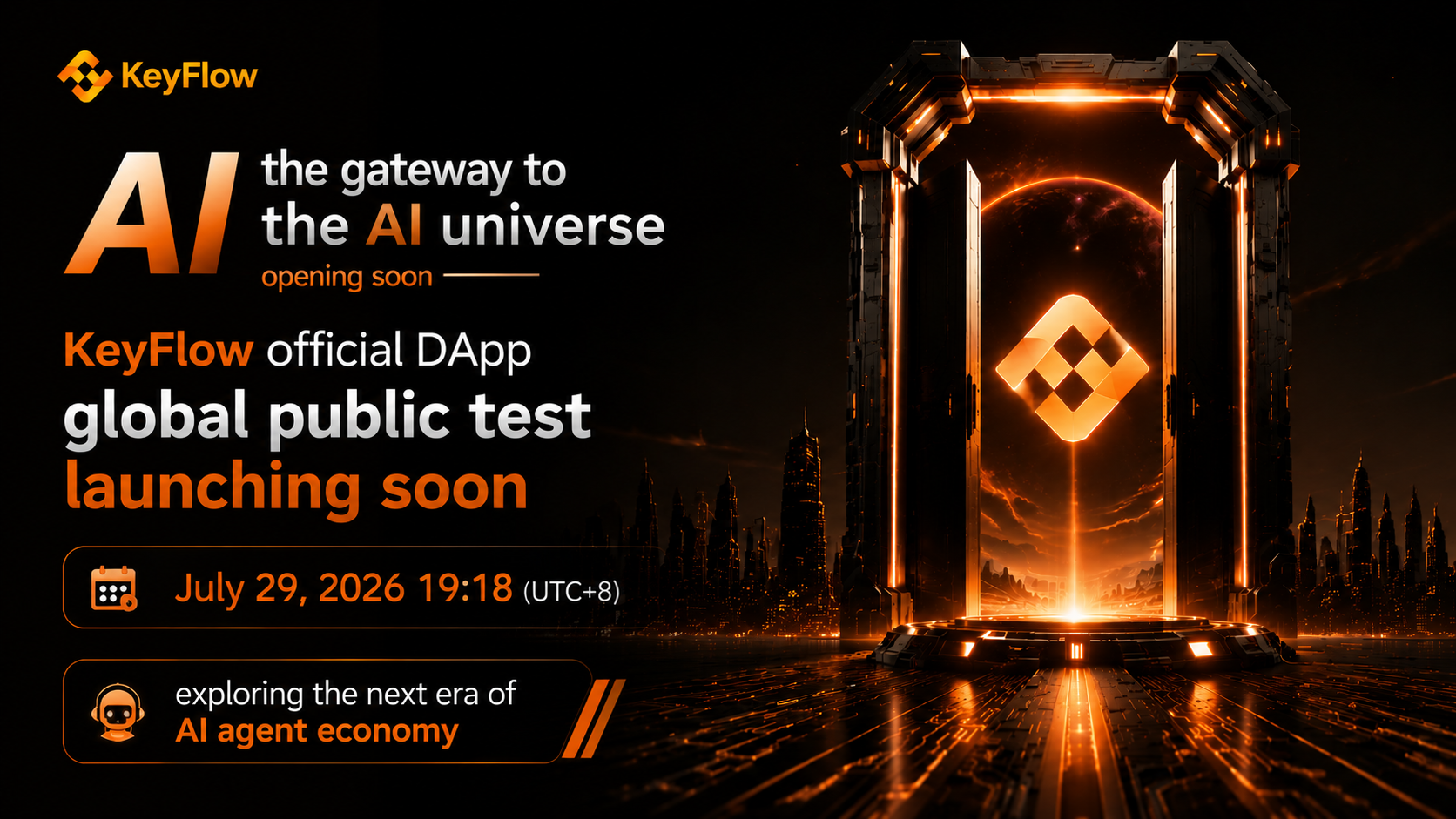
A Major Ecosystem Update Has Arrived, KeyFlow Genesis Phase Officially Begins

With the rapid growth of the global AI Agent economy, the settlement and value circulation of distributed computing power are entering a historic turning point. Therefore, as a decentralized settlement infrastructure built for the AI Agent economy, the KeyFlow official team has announced a major ecosystem update: the KeyFlow Official DApp will officially launch its global public beta on July 29, 2026, at 19:18 (UTC+8), while simultaneously opening Genesis account registration and computing power asset binding functions to global users.

This not only marks the successful completion of the on-chain deployment of KeyFlow’s core business logic and dynamic adjustment mechanisms, but also signifies the official opening of a gateway toward the “Autonomous Wealth AI Economy.” We are not only reshaping the underlying framework of distributed computing power, but also empowering every participant with a time-based compounding settlement mechanism through the KeyFlow Protocol.

The gateway to the AI Universe’s intelligent future is now open for everyone. This time, the industry will no longer be driven by luck, but by who holds the key.

A Three-Dimensional Integrated AI Settlement Infrastructure

As the core value circulation hub within the UniKey (one-stop AI comprehensive infrastructure) ecosystem, KeyFlow has built an exceptionally robust dynamic supply and value feedback mechanism around KEY. During this public beta phase, the official team will fully demonstrate its core technological advantages in integrating physical computing power infrastructure + capital flow optimization + real-world external business revenue streams.

1. Real-World Business Closed Loop, Breaking the Cycle of Internal Capital Competition

Unlike traditional crypto projects that lack practical application support, KeyFlow’s underlying assets possess strong physical value anchoring capabilities. Powered by pure smart contracts and decentralized settlement channels, the system has successfully achieved efficient on-chain settlement and revenue distribution between real-world asset (RWA)-based intelligent computing center hardware and AI cloud service business revenue streams. This means that every purchase and consumption of computing resources by global enterprises or AI Agents continuously injects real, verifiable external revenue streams into the KeyFlow network, fundamentally eliminating unsustainable speculative bubbles.

2. Dual-Track Asset Model, Driving Deflationary Value Circulation

At the protocol model level, KeyFlow introduces an innovative dual-track asset structure:

  • Credits (Consumption-Oriented Issuance): As a seamless access asset within the ecosystem, Credits’ total supply is dynamically adjusted based on the actual procurement demand of global AI models and intelligent agents, eliminating rigid hardware binding limitations.
  • KEY (System-Level Deflationary Asset): As the core asset of the network, KEY serves as the foundation of the ecosystem’s deflationary mechanism. Once external high-frequency business revenue streams are settled, the system automatically allocates the corresponding value in the background, triggering mandatory secondary-market buybacks and directly routing the acquired KEY into the reserve pool for permanent burning. As the number of AI Agent interactions across the network increases and business transaction flows become more intensive, KEY’s circulating supply will continue to experience net reduction, while the ecosystem treasury reserve pool continues to strengthen.

3. ZK Privacy-Preserving Settlement, Reinforcing Privacy Protection Within Liquidity Flows

To address the privacy exposure risks associated with on-chain asset custody, KeyFlow has innovatively introduced a Zero-Knowledge Privacy Proof (ZK Privacy Proof) solution. After users deposit assets into flexible custody, the system automatically generates encrypted ZK redemption credentials. During the withdrawal process, the smart contract executes multi-to-multi batch settlement among accounts within the same batch based solely on these credentials.

While fully ensuring flexible asset access and high-speed value circulation, this mechanism effectively obscures one-way transaction correlation paths, achieving a natural and seamless approach to on-chain privacy protection.

Genesis Node Business Flow

With the upcoming launch of the Genesis Public Beta on July 29, the official team has completed a comprehensive optimization of the front-end interaction interface and user flow, ensuring that the first wave of global participants can seamlessly familiarize themselves with the business process and prepare for subsequent underlying real asset value settlement.

1. Genesis Registration and Computing Power Verification

Once the public beta channel is activated, users can directly access the official DApp through their on-chain wallets to establish a global account. The public beta will officially open the computing power asset binding function, allowing users to connect their wallets and complete the verification and deployment process.Users are advised to pay close attention to this process, as the verification data will serve as the core reference for future network-wide business settlement and revenue distribution.

2. Multi-Asset Flexible Custody Experience

This public beta will simultaneously launch the multi-asset custody interaction interface. The system supports flexible deposits of mainstream assets including KEY, USDT, ETH, and BNB.Users will be able to clearly observe the operational logic of the 12-hour automatic compounding Rebase mechanism through the front-end interface, with all mechanisms transparently presented according to predefined on-chain rules.

3. Official Public Beta Access Channel and Timeline

  • Official DApp Website: https://www.getkeyflow.ai
  • Global Launch Time: July 29, 2026, at 19:18 (UTC+8)

Official Team Notice: The current public beta is a phase for system operation verification and UI/feature optimization. Front-end data displayed will be a dynamic simulation synced with a mock market/business dashboard and does not reflect real trading data. Community members are strongly urged to access the platform only through the official and unique link, remain vigilant against unofficial channels, and take strict precautions against phishing sites and fake platforms.

Reshaping the Settlement Landscape of the AI Agent Economy

The launch of the public beta is only the first step. Within KeyFlow’s long-term development roadmap, the team has established a clear strategic vision with strong execution capabilities. As its core business logic completes on-chain deployment, KeyFlow will gradually unlock the extensive ecosystem value of its role as the “Fourth-Generation Decentralized Settlement Infrastructure.”

1. Seamless Expansion of Cross-Chain Intent Routing

During the upcoming ecosystem expansion phase, KeyFlow will leverage its Intent-based Cross-Chain Agent Layer to seamlessly integrate with leading global distributed computing power routing service providers. The system will move beyond the closed-loop scenarios of token subscriptions and internal point-based systems, extending its settlement capabilities into a broader multi-chain interoperable ecosystem. By aggregating settlement activities from global intelligent computing service providers and cross-chain nodes, KeyFlow aims to become an indispensable settlement infrastructure for the global AI Agent economy.

2. Fully Autonomous Smart Contract Execution and Decentralized Governance

In terms of governance and ecosystem value distribution, KeyFlow is firmly committed to advancing toward complete algorithmic autonomy. Deduction mechanisms, buyback processes, and revenue distribution rules will be permanently encoded into the underlying smart contracts, eliminating the uncertainty of long-cycle proposals and the potential risks associated with centralized control. As the decentralized governance network of 10,000 global nodes gradually takes shape, consensus-based value sharing, decentralized authority, and transparent verifiability will become a reality. Every key holder will be able to share the long-term benefits generated by the growth of the global AI industry.

3. The Core Value Loop of Algorithm-Driven Productivity Transformation

Within the future AI Agent economy ecosystem, every cross-chain “AI cargo vessel” arriving for settlement and every high-frequency utilization of intelligent computing center servers will become a fundamental driver of value circulation within the KeyFlow value network. Through the continuous synergy of the dual-track engine, every unit of real-world industry consumption will be transformed into sustainable value accumulation within the asset portfolios of on-chain holders.KeyFlow will leverage uncompromising mathematical efficiency and pure smart contract sovereignty to establish a robust foundation for ordinary users in the AI era — a value protection framework that integrates both privacy preservation and long-term wealth growth.

Wealth Follows Efficiency. Algorithms Reshape Productivity.On July 29, 2026, at 19:18 (UTC+8), the Genesis Gateway will officially open.Together, we will witness the beginning of a new era — an era where the key to the AI Universe is returned to ordinary users.


Comments

All Comments

Recommended for you

  • Samsung Electronics' R&D Investment Reaches Record 27.3 Trillion Won in First Half of 2026

    On August 14, regulatory filing documents disclosed on Friday revealed that Samsung Electronics' R&D investment reached a new high of 27.3 trillion won (approximately 19 billion USD) in the first half of 2026. The South Korean tech giant's R&D expenses for the period from January to June increased by 51.5% compared to 18.06 trillion won in the same period last year, setting a record for the highest semi-annual expenditure. Additionally, Samsung Electronics' equipment investment in the first half of the year also set a semi-annual record, reaching 28 trillion won, an increase of nearly 5 trillion won year-on-year.

  • Traders Completely Abandon Rate Hike Expectations for This Year

    On August 14, retail sales data fell short of expectations, leading traders to completely abandon the prospect of a rate hike this year. The market is currently fully pricing in a rate hike to occur in January next year, which is a stark contrast to the situation just a few weeks ago, when the market increasingly anticipated two 25 basis point hikes before March 2027.

  • Market Pricing Indicates Decreased Probability of Multiple Fed Rate Hikes Before Mid-2027

    On August 14, market pricing shows that the probability of the Federal Reserve raising interest rates more than once before mid-2027 has decreased. (Jin Shi)

  • Norwegian Sovereign Fund's Bitcoin Holdings Exceed 11,549, Setting New Record High

    According to K33's research director Vetle Lunde, as of the end of the first half of 2026, the Norwegian Sovereign Wealth Fund's indirect Bitcoin exposure, through holdings in companies such as Strategy, Metaplanet, MARA, Coinbase, Block, and Tesla, has risen to 11,549 BTC, a historic high valued at approximately $725 million. This exposure increased by 21.2% in the first half of the year and by 60.5% over the past year, marking the sixth consecutive reporting period of growth. Among these, Strategy accounts for nearly 86% of the fund's indirect Bitcoin exposure, corresponding to about 9,914 BTC, with the fund holding approximately 1.17% of Strategy's shares as of June 30. Metaplanet corresponds to 671 BTC, MARA to 421 BTC, and Coinbase, Block, and Tesla correspond to 183 BTC, 120 BTC, and 97 BTC, respectively. K33 notes that this exposure is likely not a result of the fund's active allocation to Bitcoin but rather an indirect effect of its broadly diversified investment portfolio, with the related Bitcoin exposure accounting for about 0.03% of the fund's total assets. Additionally, the fund has also gained indirect ETH exposure for the first time through the Ethereum treasury company BitMine, holding 6.15 million shares of BitMine valued at $88.3 million as of June 30, which corresponds to an indirect exposure of approximately 67,340 ETH based on BitMine's current ETH holdings.

  • U.S. Retail Sales Unexpectedly Decline

    On August 14, it was reported that U.S. retail sales for July recorded a month-on-month decrease of 0.6%, marking the largest drop since May of last year, and falling short of market expectations of a 0.1% increase. (Jin Ten)

  • SK Hynix Employees' Average Salary Reaches 144 Million Won in First Half of 2023

    On August 14, SK Hynix reported that the average salary of its employees reached 144 million won (approximately $104,000) in the first half of this year, marking a 23% increase year-on-year. The company significantly increased its capital expenditures and research and development (R&D) investments during this period. Cash outlays for tangible asset purchases exceeded 18 trillion won, a year-on-year increase of over 70%. The number of small shareholders in the company grew more than fivefold within a year, surpassing 3.46 million. In the first half of 2023, SK Hynix generated over 17 trillion won in sales from Nvidia, accounting for approximately 13% of the company's total sales.

  • Strategy and Metaplanet Face Potential Removal from MSCI Index, Results Expected in October

    On August 14, MSCI sought feedback on a new non-operational company identification method, which could lead to the removal of Strategy and Metaplanet from the MSCI Global Investable Market Index. According to a simulation using May 2026 data, Strategy, Metaplanet, and uranium investment company YellowCake would be excluded from the MSCI ACWI IMI, while companies like SharpLink would be placed on a public watchlist. The new method will employ a two-step screening process. Companies will first undergo a test of their operational asset structure; if they fail, they will be assessed based on five indicators: operational asset ratio, expense intensity, operating cash flow, fair value changes, and capital dependency. If a company fails the core test and triggers at least four exclusion conditions, it may be deemed ineligible for the index. For companies already included in the index, MSCI plans to implement a relatively lenient threshold, stating that a company will only be removed after failing the screening for two consecutive reporting periods. After free float adjustments, Strategy's market capitalization in the May 2026 simulation is $23.9 billion, making it the largest company marked for potential removal. MSCI noted that this proposal will not immediately change the index composition, as it is seeking input from market participants until September 30, with results expected to be announced by October 16. Previously, JPMorgan analysts estimated that if Strategy is removed from the MSCI index, it could trigger an outflow of approximately $2.8 billion in passive funds.

  • Morgan Stanley Q2 Holdings: Increased Investment in Micron Technology and AI Hardware, Reduced Exposure to S&P and Traditional Industries

    On August 14, according to disclosures from the U.S. Securities and Exchange Commission (SEC), Morgan Stanley submitted its second-quarter holdings report (13F) for the period ending June 30, 2026. Overall, the changes in Morgan Stanley's holdings reflect a strategy of "maintaining a core technology focus, reducing index exposure, and enhancing active selection capabilities." Statistics show that the total market value of Morgan Stanley's holdings in the second quarter was $1.89 trillion, up 13.9% from $1.66 trillion in the previous quarter. In the second quarter, the fund added 449 new stocks to its portfolio, increased its holdings in 3,850 stocks, reduced its holdings in 3,280 stocks, and completely exited 334 stocks. The top ten holdings accounted for 21.09% of the total market value.

  • Binance to Restrict Trading with Multiple Crypto Asset Platforms

    According to a Binance announcement, in response to recent regulatory changes, Binance will cease processing transactions involving certain crypto asset service providers/platforms starting from the following dates: effective August 7, including Shelbit and Aban Tether Exchange; effective August 13, including A7 Nigeria, A7 Africa, and PilotFinance; effective August 23, including Rapira, Aifory Pro, ABCeX, WhiteBird, NoOnecrypto, Tradex, Monease, BitPapa, Exnode, Exnode Pay, HTX (Huobi Global SA), EXMO, and others. Binance advises users to avoid transferring or receiving assets directly or indirectly to or from the aforementioned entities, or engaging in other transactions with them, as such transactions may require additional compliance review, during which wallets may be restricted, and related activities may involve violations of Binance's Terms of Use.

  • Bank of America’s Hartnett: 2026 Midterm Elections as a Watershed for AI Bull Market, Republican Victory Could Strengthen AI Stocks Until 2027

    On August 14, according to market news, Bank of America’s Chief Investment Strategist Michael Hartnett and his team released a new research report defining the 2026 U.S. midterm elections as a core watershed for the current AI bull market in U.S. stocks. The report presents two scenarios: if the Republican Party retains the Senate and Texas Governor Greg Abbott is re-elected, the market will interpret this as a continuation of AI data center expansion and favorable AI capital expenditure policies, leading to sustained strength in the U.S. AI sector, with a potential bubble forming by 2027. Conversely, if the Democratic Party wins the Senate and the Texas governorship, the U.S. stock market could experience a significant correction of over 10%, which would simultaneously drive down the dollar and U.S. Treasury yields. Currently, the fundamentals of the U.S. stock market remain supportive, with the S&P 500's earnings growth in the second quarter significantly exceeding expectations, and trillion-dollar AI capital expenditures and wealth effects continuing to boost risk appetite. However, the market's bullish positions are extremely crowded, with Bank of America’s bull-bear indicator rising to 9.3, indicating a sell zone, and private client stock allocations reaching historic highs. If election outcomes, interest rates, or AI earnings expectations fall short, these crowded positions could amplify market volatility. Hartnett also cautioned that persistently rising U.S. Treasury yields and the pressure of servicing the country's massive debt are core constraints on market performance, noting that a significant easing of government debt servicing costs would require the 5-year U.S. Treasury yield to fall below 3.25%.