

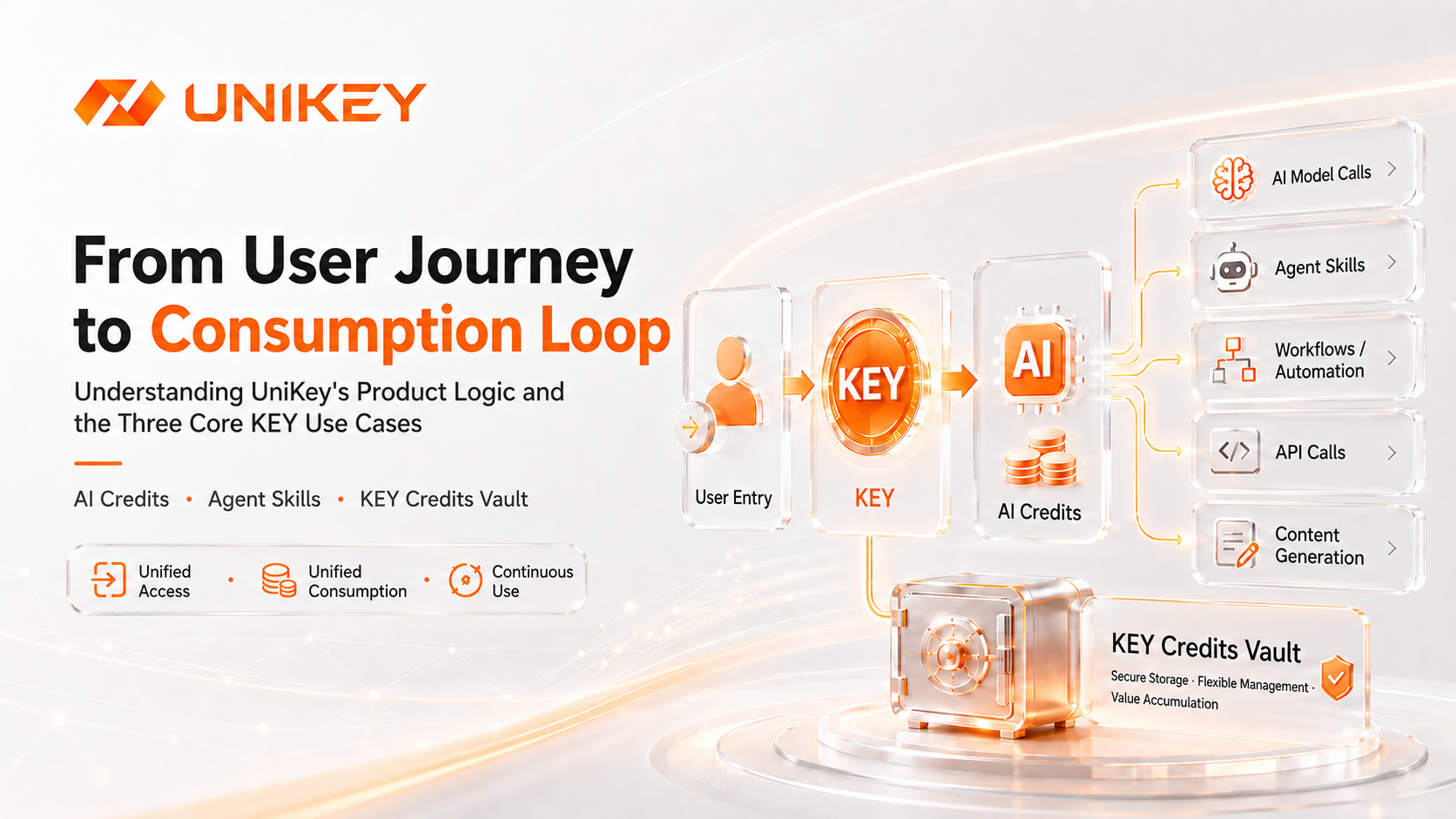
UniKey Is Not a Single Tool, but a Complete AI Usage Path
Many people first understand UniKey as an “AI aggregation platform” or a “multi-model access gateway.” This is not wrong, but if the understanding stops there, it becomes difficult to see the deeper product logic behind UniKey. UniKey is not simply about placing multiple models, tools, and services on one page. Its core value lies in building a complete user journey: users enter the platform, obtain consumption capability, call models and services, further use Agent Skills and workflows, and then continue consuming and reusing AI capabilities through a unified credit and settlement system.
From this perspective, UniKey’s true value is to reorganize the fragmented AI usage experience. In the traditional AI workflow, users often need to register across different model platforms, pay on different tool platforms, manage separate usage quotas, and deal with inconsistent interfaces, high usage barriers, scattered billing, and unstable access. UniKey consolidates these fragmented steps into one unified product path, allowing users to access, purchase, call, and continuously use AI capabilities within one system.
This is why UniKey should not be understood only as model routing or API access. It should be understood within a larger user behavior framework. A mature AI product should not merely tell users that many models are available. It must answer three more important questions: how users obtain access to AI capabilities, how users consume these capabilities efficiently, and how users form long-term usage and retention within the platform. Around these questions, UniKey builds a connected mechanism consisting of AI Credits, KEY, and KEY Credits Vault.
The Core Product Path Is to Enable Usage First, Then Build the Consumption Loop
From the user’s perspective, the UniKey journey is clear. First, users enter the platform and access a unified AI capability gateway. Second, users obtain the consumption basis for using platform capabilities through the account system, AI Credits mechanism, or KEY mechanism. Third, users begin using models, Agent Skills, APIs, workflows, and other services. Fourth, as usage deepens, users enter higher-level scenarios, such as purchasing specific Skills, configuring long-term usage credits, or managing internal team allocation and credit circulation.
This design is important because AI products often fall into the trap of “having many capabilities, but scattered usage.” If a platform can only display many models but cannot help users build a stable, low-friction, and continuous usage path, it is only a capability directory rather than a real product. UniKey places calling, payment, settlement, and service organization into one system, transforming capability display into capability consumption, and further transforming capability consumption into continuous usage. This is the key step for a platform to evolve from a tool into a network.
Because of this, UniKey naturally requires a layered mechanism. Not all users enter the platform in the same way, and not all consumption should be handled by the same asset or credential. High-frequency, small-value, real-time AI calls need an internal consumption credential that is lightweight and efficient. At the same time, a higher-level usage token is needed to connect platform entry, Skill consumption, and long-term quota mechanisms. The division between AI Credits and KEY is formed under this product logic.
AI Credits Carry High-Frequency, Low-Friction AI Consumption Inside the Platform
The role of AI Credits in the UniKey system is very clear. AI Credits are not an abstract concept or merely a display unit. They are internal AI consumption credentials within the platform. Their core purpose is to support high-frequency, continuous, low-friction AI usage. Whether users are calling models, using AI Skills, generating content, generating images, accessing APIs, using Agent services, or executing automated workflows, these are all repeated consumption behaviors inside the platform. If each action were directly tied to different external suppliers and pricing rules, the user experience would become highly fragmented.
From the user experience perspective, the value of AI Credits is unified consumption. Users do not need to understand the pricing rules of different models every time they use a different capability, nor do they need to switch between different payment relationships across external platforms. For the platform, AI Credits function as an internal settlement layer. They transform complex underlying model costs, tool supply, service calls, and usage measurement into a unified credit format that users can understand and use more easily. As a result, users focus on whether they can conveniently use AI capabilities, rather than which supplier is being called and how that supplier calculates fees.
More importantly, AI Credits allow UniKey to support not only single model calls, but the entire AI usage scenario. A user may use Credits for model conversations today, and for Agent services, workflow execution, or API consumption tomorrow. In the future, Credits may also support more complex allocation, management, and circulation inside the product system. In this sense, AI Credits are not simply “model call balance.” They are the unified carrier of AI consumption behavior inside UniKey. This unified consumption capability is the foundation for the platform to form a real product loop.
The Meaning of KEY Lies in Real Usage Scenarios, Not Abstract Narratives
Compared with AI Credits, which carry high-frequency consumption inside the platform, KEY plays more of an entry-connection role. It is not designed to replace every AI consumption action directly. Instead, it brings users into concrete product scenarios at a higher level. UniKey’s definition of KEY is now very clear: it revolves around three real use cases, namely purchasing AI Credits, purchasing or calling Agent Skills, and depositing KEY into KEY Credits Vault to obtain daily AI Credits model quota. In other words, the meaning of KEY does not come from discussing value outside the product, but from establishing stable links with concrete usage behavior.
The first use case is purchasing AI Credits, which is the most basic and direct use of KEY. Users use KEY to obtain consumption credits inside the platform, and then use those credits for model calls, content generation, image generation, API access, Agent services, and workflow execution. This allows KEY to naturally enter the main consumption path of the platform rather than staying at the edge of the ecosystem. The more real and frequent the user’s demand for AI capabilities becomes, the stronger the connection between KEY and the platform’s consumption system becomes.
The second use case is purchasing or calling Agent Skills. This allows KEY to go beyond basic credit conversion and enter a higher-value service layer. Agent Skills package AI capabilities into services that are closer to real tasks, such as content matrix operations, community operations, PPT design, and video editing. For many users, the key question is not which model should be called, but whether a task can be completed efficiently. When KEY can directly enter these service scenarios, it connects not only model capabilities, but also complete AI application value.
KEY Credits Vault Connects Long-Term Usage, Not Short-Term Stimulation
Among the three use cases of KEY, KEY Credits Vault best reflects UniKey’s product logic. Its core function is not to encourage one-time consumption, but to build a longer-term relationship between KEY and continuous use of UniKey’s AI capabilities. After users deposit KEY into KEY Credits Vault, the system releases corresponding AI Credits model quota according to daily snapshots and platform rules. When users redeem their KEY, the subsequent quota release stops. This means the Vault is not designed as a one-time purchasing behavior, but as a model quota configuration mechanism for long-term users.
From the product logic perspective, this design is reasonable. UniKey is not only serving occasional users, but also users and teams that call models frequently, use Skills continuously, and run workflows over the long term. For these users, repeatedly obtaining credits in scattered ways is not the best experience. They need a mechanism that allows them to continuously receive usable model quota. KEY Credits Vault is designed for this demand. It allows users not merely to “buy once and use once,” but to establish a continuous allocation relationship around platform AI usage behavior.
At a deeper level, the Vault mechanism extends KEY from a simple usage entry into a long-term usage connector. Users can directly use KEY to purchase AI Credits, which is an immediate consumption path. They can also deposit KEY into the Vault and receive AI Credits model quota over time, which is a continuous usage path. These two paths correspond to different user needs, but both point to the same core principle: KEY must connect with real product scenarios rather than remain outside the platform. For this reason, the Vault mechanism is not an add-on feature, but an important part of the UniKey usage loop.
Agent Skills Move UniKey from a Capability Platform to a Service Platform
If AI Credits give the platform unified consumption capability, and KEY Credits Vault gives the platform a long-term usage mechanism, then Agent Skills move UniKey from an AI capability platform toward an AI service platform. For most users, what they truly need is not abstract model capability, but service products that are closer to task outcomes. A user may not care which model is called, but does care whether they can quickly complete a content matrix, a PPT project, a set of video editing tasks, or a community operation plan. The value of Agent Skills is to package AI capabilities into service units that can be purchased, subscribed to, or called directly.
In this process, KEY plays an important role. It is not only a medium for purchasing basic consumption credits, but also a tool for directly entering Skill scenarios. This extends KEY’s usage value from “converting into Credits” to “purchasing service outcomes.” For UniKey, this is very important because the platform does not simply want users to access models. It wants users to solve problems, complete tasks, and form continuous usage behavior on the platform. The richer the Skill scenarios become, the more real the service network connected by KEY becomes, and the clearer the platform’s ecosystem loop becomes.
More importantly, Agent Skills also open space for developers and service providers. Developers are no longer only providers of underlying access capabilities. They can package their skills into service products that users can directly consume. In this way, UniKey is no longer merely an access gateway. It begins to become a service network that connects supply and demand. Users call Skills with KEY, developers gain usage opportunities through Skills, and the platform organizes consumption behavior through AI Credits and settlement mechanisms. Capability, service, and consumption are thus connected into a complete chain.
AI Credits Transfer Will Expand the Consumption Path from Individual Use to Collaborative Use
The future support for AI Credits transfer inside the platform is a particularly important step in UniKey’s product path. Once Credits can circulate flexibly inside the platform, their meaning will no longer be limited to individual consumption balance. They will further become collaborative AI usage resources. This means UniKey is not only preparing for individual user scenarios, but also laying the groundwork for teams, project groups, enterprise departments, and broader ecosystem collaboration.
For team users, the most direct value of AI Credits transfer is better allocation efficiency. A team can centrally configure Credits and then distribute them according to projects, tasks, or member needs. An enterprise can also allocate AI resources across departments and business lines. This capability will help UniKey upgrade from a simple consumption platform into an AI usage platform with stronger organizational capabilities. In other words, the platform does not only help individuals use AI more conveniently; it also helps teams manage AI more efficiently.
From a longer-term perspective, transferability will further strengthen the internal consumption loop of the platform. When AI Credits can move between different participants, users, teams, developers, and service providers become more closely connected. Calls, purchases, collaboration, allocation, and reuse inside the platform will gradually form a higher-frequency consumption network. At that point, UniKey will no longer be carrying isolated AI calls one by one, but a continuously circulating, reusable, and expandable AI usage system.
UniKey’s True Value Is Connecting Product Usage, KEY Scenarios, and AI Consumption Mechanisms
Looking at the entire system together, UniKey is not simply stacking concepts such as KEY, AI Credits, Skills, and Vault. It is building a coherent usage path. Users first enter the unified AI capability gateway, then obtain AI Credits through KEY or other methods, and then use models, Skills, APIs, Agents, and workflows. As usage deepens, users can use KEY to purchase more specific services, or obtain continuous model quota through KEY Credits Vault, thereby forming a more stable usage relationship. Throughout this process, AI Credits carry consumption, KEY connects scenarios, Skills carry services, and Vault supports continuous usage. Each component has its own role, but they work together as one system.
The most valuable part of this mechanism is that it turns UniKey from a collection of functions into a consumption system. Whether a platform can truly build product strength does not depend on how many models, tools, or modules it lists. It depends on whether these modules can form a real and executable usage path. UniKey’s product logic is to organize every step from access, consumption, service usage, and long-term retention, while giving KEY and AI Credits clear and practical roles within that path.
Therefore, if UniKey’s logic around product, KEY, and Credits were to be summarized in one sentence, it would be this: UniKey is not building a simple AI calling platform. It is building a consumption and service network around real AI usage behavior. In this network, users do not merely “see capabilities.” They can enter capabilities, consume capabilities, call services, and continue using capabilities over time. The value of KEY is precisely established and strengthened within this real usage network.


All Comments