

Cointime

Download App
iOS & Android

ENI Takes the Stage at WebX Japan and Builds a Bridge from Traditional Capital to the Future Economy


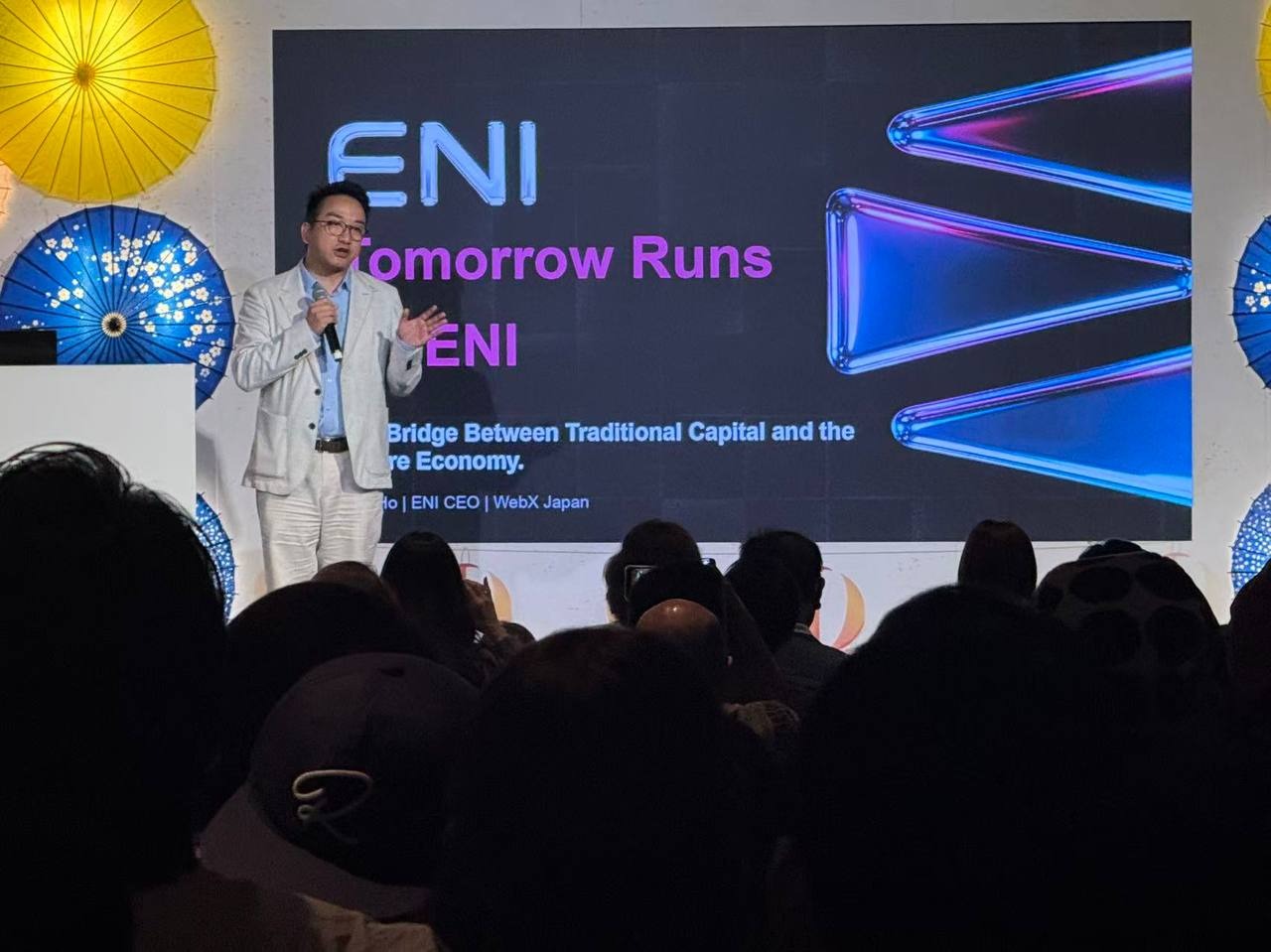
On July 13, Arion Ho, CEO of enterprise modular blockchain ENI Network, took the stage at WebX Japan and delivered a keynote titled “Tomorrow Runs on ENI: The Bridge Between Traditional Capital and the Future Economy.” Drawing on ENI’s progress around the world, he introduced its infrastructure for enterprises and institutions, its supernode network, and new ways for traditional capital to participate in Web3. The atmosphere was lively as industry guests, ecosystem partners, and community members exchanged ideas about enterprise blockchain applications.
ENI Connects Asia’s Growth Markets

Arion reviewed ENI’s regional progress across Asia. ENI strengthened its connections between Japan and Southeast Asia and held discussions shaped by the needs of local industries and institutions.

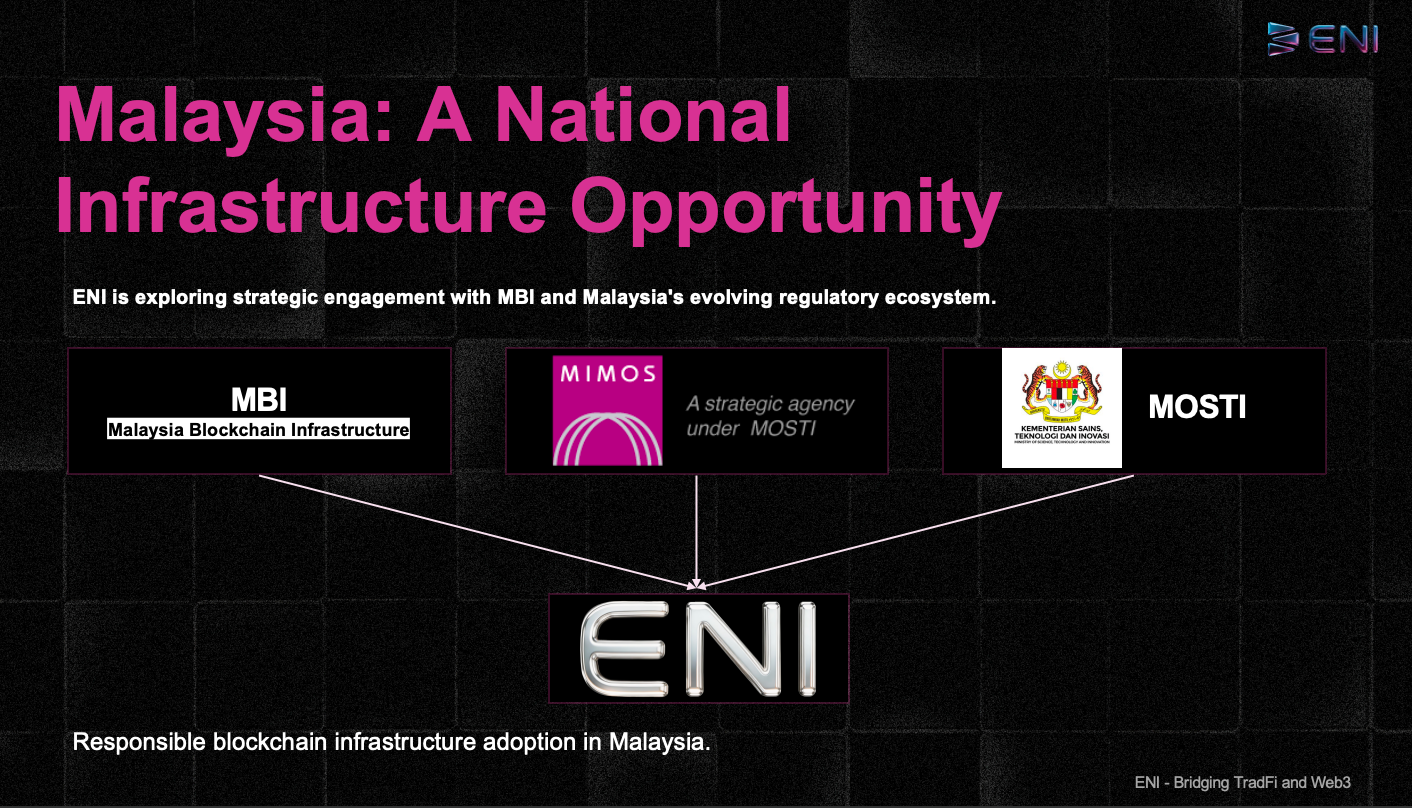
In Malaysia, ENI explored strategic engagement with MBI, Malaysia Blockchain Infrastructure, and the local regulatory ecosystem, with a focus on cross border trade, compliant finance, smart custody, and logistics. In Indonesia, ENI established a regional dialogue with Indivara, a leading technology investment holding group in ASEAN. In Thailand and Vietnam, discussions expanded to family offices, ICT companies, and banks. These developments laid a foundation for ENI to connect enterprises, institutions, and real business activity across Southeast Asia.
The Supernode Network Brings Together Global Institutional Resources

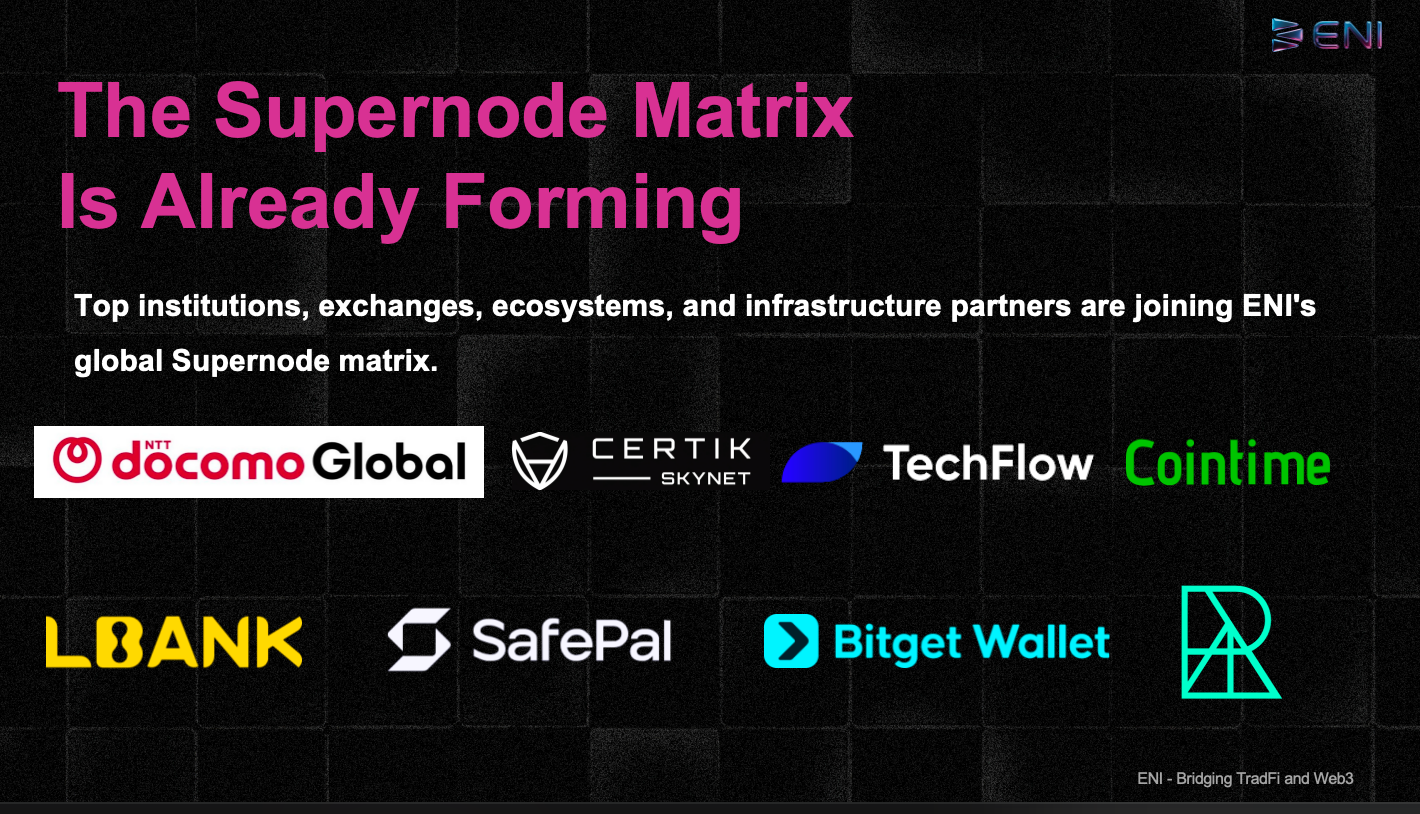
Arion Ho introduced the ENI Supernode Program. Open to institutions, trading platforms, ecosystem organizations, and infrastructure partners worldwide, the program aims to build a Supernode Matrix centered on resources, distribution capabilities, and institutional credibility.

By the time of the event, the network had brought together a diverse group of partners. NTT, a Fortune Global 500 company and a leading Japanese telecommunications provider, contributed deep market knowledge from traditional infrastructure. Blockchain security, audit, and verification organizations such as CertiK strengthened institutional trust. Republic Crypto, a globally recognized Web3 advisory and capital organization, connected ENI with international capital resources. Platforms and wallet applications including LBank, SafePal, Bitget Wallet, and Gate Wallet brought user access, market reach, and liquidity.

Building on the supernode network, ENI launched the ENI Superteam Program on July 12 to deepen coordination between global resources and local markets and accelerate both global and local ecosystem development.
Enterprises are also important participants in the expansion of the ENI ecosystem. Listed companies, banks, telecommunications operators, brands, and institutions bring trust, capital, users, channels, compliance capabilities, and real business activity, helping blockchain infrastructure serve the real economy more effectively. Under the plan, Superteam will work with local enterprises, developers, communities, and ecosystem partners to build collaborative networks and advance ENI’s ecosystem development and practical adoption in global markets.

From One Blockchain to an Integrated System

ENI consists of a mainnet, a Hub, and multiple AppChains. The mainnet handles trust and settlement, the Hub provides connectivity and liquidity, and AppChains support enterprise applications and business execution. Within this structure, capital, users, assets, and business activity can connect through one system.

Arion Ho explained that listed companies could become a new gateway for the public to connect with Web3. When a listed company joins the ENI ecosystem, investors can gain an indirect connection to the ecosystem’s long term growth by holding shares in that company. This offers traditional capital a more familiar path into Web3 and creates more room for ENI to support cross border trade, compliant finance, logistics settlement, and enterprise systems.

Multiple Events Expand ENI’s Presence

In addition to the WebX keynote, Arion and the ENI team attended ENI Community Night and the NTT Official Joint Event on the evening of July 13.

Both events attracted many industry guests, ecosystem partners, and community members. The NTT Official Joint Event further strengthened ENI’s engagement with NTT, a leading Japanese telecommunications company, and with resources from the traditional technology sector. The conversations were relaxed and energetic, helping ENI meet potential partners and open up new opportunities for collaboration and community growth. The events received a strong response and raised ENI’s visibility in Japan and across Asia.

From partnerships in Southeast Asia and the global supernode network to stronger connections with traditional enterprises and capital markets, ENI is steadily expanding its international reach. The Japan visit showcased ENI’s technology and ecosystem progress while creating new opportunities for meaningful exchange and cooperation. As more enterprises, institutions, and community partners join, ENI will continue building a bridge between the traditional economy and Web3, helping capital, assets, users, and business activity move more smoothly into the future digital economy.
Comments

All Comments

Recommended for you

  • Samsung Electronics' R&D Investment Reaches Record 27.3 Trillion Won in First Half of 2026

    On August 14, regulatory filing documents disclosed on Friday revealed that Samsung Electronics' R&D investment reached a new high of 27.3 trillion won (approximately 19 billion USD) in the first half of 2026. The South Korean tech giant's R&D expenses for the period from January to June increased by 51.5% compared to 18.06 trillion won in the same period last year, setting a record for the highest semi-annual expenditure. Additionally, Samsung Electronics' equipment investment in the first half of the year also set a semi-annual record, reaching 28 trillion won, an increase of nearly 5 trillion won year-on-year.

  • Traders Completely Abandon Rate Hike Expectations for This Year

    On August 14, retail sales data fell short of expectations, leading traders to completely abandon the prospect of a rate hike this year. The market is currently fully pricing in a rate hike to occur in January next year, which is a stark contrast to the situation just a few weeks ago, when the market increasingly anticipated two 25 basis point hikes before March 2027.

  • Market Pricing Indicates Decreased Probability of Multiple Fed Rate Hikes Before Mid-2027

    On August 14, market pricing shows that the probability of the Federal Reserve raising interest rates more than once before mid-2027 has decreased. (Jin Shi)

  • Norwegian Sovereign Fund's Bitcoin Holdings Exceed 11,549, Setting New Record High

    According to K33's research director Vetle Lunde, as of the end of the first half of 2026, the Norwegian Sovereign Wealth Fund's indirect Bitcoin exposure, through holdings in companies such as Strategy, Metaplanet, MARA, Coinbase, Block, and Tesla, has risen to 11,549 BTC, a historic high valued at approximately $725 million. This exposure increased by 21.2% in the first half of the year and by 60.5% over the past year, marking the sixth consecutive reporting period of growth. Among these, Strategy accounts for nearly 86% of the fund's indirect Bitcoin exposure, corresponding to about 9,914 BTC, with the fund holding approximately 1.17% of Strategy's shares as of June 30. Metaplanet corresponds to 671 BTC, MARA to 421 BTC, and Coinbase, Block, and Tesla correspond to 183 BTC, 120 BTC, and 97 BTC, respectively. K33 notes that this exposure is likely not a result of the fund's active allocation to Bitcoin but rather an indirect effect of its broadly diversified investment portfolio, with the related Bitcoin exposure accounting for about 0.03% of the fund's total assets. Additionally, the fund has also gained indirect ETH exposure for the first time through the Ethereum treasury company BitMine, holding 6.15 million shares of BitMine valued at $88.3 million as of June 30, which corresponds to an indirect exposure of approximately 67,340 ETH based on BitMine's current ETH holdings.

  • U.S. Retail Sales Unexpectedly Decline

    On August 14, it was reported that U.S. retail sales for July recorded a month-on-month decrease of 0.6%, marking the largest drop since May of last year, and falling short of market expectations of a 0.1% increase. (Jin Ten)

  • SK Hynix Employees' Average Salary Reaches 144 Million Won in First Half of 2023

    On August 14, SK Hynix reported that the average salary of its employees reached 144 million won (approximately $104,000) in the first half of this year, marking a 23% increase year-on-year. The company significantly increased its capital expenditures and research and development (R&D) investments during this period. Cash outlays for tangible asset purchases exceeded 18 trillion won, a year-on-year increase of over 70%. The number of small shareholders in the company grew more than fivefold within a year, surpassing 3.46 million. In the first half of 2023, SK Hynix generated over 17 trillion won in sales from Nvidia, accounting for approximately 13% of the company's total sales.

  • Strategy and Metaplanet Face Potential Removal from MSCI Index, Results Expected in October

    On August 14, MSCI sought feedback on a new non-operational company identification method, which could lead to the removal of Strategy and Metaplanet from the MSCI Global Investable Market Index. According to a simulation using May 2026 data, Strategy, Metaplanet, and uranium investment company YellowCake would be excluded from the MSCI ACWI IMI, while companies like SharpLink would be placed on a public watchlist. The new method will employ a two-step screening process. Companies will first undergo a test of their operational asset structure; if they fail, they will be assessed based on five indicators: operational asset ratio, expense intensity, operating cash flow, fair value changes, and capital dependency. If a company fails the core test and triggers at least four exclusion conditions, it may be deemed ineligible for the index. For companies already included in the index, MSCI plans to implement a relatively lenient threshold, stating that a company will only be removed after failing the screening for two consecutive reporting periods. After free float adjustments, Strategy's market capitalization in the May 2026 simulation is $23.9 billion, making it the largest company marked for potential removal. MSCI noted that this proposal will not immediately change the index composition, as it is seeking input from market participants until September 30, with results expected to be announced by October 16. Previously, JPMorgan analysts estimated that if Strategy is removed from the MSCI index, it could trigger an outflow of approximately $2.8 billion in passive funds.

  • Morgan Stanley Q2 Holdings: Increased Investment in Micron Technology and AI Hardware, Reduced Exposure to S&P and Traditional Industries

    On August 14, according to disclosures from the U.S. Securities and Exchange Commission (SEC), Morgan Stanley submitted its second-quarter holdings report (13F) for the period ending June 30, 2026. Overall, the changes in Morgan Stanley's holdings reflect a strategy of "maintaining a core technology focus, reducing index exposure, and enhancing active selection capabilities." Statistics show that the total market value of Morgan Stanley's holdings in the second quarter was $1.89 trillion, up 13.9% from $1.66 trillion in the previous quarter. In the second quarter, the fund added 449 new stocks to its portfolio, increased its holdings in 3,850 stocks, reduced its holdings in 3,280 stocks, and completely exited 334 stocks. The top ten holdings accounted for 21.09% of the total market value.

  • Binance to Restrict Trading with Multiple Crypto Asset Platforms

    According to a Binance announcement, in response to recent regulatory changes, Binance will cease processing transactions involving certain crypto asset service providers/platforms starting from the following dates: effective August 7, including Shelbit and Aban Tether Exchange; effective August 13, including A7 Nigeria, A7 Africa, and PilotFinance; effective August 23, including Rapira, Aifory Pro, ABCeX, WhiteBird, NoOnecrypto, Tradex, Monease, BitPapa, Exnode, Exnode Pay, HTX (Huobi Global SA), EXMO, and others. Binance advises users to avoid transferring or receiving assets directly or indirectly to or from the aforementioned entities, or engaging in other transactions with them, as such transactions may require additional compliance review, during which wallets may be restricted, and related activities may involve violations of Binance's Terms of Use.

  • Bank of America’s Hartnett: 2026 Midterm Elections as a Watershed for AI Bull Market, Republican Victory Could Strengthen AI Stocks Until 2027

    On August 14, according to market news, Bank of America’s Chief Investment Strategist Michael Hartnett and his team released a new research report defining the 2026 U.S. midterm elections as a core watershed for the current AI bull market in U.S. stocks. The report presents two scenarios: if the Republican Party retains the Senate and Texas Governor Greg Abbott is re-elected, the market will interpret this as a continuation of AI data center expansion and favorable AI capital expenditure policies, leading to sustained strength in the U.S. AI sector, with a potential bubble forming by 2027. Conversely, if the Democratic Party wins the Senate and the Texas governorship, the U.S. stock market could experience a significant correction of over 10%, which would simultaneously drive down the dollar and U.S. Treasury yields. Currently, the fundamentals of the U.S. stock market remain supportive, with the S&P 500's earnings growth in the second quarter significantly exceeding expectations, and trillion-dollar AI capital expenditures and wealth effects continuing to boost risk appetite. However, the market's bullish positions are extremely crowded, with Bank of America’s bull-bear indicator rising to 9.3, indicating a sell zone, and private client stock allocations reaching historic highs. If election outcomes, interest rates, or AI earnings expectations fall short, these crowded positions could amplify market volatility. Hartnett also cautioned that persistently rising U.S. Treasury yields and the pressure of servicing the country's massive debt are core constraints on market performance, noting that a significant easing of government debt servicing costs would require the 5-year U.S. Treasury yield to fall below 3.25%.
