

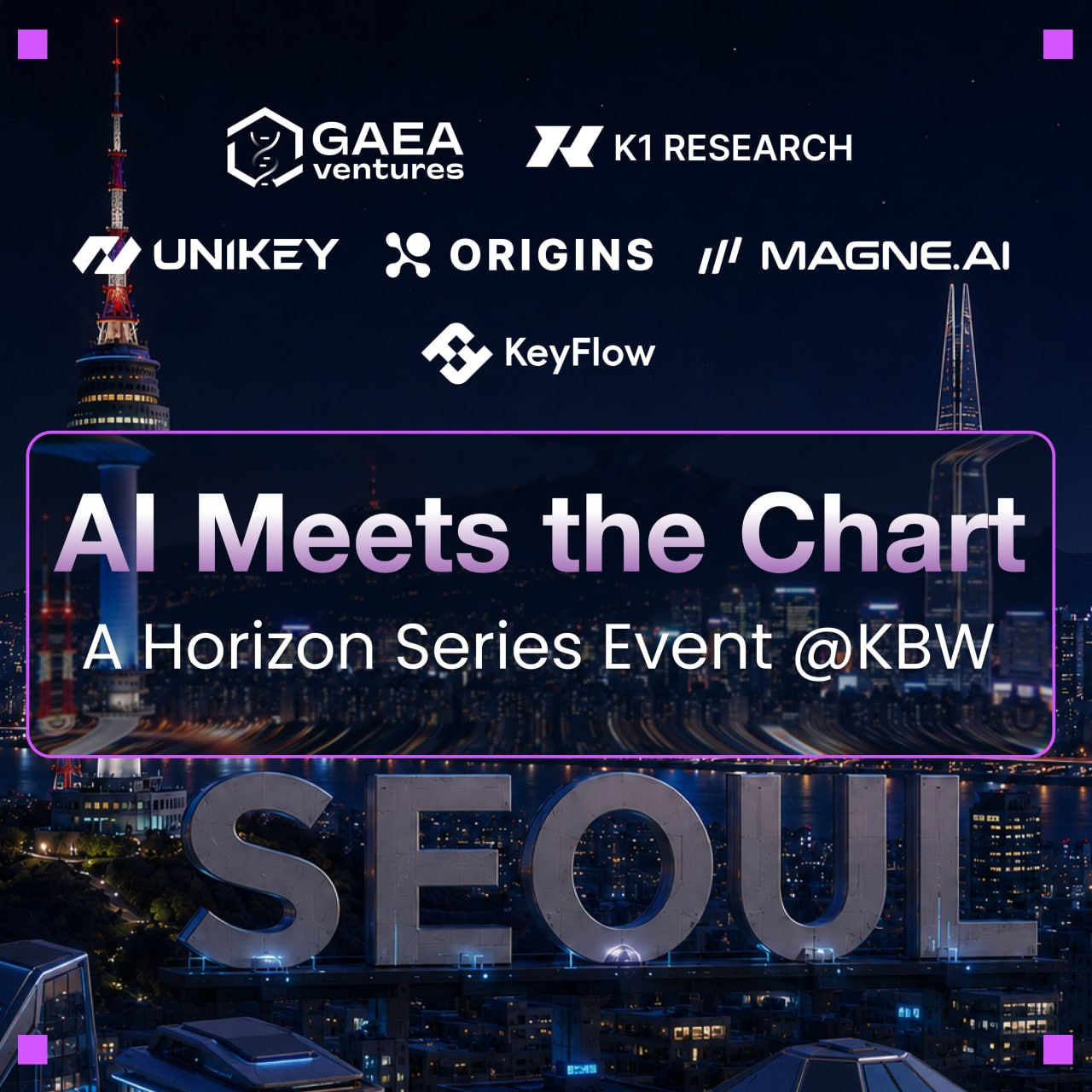
In September 2026, the global Web3 and digital asset industry will once again turn its attention to Seoul.
As one of Asia’s most influential blockchain and digital asset industry events, Korea Blockchain Week 2026 will take place from September 29 to October 1, bringing together global project founders, developers, trading institutions, investors, and industry leaders. KBW officially positions itself as an important platform connecting the Korean market with the global digital asset ecosystem. The 2025 event attracted more than 13,000 participants.
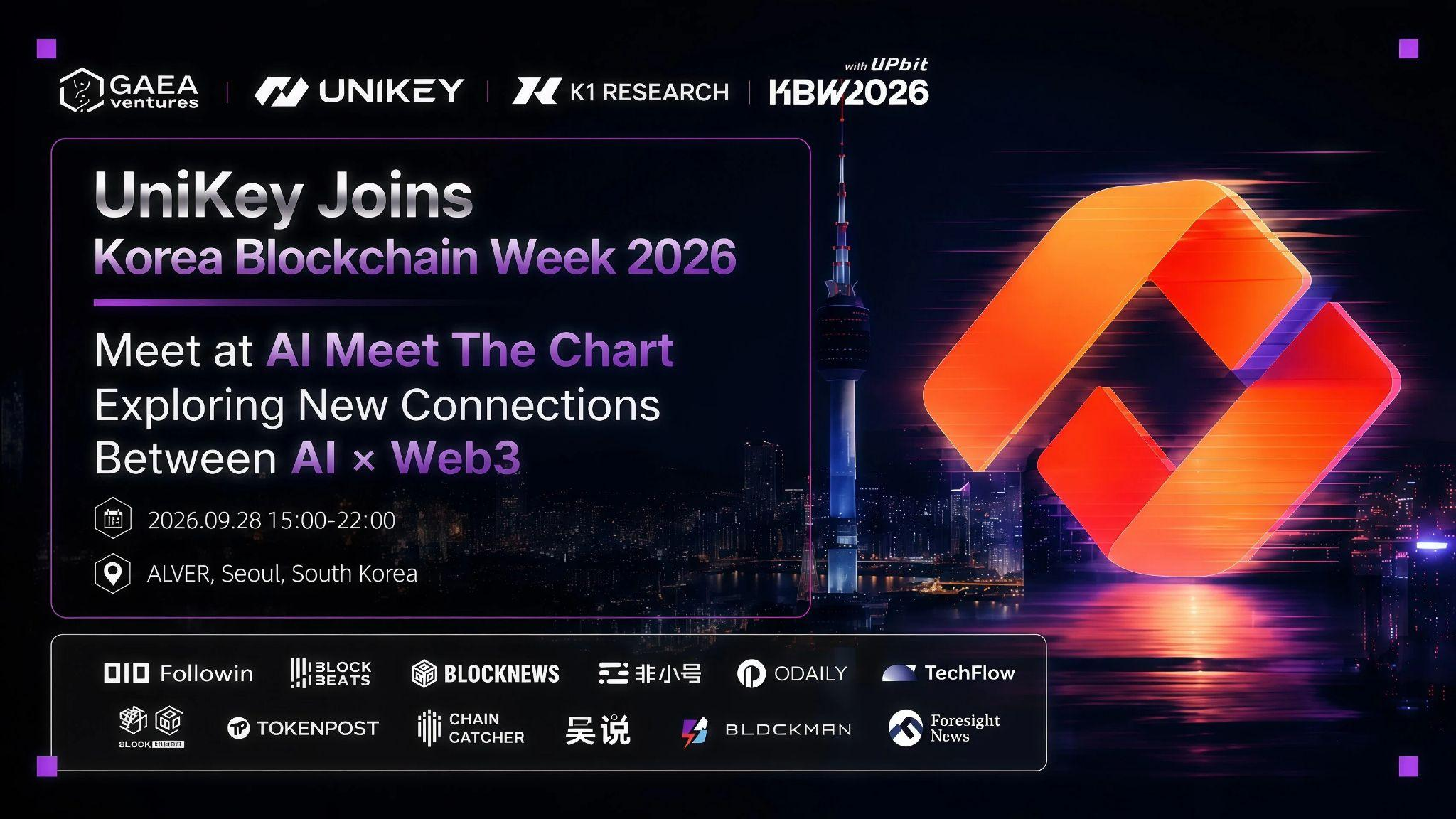
Ahead of the official opening of KBW 2026, UniKey will serve as a co-host alongside GAEA Ventures and K1 Research to jointly present AI Meets the Chart: Seoul Traders Night. On September 28, AI builders, quantitative researchers, professional traders, and global Web3 practitioners will gather at ALVER in Seoul. This will not only be an industry exchange focused on AI trading, but also a forward-looking dialogue surrounding next-generation intelligent financial infrastructure.
AI Meets the Chart: When AI Truly Enters the Trading Execution Layer
In the past, AI’s role in the trading industry was primarily focused on data analysis and assisted decision-making. Models could summarize news, identify technical indicators, and generate market reports, but final strategy formulation and trade execution still largely depended on humans.
Today, this boundary is rapidly being broken. With the continuous maturity of large-scale models, Agentic Trading, automated workflows, and low-latency execution technologies, AI Agents have begun entering real trading workflows. They are not only capable of reading market data and information, but can also break down tasks, call quantitative tools, execute trading strategies, manage risks, and even automatically execute orders within authorized limits.
AI Meets the Chart will focus on the real operational logic of AI quantitative trading, the deployment methods of Agentic Trading frameworks, the current capabilities and technical boundaries of low-latency execution, and whether human judgment remains irreplaceable in an increasingly automated era.
Through keynote speeches, panel discussions, and in-depth exchanges, the event will bring AI back from abstract concepts into real trading scenarios.
This event is not focused on the simple question of “whether AI can predict markets,” but rather explores a deeper question:
When models, data, tools, strategies, and execution systems begin to be organized by Agents, what structural changes will occur within trading infrastructure?
Why Seoul: A Key Hub Connecting Global Technological Innovation and Asian Markets
South Korea has long been one of the most influential regions in the global digital asset and Web3 markets. It has a highly active user base, mature trading ecosystems, strong technology industry foundations, and an extremely sensitive market response toward new products and emerging narratives.
Since its establishment in 2018, KBW has gradually become an important gateway for global projects to connect with the Korean market. The 2026 conference will feature Upbit as a core partner and invite major representatives from digital assets, infrastructure, and financial technology sectors worldwide. The officially announced guests include investors, project founders, trading platforms, and global institutional representatives, further demonstrating KBW’s connectivity within Asia’s digital asset industry.
Choosing to host AI Meets the Chart during KBW is based on the fact that the integration of AI and Web3 is moving from conceptual narratives toward real-world applications.
Trading is one of the most direct and data-intensive scenarios, and one of the strongest environments for testing AI execution capabilities.
Seoul provides an ideal stage for this discussion by connecting trading users, technology teams, capital institutions, and global projects simultaneously.
UniKey as Co-Host: From Connecting Global AI Capabilities to Connecting Next-Generation Intelligent Trading
As the global unified gateway for AI capabilities in the AI Agent era, UniKey is building connections between global mainstream models, image generation, video, code, search, Skills, Agents, APIs, and Workflows through one account, one KEY, and a unified access system.
Under traditional models, a trading Agent may need to separately integrate model services, market data, search tools, quantitative frameworks, execution interfaces, and payment accounts.
Different services have different APIs, token billing models, permission systems, and stability standards, making system development and continuous operation extremely complex.
The problem UniKey aims to solve is precisely the connection, orchestration, measurement, and management of these fragmented capabilities.
Through AI Gateway and unified APIs, developers can integrate multiple models and intelligent capabilities more efficiently; Through AI Router, tasks can select more suitable models based on cost, latency, and output quality; Through AI Credits, consumption from complex models, Skills, Agents, and Workflows can enter a unified quota system; As Agent Factory and Settlement Network continue to develop, intelligent agents will further gain standardized capabilities for creation, task execution, budget management, and value settlement.
For Agentic Trading, these capabilities do not represent an ordinary tool, but rather an infrastructure layer that enables intelligent agents to operate continuously.
Models Provide Intelligence, Agents Complete Tasks, UniKey Organizes Capabilities
For AI trading to truly achieve large-scale adoption, it cannot rely solely on a single powerful model.
A mature trading Agent may need to use reasoning models to analyze market structures, leverage search capabilities to track real-time information, utilize coding models for strategy calculations, and connect with data interfaces, risk control modules, and execution tools.
At different stages of a task, the requirements for model speed, cost, context understanding, stability, and specialized capabilities are also completely different.
Therefore, the core competitiveness of future trading systems will not only depend on whether a model is intelligent enough, but also on whether it can reliably organize multiple intelligent capabilities within complex tasks.
The value of UniKey lies in establishing a unified capability layer between models and Agents. Models are responsible for generating intelligence, Agents are responsible for executing tasks, and UniKey is responsible for connection, routing, measurement, and management. This product positioning also makes UniKey highly aligned with the theme of AI Meets the Chart.
The event focuses on how AI Agents will transform trading, while UniKey is advancing how these Agents can gain access to global models, tools, Skills, and workflows, and continuously operate within a unified framework.
Starting from Trading Scenarios to Explore the Next Stage of AI × Web3
The integration of AI and Web3 has often remained at the conceptual narrative level in the past.
One side provides intelligent generation and automated execution capabilities, while the other provides open networks, digital assets, and on-chain settlement systems.
However, there has always been a lack of a stable connection layer between the two. Agentic Trading provides a highly specific validation scenario. Trading Agents require identity and authorization, need to call models and data, require configurable budgets, need to execute strategies and record results, and must accurately measure every service call and resource consumption.
Within a more open intelligent agent network, different Agents may also collaborate on capabilities, divide tasks, and conduct fee settlements. This is exactly where AI and Web3 can create real synergy. UniKey aims to organize models, tools, Agents, and on-chain value systems into the same network through a global AI capability gateway, Agent service ecosystem, and intelligent settlement network.
Participating in and co-hosting AI Meets the Chart represents an important step in UniKey’s global ecosystem strategy and an advanced exploration of intelligent trading, digital assets, and Agentic Finance scenarios.
More Than an Event: A Discussion About the Future of Trading Power
When technical analysis can be completed automatically, strategies can be rapidly replicated, and orders can be executed autonomously by Agents, traditional trading advantages are being redefined.
In the future, what is truly scarce may no longer be a single indicator, a specific model, or a closed strategy.
Instead, it may be higher-quality data, more reliable execution systems, more agile model orchestration capabilities, and the judgment, experience, and risk awareness that humans can still provide in highly automated environments.
AI Meets the Chart aims to bring AI builders and professional traders to the same table. Technology teams need to understand execution constraints in real markets. Traders need to understand the capability boundaries of Agents.
Project teams and investment institutions need to evaluate how intelligent trading infrastructure will reshape future financial products and market structures.
From models to Agents, from strategies to execution, from tool invocation to value settlement, this event will showcase the real opportunities and practical challenges brought by AI entering the trading industry chain.
UniKey’s Global Expansion Takes Another Step Forward
The co-hosting of KBW Seoul Traders Night also marks a new stage in UniKey’s global brand development and international ecosystem construction.
From global model integration, multilingual user education, and developer tool support, to international team building, ecosystem partnerships, and offline industry events, UniKey is continuously expanding its connectivity capabilities within the global AI and Web3 markets.
The Korean market has highly active digital asset users, developer communities, and technological innovation environments.
Through this event, UniKey will establish direct communication with more AI Builders, quantitative teams, trading platforms, Web3 projects, and international partners, jointly exploring more possibilities for the practical implementation of Agents, model routing, automated execution, and intelligent settlement.
UniKey’s goal is not only to enable users to access more AI models, but also to allow global intelligence to enter real-world tasks, serve real industries, and create continuous value flow within a unified network.
Meet in Seoul, Witness the New Stage of Intelligent Trading
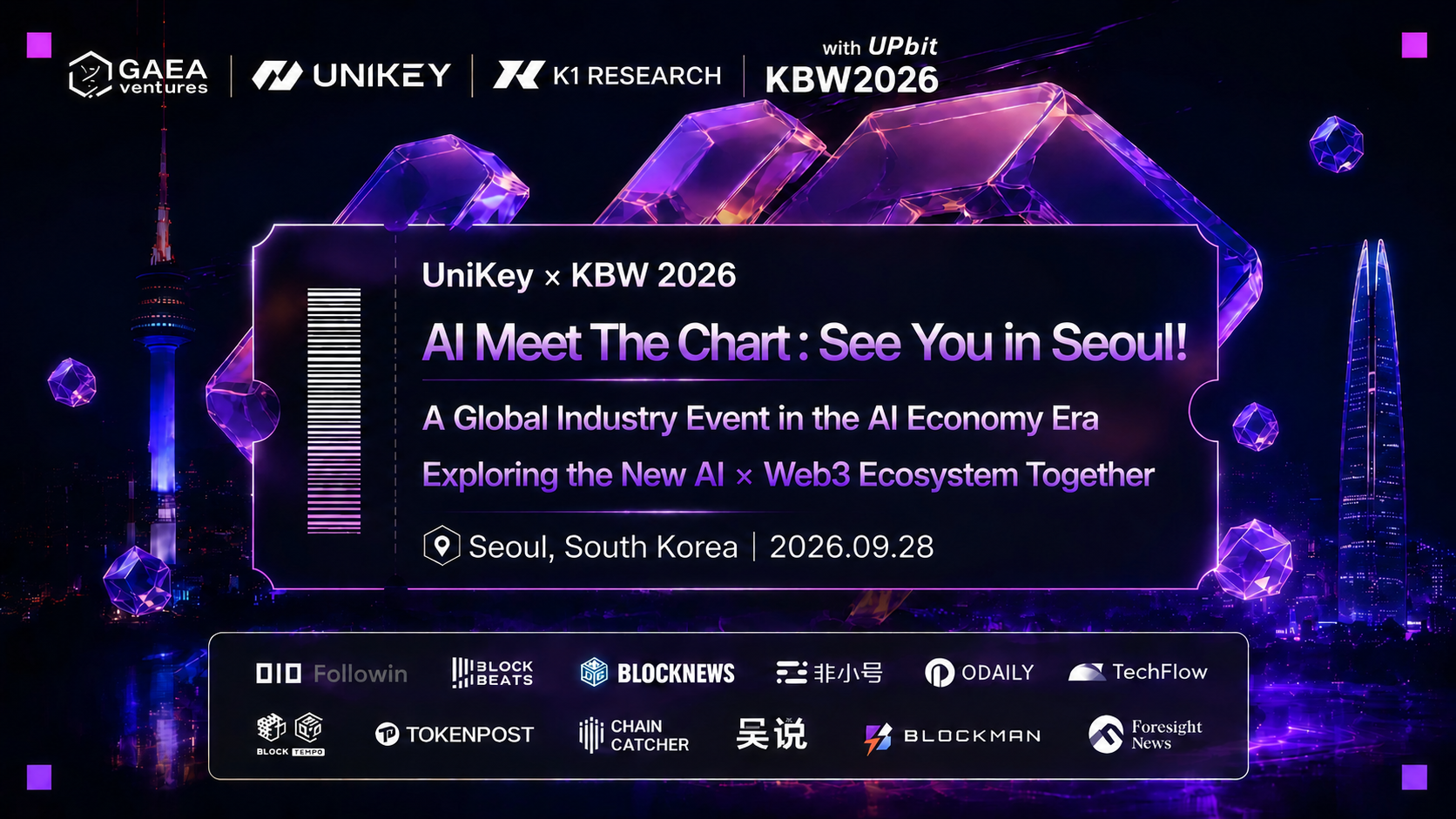
On September 28, UniKey will serve as a co-host together with GAEA Ventures and K1 Research to present AI Meets the Chart: Seoul Traders Night.
As a highly anticipated AI × Web3 themed Side Event during KBW 2026, this event will connect AI Builders, professional traders, quantitative research teams, Web3 projects, and global investment institutions to explore how AI Agents enter the analysis, strategy, execution, and risk management workflows within real market environments.
Let us meet in Seoul, South Korea, and witness the important moment when AI evolves from an auxiliary tool into trading execution infrastructure.
UniKey will work together with global industry partners to connect models, data, tools, Agents, and real business scenarios, exploring more possibilities of AI × Web3 across intelligent trading, digital finance, and value settlement.
One KEY connects global AI; one network connects next-generation intelligent trading.


All Comments