

Cointime

Download App
iOS & Android

Takashi Shimizu Appointed CEO of ENI Japan to Deepen Localization and Accelerate Ecosystem Growth

ENI Network, an enterprise-grade modular blockchain, has appointed Takashi Shimizu as CEO of ENI Japan. He will lead market strategy, institutional partnerships, ecosystem expansion, and local business development. The appointment marks a new stage in ENI’s localization strategy, building on its existing community, user base, and institutional network in Japan.

Takashi brings nearly 18 years of experience in corporate strategy, venture investment, deep tech, and cross-border business. He previously held roles at Hitachi, IGPI, and Universal Materials Incubator, and currently serves as Representative Director of Human Capital Inc.
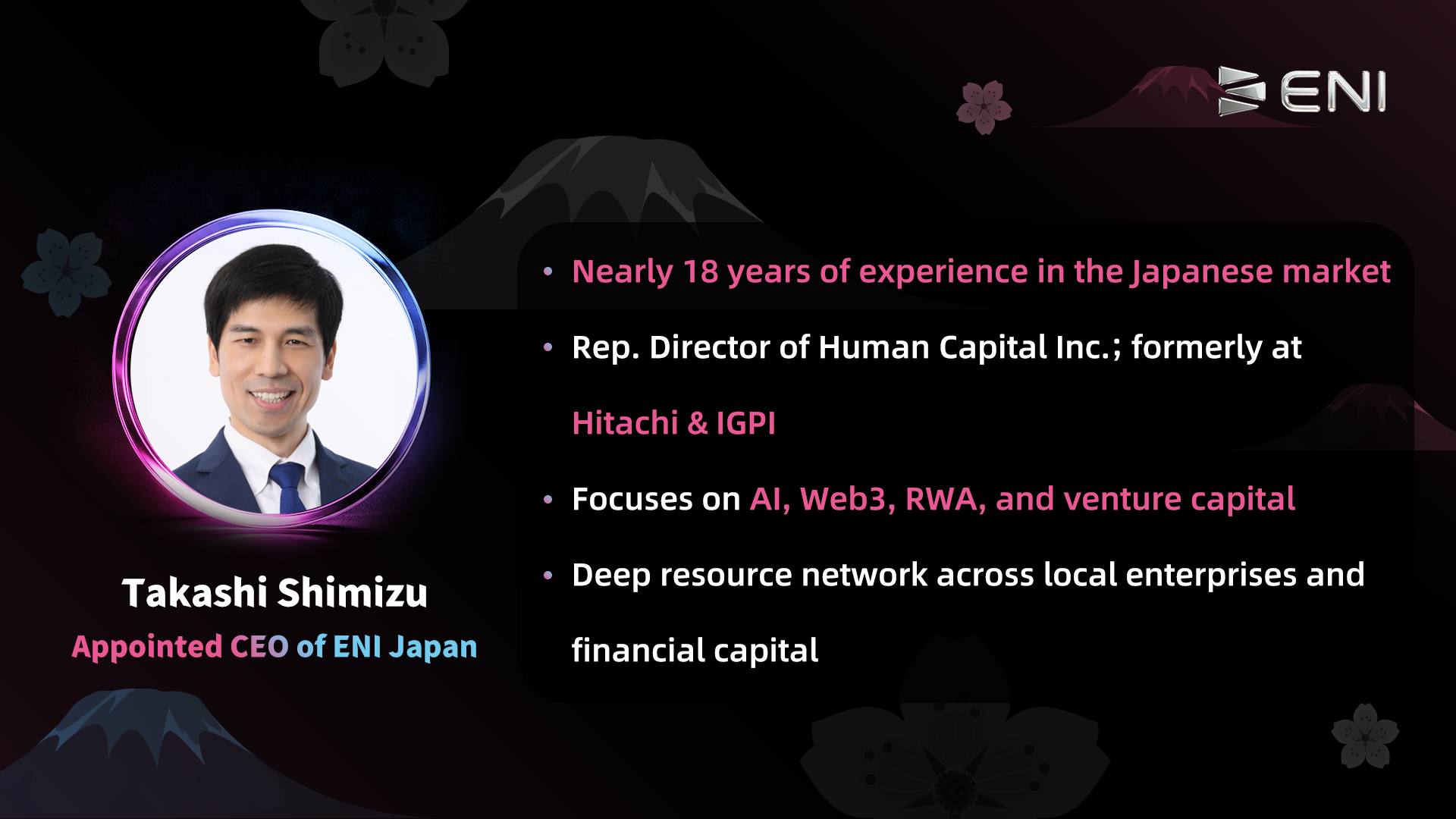
His expertise spans AI, Web3, RWA, venture investment, business development, capital strategy, and cross-border expansion. He has built extensive local networks across major Japanese enterprises, startups, investment institutions, financial organizations, and industry ecosystems, with strong connections in digital asset policy, compliance, and financial infrastructure.

ENI has long viewed Japan as a key part of its Asian expansion. The country’s mature enterprise sector, advanced financial and payment infrastructure, active developer ecosystem, and growing interest in Web3 and real-world asset digitalization align closely with ENI’s enterprise-focused strategy.

Through its Mainnet+Hub+AppChain architecture, ENI provides institutions with independent, controllable, and auditable on-chain environments while enabling unified settlement and cross-ecosystem coordination through its mainnet.

Before appointing a local CEO, ENI had already established a growing presence in Japan. The team participated in WebX and engaged with local developers, users, projects, and institutional representatives, building an initial community and user base while gaining a deeper understanding of local market needs and partnership models.

NTT, one of Japan’s leading telecommunications groups and a Fortune Global 500 company, is also part of ENI’s Super Node network. ENI has developed partnerships with multiple Japanese institutions, several of which have joined the network to support infrastructure development, industry resources, use-case integration, and ecosystem growth.

ENI has also launched its Superteam initiative in Japan, bringing together local developers, community builders, market professionals, institutional partners, and industry resources to strengthen local operations.

ENI said Takashi’s combination of technical understanding, industry insight, investment experience, and local resources will improve decision-making, institutional collaboration, and execution in Japan. The company plans to deepen partnerships across enterprise Web3, RWA, digital payments, AI Agents, and cross-border business.

From WebX and local community development to the Super Node network, the Superteam initiative, and a locally led market team, ENI is building a comprehensive foundation in Japan. With Takashi now in place, ENI will further integrate local resources and accelerate the adoption of enterprise blockchain and RWA solutions in real-world business scenarios.

Comments

All Comments

Recommended for you

  • Iran and Gulf States to Hold Meeting Next Week to Advance Strait of Hormuz Agreement

    On September 11, the Financial Times reported that foreign ministers from Gulf states plan to meet with the Iranian foreign minister in response to initiatives from Oman and Iran, seeking support for an agreement on the temporary management of shipping in the Strait of Hormuz. Meanwhile, countries in the region are looking for ways to ease the hostile situation surrounding this waterway. This meeting, proposed by Oman, will be the first between senior diplomats from the Gulf Cooperation Council, consisting of six member states, and Iranian officials since the outbreak of the U.S.-Iran conflict at the end of February. According to sources, the meeting is scheduled to take place next Monday in Salalah, a coastal city in Oman. Details have not been finalized, but several countries have confirmed that the meeting is expected to proceed as planned. If the meeting takes place, it will highlight the region's urgency to attempt to reopen the strait and ease U.S.-Iran tensions.

  • Iran and Gulf States to Hold Meeting Next Week to Advance Hormuz Strait Agreement

    On September 11, the Financial Times reported that foreign ministers from Gulf states plan to meet with the Iranian foreign minister in response to initiatives from Oman and Iran, seeking support for an agreement on the temporary management of shipping in the Hormuz Strait. Meanwhile, countries in the region are looking for ways to ease the hostile situation surrounding this waterway. This meeting, proposed by Oman, will be the first encounter between senior diplomats from the Gulf Cooperation Council, comprising six member states, and high-ranking Iranian officials since the outbreak of U.S.-Iran conflicts in late February. According to sources, the meeting is scheduled to take place next Monday in Salalah, a coastal city in Oman. Details have yet to be finalized, but several countries have confirmed their participation, and the meeting is expected to proceed as planned. If the meeting takes place, it will underscore the region's urgency in attempting to reopen the strait and de-escalate U.S.-Iran hostilities.

  • US Spot Bitcoin ETF Sees $282.7 Million Net Outflow

    According to monitoring data from Farside Investors, the US spot Bitcoin ETF experienced a net outflow of $282.7 million yesterday, September 11.

  • US Spot Bitcoin ETF Sees $282.7 Million Net Outflow

    According to monitoring data from Farside Investors, the US spot Bitcoin ETF experienced a net outflow of $282.7 million on September 11.

  • US Spot Ethereum ETF Sees Net Outflow of $29.9 Million Yesterday

    On September 11, according to monitoring data from Farside Investors, the US spot Ethereum ETF experienced a net outflow of $29.9 million yesterday.

  • US Spot Ethereum ETF Sees Net Outflow of $29.9 Million Yesterday

    On September 11, according to monitoring data from Farside Investors, the US spot Ethereum ETF experienced a net outflow of $29.9 million yesterday.

  • Sources: Bank of Japan Expected to Raise Rates by 25bps Next Week with No Predefined View on Terminal Rate

    On September 11, sources revealed that the Bank of Japan is expected to raise interest rates next week, most likely by 25 basis points, and may indicate a faster tightening pace if inflationary pressures increase. Raising rates to 1.25% would mark the highest policy rate for the Bank of Japan in 31 years. The move comes just three months after the last rate hike in June, signaling an acceleration in tightening measures. Many within the central bank believe that as the economy enters a moderate recovery and price pressures build, the conditions for another rate hike are becoming favorable. The central bank also anticipates that even if rates rise to 1.25%, financial conditions will remain accommodative. The market is closely watching Governor Ueda's comments after the meeting for any clues regarding the future pace of rate hikes and the potential peak rate in this tightening cycle. Sources indicated that the Bank of Japan may have no predefined view on the terminal rate, which will depend on how past rate hikes affect the economy and the extent to which businesses pass on rising costs to households. There is also no consensus within the Bank of Japan on the speed of rate hikes. Ueda is expected to avoid committing to a specific timeline for future rate increases but may reiterate the July statement that if financial conditions are deemed too loose, the Bank of Japan may accelerate rate hikes.

  • Sources: BOJ Expected to Raise Rates by 25bps Next Week Without Predefined Terminal Rate View

    On September 11, sources revealed that the Bank of Japan (BOJ) is expected to raise interest rates next week, most likely by 25 basis points, and may hint at a faster tightening pace if inflationary pressures increase. Raising the rate to 1.25% would mark a 31-year high for the BOJ's policy rate. This move comes just three months after the last hike in June, indicating a quicker tightening pace. Many within the central bank believe that conditions for another rate increase are forming as the economy enters a moderate recovery and price pressures build. The BOJ also anticipates that even with rates rising to 1.25%, financial conditions will remain accommodative. The market is closely watching Governor Kazuo Ueda for any clues regarding the future pace of rate hikes and the potential peak rate in this tightening cycle. Sources indicate that the BOJ may not have a predefined view on the terminal rate, as it depends on how past rate hikes affect the economy and the extent to which businesses pass on rising costs to households. There is also no consensus within the BOJ on the speed of rate hikes. Ueda is expected to avoid committing to a specific timeline for future rate increases but may reiterate his July statement that the BOJ could accelerate rate hikes if it believes financial conditions are too loose.

  • SEC Proposes Amendments to Transfer Agent Rules, Allowing Blockchain Ledgers as Official Records of Securities Ownership

    On September 11, the U.S. Securities and Exchange Commission (SEC) proposed a new rule that aims to comprehensively amend the transfer agent rules that have been in place for decades. For the first time, the proposal explicitly allows electronic databases, including blockchain ledgers, to serve as official records of securities ownership. If approved, blockchain could become the 'primary securities document,' replacing the off-chain parallel ownership records that tokenized securities currently rely on. Currently, many tokenized securities operate on two sets of records: an on-chain token ledger and an official shareholder register. Once the proposal is passed, issuers and transfer agents may no longer need to maintain duplicate records and reconcile them after each transfer, thereby reducing operational friction and the risk of inconsistencies between on-chain records and legally recognized records. Eli Cohen, Chief Legal Officer of the tokenized fund platform Centrifuge, stated that this proposal could transform the current 'two-step' process into a 'one-step' process, allowing the blockchain itself to act as the primary securities document. However, the proposal does not imply that tokenized securities will be completely 'permissionless.' Joris Delanoue, CEO of the SEC-registered on-chain transfer agent Fairmint, pointed out that while the blockchain can remain open, assets must still comply with ownership and transfer rules, and regulatory controls such as identity verification and transfer restrictions will still be embedded in the tokens. Transfer agents will still need to handle administrative matters such as shareholder death, inheritance, and legal notifications, with processing times potentially reduced from 3-5 days to 1 day. The 60-day public comment period for the proposal will end in early November.

  • SEC Proposes Amendments to Transfer Agent Rules, Allowing Blockchain Ledgers as Official Securities Ownership Records

    On September 11, the U.S. Securities and Exchange Commission (SEC) proposed a new rule last week aimed at comprehensively revising the transfer agent rules that have been in place for decades. For the first time, it explicitly allows electronic databases, including blockchain ledgers, to serve as official records of securities ownership. If approved, blockchain is expected to become the 'primary securities document,' replacing the off-chain parallel ownership records that tokenized securities currently rely on. Currently, many tokenized securities operate on two sets of records: an on-chain token ledger and an official shareholder register. Once the proposal is passed, issuers and transfer agents may no longer need to maintain duplicate records and reconcile them after each transfer, thereby reducing operational friction and the risk of inconsistencies between on-chain records and legally recognized records. Eli Cohen, Chief Legal Officer of the tokenized fund platform Centrifuge, stated that the proposal could transform the current 'two-step' process into a 'one-step' process, allowing the blockchain itself to serve as the primary securities document. However, the proposal does not mean that tokenized securities will be completely 'permissionless.' Joris Delanoue, CEO of Fairmint, a registered on-chain transfer agent, pointed out that while the blockchain can remain open, assets must still comply with ownership and transfer rules, and regulatory controls such as identity verification and transfer restrictions will still be embedded in the tokens. Transfer agents will still need to handle administrative matters such as shareholder death, inheritance, and legal notifications, with processing times potentially reduced from 3-5 days to 1 day. The 60-day public comment period for the proposal will end in early November.
