

Cointime

Download App
iOS & Android

ENI Network Appoints Paul Kim as CEO of ENI Korea to Deepen Institutional Ecosystem and Spearhead Next Phase of Growth

ENI Network, an enterprise-grade modular blockchain, has officially announced the appointment of Paul Kim as the CEO of ENI Korea. In this role, Kim will oversee strategic planning, institutional partnerships, ecosystem development, and commercialization within the South Korean market. This strategic move marks a pivotal milestone in ENI’s broader APAC expansion, signaling the transition of its Korean operations from early-stage ecosystem building to a new era of team expansion, resource integration, and large-scale adoption.

Kim brings over 15 years of extensive experience spanning Web3, APAC market expansion, payments, and corporate strategy. Previously, he served as an executive at Pi Network and as the CEO of the XPLA Foundation. At XPLA, he spearheaded Layer-1 ecosystem development, global operations, and institutional fundraising, successfully securing over $40 million in capital. Under his leadership, the network onboarded more than 23 gaming titles alongside numerous DeFi, NFT, and infrastructure projects. His proven track record in operating application-specific blockchains (appchains) is further bolstered by his deep network of tier-1 exchanges, market makers, liquidity providers, and node validators.
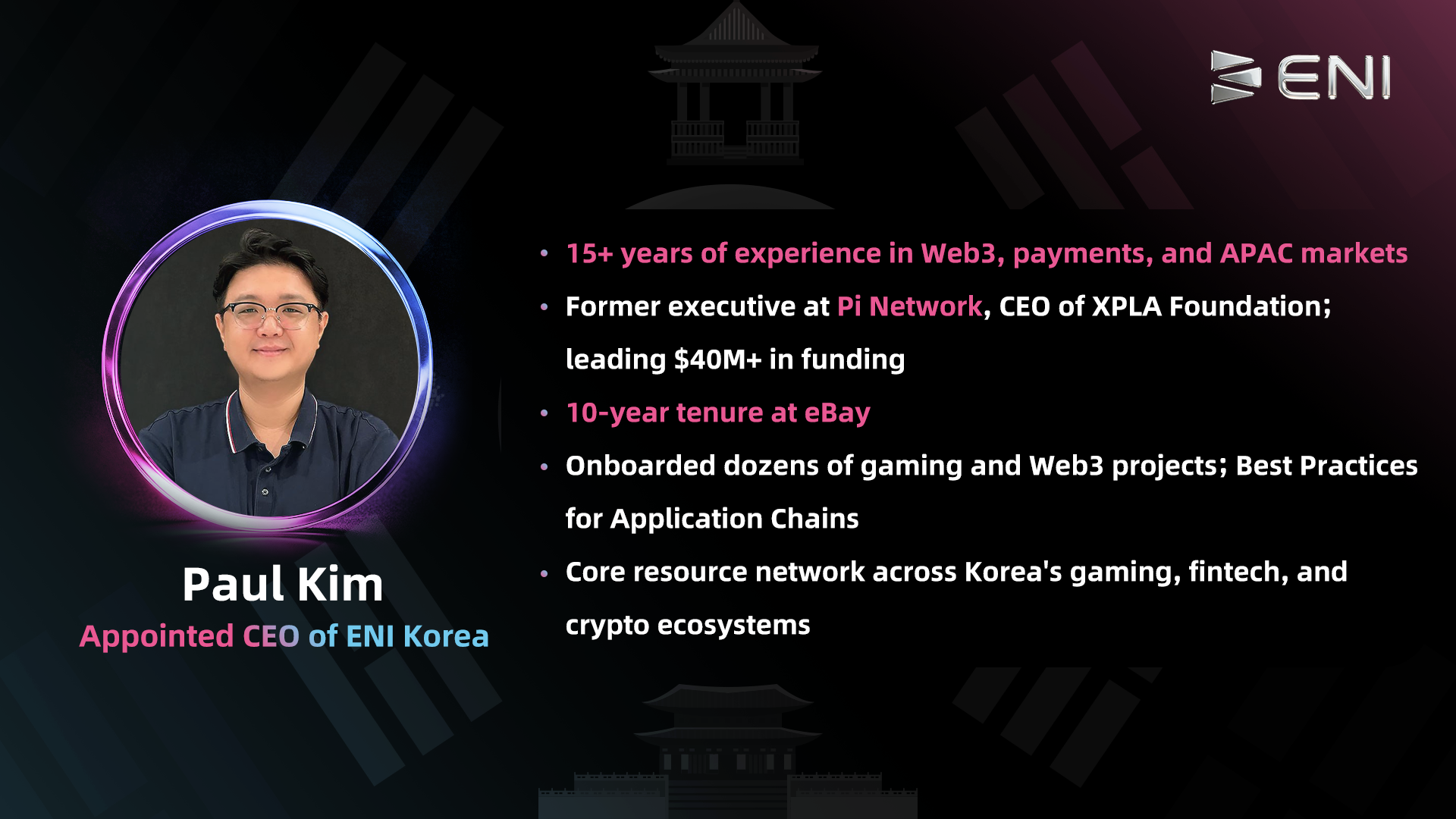
Before entering the Web3 space, Kim spent a decade at eBay, driving strategic planning, business development, financial management, and cross-border commerce initiatives across South Korea, Japan, Australia, and other key APAC markets while working closely with global payment systems like PayPal. He also holds a strong background in strategic consulting in South Korea, advising enterprises in payments, e-commerce, telecommunications, retail, and tourism on growth and market-entry strategies. This unique blend of traditional tech, fintech, corporate management, and Web3 ecosystem expertise positions him perfectly to bridge the gap between Web2 and Web3.

South Korea remains one of the world's most dynamic hubs for digital content, gaming, fintech, and blockchain technology, boasting a highly digitized user base and a vibrant Web3 community. For ENI, the Korean market offers more than just retail user growth; it presents a unique opportunity to integrate blockchain infrastructure with gaming, payments, content, AI, and real-world business scenarios. Consequently, ENI’s long-term vision in Korea extends beyond mere community expansion. By leveraging a localized team and institutional networks, ENI aims to drive the mass adoption of enterprise-grade blockchain, Real-World Assets (RWA), and AI-driven payment infrastructure into tangible, real-world applications.

Prior to this official appointment, ENI had already laid the groundwork for its localization strategy in Korea. The network initiated early-stage efforts focused on community operations, user engagement, developer ecosystems, and institutional partnerships. Notably, ENI launched the "Superteam" initiative to attract local talent, developers, community contributors, and industry partners. This initiative is steadily evolving into a comprehensive local collaborative network encompassing brand building, community growth, technical support, institutional outreach, and application expansion.

Deeply rooted in the Korean and broader APAC markets, Kim possesses an extensive network of local resources across major conglomerates, the gaming industry, fintech, payment gateways, crypto exchanges, investment firms, and Web3 communities. His profound understanding of Korean corporate decision-making, industry collaboration models, and consumer behavior will enable ENI to streamline local operations. This localized expertise will significantly enhance ENI's capabilities in partner vetting, market strategy formulation, ecosystem onboarding, and commercial execution.

According to ENI, the next phase of development in South Korea will focus on expanding the institutional ecosystem, scaling the Superteam, growing the supernode network, and integrating real-world business use cases. By capitalizing on Korea's dominance in gaming, entertainment, consumer tech, payments, and AI, ENI aims to tightly align its underlying blockchain and RWA infrastructure with local enterprise needs. This architecture allows enterprises to maintain independent ledgers, permission management, and business logic while utilizing the ENI mainnet for unified settlement and broader ecosystem interoperability.

Kim’s proven expertise in Layer-1 operations, ecosystem incentives, institutional fundraising, and game onboarding, combined with his strategic and cross-border acumen from eBay and traditional consulting, perfectly aligns with ENI’s strategic roadmap for the region.

ENI is steadily building a robust global market foundation driven by local talent, users, institutions, and industries. With Paul Kim at the helm, the Korean team is entering a transformative phase. Moving forward, ENI will continue to expand its local partnership network, onboard more Korean enterprises and Web3 projects, and unlock the long-term value of enterprise blockchain, RWA, GameFi, and AI payment infrastructure in real-world scenarios.

ENI said its next phase in Korea will focus on expanding the institutional ecosystem, strengthening the Superteam, growing the Super Node network, and onboarding real-world business use cases.

By combining Korea’s strengths in gaming, entertainment, consumer technology, payments, and AI with ENI’s blockchain and RWA infrastructure, the company aims to deliver independent ledgers, permission management, and customizable business rules while enabling unified settlement and broader ecosystem coordination through the ENI mainnet.

Paul’s experience in Layer 1 operations, ecosystem incentives, institutional fundraising, and gaming integration at XPLA, together with his background in eBay and strategy consulting, closely matches ENI’s next stage of development in Korea.

As ENI continues to build a global foundation of local talent, users, institutions, and industries, Paul’s appointment will open a new chapter for the Korean market. ENI will expand local partnerships, onboard more Korean enterprises and Web3 projects, and explore the long-term value of enterprise blockchain, RWA, gaming finance, and AI payment infrastructure in real-world applications.

Comments

All Comments

Recommended for you

  • RMB Spot Exchange Rate Against USD Hits 42-Month High

    On August 10, the onshore spot exchange rate of the RMB against the U.S. dollar rose to as high as 6.7439 during trading, marking a new high in more than three years since February 6, 2023. ICBC Asia, in its outlook on the RMB trend for the second half of the year, believes that the RMB exchange rate is likely to continue a gradual upward trend amid volatility. The main influencing factors include: first, exports are expected to maintain resilient growth in the second half of the year, with attention on the impact of geopolitical risks and tariff policies on the differentiation of export products, regional structure, and price-volume relationships; second, international capital is increasing its allocation to RMB assets, with net capital inflows supporting a stronger RMB central tendency; third, the central parity rate of the RMB against the U.S. dollar will be adjusted as circumstances dictate. The chief economist team of China Minsheng Bank pointed out that since the beginning of this year, the main factor supporting the strength of the RMB exchange rate has been the high prosperity of exports. At present, with the continuous optimization of the trade structure, the high growth rate of exports is expected to continue, and the trade surplus is also expected to remain at a high level. Overall, China's economy has demonstrated strong resilience in an environment of complex and volatile external conditions and the transition of domestic growth drivers, while the foreign exchange market operates steadily, laying a solid foundation for the RMB exchange rate to remain basically stable at a reasonable and balanced level. It is expected that in August, the RMB exchange rate will maintain a stable two-way fluctuation pattern around 6.75. (The Paper)

  • Robinhood Launches Crypto Trading in UK Main App via Bitstamp

    On August 10, Robinhood began rolling out cryptocurrency trading services to eligible UK customers via Bitstamp, increasing the number of digital assets in its main investment app to more than 50. The launch places crypto alongside stocks, ISAs, options, and futures as services Robinhood offers in the UK, as the company continues to expand its broader crypto ecosystem.

  • xStocks Tokenized US Stocks May Soon Launch on Hyperliquid

    Recently, xStocks, the tokenized stock platform under Kraken's parent company, interacted with Hyperliquid on X, and xStocks' tokenized US stock products may soon launch on Hyperliquid. Starting from July 15, addresses related to xStocks (0xe2810af447c12c787ce02e60587c248529344b8a#txs) have gradually spent approximately 5,000 HYPE tokens to bid on 10 tokenized stock codes for xStocks in the HIP-1 market: NVDAX, SPYX, QQQX, SKHYX, MUX, SNDKX, SPCXX, TSLAX, AAPLX, and CRCLX. As of now, the trading pairs for these ten tokenized US stock products/USDC have all been registered, but trading has not yet begun. If xStocks tokenized US stock products open for trading on Hyperliquid, Hyperliquid will be able to simultaneously trade four major product categories: crypto spot, HIP-3 perpetual contracts, HIP-4 prediction markets, and US stock spot.

  • Weekly Key Events and Data Preview: US CPI; Fuel Price Adjustment, Tencent Earnings

    August 10 — Here is the weekly preview of key events and data: 1. Monday: ① Data: Japan June trade balance; Eurozone August Sentix investor confidence index; (pending) China July M2 money supply YoY. ② Events: Bank of Japan releases summary of opinions from board members at the July monetary policy meeting. 2. Tuesday: ① Data: Australia's RBA interest rate decision for August 11. ② Events: RBA announces interest rate decision and monetary policy statement; RBA Governor Bullock holds monetary policy press conference. ③ Holiday: Tokyo Stock Exchange closed all day. 3. Wednesday: ① Data: US API crude oil inventories for week ending August 7; Germany July CPI monthly final; US July unadjusted CPI YoY, US July seasonally adjusted CPI MoM, US July seasonally adjusted core CPI MoM, US July unadjusted core CPI YoY. ② Events: Tencent Q2 earnings call. 4. Thursday: ① Data: US initial jobless claims for week ending August 8, US July PPI YoY, US July PPI MoM, US EIA natural gas inventories for week ending August 7. ② Events: JD.com Q2 earnings call; 2026 FOMC voter, Cleveland Fed President Hammack speaks; 2027 FOMC voter, Richmond Fed President Barkin speaks on economic outlook. ③ Earnings: SMIC, China Mobile, etc. 5. Friday: ① Data: France July CPI monthly final; Eurozone Q2 GDP YoY revised, Eurozone Q2 seasonally adjusted employment change quarterly final, Eurozone June seasonally adjusted trade balance; Canada June wholesale sales MoM; US July retail sales MoM, US August one-year inflation expectations preliminary, US June business inventories MoM, US August University of Michigan consumer sentiment preliminary. ② Events: Domestic refined oil products will open a new adjustment window; National Energy Administration publishes social electricity consumption data around the 15th of each month; RBA Governor Bullock attends hearing. 6. Saturday: ① Data: US total oil rig count for week ending August 14. (Jin Shi)

  • Netanyahu sees 'no risk' in opposing Trump on Gaza plan

    Former Israeli diplomat Alon Pinkas said Netanyahu absolutely needs a permanent war. Israel's rejection of the Gaza plan should be viewed entirely against the backdrop of the October 27 Israeli elections. Pinkas said Netanyahu has made a calculation he sees as risk-free — he believes he can openly defy Trump because Trump doesn't care that much, because of timing, because Hamas has not yet disarmed, and because he can do so with impunity. It's all about permanent war and elections. (Jin Shi)

  • Yemeni National Resistance: Houthis Are Iran's Tool, Decision-Making in Tehran's Hands

    According to Saudi media Alhadath: The Yemeni National Resistance stated that the Houthis are Iran's tool, with decision-making power held in Iran's hands. The group attempts to serve Iran by creating chaos and escalating tensions, in order to help it alleviate external pressure. The Yemeni National Resistance emphasized that the Houthis are not a tool for peace but a "tool of war," making peace with them utterly impossible. The organization also warned that the Houthis' reckless actions will never be tolerated or indulged. (Jin Shi)

  • US Media: Trump Halts Military Action Against Iran, Says Handling Iran Issue 'Quietly'

    August 10 news, according to Axios, US President Trump said on Sunday local time that he is prepared to increase economic pressure on Iran rather than order new military action, despite Iran continuing to resist the United States. The report said Trump said in a brief phone call: "We are handling this quietly." "We are only in a semi-negotiation state. We are just watching Iran, they face serious inflation and are short of funds." He emphasized that the Iranian economy "is in very bad shape" and has no money to pay military salaries. Trump said the US naval blockade has exacerbated the economic crisis of the Iranian regime. Meanwhile, Trump said that because oil prices have fallen to just above $75 per barrel, American consumers have felt less pain from the war. "It will work out. It always works out. It's like chess," Trump said of the back-and-forth with Iran. (Jin10)

  • Iranian Parliament's National Security Committee Approves Strait of Hormuz Security Outline

    On August 9, according to Iran's Mehr News Agency, the National Security and Foreign Policy Committee of the Iranian Parliament approved the strategic action plan outline for ensuring the security and development of the Strait of Hormuz. (Xinhua)
