

The Biggest Transformation in Finance Is Not Blockchain — It Is the Transfer of Decision-Making Power
Over the past decade, blockchain has fundamentally transformed the way value is transferred. Assets moved on-chain, transactions became decentralized, and for the first time in history, people around the world were able to exchange value without relying on centralized intermediaries. Yet despite all the technological progress, the most critical component of finance has remained unchanged: decision-making still belongs to humans. Whether in traditional banks, hedge funds, quantitative trading firms, or DeFi protocols, market analysis, risk assessment, asset allocation, and strategy development ultimately depend on human experience, judgment, and cognition.
This model made sense in the past because humans were the only entities capable of interpreting complex information and making informed decisions. However, as artificial intelligence enters an era of exponential advancement, the financial industry is witnessing the emergence of truly intelligent decision-making systems for the first time. AI can process data volumes far beyond human capability, operate continuously around the clock, learn and improve autonomously, and execute market decisions within milliseconds. In the future, the greatest competitive advantage in financial markets will no longer be how much capital one controls, but how much intelligence one possesses.
This signals a transformation even deeper than the blockchain revolution. Blockchain solved the problem of value transfer; AI is solving the problem of value creation. As the ability to generate value shifts from humans to intelligent agents, a completely new financial era is emerging. SuperStrike is being built as the native financial infrastructure for this new AI-driven economy.
AI Agents Will Become the Most Important Productive Force of the Future
Every major technological revolution throughout history has ultimately been a revolution in productivity. The steam engine expanded human physical capabilities. Electricity reshaped industrial society. The internet eliminated barriers to information. Artificial intelligence is now redefining decision-making itself. In finance, decision-making is productivity. The ability to access information faster, analyze markets more accurately, and execute strategies more efficiently directly determines capital performance.
Historically, these capabilities were concentrated within large financial institutions. Wall Street research teams, quantitative trading firms, and global asset management giants built enormous advantages through data infrastructure, engineering talent, and institutional expertise. Individual investors, by contrast, were forced to rely on limited information, personal experience, and emotional judgment when making financial decisions.
The emergence of AI Agents is fundamentally changing this dynamic. In the future, every individual will have access to their own intelligent financial agent capable of continuously analyzing market conditions, assessing risk in real time, executing strategies autonomously, and identifying opportunities hidden within vast datasets. As more decision-making shifts from humans to AI, the financial industry will gradually evolve from “human-managed assets” to “AI-managed assets.” The most valuable wealth management tool of the future will not be a fund manager or financial institution—it will be an ever-evolving network of intelligent AI Agents.
SuperStrike Is Building the Operating System for the AI Financial Era
SuperStrike was never designed to be a simple yield platform or a short-term speculative market. Our mission is to build the foundational operating system for the AI financial era—a global intelligent financial network connecting AI Agents, digital assets, and users through a unified ecosystem. Through modular Agent architecture, on-chain value systems, and autonomous yield engines, SuperStrike transforms AI from a tool into an independent economic participant capable of creating and managing value.
In the internet era, platforms accumulated users. In the blockchain era, protocols accumulated assets. In the AI era, the most valuable networks will accumulate intelligence. Every AI Agent within the SuperStrike ecosystem continuously learns, optimizes, and creates value. As more users join, more Agents become active, and more data is generated, the network develops increasingly powerful forms of collective intelligence.
This growth model is fundamentally different from traditional finance. Conventional institutions scale through organizational expansion and increasing human resources. SuperStrike scales through intelligence expansion. Instead of increasing operational complexity, the Agent network becomes more efficient as it grows. The result is a self-operating, self-improving, and self-sustaining AI financial ecosystem capable of generating long-term value at global scale.
From Financial Products to Financial Infrastructure
Most market participants evaluate projects through the lens of returns. However, the organizations that ultimately reshape industries are rarely products—they are infrastructure. Amazon did not become one of the world’s most valuable companies because it sold books. Google did not become dominant because it offered search. NVIDIA did not transform global markets because it manufactured graphics cards. Their true value comes from becoming indispensable infrastructure upon which entire ecosystems depend.
The same principle applies to SuperStrike. Yield generation is only one manifestation of value within the ecosystem—it is not the source of value itself. The real objective is to build a financial operating system capable of continuously generating value, improving capital efficiency, and strengthening network intelligence over time. As AI Agents increasingly manage capital, as users increasingly rely on intelligent decision-making, and as more assets flow into autonomous financial networks, the value of the ecosystem expands exponentially.
Over the next decade, the greatest opportunities in finance may not come from individual assets or market cycles. Instead, they will emerge from the rebuilding of financial infrastructure itself. Those who build the infrastructure of the AI financial age will become the central hubs of future value creation. SuperStrike is positioning itself at the heart of that transformation.
STRIKE: The Value Engine Connecting Intelligence and Capital
Every complex economic system requires a core asset capable of connecting participants, incentives, and value circulation. Industrial economies were powered by energy. Internet economies were powered by data. The AI financial era requires a new form of value engine capable of connecting intelligence and capital simultaneously.
STRIKE serves this role within the SuperStrike ecosystem. It is not simply a platform token—it is the engine that powers the network. As AI Agents continue to generate value, as user adoption grows, and as ecosystem applications expand, STRIKE becomes the medium through which incentives, governance, participation, and value distribution are coordinated. It connects users to the ecosystem while simultaneously connecting AI Agents to the value they create.
The financial systems of the future will be more than capital networks; they will be intelligence networks. Capital provides resources. Intelligence creates value. STRIKE acts as the bridge that unites the two. It is both a beneficiary of ecosystem growth and a catalyst for further expansion. As the network matures, STRIKE's significance will extend beyond the platform itself, becoming a foundational component of the broader AI financial economy.
In the Age of AI Finance, the Scarcest Asset Will Be Network Ownership
History shows that every technological revolution creates new forms of scarcity. In the internet era, traffic and attention were scarce assets. In the mobile era, user acquisition became the defining advantage. In the blockchain era, consensus networks created entirely new forms of value. In the AI financial era, the scarcest asset will be ownership of intelligent networks.
As AI Agents increasingly participate in value creation, wealth distribution will no longer be determined solely by asset ownership. Instead, it will be determined by one's position within the network itself. This is the foundation upon which the SuperStrike global node system is built. Nodes are more than participation rights; they represent strategic positions within the future architecture of AI-powered finance.
As the ecosystem expands, more Agents operate across the network, more value circulates through the system, and more intelligence is generated collectively. Nodes become critical connection points between ecosystem growth and value distribution. Owning a node means more than participating in today's ecosystem—it means helping shape and benefit from tomorrow's financial infrastructure.
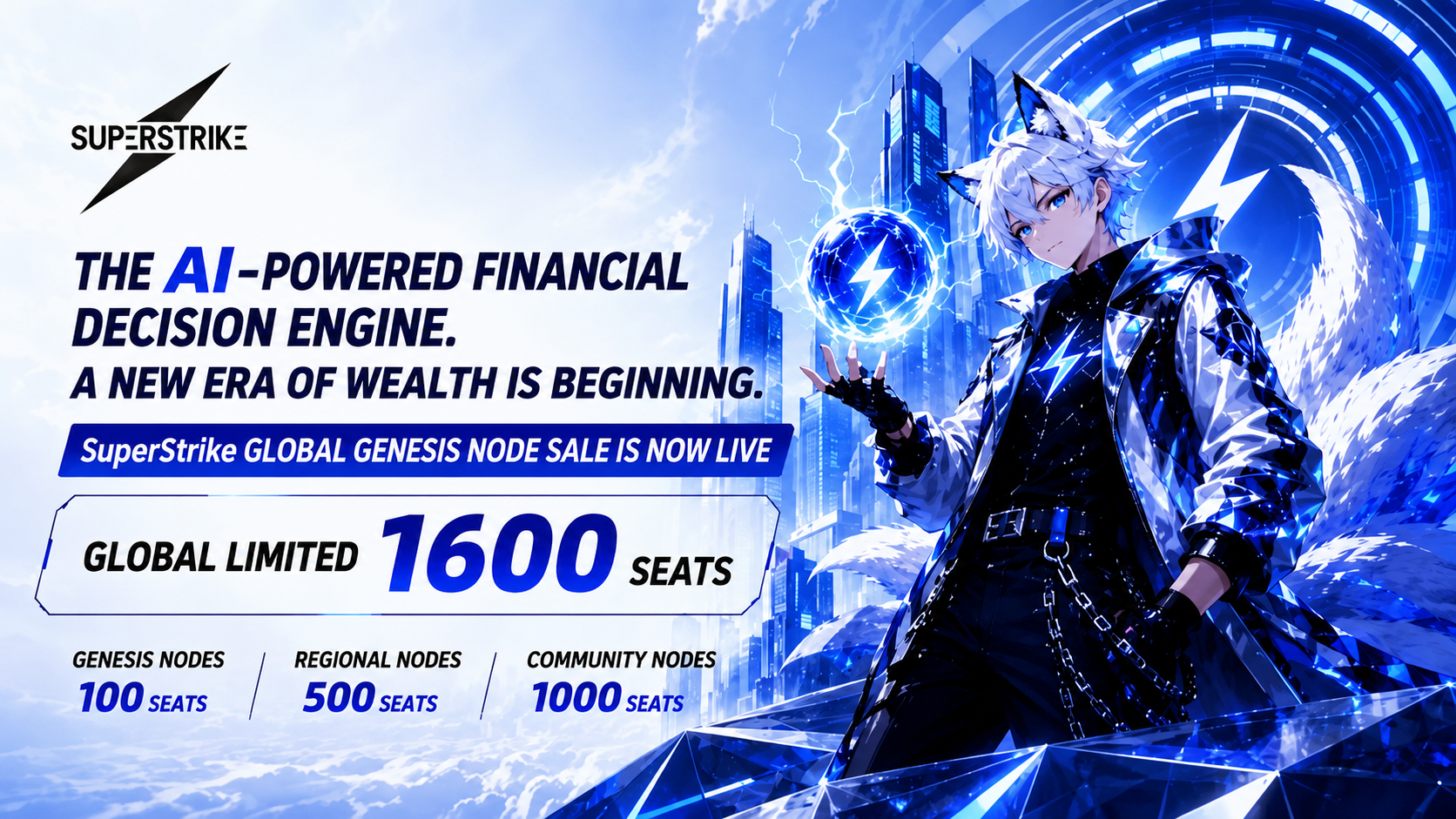
Global node allocations are strictly limited: 100 Genesis Nodes, 500 Global Nodes, and 1,000 Consensus Nodes, for a total of only 1,600 positions worldwide. These are not merely numbers. They represent early ownership in the emerging AI financial network. Just as internet domains, mobile traffic gateways, and early blockchain mining positions became highly valuable over time, node ownership may become one of the defining assets of the autonomous finance era.
A New Financial Civilization Is Emerging
The financial industry has evolved through multiple eras: banking, the internet, and blockchain. The next era will belong to autonomous finance powered by artificial intelligence. Asset management will increasingly be performed by intelligent agents. Value creation will increasingly be generated by intelligent systems. Financial networks will increasingly be built through the convergence of AI and blockchain technologies.
As every individual gains access to their own intelligent agent, as every Agent becomes capable of creating value autonomously, and as financial systems develop the ability to learn and evolve independently, an entirely new financial civilization begins to take shape. This transformation is not merely technological. It represents a fundamental shift in economic organization, value creation, and wealth distribution.
End intuitive trading. Embrace AI sovereignty.
In an era where superintelligence is rapidly transforming traditional finance, you can choose to remain the capital fuel powering opaque algorithms—or become a digital landowner helping define the next financial paradigm.
The SuperStrike Global Genesis Node Subscription Program is now officially open.Only 1,600 positions are available worldwide.The ultimate race for network ownership has begun, exclusively available through selected strategic communities.
SuperStrike is more than lightning.It is the perpetual energy powering the future of AI-driven finance.


All Comments