

AI Capability Gateways Are Becoming a New Infrastructure Layer
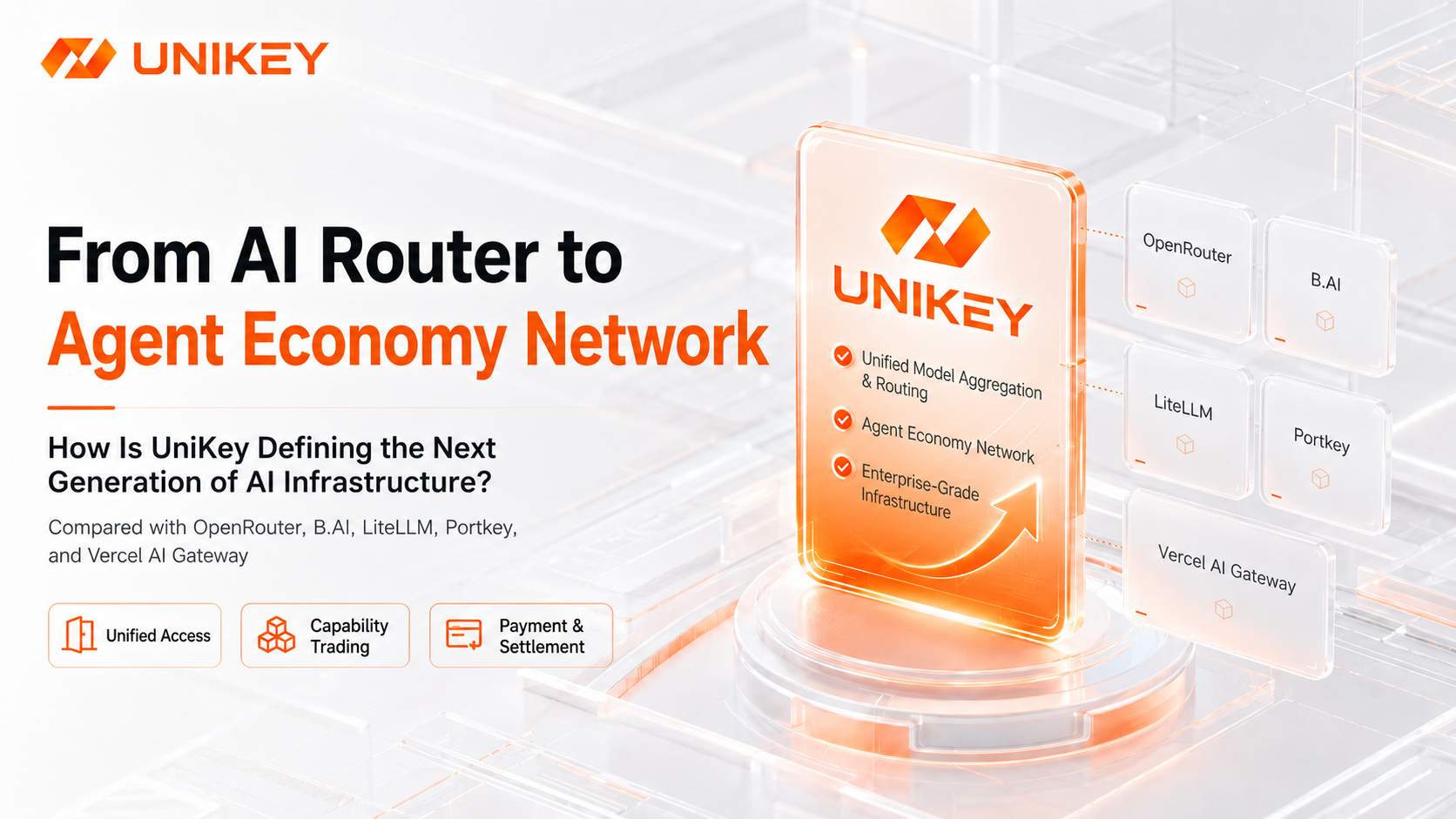
As global AI models, tools and agent applications continue to grow rapidly, a clear trend is emerging across the industry: users no longer need only one powerful model. What they truly need is an AI capability gateway that can unify access, intelligently route requests, manage usage, connect developers and support payment settlement. In the past, AI products competed around model performance. Today, the competition is shifting toward who can connect global AI capabilities more efficiently. OpenRouter positions itself around “One API for Any Model,” LiteLLM provides a unified interface for more than 100 LLM providers, Portkey focuses on AI Gateway, observability and governance, while Vercel AI Gateway offers unified model access for developers. These products all show that AI Gateway and AI Router are becoming a clear infrastructure direction.
At the same time, AI Router itself is evolving. The first generation of routers mainly solved the problem of model access, allowing developers to call multiple models through one API. The second generation began to emphasize cost, speed, availability and routing strategies. The next truly imaginative stage is to place model calling, AI service trading, agent collaboration, workflow execution and on-chain payment settlement into the same network. This is where UniKey differentiates itself. UniKey is not only building a multi-model API gateway. It aims to combine AI Router, AI Marketplace, Agent Marketplace, Workflow Marketplace and Agent Payment Network into a complete AI economic infrastructure.
Compared with OpenRouter: UniKey Goes Beyond Model Calling and Moves Toward AI Capability Circulation
OpenRouter is one of the most representative products in the AI Router category. Its core advantage is that it provides unified API access to multiple models and providers, allowing developers to call different models through a single interface and choose based on pricing, performance and availability. Its value lies in reducing the complexity of multi-model integration, so developers do not need to separately connect to OpenAI, Anthropic, Google, Meta and other model ecosystems. It can also improve availability and cost flexibility through a distributed supplier network. For developers, this kind of product has already significantly lowered the barrier to building AI applications.
UniKey is similar to OpenRouter in that both recognize the key demand for a unified AI capability gateway. However, UniKey extends further toward an AI economy network, rather than remaining only a model-calling network. OpenRouter is closer to a traffic gateway and inference marketplace at the model layer, with the core scenario being developers using different models through one API. UniKey aims to go further by expanding into the service layer, agent layer and payment settlement layer. In other words, UniKey does not only care about how users call GPT, Claude, Gemini or DeepSeek. It also cares about how AI services are published and traded, how agents are commercialized, how workflows become assets, and how agents complete payment and revenue sharing. This allows UniKey’s narrative to move from AI Router toward AI Economy Network.
Compared with B.AI: UniKey Places More Emphasis on Product Entry, Developer Infrastructure and Service Marketplaces
B.AI is publicly positioned closer to financial infrastructure for the AI Agent era. It emphasizes economic identity for AI agents, autonomous fund management, compute purchasing and agent-to-agent settlement. Its goal is to become the underlying financial infrastructure for the AI Agent era. This direction is closely aligned with UniKey’s view on the Agent Payment Network. Both recognize that future agents will not only be software features, but new digital actors capable of autonomously calling services, purchasing resources and exchanging value.
The difference is that UniKey does not enter the market only from the perspective of Agent financial infrastructure. It first builds a complete AI product gateway for users and developers. UniKey’s path is more product-driven. It begins with a unified workspace, model routing, API access, usage management and AI Credits to support real AI usage, then gradually expands into AI Marketplace, Agent Marketplace, Workflow Marketplace and Agent Payment Network. The advantage of this path is that UniKey does not start from an abstract Agent finance narrative. Instead, it builds usage scenarios from real user calls, real developer integration, real enterprise management and real service transactions. Agent payment settlement is not an isolated module. It is a natural extension built on top of model calls, service transactions and workflow execution.
Compared with LiteLLM: UniKey Is Not Only an Open-Source Gateway, but a Commercial AI Capability Network
LiteLLM’s strength lies in being open-source and engineering-friendly. It can be used as a Python SDK or Proxy Server, offering OpenAI-compatible access to OpenAI, Anthropic, Gemini, Bedrock, Azure and more than 100 LLM providers. For engineering teams, LiteLLM is well suited as an internal AI Gateway to reduce multi-model adaptation costs and help teams manage model calls within their own systems. It solves the internal developer and enterprise problem of standardizing multi-model interfaces.
UniKey’s direction is clearly different from LiteLLM. LiteLLM is more like a low-level developer tool and enterprise internal gateway, focused on open-source deployment and interface compatibility. UniKey is closer to a market-facing AI capability network. In addition to unified API access, it includes account systems, usage visualization, model selection, Web3 wallet accounts, AI Credits, KEY application scenarios, and future service marketplaces, agent marketplaces and workflow marketplaces. Simply put, LiteLLM is better suited for companies that want to build their own AI Gateway internally, while UniKey is better suited for users, developers, enterprises and agents entering an open AI capability network together. This means UniKey’s growth does not only come from tool usage, but also from platform transactions and ecosystem network effects.
Compared with Portkey: UniKey Moves from Enterprise Governance Toward Agent Trading and Settlement
Portkey is positioned more as an enterprise-grade AI Gateway and production control plane. It emphasizes fast, reliable and secure model routing, while also offering observability, governance, guardrails and prompt management. Public information shows that Portkey’s AI Gateway supports a wide range of language, vision, audio and image models, with a focus on helping enterprises use GenAI in production environments with better stability, security, cost monitoring and governance. For enterprise teams, Portkey represents the question of how to deploy AI applications in a safer, more controllable and more observable way.
UniKey can learn from this enterprise-grade product logic, but its final goal leans more toward open ecosystems and the agent economy. Portkey is strong in enterprise control panels, observability and governance. UniKey, on the other hand, emphasizes unified access, developer APIs, AI service trading, agent publishing, workflow assetization and on-chain payment settlement. In other words, Portkey is more like the control layer for enterprise AI applications, while UniKey is closer to the transaction and settlement layer for AI capability circulation. If Portkey solves how enterprises better manage AI requests, UniKey aims to further solve how AI capabilities flow, trade and settle among users, developers, enterprises and agents.
Compared with Vercel AI Gateway: UniKey Serves Not Only Developers Building Applications, but All Participants in the AI Economy
Vercel AI Gateway targets modern application developers by offering a unified API for switching between different AI models and providers. Combined with the broader Vercel ecosystem, it helps developers build AI features more quickly. Its advantage comes from Vercel’s existing developer ecosystem, frontend deployment capability and AI application development toolchain. Therefore, it is especially suitable for teams already building applications within the Vercel ecosystem. The key focus of Vercel AI Gateway is to reduce the complexity of building AI features and make model access more flexible.
UniKey and Vercel AI Gateway both value developer access, but UniKey serves a wider range of participants. It is designed not only for developers, but also for ordinary users, enterprise teams, AI service providers, agent developers, workflow creators and future autonomous agents. Vercel AI Gateway is more like infrastructure for developers building AI applications. UniKey is closer to a comprehensive network for AI capability usage, trading and settlement. This positioning allows UniKey to avoid being limited to a single development framework. Instead, it aims to become a unified value circulation gateway across models, applications, users and agents.
UniKey’s Differentiation: From a Single Tool to a Five-Layer AI Economy Network
When these five types of products are compared together, it becomes clear that they represent different aspects of AI infrastructure. OpenRouter represents multi-model routing and inference marketplaces. B.AI represents the imagination of Agent financial infrastructure. LiteLLM represents open-source unified gateways. Portkey represents enterprise-grade AI Gateway and governance. Vercel AI Gateway represents a developer application-building entry point. These directions are all valid, and they all prove that the market demand for AI capability gateways and model routing is growing rapidly.
UniKey’s opportunity is not to simply copy any one of them, but to find a more complete position between them. UniKey’s core advantage lies in integrating model routing, developer access, AI service trading, agent commercialization, workflow assetization and on-chain settlement into a five-layer structure: AI Router Network, AI Marketplace, Agent Marketplace, Workflow Marketplace and Agent Payment Network. It has the access capability of an AI Gateway, the transaction logic of a marketplace, and the long-term narrative of an Agent Payment Network. Compared with products that only offer model APIs, UniKey’s upper limit is closer to AI economic infrastructure. Compared with projects that only talk about Agent payment, UniKey has a clearer user gateway and product implementation path.
Why UniKey Is Better Suited for the AI Agent Era
The core of the AI Agent era is not simply “one more chatbot.” It is the rise of large numbers of agents running continuously and automatically calling services. To complete a task, an agent may need to call models, purchase AI services, execute workflows, call another agent and distribute fees across different participants. Traditional AI Gateways can solve model calling, but they do not fully solve service trading, agent identity, automatic payment and revenue sharing. Traditional Web3 projects can solve assets and payments, but often lack real AI consumption scenarios. UniKey’s value lies in connecting these two worlds.
UniKey uses AI Credits to support high-frequency AI consumption, KEY to connect ecosystem rights and value flow, and Agent Payment Network to support future service calls and settlements between agents. This makes UniKey not just an AI model gateway, but a network where AI capabilities, developer services, agents, workflows and on-chain value systems can operate together. As agent applications grow, the truly scarce infrastructure will not be a single model capability, but a system that allows agents to access capabilities, call services, pay fees and complete revenue sharing. UniKey’s roadmap is designed in advance for this future.
Conclusion: UniKey Is Not Building Another Router. It Is Building an AI Economy Gateway.
From an industry comparison perspective, AI Router and AI Gateway are already clear infrastructure categories. OpenRouter, LiteLLM, Portkey and Vercel AI Gateway all prove the value of unified model access from different angles. B.AI further expands the perspective toward financial infrastructure for AI Agents. UniKey’s uniqueness is that it does not stop at any single dimension. Instead, it aims to bring AI capability routing, AI service marketplaces, agent marketplaces, workflow marketplaces and agent payment settlement networks into one complete system.
This is UniKey’s strategic judgment: future AI competition will not only happen at the model layer. It will also happen at the capability connection layer, service transaction layer and value settlement layer. Models will continue to change, tools will continue to evolve and agents will continue to emerge. But the infrastructure value of connecting, trading and settling capabilities will continue to grow. UniKey aims to make global AI capabilities uniformly accessible, AI services freely tradable, agents autonomously collaborative and payable, and the AI economy equipped with its own settlement network.
One Key, Unlimited AI.
One key to access global AI.One network to power the AI economy.



All Comments