

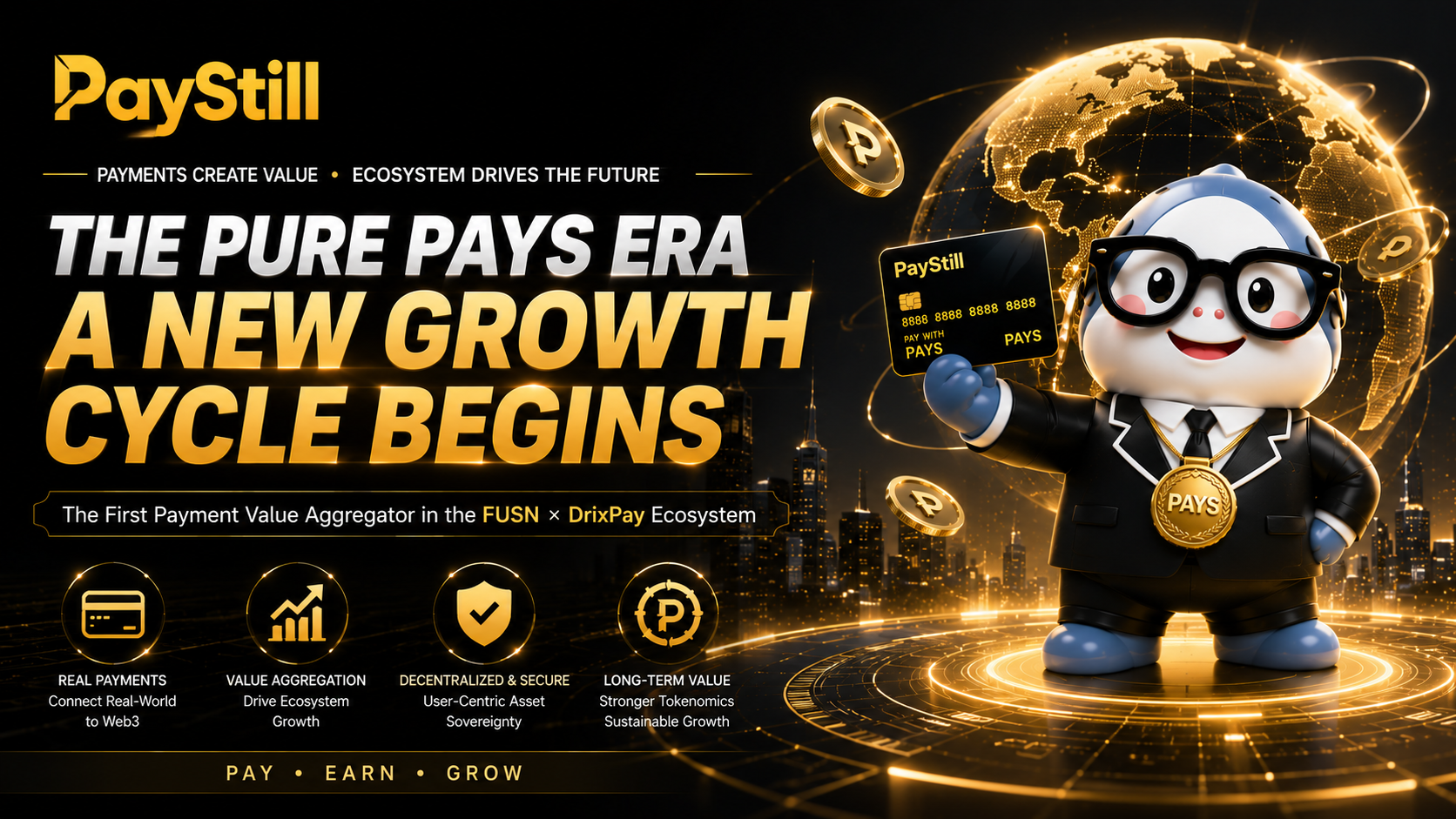
The future of Web3 is not merely about the transfer of assets—it is about the continuous creation of value.
As the first Payment Value Aggregator within the FUSN × DrixPay ecosystem, PayStill was founded with a clear mission: to transform real-world payment activities into gateways connecting the real economy with the Web3 world.
Today, with the comprehensive upgrade of its underlying ecosystem mechanisms, PayStill officially enters a new phase of development—the Pure PAYS Era.
This is more than a technical optimization. It represents a significant evolution in ecosystem consensus, value aggregation, and long-term growth strategy.
From Payment Tool to Value Engine: PAYS Becomes the Sole Value Anchor
PayStill's vision has always been straightforward:
To make every payment the beginning of value creation.
Following this upgrade, PAYS will become the exclusive core asset powering the entire ecosystem. Mining power purchases, ecosystem circulation, value distribution, and future application scenarios will all revolve around PAYS.
This transformation further strengthens ecosystem consensus, streamlines value flow, and ensures that every contribution made by users directly feeds back into the PAYS value network.
In any mature economic model, a unified value anchor often leads to greater efficiency, stronger consensus, and a more sustainable foundation for long-term growth.
PAYS is now positioned to become the central engine driving this expanding value network.
The Arrival of the PAYS-Native Era
PayStill has always been committed to growing together with its community.
With this upgrade, all mining rewards will move closer to a PAYS-native settlement model, creating a stronger alignment between user participation and ecosystem expansion.
As the user base grows, payment adoption increases, and ecosystem applications continue to expand, demand for PAYS is expected to grow alongside real economic activity.
This growth is no longer dependent on isolated market behavior. Instead, it is driven by a complete value cycle powered by real payments, real consumption, and real ecosystem participation.
In essence, PayStill is building a new economic framework fueled by payments, supported by users, and strengthened by ecosystem growth.
Every participant becomes a stakeholder in the ecosystem's success.
A True On-Chain Trading System: Empowering User Asset Sovereignty
PayStill's long-term ambition extends beyond payment infrastructure. Its goal is to contribute to the evolution of Web3 financial infrastructure as a whole.
The introduction of the new on-chain C2C trading framework marks another major milestone in PayStill's decentralization journey.
Going forward, value exchange between users will become more transparent, efficient, and autonomous. Asset transfers are executed through blockchain mechanisms, ensuring verifiable transactions and an enhanced user experience.
This upgrade enables PayStill to evolve from a payment application into a comprehensive PayFi infrastructure with complete value circulation capabilities.
For the ecosystem, this represents a transformational leap forward.
Enhanced Deflationary Economics and Long-Term Value Accumulation
A successful economic model does not merely generate value—it preserves and amplifies it.
As part of this upgrade, PayStill has further optimized its incentive structure by introducing stronger value recycling and deflationary mechanisms.
As ecosystem activity expands and user participation increases, more value will continuously flow back into the PAYS ecosystem through buyback initiatives, token burns, and ecosystem development programs.
This strengthens PAYS not only as a utility asset but also as a long-term value-capturing asset.
Payments generate value.
Value drives demand.
Demand fuels ecosystem growth.
Ecosystem growth reinforces value.
A powerful and sustainable growth flywheel is now taking shape.
The Next Destination: Becoming a Global PayFi Benchmark
Across the Web3 industry, many projects remain focused on isolated financial products.
PayStill is building something much larger—a complete payment value ecosystem.
From dual-asset synthetic mining power to global payment cards.
From on-chain consumption rewards to ecosystem-wide token swaps.
From connecting real-world payment scenarios to unlocking Web3 value creation.
PayStill is gradually integrating payment, consumption, rewards, circulation, and value growth into one seamless economic network.
This is not only an innovative PayFi model but also a meaningful step toward the convergence of traditional finance and blockchain-based economies.
With continued support from the FUSN blockchain and DrixPay's global financial infrastructure, PayStill is well-positioned to become a leading PayFi application serving millions of users worldwide.
Final Thoughts
Every great upgrade marks the beginning of a new chapter.
The arrival of the Pure PAYS Era represents far more than a mechanism update. It reflects stronger ecosystem consensus, a more robust value framework, and tremendous opportunities for future growth.
For PayStill, this is a strategic leap into its next stage of development.
For ecosystem participants, it is an opportunity to share in the benefits of a rapidly expanding value network.
PayStill is opening the door to a new era of PayFi.


All Comments