

Recently, according to disclosures from Bloomberg and multiple financial media outlets, the Zenith Arc data center project in Oklahoma, United States, plans to issue up to $2.25 billion in green bonds to fund the construction of computing facilities and substations.
The most notable pillar behind this massive financing structure is the Absolute NNN Lease signed by a subsidiary of global quantitative market-making giant Jane Street Group.
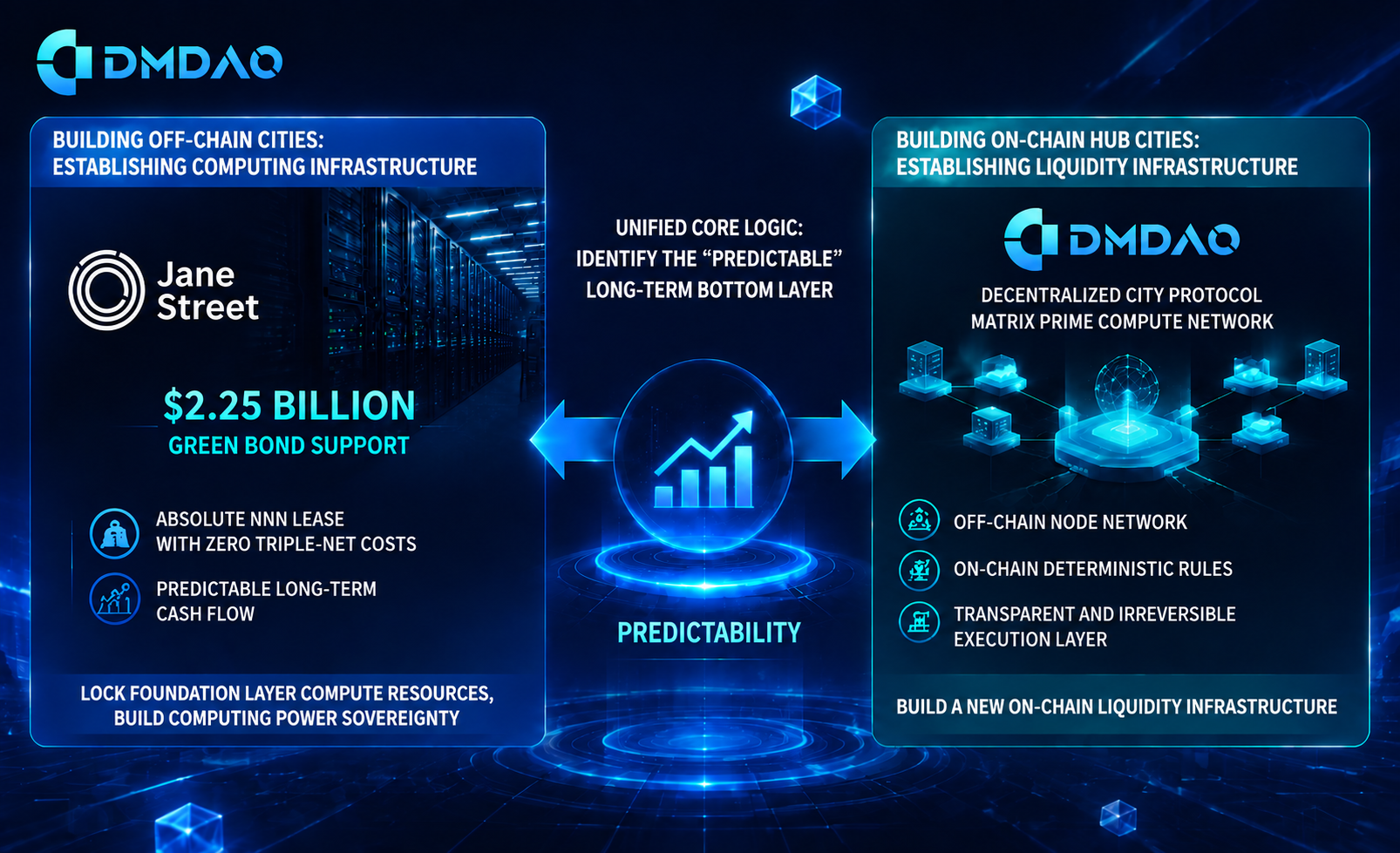
In traditional quantitative finance, when top-tier market makers are willing to pay hundreds of millions of dollars in long-term rental commitments for highly deterministic hash power over the coming decades, they are essentially using “predictable long-term contracts” to secure underlying computing resources and establish absolute hash power advantages in the millisecond-level trading battlefield.
At the crossroads of decentralized finance (DeFi) evolving toward the next generation, a parallel question is emerging:
When top off-chain market-making institutions build competitive barriers through advanced hash power infrastructure and balance sheets, how can on-chain markets construct deterministic infrastructure for decentralized market makers (AMM/DEX)?
Focused on the foundation of distributed market making and the reconstruction of high-frequency liquidity, the DMDAO Distributed Market-Making Protocol is providing an ultimate on-chain solution.
I. The Core Logic of Financial Pricing: Seeking a Predictable Long-Term Foundation
The commercial logic demonstrated by Jane Street in the Zenith Arc financing case is extremely clear:
● Creditors and capital providers are not focused on abstract concepts, but rather on the predictable, resilient, and long-term deterministic cash flow provided by the lessee.
● Top market-making institutions understand that regardless of how dramatically underlying assets or market volatility fluctuate, the ability to control core market-making infrastructure and maintain execution certainty is the fundamental key to long-term success.
Returning to the on-chain world, the biggest challenge facing traditional DeFi is precisely the lack of certainty.
Under single-leader block production structures, issues such as censorship, front-running (MEV), latency, and fragile short-lived token economic models force on-chain market makers to face significant adverse selection risks, ultimately damaging the overall depth of on-chain asset markets.
DMDAO’s breakthrough lies exactly here: by using the foundation of “Distributed Market-Making Protocol + Matrix Prime Intelligent Computing System,” it directly embeds market-maker execution certainty and liquidity accumulation into decentralized smart contracts.
DMDAO does not rely on the “moral goodwill” of any single node or centralized institution. Instead, through global core node coordination, deterministic on-chain rules, and algorithmic agreements, DMDAO creates an open, transparent, and irreversible execution foundation for global market-making participants — similar to a “Triple Net Lease” structure.
II. Moving Beyond Conceptual Labels: Building a Real Protocol Balance Sheet Through a Structured Liquidity Foundation
In discussions surrounding Jane Street’s hash power bond financing, analysts emphasized that financing labels should not be confused with actual asset construction costs. It is essential to understand the real cash flows behind the project and the allocation of fulfillment responsibilities.
The same principle applies to decentralized finance (DeFi):
A protocol without deep liquidity capture capabilities and genuine settlement mechanisms is merely a fragile conceptual package.
Starting from its underlying economic model, DMDAO structurally redesigns the flow rules of market-making capital and builds a highly deterministic on-chain asset balance sheet:
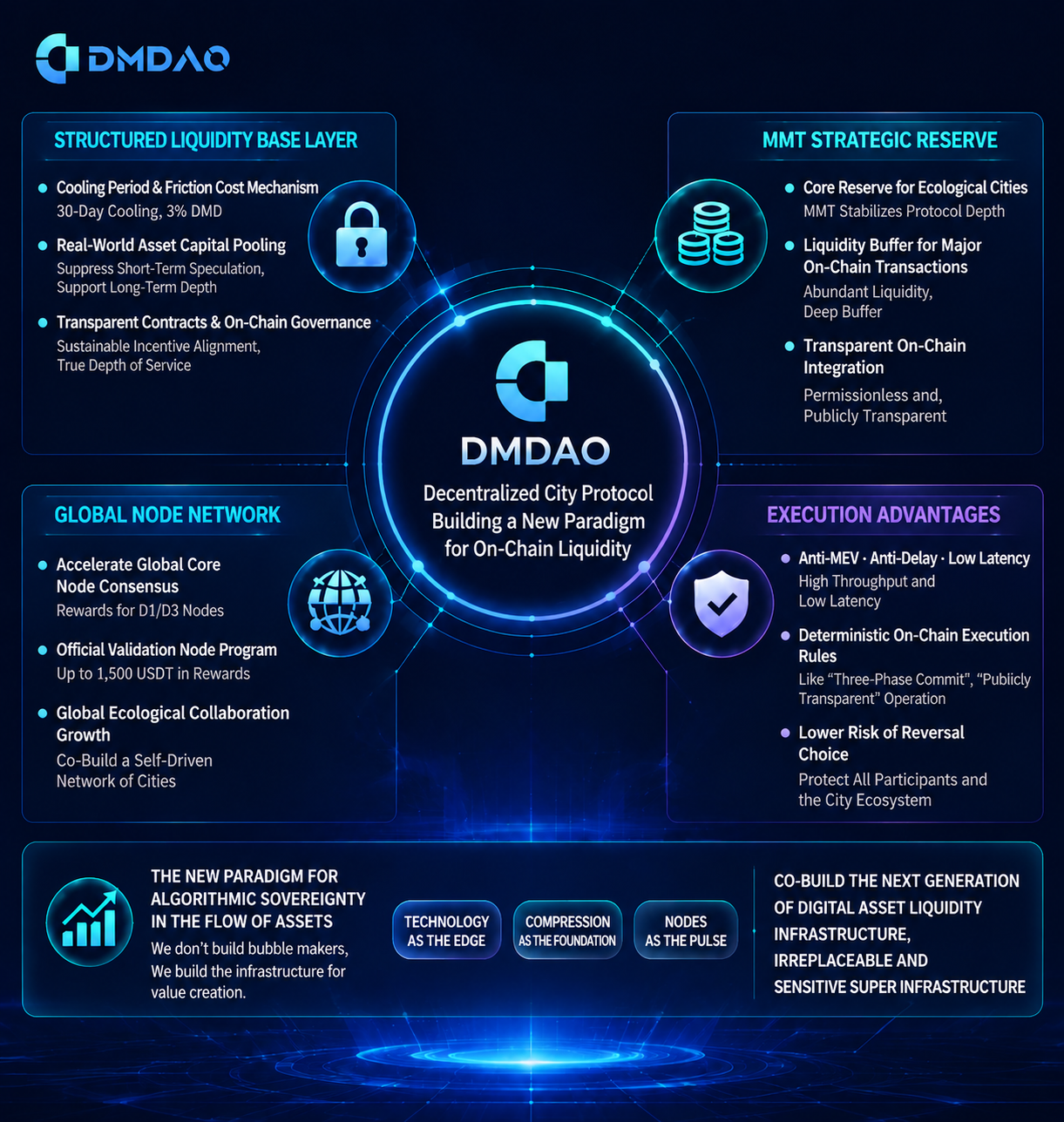
● Frozen Period and Friction Cost Mechanism
Recently, the DMDAO community passed a governance proposal with high voting support regarding the “Adjustment of the 30-Day Frozen Withdrawal Tax (charging a 3% DMD tax).”
This mechanism is similar to structured lock-up period designs in traditional finance. Through reasonable friction costs, it effectively reduces high-frequency speculation and malicious short-term arbitrage behavior, ensuring the long-term stability of the underlying liquidity pool.
● Establishing a Real Market-Making Capital Liquidity Pool
Through tiered withdrawal mechanisms and transparent smart contracts, DMDAO transforms short-term capital that is vulnerable to market sentiment fluctuations into a medium-to-long-term liquidity foundation capable of continuously supporting market depth.
This not only reduces adverse selection risks faced by market makers during extreme market conditions, but also gives protocol capital accumulation a predictable and volatility-resistant capability similar to a “long-term lease agreement.”
Through continuous adjustments of on-chain rules and decentralized governance mechanisms, DMDAO enables every liquidity interaction to serve genuine market-making depth, building a solid value moat for all long-term participants and nodes.
III. Core Network and Strategic Reserve (MMT): Building the “Hash Power Facility” of Decentralized Market Making
If data centers and substations represent the physical infrastructure supporting the hash power of traditional off-chain market makers, then the global core node network and MMT strategic reserve pool represent the supercomputing center of DMDAO’s distributed market-making system.
1. 1. MMT Strategic Asset Empowerment: As the core liquidity reserve supporting ecosystem market-making strategies, MMT is deeply integrated with the underlying protocol. It avoids opaque off-chain matching mechanisms and directly provides sufficient deep liquidity buffers on-chain for large-scale transactions and high-frequency market making.
2. Accelerating Global Core Consensus: From the successful conclusion of the DMDAO Global Core Training Camp (Northern Region) at Qianshan Hot Spring, to the upcoming official certified studio salon support program (providing up to 1,500 USDT subsidy per session) and the D1/D3 special reward programs, DMDAO is continuously connecting global market-making core participants and building a decentralized market-making liquidity network with strong self-driven growth capabilities.
IV. Conclusion: A New Liquidity Paradigm in the Era of Algorithmic Sovereignty
Jane Street’s $2.25 billion green bond case demonstrates to global capital markets that: In the institutionalized era, financial markets will always pursue infrastructure supported by solid assets, deterministic rules, and long-term value accumulation.
DMDAO is not a creator of short-term speculative bubbles. Instead, with technology as its edge, deflation mechanisms as its foundation, and nodes as its network, DMDAO is reconstructing traditional quantitative market-making intelligence into a permissionless on-chain public protocol.
Amid the wave of reshaping the new order of on-chain market making, DMDAO is steadily becoming an essential super infrastructure for next-generation digital asset liquidity.



All Comments