

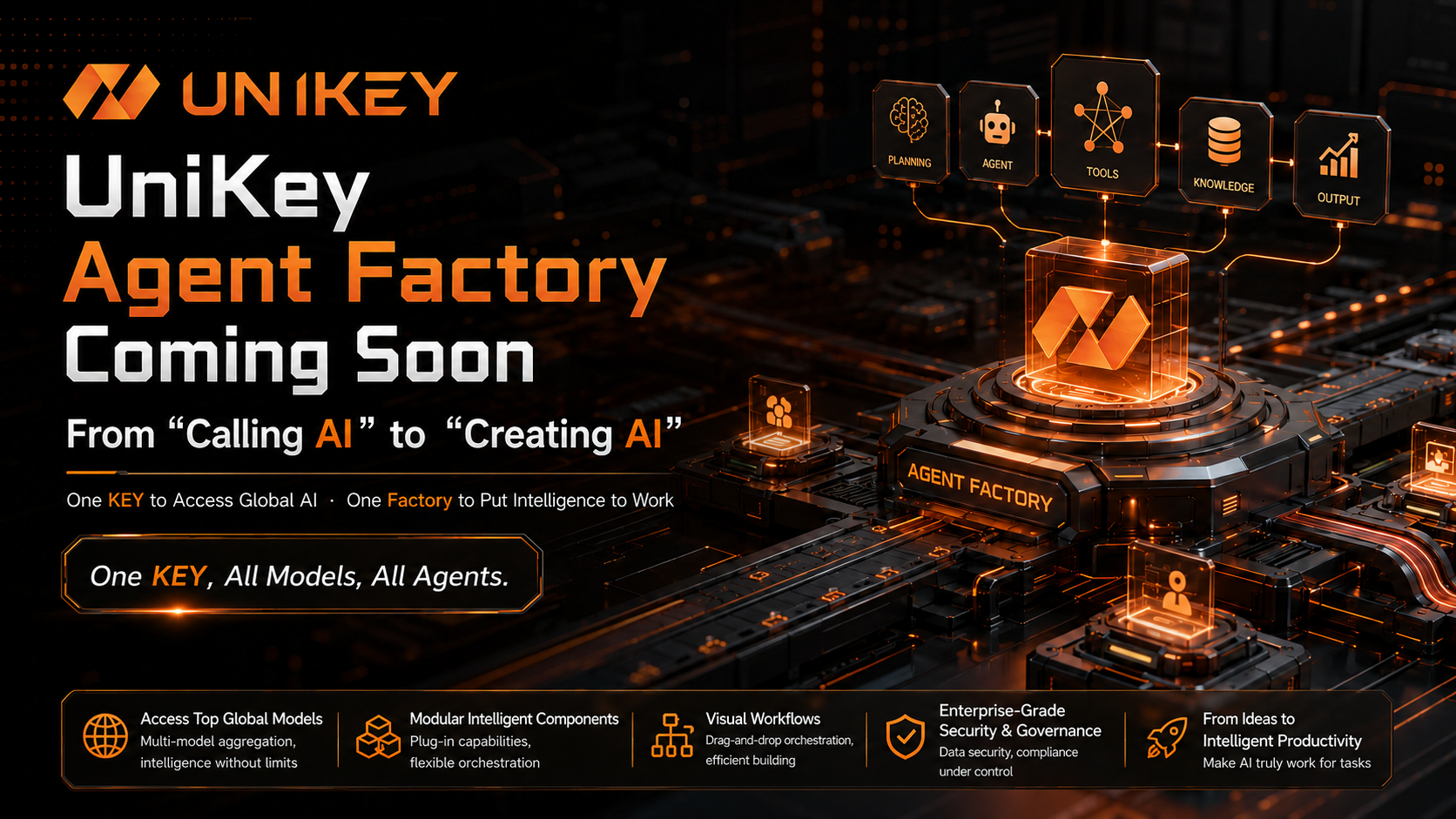
The next stage of AI is no longer just about getting models to answer questions. As models, image generation, video generation, search, coding, and specialized tools become increasingly abundant, the capabilities with real commercial value are shifting from “making a single model call” to orchestrating multiple AI capabilities to continuously complete real-world tasks. A marketing Agent may need to use a large language model for planning, call an image model to generate creative assets, connect to search capabilities for information retrieval, and then use a Workflow to complete content production and distribution. An enterprise Agent may need to execute multiple steps across knowledge bases, data analytics, APIs, and business systems.
This is the core significance of the upcoming UniKey Agent Factory. Following the launch of AI Gateway, multi-model chat, image generation, text-to-video, and unified API calling, UniKey is moving beyond being a “unified gateway to global AI capabilities” toward becoming intelligent service infrastructure where Agents can be created, assembled, published, and called.
AI Is Entering the Agent Era, Where What Really Matters Is “Getting the Job Done”
In the past, most users understood AI through the chat interface: enter a question, and the model returns an answer. But real business is not a single question-and-answer exchange. It is a continuous sequence of actions. A market research task may involve information search, document reading, data analysis, content summarization, and report generation. Social media operations may include topic selection, copywriting, image creation, video production, review, and publishing.
Agents change exactly this. Instead of waiting for users to issue instructions step by step, an Agent can understand a goal, break it into tasks, call models and tools, and continue executing until the result is delivered. This also means AI competition is moving beyond “which model is smarter” toward “who can organize different AI capabilities into continuously executable services.”
That is why Agent Factory is not simply another page added to UniKey. It represents an important upgrade of the entire product architecture. AI Gateway connects intelligence; Agent Factory begins to organize intelligence. In the future, users will no longer interact only with individual models such as GPT, Claude, Gemini, or DeepSeek, but with complete Agents capable of accomplishing specific tasks.
UniKey Agent Factory: Turning Fragmented Capabilities into Agents That Can Actually Work
UniKey Agent Factory has completed the design of its core standardization framework, built around three key standards: Input Contracts, Capability Declarations, and Billing Units. Once an Agent is configured according to this unified standard, it can enter UniKey’s calling and metering system without requiring an entirely different runtime logic for every individual Agent.
The Input Contract defines what tasks and parameters an Agent can receive. The Capability Declaration specifies which models, Skills, and Workflows it can call. The Billing Unit defines how usage and fees are calculated for each execution. Through standardization, an Agent is no longer a difficult-to-replicate custom program. It can gradually become a standardized intelligent service that can be created, combined, called, and commercialized.
At the runtime layer, UniKey is advancing a unified orchestration layer that allows Agents to combine models, Skills, and Workflows according to task requirements. An Agent may use a powerful reasoning model for planning, then call image or video capabilities for content production, and further connect to external APIs and Workflows to execute complex tasks. The entire call chain can be recorded and metered step by step, laying the foundation for budget control, service billing, and settlement.
No Repeated Deployment Required: Configure Once, Publish Directly to the Agent Market
One obvious problem with traditional Agent development is the long distance between creation and commercialization. After building an Agent, developers often still need to deploy servers independently, write calling interfaces, handle billing, build front ends, and then find users.
UniKey aims to platformize this foundational work. The publishing channel from Agent Factory to the Agent Market has already been connected. Under the current product plan, once an Agent completes its standardized configuration, it can enter the market publishing process directly, without requiring a separate and complex off-chain scripting system for every Agent. Developers can focus more on the Agent’s capabilities, use cases, and task performance, while UniKey provides the unified infrastructure for calling, metering, publishing, and subsequent market distribution.
This means Agent Factory is not merely an “Agent creation tool.” It is closer to the production gateway through which Agents enter the UniKey ecosystem. In the future, developers create Agents, users call Agents, the platform records real usage and ratings, and high-quality capabilities gain more demand—forming a complete cycle from production to consumption.
Models, Skills, and Workflows Are Becoming the “Capability Components” of Agents
A truly powerful Agent should not be permanently tied to a single model. Different models have different strengths in reasoning, coding, multilingual tasks, speed, cost, and multimodal capabilities. Different Skills provide specialized capabilities such as search, data processing, content creation, and marketing operations. Workflows organize multiple actions into continuous business processes. The value of an Agent lies in dynamically combining these capabilities according to the task at hand.
For this reason, UniKey Agent Factory does not exist in isolation. It is built on UniKey’s existing AI Gateway, AI Router, and unified API system, and will further connect with the Skill Library and Workflow ecosystem currently under development. Models provide the underlying intelligence, Skills provide standardized professional capabilities, Workflows organize execution processes, and Agents become the execution units directly responsible for completing objectives.
This is why UniKey’s next-stage product architecture is becoming increasingly clear: Models provide foundational intelligence, Skills package specialized capabilities, Workflows organize execution processes, and Agents complete goal-oriented tasks. UniKey, in turn, connects all these fragmented capabilities within the same network.
From Agent Factory to Agent & Skill Market: AI Capabilities Become Callable Services
Creating Agents is only the first step. UniKey is simultaneously advancing the Agent & Skill Market. The Agent Market’s domain classification and pay-per-use billing framework have already been designed, with initial categories covering content creation, e-commerce operations, predictive analysis, on-chain trading, and other scenarios. In the future, users entering UniKey will not necessarily need to configure their own Agents. They will also be able to directly choose mature intelligent services to complete tasks.
The Skill Library further breaks down reusable capabilities within Agents. A data analysis Skill, translation Skill, content generation Skill, or industry knowledge Skill only needs to be standardized once before it can be combined and called by multiple different Agents. Developers no longer need to repeatedly build the same foundational capability, while high-quality Skills can continue to be reused by new Agents.
Once Agents and Skills can both be published, called, and rated, UniKey’s role begins to change as well: from providing AI tools to building an intelligent service supply market. Developers produce capabilities, users purchase results, and real usage determines which high-quality services gain more market demand.
AI Router Frees Agents from Being Locked to a Single Model
The Agent era will make model calling far more complex than ordinary AI chat. A single task may involve more than a dozen consecutive steps, each with different model requirements. If every step uses the most expensive model, costs will rise rapidly. If only low-cost models are used, task quality may suffer. More importantly, models may experience rate limits, timeouts, or temporary outages, which means production-grade Agents must be able to dynamically select and switch between alternative capabilities.
UniKey has already completed unified model adaptation and the core AI Router infrastructure, converting differences in response formats, billing methods, timeout rules, and rate-limit policies across providers into a standardized calling protocol. The routing system dynamically scores available options based on cost, latency, and output quality, and automatically triggers circuit breaking and switches to backup routes when a single model encounters an issue.
For Agent Factory, this means developers will not need to permanently bind an Agent to one model. The Agent interacts with UniKey’s unified capability layer, while the underlying system continuously selects the most suitable intelligent resource for the actual task.
Users define the goal. Agents execute the task. UniKey orchestrates the intelligence.
AI Credits Bring Complex Agent Consumption into a Unified Metering System
One of the biggest differences between Agents and ordinary AI conversations is that a single Agent task may involve a large number of continuous calls. It may call a language model and consume Tokens, generate images or videos, call Skills and APIs, or even run multiple Workflows. If these services come from different providers, enterprises and developers must deal with completely different pricing systems, account balances, and billing structures.
Through AI Credits, UniKey is gradually bringing these different types of AI usage into one unified consumption system. Model calls, content generation, image and video generation, Skills, Agents, APIs, and Workflows can all be metered and managed within the same usage framework.
Therefore, the launch of Agent Factory is not simply about “how many Agents can be created.” More importantly, it is about whether UniKey can further complete the full chain of Agent Creation → Capability Calling → Task Execution → Consumption Metering → Service Settlement. As Agents begin to execute tasks at scale, unified metering and settlement will become increasingly important.
From AI Gateway to Agent Factory, UniKey Is Completing Its Second Product Leap
UniKey’s first stage addressed a fundamental problem: as global AI capabilities multiply, users and developers should not have to manage an ever-growing number of accounts, APIs, billing systems, and calling rules.
That is why UniKey built the AI Gateway, using unified accounts, unified APIs, AI Router, and unified metering to connect fragmented models and multimodal capabilities. Multi-model chat, image generation, and text-to-video are already live, while features such as call records, usage information, API Keys, model rankings, and task logs continue to improve.
Agent Factory represents the second stage. If AI Gateway answers the question of “how to use global AI,” Agent Factory answers “how to organize global AI to complete tasks for you.”
As Agent Factory, Agent & Skill Market, Workflow, and Credit Vault gradually form a complete product ecosystem, UniKey will continue evolving from a model-calling platform into a network connecting intelligent supply, intelligent services, and real-world task demand.
Agent Factory Is Coming Soon: One KEY Will Not Only Connect Models, but Also Create Intelligent Services
The future of AI will not consist of only a handful of supermodels, nor will there be one universal Agent. What is more likely to emerge are millions of professional Agents serving different roles, industries, and scenarios: some for marketing, some for research, some for community management, some for enterprise services, some for coding, and others for running complex Workflows. Models will become the underlying capability layer, while Agents will increasingly interact directly with real-world work.
UniKey does not aim to compete with every developer to build every Agent. Instead, it aims to give more people the infrastructure to create, combine, publish, and call Agents.
From one model to many models; from a single call to continuous tasks; from using AI to creating your own Agent.
UniKey Agent Factory is coming soon. One KEY connects global AI. One Factory puts global intelligence to work on real tasks.


All Comments