

As the number of platforms continues to grow, simply “building another platform” is no longer a convincing reason to exist.
What users really want to know is why a platform was created, what problem it aims to solve, and where it intends to go.
NodeXX was founded in 2024. Unlike platforms that begin with a single feature or product category, NodeXX did not define itself around one narrow function. From the beginning, it focused on a longer-term question: as users, markets, products, and services become increasingly fragmented, can a platform provide a more complete and stable way to connect them?
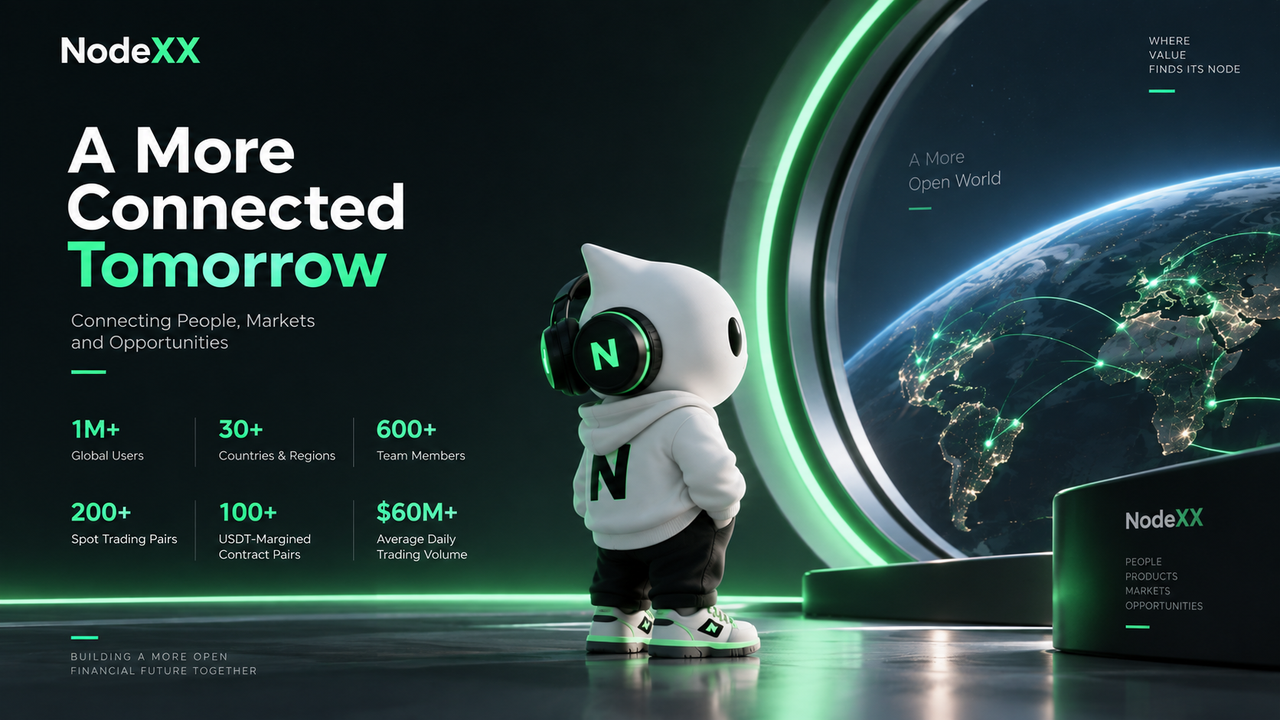
Today, NodeXX serves more than 1 million users worldwide, covers 30+ countries and regions, and has a global team of over 600 people. Its spot market supports 200+ trading pairs, its USDT-margined futures market covers 100+ contract pairs, and its average daily business volume exceeds US$60 million.
The significance of these numbers is not simply to show how large the platform has become. More importantly, they indicate that NodeXX has moved beyond its early product-building stage and entered a phase of broader global service expansion, product development, and continuous infrastructure improvement.
Why Does the Name NodeXX Emphasize “Node”?
In the NodeXX brand name, “Node” refers to a node within a network.
In network systems, an individual node is not especially complex. The real value emerges when multiple nodes are connected and form a functioning network.
NodeXX applies this logic to platform services.
A user can be a node. A product can be a node. A regional market can be a node. A partner can also be a node. Each has its own needs and value, but when these nodes remain disconnected, users are still forced to switch repeatedly between different entry points, products, and services.
That is why the name NodeXX is more than a technology-inspired label.
The idea behind it is to view the platform as a connector: rather than simply placing more services in one place, NodeXX aims to shorten the paths between users, products, markets, and services.
“XX” represents a more open space for extension. As the platform continues to evolve, it can stand for more types of connections, more service scenarios, and a willingness not to be restricted by a single business boundary.
From this perspective, the core of the NodeXX brand is not “how many functions it has,” but rather “how effectively those functions can be connected.”
Why Was NodeXX Founded in 2024?
The timing of NodeXX’s founding also reflects a broader shift in the market.
In the earlier stages of platform competition, the focus was often on basic functionality: launching faster, offering more products, and providing more entry points could quickly attract attention.
As the market matured, however, the value of simply adding more features began to decline.
Users started asking different questions: Is the system stable? Are services continuous? Is the security framework complete? Can different products work together? Can the platform adapt to the needs of different regions?
This marked a shift from feature competition to competition in overall platform capability.
NodeXX began building in this environment.
Members of its core team have professional backgrounds from companies including Binance, OKX, Morgan Stanley, and Google, with expertise spanning product, technology, security, risk control, compliance, and global operations.
This team structure means NodeXX does not approach platform development from only one product perspective. Instead, it considers systems, services, security, and globalization at the same time.
From building core infrastructure in its early stage to gradually developing a broader product and service ecosystem, NodeXX has followed a relatively clear path: strengthen the foundation first, then expand into additional use cases.
From Team Building to a Global Service Network
Whether a brand can grow over the long term ultimately depends on organizational capability.
NodeXX now has a global team of more than 600 people, with members distributed across 30+ countries and regions.
This distributed team structure is particularly important for a global platform.
User habits, language environments, service expectations, and risk requirements differ from market to market. If all decisions come from a single region, it becomes difficult for a platform to truly understand global users.
Local teams therefore do more than support operations. They also act as market-sensing and feedback nodes.
When regional needs can be quickly passed to product, technology, and service teams, the platform has a better chance of building genuine global service capability.
NodeXX now serves more than 1 million users worldwide. As a result, its next stage is not simply about expanding coverage, but about improving service quality and connection efficiency.
Globalization is not about adding more countries to a map. It is about helping users in different regions receive a stable and consistent experience.
Why Technology Is a Core Part of the NodeXX Brand
Although NodeXX is a platform company, its brand story is not built around products alone.
As the number of users grows, the volume of information, service requests, and risk variables the platform must process increases rapidly. If the underlying technology does not scale at the same pace, even a rich product ecosystem cannot deliver a stable experience.
That is why NodeXX continues to build capabilities around high-performance matching, real-time clearing, and intelligent risk control, while also applying intelligent technologies to platform operations, risk support, and service efficiency.
These capabilities support a growing level of real business activity: more than 200 spot trading pairs, over 100 USDT-margined contract pairs, and more than US$60 million in average daily business volume.
High-performance systems address scale. Real-time clearing helps maintain data consistency. Intelligent risk control supports risk detection in more complex environments, while AI capabilities can improve information processing and service efficiency.
The purpose of these technologies is not simply to make the platform appear more “advanced.”
Their real value is to ensure that as more users, products, and services enter the same system, the platform can continue to operate with stability and efficiency.
What Does NodeXX Ultimately Want to Become?
NodeXX’s long-term goal is not to become a platform with more and more products and an increasingly complicated structure.
Quite the opposite: it wants to make complex markets and services easier to use.
When users need different services, they should not have to constantly switch between multiple platforms. As NodeXX expands into more regions, it should not need to rebuild an entirely separate service system each time. And as new products are added, the user experience should remain relatively unified.
This is also why NodeXX emphasizes the idea of “connecting global value flows.”
From its early infrastructure-building stage, NodeXX has grown to serve 1 million+ users worldwide, employ 600+ team members, and operate across 30+ countries and regions.
But these numbers are not the end goal.
The real long-term test is whether, as the platform continues to scale, the connections between users, products, markets, and services can remain efficient.
If NodeXX can achieve that, its role will go beyond being just another service entry point. It can become a foundational node connecting different needs and market opportunities.
That is the most direct meaning behind the NodeXX name.
NodeXX does not aim to become the endpoint of a network. It aims to become the place where more forms of value can find one another and connect.
About NodeXX
Founded in July 2024, NodeXX is a next-generation multi-asset platform built for global users. With digital asset trading at its core, NodeXX connects diverse markets including Hong Kong stocks, U.S. stocks, gold, forex, and indices. The platform provides integrated services across spot trading, futures trading, earn, wallets, and innovative financial solutions, aiming to become an intelligent node that connects global assets and value opportunities.
Powered by fast, reliable, and intelligent infrastructure, NodeXX combines AI and social trading capabilities to help users discover market opportunities, understand market dynamics, and access a more efficient asset experience.
For more information, please visit: Official Website | Twitter | Telegram


All Comments