

Along the evolutionary trajectory of crypto finance, the industry is undergoing a profound transformation from a narrative centered on “pure speculation” toward real yield generation (Real Yield) and real-world asset tokenization (RWA). As on-chain capital increasingly demands high-frequency execution efficiency, transparent risk management, and sustainable yield, traditional market-making models and standalone DEXs are no longer sufficient to independently support the capital deployment and liquidity requirements of trillion-dollar-scale assets.
On September 19, 2026, DMDAI (the hash-power-driven decentralized market-making yield network) officially announced a comprehensive strategic collaboration with THENA, a core liquidity layer on BNB Chain, and formally integrated into the THENA ecosystem.
This is not merely another routine ecosystem integration, but an industry-level convergence driven by the deep coupling of an AI intelligent market-making strategy engine, decentralized hash-power ownership and verification, and a top-tier ve(3,3) liquidity architecture. Built on BNB Chain as its foundation, the two parties will extend across the Binance blue-chip ecosystem and the global RWA market, jointly constructing a new foundational infrastructure for sovereign-grade liquidity in the Web4.0 era.
I. Convergence of Macro Paradigms: When AI-Powered Intelligent Market Making Meets BNB Chain’s Leading ve(3,3) Architecture
For years, on-chain market making and DEX development have faced a fundamental dilemma: on one side, Mercenary Capital creates a cycle of impermanent loss and liquidity mining sell pressure; on the other, traditional CEXs and Wall Street institutions have monopolized the ability to capture cross-market Spread through high-frequency algorithms. Ordinary users have been effectively locked out of professional market-making returns, while passive capital has lacked the ability to generate sustainable endogenous yield.
As a flagship DEX and liquidity distribution hub on BNB Chain, THENA, through its sophisticated ve(3,3) governance game architecture, deep on-chain TVL, and millisecond-level settlement capabilities, has established a powerful flywheel for asset issuance and market making.
Meanwhile, DMDAI, as a pioneer in reshaping decentralized market-making yield, transforms passive capital into intelligent hash power with autonomous allocation capabilities through its “1 USDC = 1 TOPS” unified hash-power accounting mechanism and its 24/7 AI intelligent computing and allocation engine.

The integration of the two achieves a powerful combination of “liquidity infrastructure” and “intelligent hash power”:
- THENA provides DMDAI with deep on-chain trading venues, highly efficient settlement channels, and extensive decentralized liquidity and traffic interfaces;
- DMDAI, in turn, injects THENA with continuous cross-market high-frequency Spread capture capabilities, AI-powered automated market-making liquidity, and a robust hash-power-driven market-making foundation centered around Binance blue-chip assets and tokenized U.S. equities such as NVDA.
II. Three Dimensions of Deep Integration: Reshaping On-Chain Asset Value-Capture Efficiency
Following its integration with the THENA ecosystem, DMDAI will establish protocol-level interoperability and demonstrate powerful synergies across three dimensions: asset exposure, yield capture, and deflationary mechanisms.
1. Deep Decoupling of Asset Exposure and Liquidity (THE & RWA Hash-Power Matrix)
DMDAI will officially incorporate THENA’s native token THE and its ecosystem-linked assets into the DMDAI hash-power allocation network through its A/B dual-track incentive model.
- Intelligent Hash-Power Investment Channel: Users can deposit USDC, DMD, THE, NVDA tokens, and other diversified assets, which can be converted into TOPS hash power according to a unified standard, with 200%–350% hash-power multiplier boosts;
- ve-Token Locking Synergy: By integrating long-term ve-Token locking mechanisms, the governance incentives of THE will be combined with DMDAI’s market-making weight, breaking down the traditional barriers between U.S. equities and on-chain derivatives while significantly improving Capital Efficiency.
2. 24/7 Spread Capture and 100% Core Allocation
Leveraging THENA’s high-performance on-chain trading infrastructure, DMDAI’s AI intelligent computing engine will enable uninterrupted 24/7 high-frequency market making and cross-market arbitrage.
All genuine cash flow captured by the protocol will be allocated 100% to the core protocol and distributed back to the Yield Aggregator in real time. Users can benefit from automated compounding every 12 hours, while also having the flexibility to select different unlock periods: instant unlock with a 20% freeze tax, 10-day unlock with a 10% freeze tax, or 30-day unlock with a 3% freeze tax.
The freeze tax is precisely allocated to the Yield Aggregator for compounding (50%), Genesis Nodes (30%), and the Ecosystem Development Fund (20%), creating a highly resilient internal economic loop.
3. Extreme Deflationary Model and the Flywheel of Transaction Velocity
From a tokenomics perspective, DMDAI’s native token DMD adopts a strict three-year stepped and smoothed emission schedule, with a total supply of 21,000,000 tokens, of which 95.24% is allocated to mining emissions, while its ultimate deflationary target is fixed at 1,000,000 tokens.
The substantial trading volume and liquidity interactions within the THENA ecosystem will accelerate the operation of DMDAI’s deflationary flywheel:
- Daily Pool Burn: The DMD LP pool undergoes a mandatory 0.5% burn every day at a scheduled time;
- Hash-Power Purchase Burn: When users purchase hash power with DMD, 100% of the DMD used is burned;
- Swap Transaction Tax: A 3% fee on both buys and sells is strictly allocated to token burns, LP injection, D9 dividends, and the DMD Foundation’s market-support operations.
- The higher the transaction velocity within the THENA ecosystem, the stronger the acceleration of DMD’s black-hole convergence and scarcity effect.
III. Dynamic Risk Management and Treasury Principles: Building an Impenetrable Risk Shield for Market-Making Capital
To mitigate the impact of extreme market conditions on the market-making pools, DMDAI has introduced strict treasury capital-allocation principles, providing an institutional-grade risk-isolation mechanism for the entire market-making network integrated with THENA.
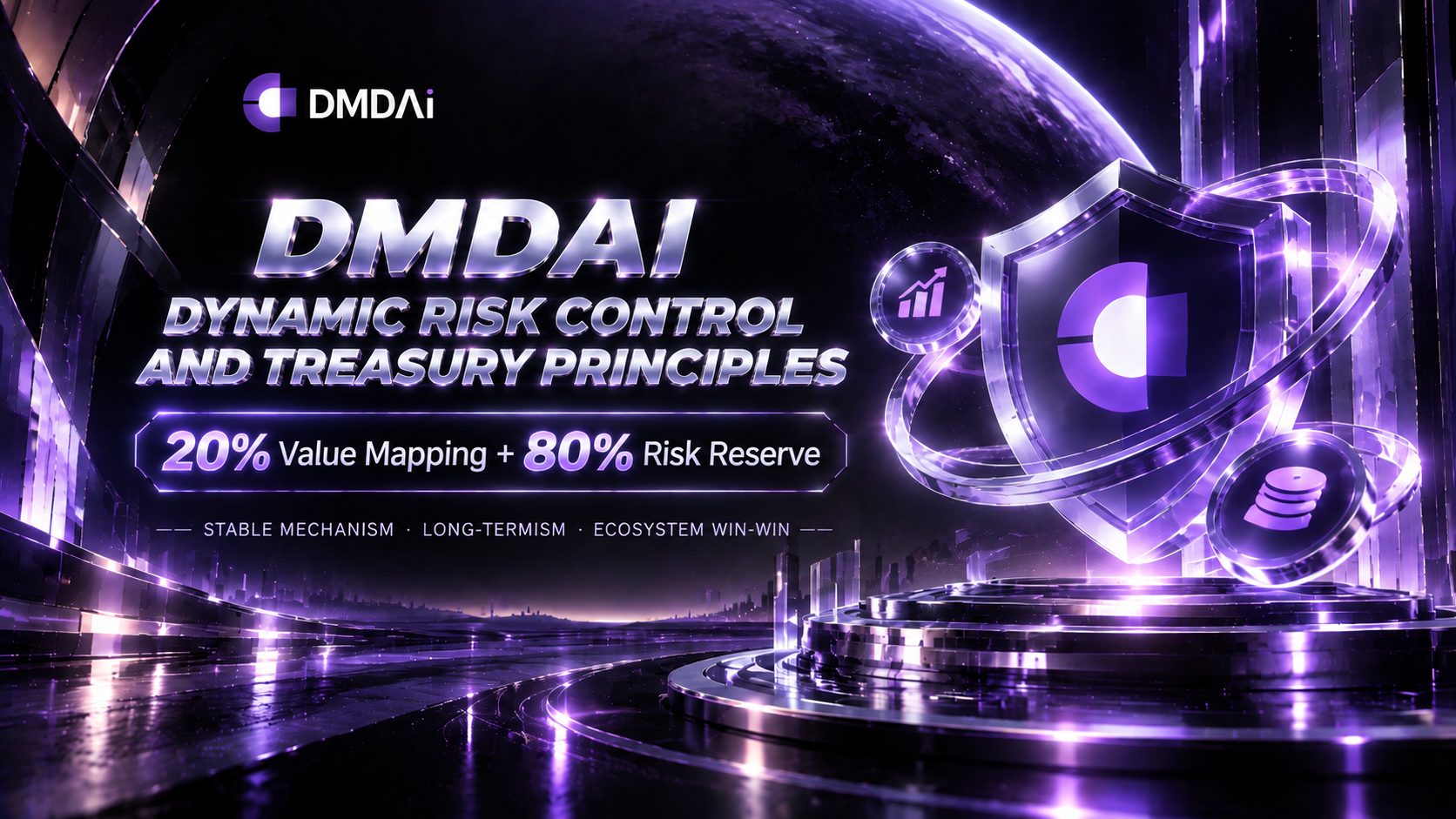
The system follows the principle of “20% value mapping + 80% risk reserves.”
Of this allocation, 20% is used to support community governance and ecosystem incentives, while 80% is established as a risk reserve fund for hedging against extreme market conditions and providing circuit-breaker protection.
IV. Prelude to Disruption: From Institutional Privilege to Sovereign-Grade Liquidity for All
Traditional market-making privileges have long been concentrated in the hands of a limited number of Wall Street institutions and centralized market makers, while ordinary investors have often been positioned as passive counterparties absorbing liquidity costs.
DMDAI’s integration with the THENA ecosystem is more than the convergence of two decentralized protocols; it represents a broader movement toward “liquidity sovereignty.” By bringing sophisticated, high-level AI quantitative algorithms down to the level of foundational infrastructure, DMDAI enables every ordinary participant holding TOPS hash power to access the global intelligent market-making network with a low barrier to entry and participate in the potential value premium generated by cross-market arbitrage and the on-chain tokenization of RWA assets.
Say goodbye to centralized monopolies and take control of the digital market-making whales.
DMDAI will stand closely alongside THENA, wielding intelligent computing as its blade, deflation as its foundation, and DAO as its soul, as the two embark together toward the boundless frontier of on-chain liquidity freedom.


All Comments