

Cointime

Download App
iOS & Android

Venture Capital Investments Into Blockchain Continue To Free-Fall: Report

Validated Media

Cointelegraph Research has analyzed all the deals and trends from venture capital in the blockchain industry during the fourth quarter of 2022. The second half of 2022 saw a dramatic decline in capital inflows across all five major sectors of the blockchain industry: decentralized finance (DeFi), centralized finance (CeFi), nonfungible tokens (NFTs), infrastructure and Web3. The first half of 2022 brought in just under $30 billion of investment, while the second half only saw $7.3 billion — a dramatic plunge.

As the crypto industry moves into 2023, Cointelegraph Research has looked at the data from its Venture Capital Database, which contains comprehensive details on deals, mergers and acquisition activity, investors, crypto companies, funds and more. Using this database, Cointelegraph Research crunches the numbers to find the most important trends in the industry. Its latest report explores Q4 2022 and how it relates to the broader picture of 2018 through 2022.

Investments declined starting April 2022

After the fallout from the collapse of Terra in the first part of 2022, the blockchain industry could not seem to attract venture capital back into investing in this industry as it did in 2021 and the start of 2022. There was $30.5 billion invested in 2021, and 2022 was on pace to double that — right up until April 2022, when everything began to decline. September saw a brief bounce in capital investment, but it did not sustain as the year ended, with the last three months staying below $1 billion in investments.
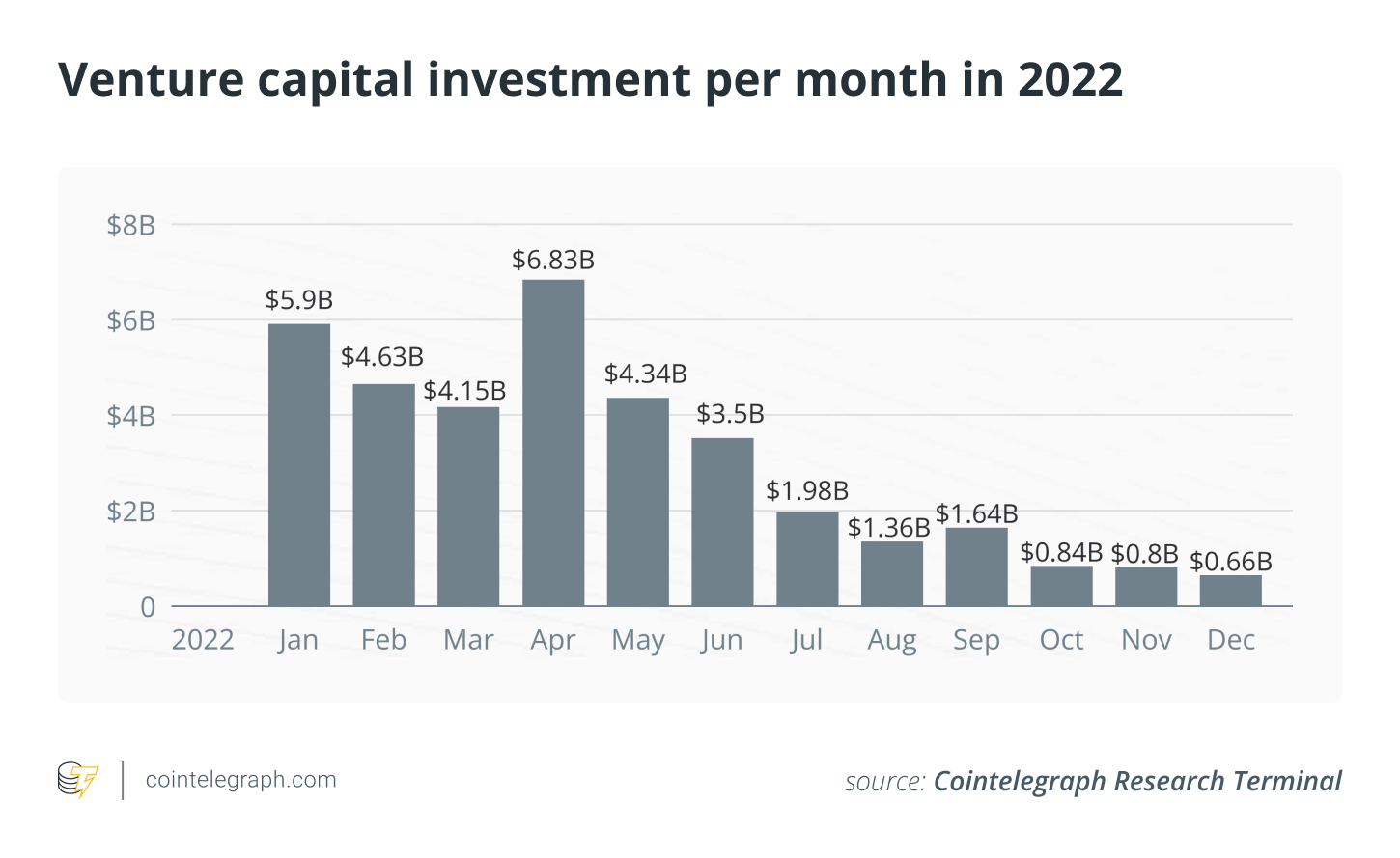
The number of deals also dropped considerably, down to just 182 in Q4. While previous months saw large deals that were always over the $100 million mark, there were only five in Q4 above $100 million. The focus for those 182 deals stayed within the Web3 sector — which comprises subcategories like metaverse, GameFi, identification and a host of others — followed by infrastructure and DeFi. NFTs and CeFi were the least popular in terms of the number of deals, but just looking at those numbers can be misleading.

The most active and least active sectors tie for investment

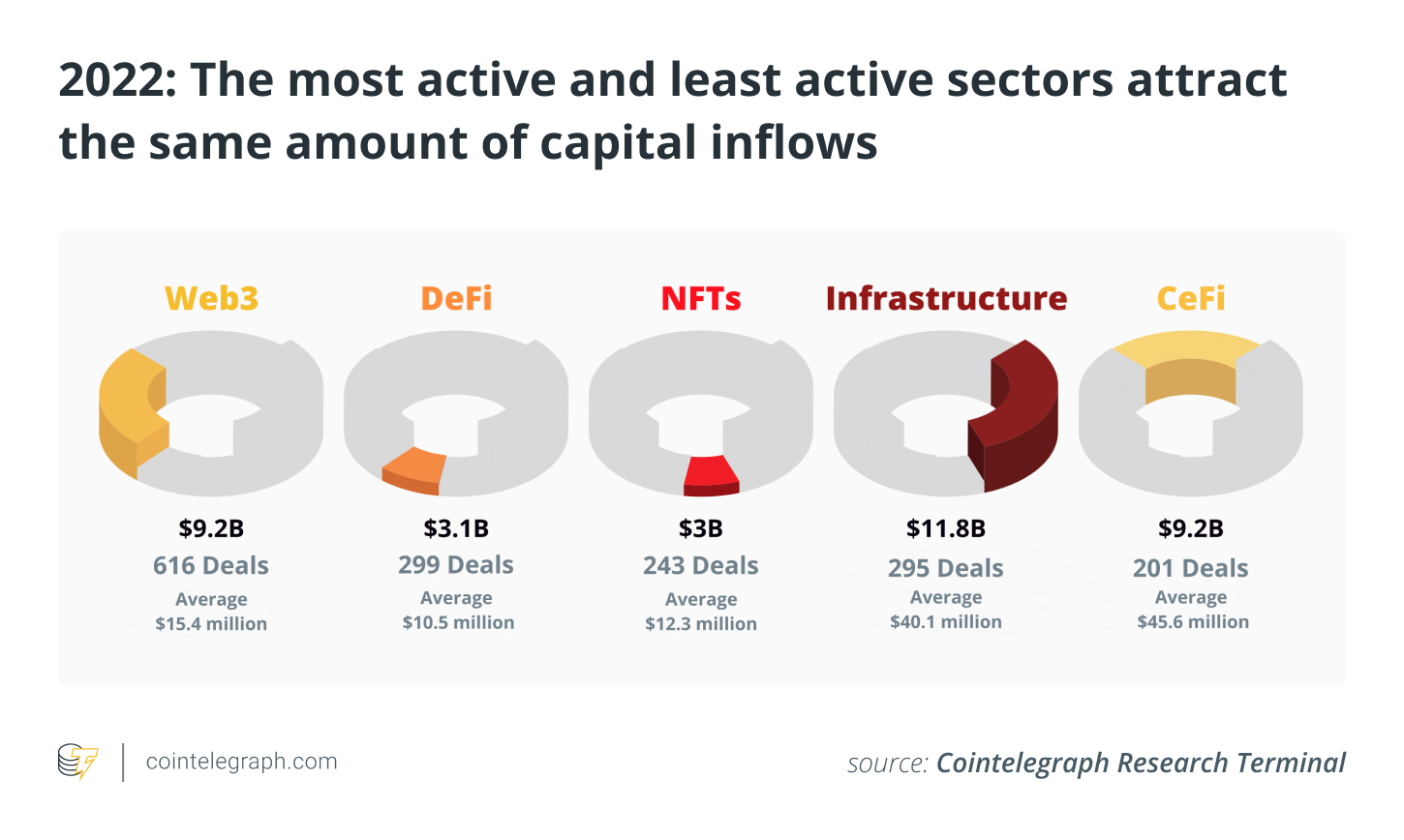
Web3 was the most popular sector of the blockchain industry for investment, with 616 individual deals, while CeFi was the least popular, with 201 deals. Yet, both sectors brought in a total of $9.2 billion in 2022. The average deal for Web3 was $15.4 billion, compared with CeFi’s average of $46.6 million. Blockchain and crypto projects looking for VC or investment funding in the future may want to pay attention to which sector they fall into so they can better prepare.
This report pulls from Cointelegraph Research Terminals’ expansive database along with analysis from Michael Tabone, senior economist for Cointelegraph Research. Tabone has an extensive background in economics, business, finance, cryptocurrency, blockchain technology and emerging technologies. Besides working for Cointelegraph Research, he is a Ph.D. candidate completing his dissertation, which is focused on the theory and application of DAOs.

Keychain Ventures is a crypto investment firm that invests in different funds in the blockchain space. Keychain Ventures, along with Cointelegraph Research, will be presenting quarterly interviews with VC firms as well as crypto and blockchain projects that have recently gone through a funding round. These interviews will reveal various viewpoints on investment practices from all parties involved.

The opinions expressed in this article are for general informational purposes only and are not intended to provide specific advice or recommendations for any individual or on any specific security or investment product.


Comments

All Comments

Recommended for you

  • Global Bond Market Faces Sell-off, Panda Bond Issuance Reaches Record High

    According to CCTV Finance, the long-term government bond yields of major global economies have continued to rise recently, intensifying sell-off pressure in the bond market. However, China's bond market and exchange rate have remained relatively stable, with the issuance of Panda bonds reaching a historical high for the same period. Data shows that as of August 21, the cumulative issuance of 2026 Panda bonds has reached 209.975 billion yuan, an increase of over 73% year-on-year. Against the backdrop of significant fluctuations in the global bond market, the increased interest from international institutions in domestic RMB financing has drawn attention. Industry insiders noted, 'We are in completely different economic and monetary cycles compared to overseas. Foreign capital accounts for only about 5%-8% of our bond market, while domestic capital holds absolute pricing power. Coupled with our monetary policy that prioritizes domestic considerations, overseas shocks cannot reverse the overall trend of the domestic bond market.' Looking ahead, industry experts believe that overseas bond yields are likely to remain highly volatile, highlighting the value of RMB bond allocations, and foreign capital may continue to increase its allocation in the medium to long term. However, it is also important to note that rising U.S. bond yields have raised the return threshold for global allocation funds, which may disrupt the willingness of foreign institutions to increase their holdings of RMB bonds. Additionally, the rapid rise in bond yields in developed countries overseas may also constrain the valuation of domestic risk assets.

  • Global Bond Market Faces Sell-Off, Panda Bond Issuance Reaches Record High

    According to CCTV Finance, recent long-term government bond yields in major global economies have been rising, increasing sell-off pressure in the bond market. In contrast, China's bond market and exchange rate have remained relatively stable, with Panda bond issuance reaching a historical high for the same period. Data shows that as of August 21, the cumulative issuance of 2026 Panda bonds has reached 209.975 billion yuan, a year-on-year increase of over 73%. Amidst significant fluctuations in the global bond market, international institutions are increasingly focusing on domestic RMB financing. Industry insiders noted, 'We are in completely different economic and monetary cycles compared to overseas. Foreign capital accounts for only about 5%-8% of our bond market, while domestic capital holds absolute pricing power. Coupled with our monetary policy that prioritizes domestic conditions, overseas shocks cannot reverse the overall trend of the domestic bond market.' Looking ahead, industry experts believe that overseas bond yields are likely to remain highly volatile, highlighting the value of RMB bond allocation, which may attract continued foreign investment in the medium to long term. However, it is also important to note that rising U.S. bond yields have raised the return threshold for global allocation funds, which may disturb the willingness of foreign institutions to increase their holdings of RMB bonds. Additionally, the rapid rise in yields of bonds from developed countries overseas may also constrain the valuation of domestic risk assets.

  • Whale Transfers 1,727 Bitcoins Worth $133 Million to Binance

    According to monitoring by Bitcoin News, a whale has transferred 1,727 bitcoins, valued at $133 million, to Binance.

  • A Whale Transfers 1,727 Bitcoins Worth $133 Million to Binance

    According to monitoring by Bitcoin News, a whale has transferred 1,727 bitcoins to Binance, valued at $133 million.

  • Canadian Prime Minister: Tariff Measures Against the U.S. to Take Effect on September 8

    On August 22, Canadian Prime Minister Carney announced that Canada's tariff measures against the United States will take effect on September 8. (Jin Ten)

  • Canadian Prime Minister: Tariff Measures Against the U.S. to Take Effect on September 8

    On August 22, Canadian Prime Minister Carney announced that Canada’s tariff measures against the United States will take effect on September 8. (Jin Shi)

  • Over $1.244 Billion Liquidated in 24 Hours, Majority in Long Positions

    On August 22, according to CoinGlass data, the total liquidation amount in the cryptocurrency market reached $1.244 billion in the past 24 hours, with long positions accounting for $744 million and short positions for $500 million. A total of 246,203 individuals were liquidated. Among them, the liquidation amount for BTC was approximately $194 million, for ETH about $277 million, for SOL around $104 million, for XRP about $123 million, for ZEC approximately $66.77 million, and other assets totaled about $479 million in liquidations. The largest single liquidation in the past 24 hours occurred on the BTC-USD trading pair on Hyperliquid, valued at approximately $24.96 million.

  • Over $1.244 Billion Liquidated in the Last 24 Hours, Primarily Long Positions

    On August 22, according to CoinGlass data, the total liquidation amount in the cryptocurrency market over the past 24 hours reached $1.244 billion, with long positions accounting for $744 million and short positions for $500 million. A total of 246,203 individuals were liquidated. Among them, the liquidation amounts were approximately $194 million for BTC, $277 million for ETH, $104 million for SOL, $123 million for XRP, and about $66.77 million for ZEC, with other assets totaling approximately $479 million in liquidations. The largest single liquidation occurred on the Hyperliquid BTC-USD trading pair, valued at approximately $24.96 million.

  • Grayscale: Bitcoin May Have Hit Bottom, This Week's Rise Signals Key Cycle Reversal

    On August 22, Grayscale published an article indicating that this week could mark a turning point for Bitcoin. Historical data shows that Bitcoin typically bottoms out after falling about 80% from its cycle peak. In the recent bear market, Bitcoin has dropped about 50% from its cycle high, which is less than in all previous cycles up to this point. There has been ongoing market speculation about whether Bitcoin will experience a new round of declines in the fourth quarter of 2026. Although risks remain in the market, this week's rise may suggest that Bitcoin has formed a more solid bottom.

  • Grayscale: Bitcoin May Have Reached Bottom, This Week's Rise is a Key Signal for Cycle Reversal

    On August 22, Grayscale published a statement indicating that this week could mark a turning point for Bitcoin. Historical data shows that Bitcoin typically bottoms out after falling about 80% from its cycle peak. In the recent bear market, Bitcoin has dropped about 50% from its cycle high, which is less than the declines seen in all previous cycles. There has been ongoing market speculation about whether Bitcoin will experience a new downturn in the fourth quarter of 2026. Although risks remain in the market, this week's rise may suggest that Bitcoin has formed a more solid bottom.