

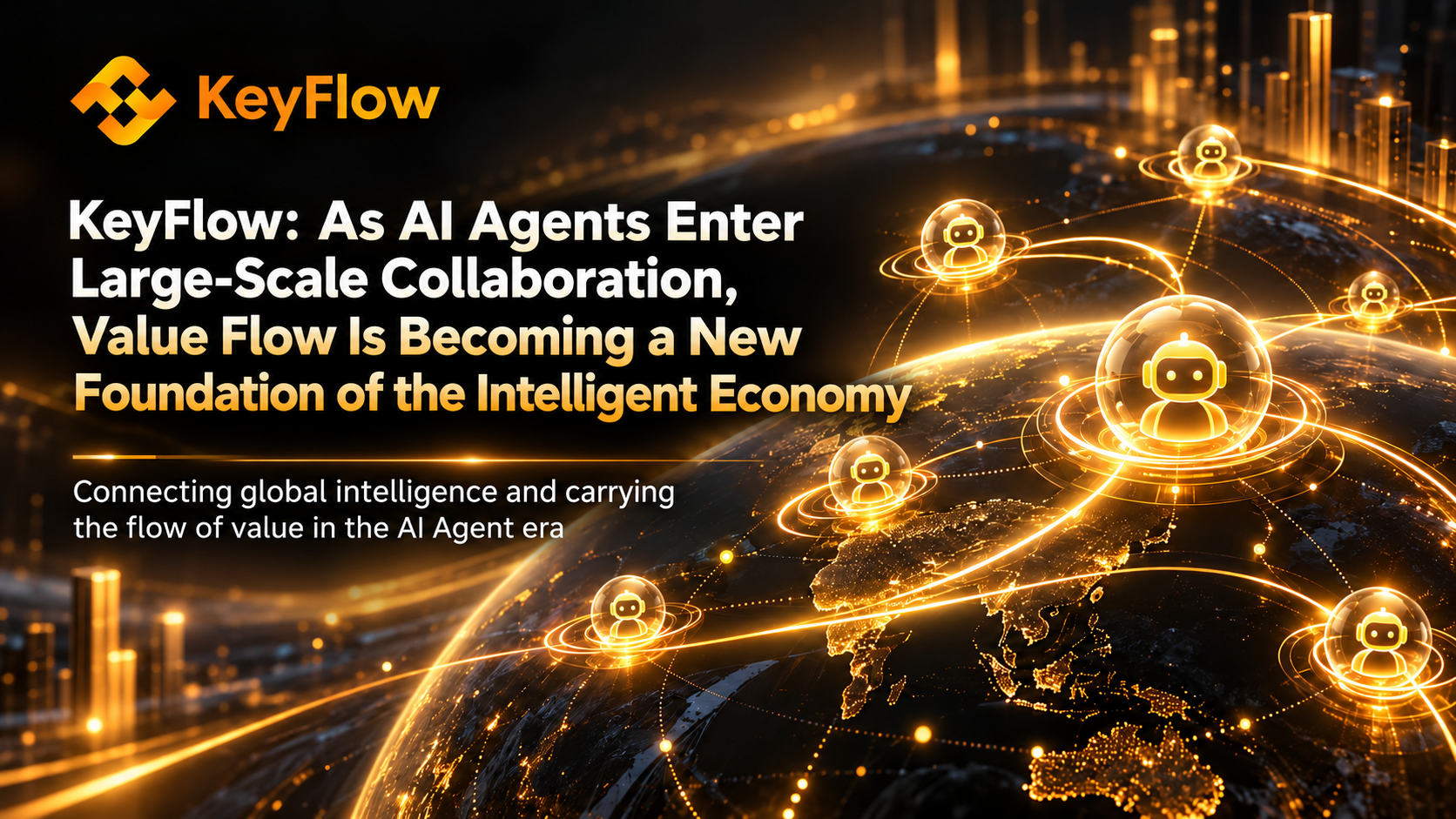
As AI evolves from simply “answering questions” to continuously completing real tasks, a fundamental shift is taking place across the industry. The value of AI is moving beyond model capability itself toward real usage, task execution, and ongoing collaboration. In the future, a single Agent may call multiple models, Skills, Workflows, data interfaces, and external services to complete one task, with every interaction generating real compute consumption, service costs, and economic settlement. AI is no longer only a software tool. It is gradually becoming a new productivity network.
UniKey addresses the question of how global AI capabilities can be connected, accessed, and organized through a unified infrastructure. KeyFlow focuses on the next layer: how the value created by real AI usage can circulate through an ecosystem. Once models are called, Agents execute tasks, and APIs generate consumption, the network requires mechanisms that can support supply, circulation, return flows, and long-term balance. This is where KeyFlow positions itself—connecting real AI business activity with the KEY ecosystem and allowing the value generated by intelligent productivity to move beyond a single transaction into a broader circulation system.
From the Model Economy to the Agent Economy, the Real Change Is How Value Is Created
Traditional AI business models were relatively straightforward. Users purchased subscriptions, platforms paid model providers for inference, and the transaction effectively ended after the model generated a result. Agent-based tasks are significantly more complex. A market intelligence Agent may use search services, reasoning models, data Skills, and document-generation tools. A content Agent may consume text, image, and video capabilities, while an enterprise Agent may continuously operate across proprietary knowledge bases, Workflows, and multiple external APIs.
This means the fundamental economic unit of future AI may no longer be a Token alone, but a complete unit of intelligent work. Models, compute, Skills, Agents, and Workflows all participate in completing that work, creating continuous flows of value between multiple capability providers. As the number of Agents grows and machine-to-machine calls increasingly exceed direct human interaction, the AI industry will require more stable mechanisms for value coordination and settlement.
KeyFlow is designed around this emerging challenge. Rather than building an abstract economic model disconnected from UniKey, its logic is intended to grow from real AI usage. UniKey provides AI Gateway, Agents, Skills, Workflows, APIs, and usage scenarios; KEY serves as a core ecosystem value carrier; and KeyFlow builds mechanisms around the supply, circulation, locking, return, and reduction of KEY, creating a closer relationship between AI consumption and ecosystem value.
UniKey × KeyFlow: From AI Capability Consumption to a Value Loop
Within the broader architecture, UniKey functions as the access and infrastructure layer for intelligent productivity. Users access models through UniKey, developers obtain AI capabilities through a unified API, and enterprises can build their own intelligent work systems using Agent Factory, Knowledge Base, Skills, and Workflow. As these services are used, they generate real model calls, compute consumption, API usage, and demand for Agent-based services.
KeyFlow operates on the value-circulation side of this structure. Its objective is to connect the value created by real AI business activity with the KEY ecosystem, so that KEY can participate in AI usage, compute coordination, and ecosystem circulation rather than remaining a passive asset. In simple terms, UniKey focuses on making intelligence work, while KeyFlow focuses on how value moves after that work occurs.
Together, this creates a more complete UniKey × KeyFlow structure. New models and intelligent capabilities enter through the upstream layer, UniKey organizes Agents, Skills, and Workflows to complete tasks in the middle, while KeyFlow builds a value cycle around KEY on the downstream side. Models provide intelligence, Agents perform work, real usage creates consumption, and value re-enters the ecosystem through circulation mechanisms, forming a continuous link between AI capability and on-chain value.
Dual-Track Compute Participation: Building Different Paths for Ecosystem Participation
KeyFlow currently defines two primary participation paths around compute and liquidity. The first is a flexible participation model supporting assets including USDT, KEY, ETH, and BNB, with greater emphasis on liquidity and flexible entry and exit. Under the current mechanism parameters, this structure uses a Rebase-based calculation model with twelve-hour cycles and a defined daily parameter range.
The second track is built around KEY-USDT LP positions, combining KEY and USDT in equal proportions and using different time horizons to define different mechanism parameters. The 180-day, 360-day, and 540-day structures correspond to different levels of enhancement, while generated value is designed to follow automatic reinvestment rules and principal is released according to the defined unlocking schedule. Compared with the flexible model, this structure places greater emphasis on long-term liquidity formation and sustained KEY locking.
These two structures serve different purposes. The flexible track emphasizes liquidity access, while the fixed LP structure supports deeper long-term participation. Through this dual-track design, KeyFlow attempts to balance capital flexibility with long-term ecosystem liquidity. All rates, cycles, and parameters should be understood as mechanism settings rather than fixed-return guarantees, with actual execution subject to on-chain rules and real-time parameters.
Dynamic Balance: Connecting Liquidity, Return Flows, and KEY
An ecosystem that only provides an entry mechanism without a dynamic exit and balancing structure will eventually face increasing liquidity pressure as it scales. For this reason, another core element of KeyFlow is its dynamic balancing architecture, designed to coordinate withdrawals, liquidity, and KEY rather than allowing value to move in only one direction.
Within this structure, withdrawal mechanisms, cluster energy, and on-chain dynamic adjustment work together to manage liquidity. Withdrawal activity can interact with KEY purchasing, locking, and reduction mechanisms, while C2C, SWAP, and circuit-breaker systems provide additional tools for adapting liquidity conditions to different market environments. The goal is not to keep every parameter permanently fixed, but to create an ecosystem capable of adjusting to changing conditions.
This becomes particularly important in an Agent Economy. AI usage will not remain constant, and model costs, Agent calls, and platform revenue can change dynamically over time. A static value system would struggle to adapt to real business fluctuations. KeyFlow therefore aims to create a structure capable of evolving alongside AI usage, liquidity conditions, and ecosystem participation.
Energy Clusters: Turning Community Growth into a Productivity Network
Another important component of KeyFlow is the A1–A12 Energy Cluster system. Traditional community growth often relies heavily on referrals and distribution, but if a community only brings new users without contributing to real usage or productivity, its expansion can remain limited to the traffic layer. KeyFlow attempts to connect community participation more closely with the development of the broader AI ecosystem through compute expansion, hierarchical collaboration, and different cluster levels.
As cluster scale expands, participants can progress through different levels according to the mechanism, with invitation incentives, differential distribution, peer collaboration, and advancement structures tied to different stages. The more important idea is not any single reward parameter, but the attempt to make community relationships part of the growth infrastructure of the AI ecosystem. More participants can mean more AI users, more API consumption, more Agent scenarios, and greater potential for ecosystem collaboration.
In the long term, a mature AI network cannot consist only of technology and capital layers. It also requires a community layer capable of driving real usage. UniKey provides the capabilities and products, while KeyFlow connects users and communities through its cluster structure. Together, the community evolves from a simple distribution channel into part of the intelligent productivity network itself.
KeyFlow’s Long-Term Challenge Is Building a Real Relationship Between AI Revenue and KEY Value
Every ecosystem model ultimately has to answer one fundamental question: where does value come from? For KeyFlow, the most important answer should not simply be new participants. It should increasingly be the real AI usage generated by the UniKey ecosystem. The more models are called, Agents execute tasks, Skills are used, Workflows run, and APIs generate consumption, the larger the real business foundation supporting the ecosystem becomes.
KeyFlow’s long-term logic is therefore not about discussing value independently from the product. It is about building a progressively stronger relationship between KEY and real AI activity. As UniKey continues expanding AI Gateway, Agent Factory, Agent & Skill Market, AI Credits, and enterprise APIs, actual AI-service consumption becomes one of the most important underlying metrics. More meaningful future indicators will include how many tasks Agents execute, how much API usage is generated, how much AI Credits consumption occurs, and how the value created by those activities enters KEY’s return and ecosystem mechanisms.
Only when AI usage and ecosystem value remain continuously connected can KeyFlow truly become part of UniKey’s value architecture rather than an isolated financial structure. This is the foundation of a genuine AI value loop: first comes real intelligent productivity, then real consumption, and only after that can sustainable value circulation emerge.
From AI Capability to the Intelligent Economy, KeyFlow Adds the Value-Flow Layer
The AI industry is entering a new stage. In the past, the main question was which model was smarter. In the future, the industry will increasingly focus on how Agents collaborate, how Skills are called, how intelligent services are purchased, and how value generated between machines is settled. As more tasks are executed autonomously by Agents, the intelligent economy will require more than models and compute. It will also need infrastructure capable of supporting continuous value circulation.
UniKey is building the global AI access layer, Agent production infrastructure, and intelligent services network. KeyFlow’s role is to connect KEY more closely with real AI business activity, liquidity, and ecosystem participation. Through dual-track participation structures, dynamic balancing, Energy Clusters, and mechanisms around KEY circulation, locking, return flows, and reduction, KeyFlow aims to create a value layer that evolves alongside the scale of AI business itself.
From AI capability calls to compute and service consumption, from Agent execution to the circulation, locking, return, and long-term value cycle of KEY, UniKey and KeyFlow are attempting to connect intelligent productivity with on-chain value. If UniKey is responsible for making global intelligence truly work, KeyFlow is designed to address the next question: how does value continue to flow once that intelligence starts working?
KeyFlow — The Gateway for Everyday People to Awaken to the AI Univer


All Comments