

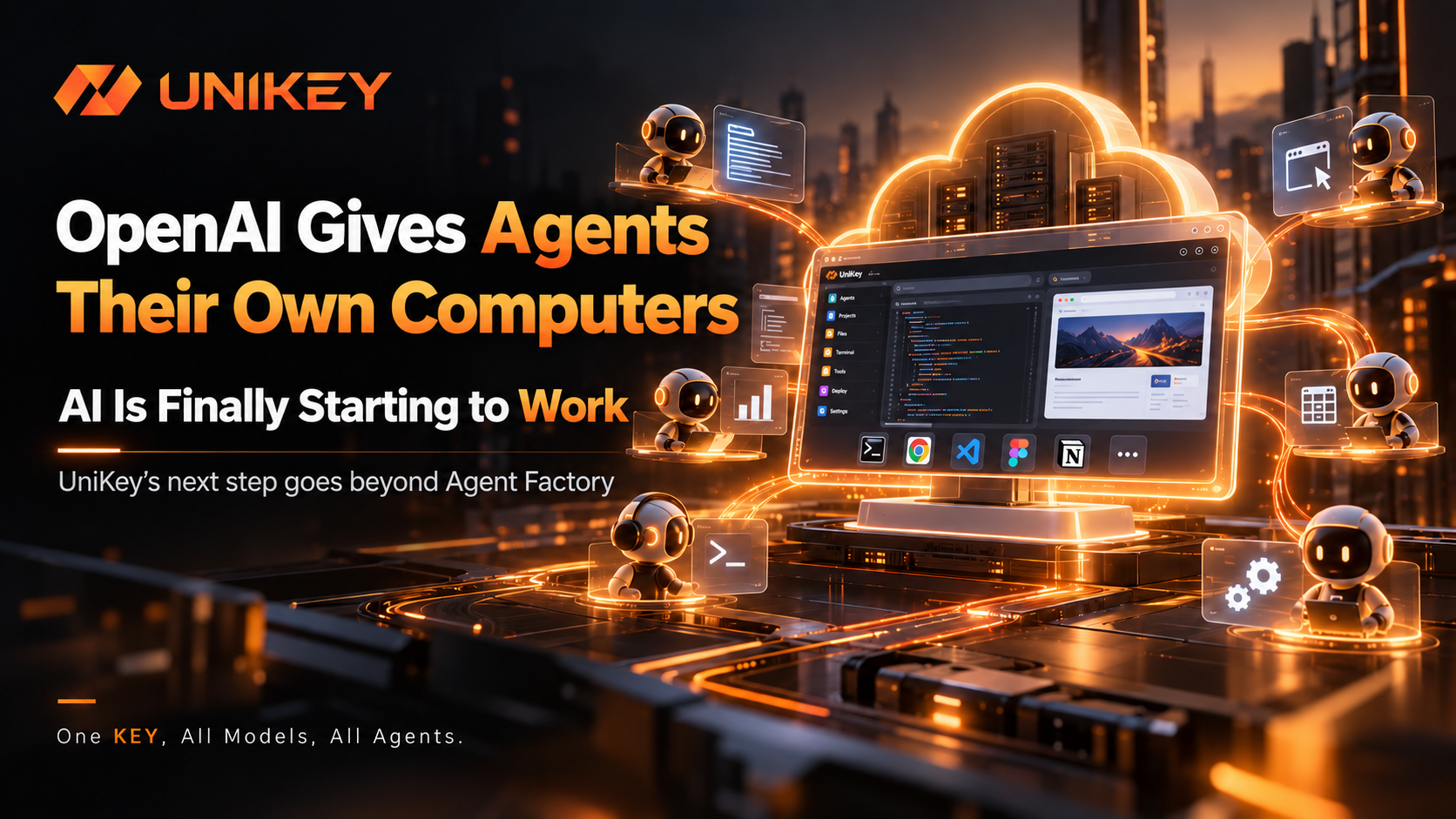
At DevDay 2026 on September 29, OpenAI pushed the Agent paradigm significantly further. The most important development was not simply another more powerful conversational model, but Dots—always-on Agents designed to take ongoing responsibility for work. Each Dot has its own cloud computer and browser, can connect to external tools, continue making progress after the user leaves the conversation, follow up through ChatGPT, email, Slack, and other channels, and delegate complex work to sub-agents. At the same time, OpenAI expanded Codex Cloud with reusable cloud environments that allow development tasks to continue across devices.
At first glance, this may look like OpenAI simply “gave an Agent a computer.” In reality, it represents a critical breakthrough for the Agent industry: AI is beginning to have its own persistent working environment. Models already had intelligence, but they lacked a place to keep working. Agents could reason, but they often existed only within the boundaries of a single session. Now models, browsers, files, tools, code environments, long-term context, and task state are beginning to operate inside one persistent execution system. AI is moving from “ask once, execute once” toward “assign a responsibility, and let the Agent keep working.”
The Real Breakthrough Is Not That GPT Became Smarter — It Is That Agents Now Have a Workplace
For the last two years, most AI competition has centered on models: higher benchmark scores, stronger reasoning, larger context windows, and better multimodal performance. But once Agents enter real enterprise workflows, it becomes clear that intelligence alone is not enough. Even the smartest model still behaves more like an advanced answering system if its state disappears after every task, if it cannot continuously access files and tools, and if it cannot continue working in the background.
OpenAI’s Agents API, introduced earlier this month, made this shift explicit. The API exposes the execution harness behind Codex, including context management, tool usage, sub-agent coordination, and infrastructure capable of keeping Agents running reliably for days. Dots then take that architecture one step further by giving Agents their own cloud computers and browsers. The competitive frontier is therefore moving beyond “Who has the smartest model?” toward “Who can combine intelligence, environment, tools, memory, and persistent execution into one working system?”
The Unit of AI Interaction Is Changing: From a Prompt to an Ongoing Responsibility
The deeper significance of this shift is that the relationship between humans and AI is beginning to change. Traditionally, using ChatGPT meant creating individual requests: write an article, analyze a file, research a topic. Even highly capable models still depended on users to trigger the next action. Once an Agent has its own working environment and can continue operating in the background, the unit of interaction changes from a single request to a persistent objective.
A market intelligence Agent, for example, does not need to produce only one competitor report. It can continuously monitor competitors, process new information, update its analysis, and return to a human only when judgment is required. A development Agent can continue maintaining code, running tests, and resolving issues in the cloud without requiring a laptop to remain online. OpenAI’s latest Codex Cloud direction reinforces this model: tasks can continue inside isolated cloud workspaces even when the user’s computer is asleep.
This suggests that the most important AI metric of the future may no longer be how many questions users ask every day. It may become how many Agents are continuously taking responsibility, executing tasks, and consuming external capabilities. Once Agents move from occasional tools to persistent digital labor, the economics of AI changes with them.
This Is the Real Next Step for UniKey Agent Factory
UniKey has already introduced Agent Factory, Knowledge Base, Skills Management, and Workflow Orchestration. Until now, this architecture could be explained primarily as a way to create Agents: models provide reasoning, Knowledge Base provides proprietary context, Skills provide tools, and Workflow determines how actions are executed. OpenAI’s latest breakthrough reveals the next layer: Agent Factory eventually needs to solve not only how an Agent is created, but how an Agent continues to work over time.
Seen from this perspective, UniKey’s product stack becomes more complete. AI Gateway connects global models and multimodal intelligence. AI Router chooses and schedules the appropriate intelligence for each task. Knowledge Base gives an Agent business-specific context. Skills provide specialized capabilities. Workflow organizes continuous execution. Agent Factory combines everything into a working digital unit. The next evolution naturally includes persistent tasks, state management, permissions, budgets, and execution environments. An Agent is not simply something that is created. It is something that must be continuously operated.
This is also where UniKey can differentiate itself from a single-model company. OpenAI can build Agents around GPT, Codex, and its own cloud infrastructure. Google and Anthropic will build their own integrated Agent ecosystems as well. But enterprises and developers are unlikely to rely on only one intelligence provider forever. A single Agent might use GPT for deep reasoning, Claude for long-document work, Gemini for multimodal understanding, and third-party search, video, data, or specialized Skills for other steps. UniKey’s opportunity is to become a neutral connection and orchestration layer across those capabilities.
Once an Agent Has Its Own Computer, It Will Also Need Its Own Budget
As soon as Agents begin working continuously, another question appears: who manages their spending? A persistent Agent may call models dozens of times per day, use search, image and video generation, databases, external APIs, and even other Agents. If every service requires a human to log in, recharge an account, approve payment, and manage a separate balance, then the Agent is not truly autonomous.
Giving an Agent a cloud computer solves the question of where it works. The next phase must solve how it purchases capabilities, manages budgets, and records costs. This is where UniKey’s AI Credits + KEY + Settlement Network becomes increasingly relevant. AI Credits can provide unified metering across models, Skills, Agents, Workflows, images, videos, and APIs, while KEY can connect broader ecosystem value and service settlement.
This also explains the importance of UniKey’s newer narrative as a global intelligent productivity market and settlement network. In the future, the platform may not serve only humans consuming AI. Increasingly, Agents themselves may become AI consumers. Humans assign objectives to Agents; Agents then autonomously acquire models, Skills, data, and other intelligent services to complete those objectives.
From Agent Factory to the Agent Economy, the Missing Layer Is a Global Intelligent Services Network
OpenAI Dots represent an important endpoint: every person may eventually have one or more persistent Agents. But if the future contains millions—or hundreds of millions—of continuously working Agents, those Agents cannot all depend on a single closed capability stack. They will constantly search for better models, lower-cost inference, more specialized Skills, more reliable data, and other Agents capable of helping them complete tasks.
The AI world will increasingly resemble the internet and cloud computing. Model companies produce intelligence. Skill developers produce specialized capabilities. Agent builders create digital labor. Enterprises provide data and business scenarios. Between all of them, a network is required so that those capabilities can be discovered, called, combined, exchanged, and settled. UniKey’s AI Gateway + AI Router + Agent Factory + Skill / Agent Market + AI Credits + Settlement Network is designed around exactly this layer.
That means UniKey’s next story should not simply be, “We also have an Agent Factory.” The bigger story is: as the world begins producing millions of Agents, UniKey aims to become the network through which those Agents access global intelligent services. Agents can discover models, call Skills, execute Workflows, purchase services, and record intelligent consumption and value distribution through a unified system.
OpenAI Gave Agents a Computer. The Next Competition Is About Who Gives Agents the World.
The most important message from OpenAI’s latest Agent push is not a single feature. It is that the shape of a true digital worker is becoming visible. It has its own working environment. It can stay online. It can use browsers and software. It can call tools. It can delegate tasks to other Agents. And it can continue working even after the human user has stepped away.
But a computer is only the beginning. A working Agent also needs models, knowledge, Skills, Workflows, data, APIs, budgets, payments, and settlement. Once these pieces are connected, we are no longer talking about a single AI application. We are talking about the foundations of a new digital labor economy.
That is the position UniKey’s new narrative can increasingly occupy:
OpenAI is giving Agents their own computers.
UniKey aims to give Agents access to the entire world of global intelligence.
One KEY, All Models, All Agents.


All Comments