

For years, market-making profits and high-frequency arbitrage opportunities in the crypto market have been concentrated among centralized market makers (CMMs) with proprietary strategies, expensive hardware, and exclusive access to computing power. Ordinary developers and retail investors, constrained by limited capital and high technical barriers, have struggled to access the revenue streams generated by advanced financial infrastructure. The industry research report Autonomous AI Agents as Liquidity Providers predicts that, driven by the rapid development of Web3 intent-centric architecture and decentralized physical infrastructure networks (DePIN), autonomous AI agents will help bring market-making technology out of Wall Street’s institutional black boxes and into decentralized networks accessible to a broader community.
As a pioneer in this transformation, the decentralized market-making protocol DMDAI has officially launched its distributed AI hash power network for collaborative market making. Its goal is to break down both capital and technological barriers, enabling ordinary community participants to access professional-grade market-making strategies and share in the potential benefits of Web4.0 intelligent finance.
I. Hash Power Allocation: Making Professional Market Making Accessible to Everyone
DMDAI introduces an innovative subscription mechanism based on AI hash power allocations, transforming sophisticated quantitative hedging strategies into standardized intelligent computing services accessible to a wider audience. Users do not need advanced quantitative programming skills or expensive high-frequency trading equipment. By subscribing to intelligent hash power allocations, they can connect their assets to a global decentralized AI strategy network.
Once activated, distributed AI agents operate around the clock, automatically executing on-chain order book mapping, millisecond-level cross-chain arbitrage, and automated risk hedging. Throughout this process, ownership of users’ assets remains with their personal on-chain wallets. This model aims to combine greater control over assets with zero-code access, allowing users to participate in the potential returns generated by a global professional market-making network.
II. Systematic Treasury Risk Management: Building a Strong Foundation Through a 20/80 Allocation Model
To help the distributed hash power network operate reliably during extreme market volatility and black swan events, DMDAI has established a structured treasury allocation and security framework. The USDC funds committed by users to hash power allocations are directed 100% back into the liquidity pool, where they support market-making depth and provide a capital foundation for managing market volatility.
Treasury earnings follow a defined allocation principle: “20% Value Mapping + 80% Risk Reserves.”
- 20% Value Mapping: Transparently mapped on-chain to support community governance nodes, network-wide consensus incentives, and long-term ecosystem development.
- 80% Risk Reserves: Retained over the long term in an on-chain multisignature treasury as a system-level security buffer. During severe market volatility or sharp one-sided declines, the system is designed to activate cross-hedging and protective circuit breakers to help safeguard user assets.

III. Rule-Based Deflation and a Closed-Loop Ecosystem: Building a Sustainable Growth Flywheel
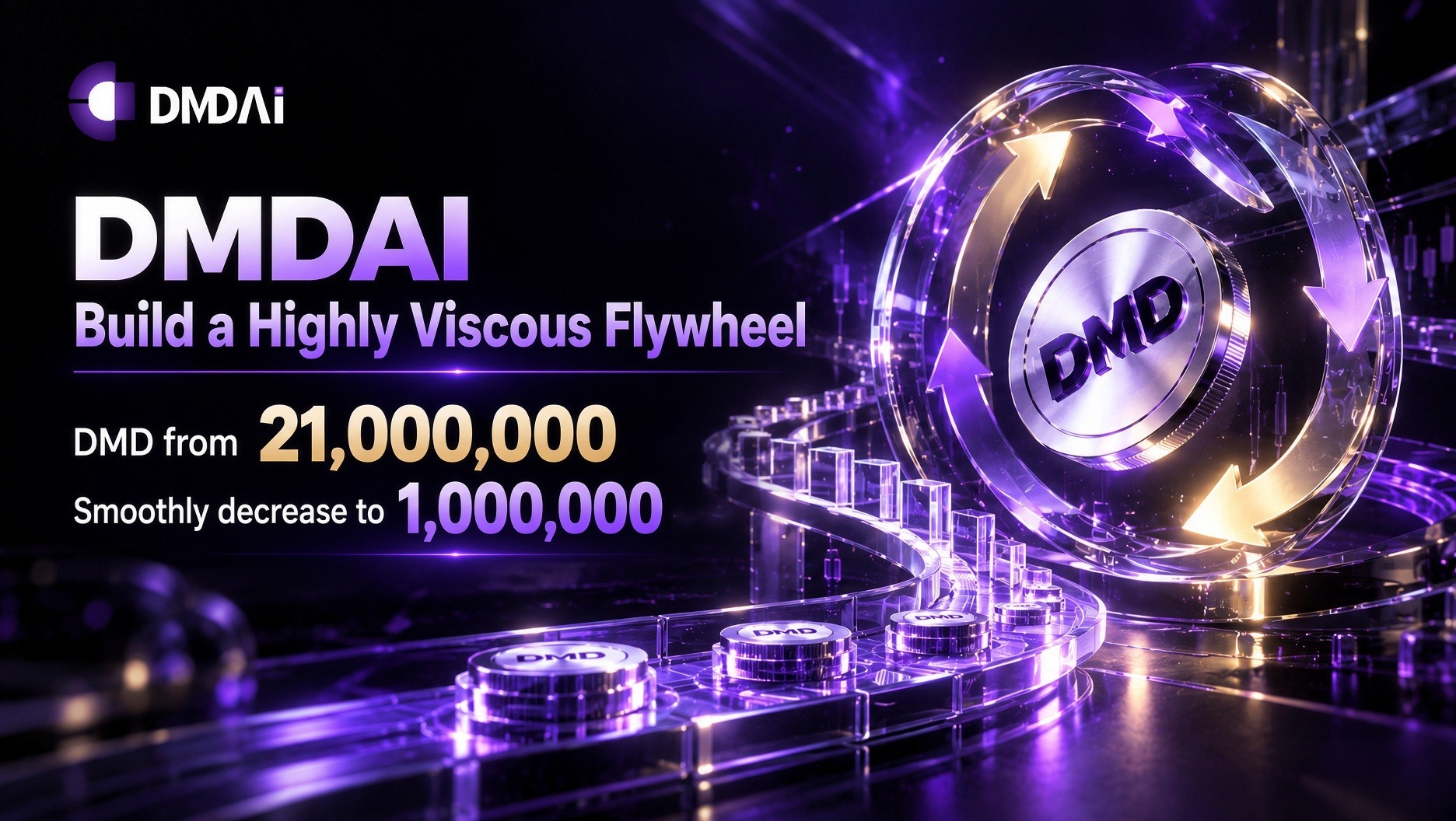
Under its tokenomics and circulation model, DMDAI’s governance token, DMD, follows a clearly defined, rule-based deflationary roadmap, with its total supply designed to decrease progressively from 21,000,000 tokens to an extremely scarce 1,000,000 tokens. The core liquidity pool implements an automated daily burn mechanism of 0.5%. As market trading activity increases, the token-supply contraction and value-convergence effects are designed to become more pronounced.
The ecosystem also incorporates an intelligent yield vault (Vault) and withdrawal protection rules. Any freeze tax deducted when users withdraw funds immediately or terminate their hash power allocations is 100% retained within the ecosystem, supporting automatic compounding, community profit sharing, and the ecosystem fund. This design aims to mitigate potential selling pressure and redirect it into buying support for the liquidity pool, creating a sustainable, self-reinforcing internal economic cycle.
IV. D1–D9 Matrix and Global Community Studio Collaboration
To build a highly engaged and sustainable global community, DMDAI has designed a D1–D9 tiered quantitative matrix and a peer-level support mechanism. These mechanisms aim to limit speculative excesses while strengthening coordination across the ecosystem. Combined with a global Community Studio support program, DMDAI seeks to turn the benefits of advanced intelligent computing into tangible momentum for local community development.
The DMDAI team stated: “DMDAI’s core mission is to bring the Web4.0 vision to life. Through a distributed intelligent computing network, we are transforming advanced market-making tools once accessible primarily to Wall Street institutions into decentralized financial infrastructure designed for broader participation. As our new platform, dmdai.net, becomes fully operational, we will continue to deepen collaboration with leading global infrastructure providers and work toward our vision of enabling ordinary people to take control of digital market-making opportunities.”


All Comments