

The prospect of another altcoin exchange-traded fund (ETF) in the United States could depend on political changes following the upcoming 2024 U.S. presidential election.
This is despite the U.S. Securities and Exchange Commission (SEC) giving the green light for fund managers to list spot Ether ETFs on May 23.
Although SEC Chair Gary Gensler admitted that “it will take time” until the Ether ETFs are launched, speculation about the next crypto ETF has already begun, with Solana’s emerging as a top contender.
Despite the enthusiasm for more crypto ETFs, Ophelia Snyder, co-founder and president of 21.co — a sponsor and subadviser for ARK Invest’s spot Ether ETF — told Cointelegraph that expectations for new altcoin ETFs shouldn’t be too high.
“It’s unlikely that the approval of ETH will result in a large wave of approvals.”
However, as the spot Bitcoin and Ether ETFs demonstrated, high demand from institutional investors for altcoin ETFs could compel ETF issuers to file applications.
In an April report, CoinShares — an alternative asset manager specializing in digital assets — found that hedge funds and wealth managers have significantly increased their altcoin holdings, specifically Solana.
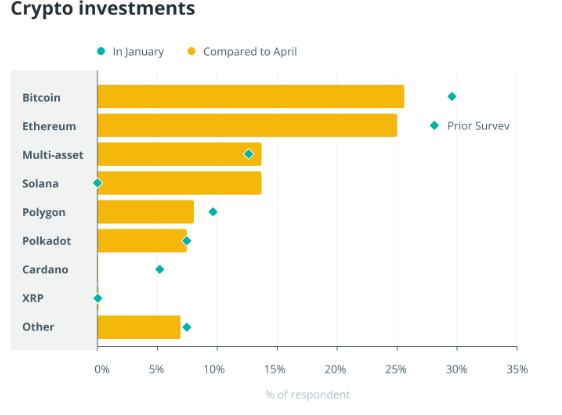
Snyder highlighted the significant interest in 21.co’s Solana exchange traded-product (ETP) on European exchanges, stating that it has nearly $990 million in assets under management.
The SEC has not shown any signs of embracing other cryptocurrencies for future ETFs. Approving spot Ether ETFs was already a hard pill to swallow for the commission.
An altcoin ETF may be even more difficult for the SEC to accept; however, a number of different factors could change that.
U.S. elections could be a catalyzer for altcoin ETF approvals
Spot Bitcoin, Ether and altcoin ETFs exist worldwide. However, U.S. regulators are more restrictive. Snyder remarked that foreign altcoin ETFs do not matter to the SEC, as “U.S. regulators have a tendency not to rely on foreign regulators.”
Bloomberg ETF analyst Eric Balchunas explained to Cointelegraph that the SEC follows a specific timeline for approving ETFs, and if it were to follow it again, it could take years for another altcoin ETF to receive a green light from the agency.
One key element that allowed the SEC to investigate market integrity was utilizing Chicago Mercantile Exchange (CME) data to compare correlation with spot prices on spot exchanges such as Coinbase and Kraken. “The analysis used a 32-month sample, which required significant tenure of the asset on CME,” crypto data firm CCData research lead Joshua de Vos explained to Cointelegraph.
Snyder highlighted the significant interest in 21.co’s Solana exchange traded-product (ETP) on European exchanges, stating that it has nearly $990 million in assets under management.
The SEC has not shown any signs of embracing other cryptocurrencies for future ETFs. Approving spot Ether ETFs was already a hard pill to swallow for the commission.
An altcoin ETF may be even more difficult for the SEC to accept; however, a number of different factors could change that.
U.S. elections could be a catalyzer for altcoin ETF approvals
Spot Bitcoin, Ether and altcoin ETFs exist worldwide. However, U.S. regulators are more restrictive. Snyder remarked that foreign altcoin ETFs do not matter to the SEC, as “U.S. regulators have a tendency not to rely on foreign regulators.”
Bloomberg ETF analyst Eric Balchunas explained to Cointelegraph that the SEC follows a specific timeline for approving ETFs, and if it were to follow it again, it could take years for another altcoin ETF to receive a green light from the agency.
One key element that allowed the SEC to investigate market integrity was utilizing Chicago Mercantile Exchange (CME) data to compare correlation with spot prices on spot exchanges such as Coinbase and Kraken. “The analysis used a 32-month sample, which required significant tenure of the asset on CME,” crypto data firm CCData research lead Joshua de Vos explained to Cointelegraph.
No futures altcoin ETFs have yet been listed in the U.S., suggesting a long wait before the U.S. market might see a spot altcoin ETF. However, Balchunas said, “there’s a huge variable here, which is the U.S. election.”
The approaching U.S. elections on Nov. 5, 2024, could be critical for the future of altcoin ETFs, with U.S. crypto regulation becoming a political topic. Donald Trump introduced himself as a pro-crypto candidate in reaction to President Joe Biden’s somewhat anti-crypto stance toward U.S. crypto regulation.
The results could radically change the course for altcoin ETFs. Balchunas noted:
“If Trump wins, we could see other coins as ETFs, in my opinion.”
Balchunas added that if Trump were victorious, he could go “really liberal on crypto and support it with everything,” as he has pledged. In that case, Balchunas said Trump could put in place “a new SEC commissioner who doesn’t care” about the process followed by the SEC in the last few years, where having futures data was a vital part of spot ETF approval process.
Additionally, Balchunas believes that Trump’s victory could prompt ETF issuers to apply for new crypto ETFs en masse: “If Trump wins, I suspect people will test the waters and try all kinds of stuff [ETFs].”
On the other hand, Balchunas believes that “if Democrats keep on power, it’s unlikely there’ll be an altcoin ETF,” even if Biden removes Gensler and appoints another Democrat as SEC chair.
The prospects of an altcoin ETF in the U.S. seem highly correlated to the results of the approaching presidential election, and the possibility of an altcoin ETF in 2024 is slim, as the elected president would take office in January 2025.
Aside from the upcoming U.S. elections, some specific requirements are generally expected to be met to obtain approval for an ETF: It must offer healthy levels of liquidity, decentralization, resistance to price manipulation and, if possible, a precise classification from regulatory agencies. Are altcoins ready to meet these conditions?
Price manipulation in altcoin markets
The market cap of Bitcoin and Ether is substantially larger than that of other altcoins. As Balchunas remarked, this is a concern for ETFs, as “the smaller the market gets, the bigger the chance for price manipulation.”
With the current status, “the altcoin market is prone to market manipulation as the markets are still very nascent,” CCData’s de Vos concluded.
However, price manipulation may not be as strong of an impediment as some would think.
De Vos noted that spot Bitcoin ETFs were rejected many times in the past due to concerns surrounding market manipulation before the SEC finally “reluctantly approved” them. Balchunas said that ETFs could handle some price manipulation:
“Just because there’s a little price manipulation or the price moves and swings a lot, doesn’t mean you cannot have an ETF.”
For example, he said that a couple of active ETFs have GameStop as their biggest holding and that, although there has certainly been GameStop stock price manipulation, the ETFs are still active.
Can ETFs back a crypto asset with low liquidity?
Another issue is that altcoin markets lack liquidity due to their lower volume than Bitcoin or Ether.
Sebastian Heine, chief risk and compliance officer of institutional staking partner Northstake, told Cointelegraph that he believes an altcoin needs a large market cap and significant daily trading volume to justify an ETF.
However, Balchunas explained how an ETF can exist without much liquidity. He noted the existence of junk bond ETFs, where even “the biggest ones don’t even trade every day.” Therefore, if junk bond ETFs exist, why not an altcoin ETF?
Although ETFs with low liquidity may exist, this factor can represent a problem.
Balchunas explained that the main issue in a market with low liquidity is the appearance of premiums and discounts. This is not beneficial for the ETF, as it may offer a different price than the actual asset. At this point, market makers could help to avoid these arbitrage gaps.
Alexis Sirkia, the founder and former CEO of market maker GSR, told Cointelegraph that market makers shouldn’t have any difficulties ensuring liquidity in the most mature altcoin markets, such as Solana.
Additionally, the appearance of an ETF would “attract market makers from other markets, leading to an overall improvement in liquidity and the market.”
In the case of altcoins with smaller markets, lower liquidity metrics could be insufficient for a unique ETF. Therefore, a basket of altcoins could be an option.
Justin d’Anethan, head of business development at market maker Keyrock, believes they’ll have to batch multiple altcoins to have one sustainable ETF. He believes there could be an “Ethereum layer-2 ETF or maybe even a memecoins ETF” in the future.
However, investors don’t seem to favor altcoin baskets. Snyder said that 21.co has detected “more demand for single asset trackers” than for altcoin baskets on offer. Additionally, she explained that an ETF with a basket of altcoins is unlikely as ETF wrappers in the U.S. will likely require “additional regulatory engagement.”
Is a Solana ETF likely?
Snyder said that Solana is the leading contender for the next altcoin ETF, as it has the highest market capitalization compared to other altcoins. However, Solana has an issue with centralization.
De Vos explained that the scoring metrics used for their crypto ESG Benchmark index evaluated decentralized metrics, including the percentage of coins in the top 10 Solana wallets, the Nakamoto coefficient and the type of governance system.
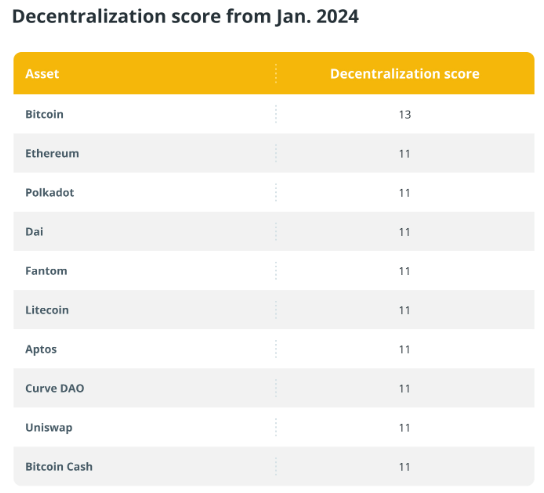
Solana doesn’t break the top 10 in CCData’s rankings for decentralization.
De Vos said that the top 10 Solana holders hold 7.29% of the supply and play an essential role in price action.
The high concentration of wealth among a small number of wallets is not solely an issue for Solana; it’s a common problem for altcoins. Data from CCData showed that the top 10 wallets own 5.58% of XRP , 4.88% of Stellar Lumens and 3.90% of Chainlink’s.
Basel Ismail, the CEO of investment analytics company Blockcircle, told Cointelegraph that Solana enterprise validators receive the most support from a small group, which, if they colluded, could manipulate the network.
Ismail also noted that Solana has previously suffered several outages that halted trading without any indication of when the blockchain would come back online. He said this issue must be solved before any ETF could be considered.
If current regulators are not changed after the upcoming elections, a spot Solana ETF will face significant barriers. The SEC has directly labeled Solana as a security, “which makes it very unlikely for a spot ETF to be approved until clarity arises on their treatment,” said de Vos.
Solana has the market cap and volume to justify an ETF, but — like other altcoins — it may need to improve its fundamentals to overcome current U.S. regulatory requirements and become a viable ETF option.


All Comments