

Cointime

Download App
iOS & Android

Trump’s trade war pressures crypto market as April 2 tariffs loom

Validated Media

Concerns over a global trade war continue to pressure traditional and cryptocurrency markets as investors brace for a potential tariff announcement from US President Donald Trump on April 2 — a move that could set the tone for Bitcoin’s price trajectory throughout the month.

Trump first announced import tariffs on Chinese goods on Jan. 20, the day of his inauguration as president.

Global tariff fears have led to heightened inflation concerns, limiting appetite for risk assets among investors. Bitcoin has fallen 18%, and the S&P 500 (SPX) index has fallen more than 7% in the two months following the initial tariff announcement, according to TradingView data,TradingViewdata shows.

“Going forward, April 2 is drawing increased attention as a potential flashpoint for fresh US tariff announcements,” Stella Zlatareva, dispatch editor at digital asset investment platform Nexo, told Cointelegraph.

  Investor sentiment took another hit on March 29 after Trump pressed his senior advisers to take a more aggressive stance on import tariffs, which may be seen as a potential escalation of the trade war, the Washington Post reported, citing four unnamed sources familiar with the matter.

The April 2 announcement is expected to detail reciprocal trade tariffs targeting top US trading partners. The measures aim to reduce the country’s estimated $1.2 trillion goods trade deficit and boost domestic manufacturing.

Bitcoin ETFs, whales continue accumulating

Despite mounting uncertainty, large Bitcoin holders — known as “whales,” with between 1,000 BTC and 10,000 BTC — have continued to accumulate.

Addresses in this category have remained steady since the beginning of 2025, from 1,956 addresses on Jan. 1 to over 1,990 addresses on March 27 — still below the previous cycle’s peak of 2,370 addresses recorded in February 2024, Glassnode data shows.

“Risk appetite remains muted amid tariff threats from President Trump and ongoing macro uncertainty,” according to Iliya Kalchev, dispatch analyst at Nexo, who told Cointelegraph:

“Still, BTC accumulation by whales and a 10-day ETF inflow streak point to steady institutional demand. But hawkish surprises — from inflation or trade — may keep crypto rangebound into April.”

The US spot Bitcoin exchange-traded funds halted their 10-day accumulation streak on March 28 when Fidelity’s ETF recorded over $93 million worth of outflows, while the other ETF issuers registered no inflows or outflows, Farside Investors data shows.
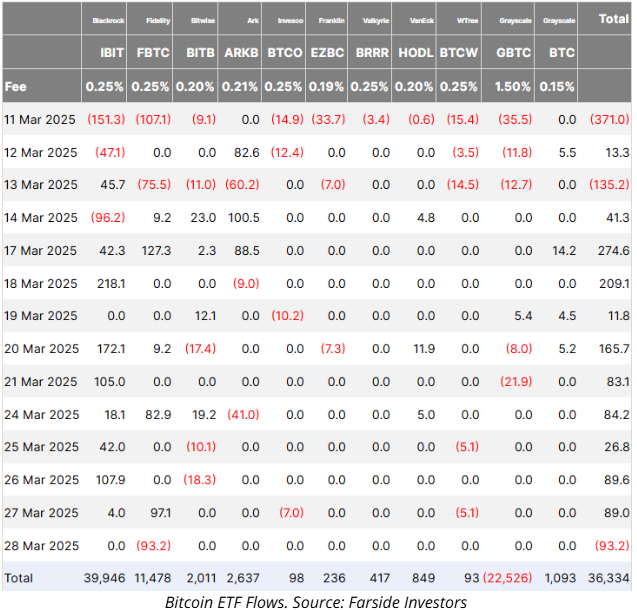
  Despite short-term volatility concerns, analysts remained optimistic about Bitcoin’s price trajectory for late 2025, with price predictions ranging from $160,000 to above $180,000.  

Comments

All Comments

Recommended for you

  • J.P. Morgan: Korean Leveraged ETF Unwinding Nears End

    On July 29, J.P. Morgan stated that the large-scale deleveraging experienced by the South Korean stock market since mid-June indicates that the unwinding of leveraged ETFs has largely been completed, with hedge funds having executed about 90% of the deleveraging process and leverage levels having fallen back to a more reasonable range. J.P. Morgan strategists, including Mixo Das, wrote in a report that, taken together, the current positioning in the South Korean stock market is quite attractive, with low valuations and strong earnings growth momentum. "With the market correction, the scale of such funds has now dropped to $17 billion," the report said, noting that the rapid inflow of funds into leveraged ETFs has notably slowed in recent days. However, the recent plunge in stock prices could still trigger further deleveraging in the coming days. At the same time, many investors remain cautious given the risk of a rate hike at the Federal Open Market Committee meeting and high expectations for upcoming earnings reports from mega-cap tech companies.

  • WTI Crude Oil Futures Up 5% at $83.219/bbl

    On July 29, WTI crude oil futures rose 5% to $83.219 per barrel; Brent crude oil futures rose 4.69% to $85.933 per barrel.

  • Insider: Strait of Hormuz Remains Fully Closed

    On July 29, according to Iranian media Fars News, a military insider stated that the Strait of Hormuz remains completely closed, and no vessel has the right to pass through this strategic waterway. Any vessel attempting to pass, especially those ignoring warnings, will face a decisive and swift response.

  • Semiconductor foundry GlobalFoundries' US stock rises over 16% pre-market

    On July 29, semiconductor foundry GlobalFoundries' US stock rose over 16% pre-market. The U.S. government previously announced that GlobalFoundries would receive up to $300 million in funding.

  • US Plans $874 Million for Semiconductor R&D, GlobalFoundries to Receive up to $300 Million

    On July 29, the United States announced a letter of intent for semiconductor R&D investment totaling $874 million to further strengthen domestic chip technology research and development capabilities. At the same time, the U.S. announced that wafer foundry company GlobalFoundries will receive up to $300 million in government funding to support its semiconductor R&D and advanced manufacturing capacity building. (Jin Shi)

  • Zelensky: U.S. Envoy May Visit Kyiv Within Next Two Weeks

    On July 29, according to AXIOS, Ukrainian President Zelensky asked Trump to provide 300 Patriot interceptors before winter. Zelensky said that the U.S. envoy may visit Kyiv within the next two weeks.

  • Korean 'Oracle' Broker Strikes Again, Cuts SK Hynix Target Price to 1.48 Million Won

    On July 29, the Korea Composite Stock Price Index (KOSPI) closed at 5,663 points, while SK Hynix closed at 1.401 million won. It is reported that BNK Investment & Securities, a local brokerage that had precisely predicted the subsequent plunge in the KOSPI by cutting SK Hynix's target price to 1.85 million won (when Hynix was trading at 2.329 million won) on July 8, when the KOSPI was at a high of 7,700 points, has once again sharply lowered its target price for SK Hynix to 1.48 million won. Notably, in the South Korean securities industry, brokerages rarely issue explicit 'sell' ratings, so lowering the target price effectively serves as a de facto sell recommendation. In a research report on SK Hynix released today, BNK Investment & Securities stated that SK Hynix is currently in a state of oversold short-term, but the rebound potential is limited due to sustained demand slowdown. The report pointed out: 1) SK Hynix's earnings have fallen short of expectations for two consecutive quarters; 2) Despite demand momentum peaking, companies are still pursuing competitive capacity expansion: although demand growth is slowing, chip manufacturers, based on long-term optimistic demand forecasts, have been successively announcing large-scale new construction and expansion investments, leading to heightened concerns about a future supply-demand surplus inflection. Moreover, at a time when the domestic industry cycle is peaking, the successful IPO of China's ChangXin Memory Technologies (CXMT) is negatively impacting the market from the perspective of intensified competition. The brokerage noted that reflecting the slowdown in demand momentum, the company's stock price has plummeted to the lower end of its valuation range and is currently in an oversold state in the short term. However, considering that the competitive expansion attitude among companies is unlikely to change in the short term, and the demand slowdown trend is expected to persist in the second half of the year, the rebound in stock price is expected to be limited. BNK maintained a 'hold' investment rating and lowered the target price from 1.85 million won to 1.48 million won (applying 26E P/B 3.1x).

  • Houthis Consider Fees on Ships Passing Through Red Sea, Sources Say

    On July 29, according to Reuters citing sources, Yemen’s Houthi movement is considering imposing fees on commercial ships passing through the southern Red Sea. The Houthis declared a maritime embargo against Saudi Arabia on July 20, opening a new front against the United States and its allies and expanding attacks on tankers carrying global energy and other goods to waters beyond the Gulf. Sources said the Houthis are studying the imposition of fees on most vessels passing through the Bab el-Mandeb Strait, though the timing of such measures has not yet been determined. The Houthi media office has not yet responded. Sources indicated that the move aims to normalize the practice of charging for passage through international waterways and increase pressure on the United States. (Jin Shi)

  • South Korea Plans to Restrict Single-Stock Leveraged Products: Only Professional Investors or Lower Leverage from 2x

    July 29, according to the Chosun Ilbo, South Korea's Financial Services Commission (FSC) Chairman Lee Eog-weon stated that for 'single-stock leveraged products,' which have been identified as one of the triggers for sharp fluctuations in the domestic stock market, the authorities will consider restricting trading to professional investors when necessary. On the 29th, Lee Eog-weon attended a Government Affairs Committee business report in Seoul. In response to a question from a Democratic Party lawmaker who proposed that 'investment qualifications for single-stock leveraged products should be limited to professional investors,' he replied, 'If it is indeed necessary, there is a plan to raise the investment threshold to professional investors.' Professional investors are defined as those who have maintained an average month-end balance of 50 million won or more in financial investment products for at least one year within the past five years, while also meeting related requirements for income, professional qualifications, and assets. This statement is interpreted as an official hint that, given the high-risk nature of single-stock leveraged products, authorities may consider restricting access for ordinary retail investors. Regarding the plan to lower the leverage multiple of single-stock leveraged products, Lee also said that once the National Assembly prepares the relevant legislation, the authorities will review it. He stated, 'Since the tracking multiple of 2x is indeed too large, lowering it is expected to be effective in alleviating market volatility.'

  • South Korea's Top Financial Regulator Apologizes Over Leveraged ETF Controversy, Vows to Restore Market Trust

    On July 29, the head of South Korea's primary financial regulatory body publicly apologized over a controversy surrounding single-stock leveraged exchange-traded funds (ETFs). Earlier, some investors and market participants argued that such products had exacerbated market volatility and led to significant losses in investor wealth. Lee Bok-hyun, Chairman of the Financial Services Commission, expressed regret that the regulator had failed to meet public trust in multiple aspects. Lee Chan-jin, head of the Financial Supervisory Service, stated that regulators are doing their utmost to restore market trust.
