

With the rapid evolution of global AI infrastructure and the explosive growth of quantitative trading strategies, traditional crypto market-making models and liquidity provision structures are undergoing a profound transformation. To embrace this new era of deep integration between technology and finance, the decentralized market-making protocol has officially announced a comprehensive strategic restructuring and brand transformation, with DMDAO completing a cross-era transition and officially entering the DMDAI era.
This strategic upgrade represents far more than a refreshed brand identity—it marks a comprehensive evolution of the underlying logic and algorithmic architecture. Through a three-dimensional framework of “AI intelligent computing orchestration + real-asset anchoring + scientific treasury risk management,” DMDAI aims to build a highly efficient, accessible, and resilient decentralized intelligent market-making network for the Web4.0 era.
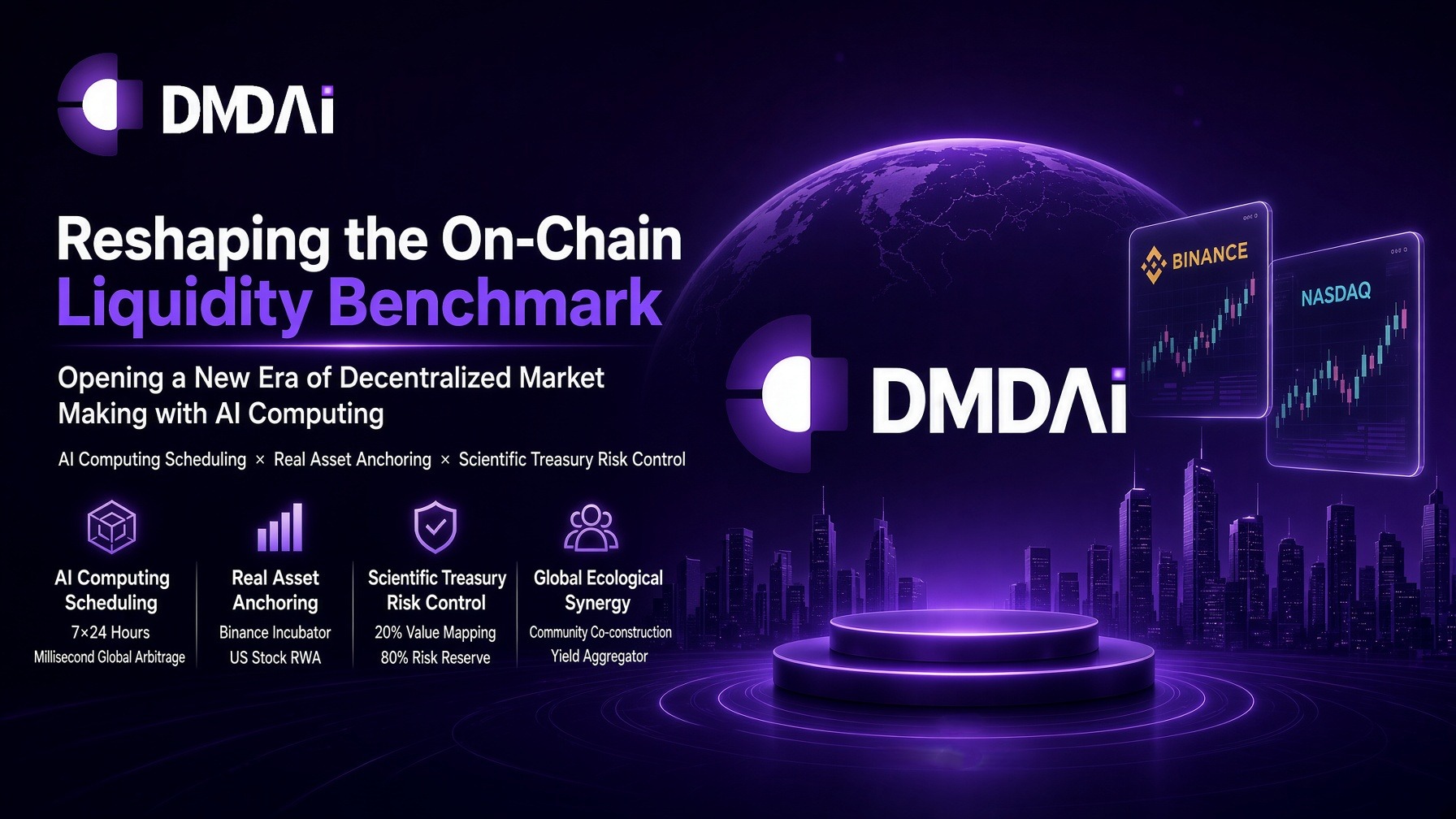
AI Intelligent Computing Orchestration: Capturing Global Price Spreads in Milliseconds
In traditional crypto markets, market makers typically rely on the proprietary computing power and private strategies of centralized institutions, making it difficult for ordinary users to access market-making-level liquidity benefits. DMDAI introduces a decentralized AI intelligent strategy engine that dynamically orchestrates distributed TOPS computing capacity, enabling 24/7 monitoring of market data and algorithmic hedging at millisecond-level precision.
The system can adaptively adjust order-book depth and liquidity distribution according to market volatility, significantly improving capital efficiency while providing on-chain markets with continuous, optimized price depth and order-book capacity.
Real-Asset Anchoring: Strengthening the Foundation and Creating a Cash-Flow Cycle
Unlike purely conceptual projects lacking fundamental value support, DMDAI anchors its market-making assets in Binance core blue-chip assets and stock-based RWA (Real-World Assets).
By deeply integrating highly liquid blue-chip assets with real-world assets, DMDAI injects sustainable real market-making cash flow into the protocol. This combination of “real assets + quantitative market making” not only reduces systemic risk arising from the volatility of individual crypto assets, but also establishes a solid value foundation for the long-term and stable operation of the ecosystem.
Scientific Treasury Risk Management: An 80% Risk Reserve Builds a Robust Security Layer
To safeguard system stability under extreme market conditions, DMDAI has established a rigorous capital-flow and treasury risk-management framework. 100% of users’ USDC funds allocated to hash power are strictly routed back into the liquidity pool, directly converting them into market-making depth and strengthening the protocol’s resilience.
At the same time, treasury proceeds follow a disciplined “20% value mapping + 80% risk reserve” allocation model:
- 20% Value Mapping: Transparently mapped on-chain to support community governance nodes, ecosystem contributors, and network-wide consensus incentives;
- 80% Risk Reserve: Retained as a system-level security buffer. In the event of black-swan events or extreme market volatility, it can activate cross-hedging strategies and circuit-breaker protections to safeguard the protocol and user assets.
Deflationary Model and Global Ecosystem Synergy
In terms of tokenomics, DMDAI has established a clear deflationary roadmap, with the total supply of DMD gradually decreasing from 21 million to 1 million tokens. Through an automated 0.5% daily burn from the liquidity pool, combined with periodic treasury-funded buybacks, higher transaction velocity is designed to accelerate the convergence of the token’s deflationary supply.
Together with the D1–D9 tiered collaboration matrix and the global Community Studio support program, DMDAI is building a highly engaged and scalable global community ecosystem through a closed-loop model of “hash power allocation → intelligent market making → cash-flow distribution.”
Looking Ahead: Putting the Power of Digital Market-Making Whales in the Hands of the Masses
Aayush, Chief Marketing Officer (CMO) of DMDAI, stated:
“The birth of DMDAI represents a fundamental transition in on-chain liquidity provision—from a ‘capital-intensive’ model to an ‘AI computing-powered’ model. Our goal is to break the long-standing dominance of traditional institutions over market-making returns and leverage the power of AI algorithms to enable every ordinary contributor worldwide to participate in a professional-grade market-making network with a low barrier to entry and share in the intelligent financial opportunities of the Web4.0 era.”
As global intelligent computing nodes continue to come online and ecosystem partnerships deepen, DMDAI will continue expanding its presence across BNB Chain and other major public blockchains, driving the decentralized market-making sector toward a new stage of development.
About DMDAI
DMDAI is a decentralized intelligent market-making protocol powered by distributed AI computing. By combining an AI quantitative strategy engine, Binance blue-chip and RWA asset anchoring, and a scientific treasury risk-management framework, DMDAI aims to build transparent, efficient, and resilient on-chain liquidity infrastructure.


All Comments