

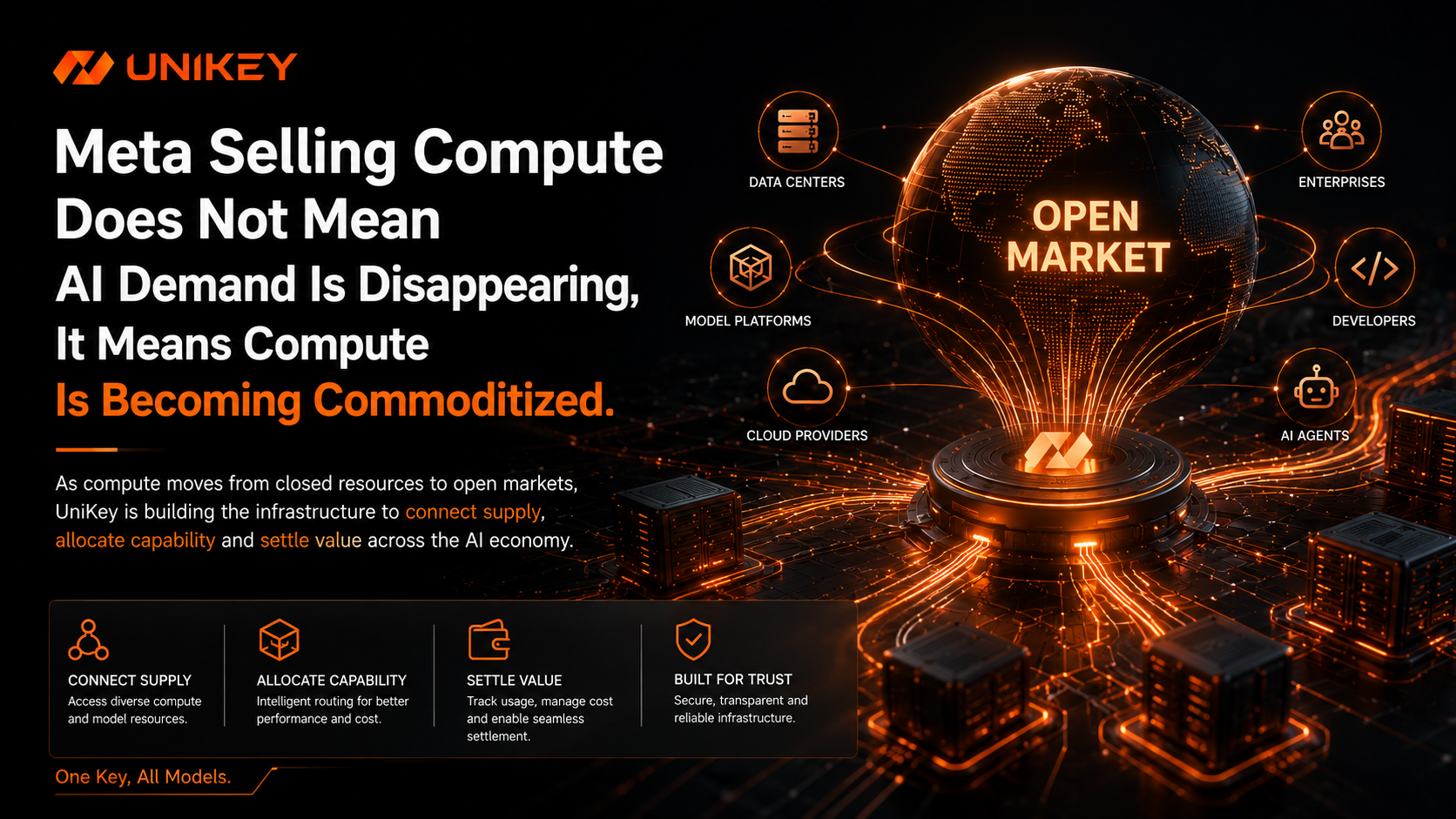
The Shift in the Compute Market Is Not the End of Demand, but a Rewrite of Supply Structure
According to media reports, Meta is planning a cloud infrastructure business and may provide AI model access or raw computing power to external customers in the future. Although this news has not yet been officially confirmed by Meta, the market has already reacted quickly. Meta’s stock price rose sharply, while storage companies such as Micron and SanDisk, as well as compute rental companies such as CoreWeave and Nebius, experienced significant pressure. The market reaction is not just about one company’s potential move. It reflects a broader repricing of the AI infrastructure logic.
Over the past two years, the main AI industry narrative has been very clear: large models drive rising demand for computing power, technology giants continue to expand capital expenditure, and GPUs, storage, data centers and cloud infrastructure become some of the most certain directions in capital markets. The market has long believed that AI compute would remain scarce, leading technology companies would continue buying more chips and building more data centers, and stronger models, more complex inference and more AI applications would keep driving hardware demand.
But when a super buyer of compute like Meta may also become a seller of compute, the market begins to rethink a deeper question: is computing power shifting from an internal strategic resource of technology giants into a standardized commodity that can be sold externally, dynamically allocated and traded on demand? If this trend is real, the competitive focus of AI infrastructure will change. The market will no longer care only about who owns more GPUs, but also about who can connect, route, use and settle these compute resources more efficiently.
From Compute Scarcity to Compute Commoditization, AI Infrastructure Is Entering Its Second Stage
In the first stage of the AI industry, the core constraint was compute scarcity. Model companies needed more training resources, cloud providers needed more inference capacity, enterprise users needed more stable AI services, and developers needed lower-friction model access. In this stage, whoever owned more GPUs, more data centers and stronger supply chain capacity held the infrastructure advantage. That is why capital markets rewarded chips, storage, cloud infrastructure and compute rental companies: they represented the most direct “pick-and-shovel” opportunity in the AI demand boom.
However, after more technology giants complete large-scale compute buildouts, the industry may enter a second stage. Computing power remains important, but it may no longer be an absolutely scarce resource. Instead, it begins to show the characteristics of a commodity. More supply options may emerge across cloud providers, data centers, model platforms and compute service providers. Price, availability, latency, region, model compatibility and service reliability will all become key selection factors. For enterprises and developers, the question will no longer only be whether compute exists, but where the most suitable compute is and how to access it with lower cost and higher efficiency.
This means the value center of AI infrastructure will gradually move from simple resource ownership to resource connection and resource orchestration. When compute is scarce, the market rewards those who own resources. When compute becomes commoditized, the market rewards those who can improve resource utilization. Whoever can connect more compute supply, intelligently route based on price, speed, stability and availability, help enterprises record every call, manage every cost and complete every settlement may occupy a more critical position in the next stage of AI infrastructure competition.
Meta’s Signal: Super Buyers May Also Become Super Sellers
If Meta truly begins offering AI model access or raw compute to external customers, its significance is not merely that Meta gains another revenue line. More importantly, it changes how the market understands AI compute supply and demand. In the past, companies such as Meta, Google, Microsoft, Amazon and OpenAI were mainly viewed as super buyers in the compute market. They bought chips, built data centers, trained models, deployed inference services and primarily used compute for internal products and ecosystem expansion.
But when super buyers gain the potential to sell compute externally, the compute market enters a new phase. Resources that were previously locked inside large technology companies may be packaged into cloud services, model access, inference capacity or raw computing resources and opened to enterprises, developers and more AI application builders. This means AI compute is no longer only a capital expenditure item on the balance sheets of technology giants. It may become a production factor that can be sold, allocated, combined and traded.
This does not mean AI demand is disappearing. On the contrary, it may show that AI demand is moving from internal buildout by giants toward market-based allocation. As more AI applications, AI Agents, enterprise workflows, automation tools and industry models emerge, demand will become more distributed, while supply will also move from a few closed resources to more open resources. The real question is not whether AI still needs compute. The real question is who can connect fragmented demand and fragmented supply more efficiently.
Once Compute Becomes Commoditized, the Market Needs More Than More Data Centers
If compute begins to commoditize, what the AI market truly needs will not simply be more data centers. Data centers still matter, GPUs still matter, and storage and networking still matter. But these are only foundational resources. For enterprises, developers and future AI Agents, the more important question is how to turn these resources into capabilities that are directly usable, flexibly switchable, cost-measurable and integrated into business systems.
When an enterprise uses AI, it is not simply buying a GPU. It needs to call different models, compare prices and speeds across different providers, control budgets across teams, record every API call, manage permissions for different Agents, evaluate the cost of each workflow and understand which tasks require high-performance models and which can run on lower-cost models. Developers also do not want to be locked into a single model or cloud provider. They want to access multiple models and compute resources through a unified interface and route flexibly based on actual needs.
In the future, the key questions in AI infrastructure competition will become: can it connect more compute supply? Can it improve resource utilization? Can it intelligently route based on price, speed and availability? Can it record every call and every cost? Can it complete settlement among enterprises, developers, service providers and AI Agents? In other words, when compute shifts from a closed resource to an open market, the scarce capability will no longer only be owning compute, but organizing compute, allocating compute, calling compute and settling compute.
UniKey’s Position: Not Building a Single Model, Not Betting on a Single Compute Provider
This is exactly UniKey’s strategic position. UniKey does not train foundation models, nor does it bet on a single cloud provider, hardware supplier or compute rental platform. In the trend of compute commoditization, single resources will become increasingly replaceable. What holds long-term value is connection capability, routing capability and settlement capability. UniKey aims to build the unified connection layer between compute supply and business demand.
Within UniKey’s product system, AI Gateway serves as the unified entry point and intelligent routing layer. It helps users, developers, enterprises and future AI Agents access different models, AI capabilities and compute resources through one unified entry. Whether the underlying provider is a model platform, cloud provider, inference service provider or future open compute supplier, the front-end user needs a simpler, more stable and more manageable experience, rather than repeatedly switching accounts, interfaces, prices and billing systems.
Skill Hub further turns raw compute and model capabilities into directly usable business capabilities. Compute itself is not the final product, and models themselves are not the final delivery. Real users need content generation, image creation, project copywriting, community operations, presentation design, video workflows, data analysis, customer service assistance, developer tools and automation processes. The value of Skill Hub is to package complex AI capabilities into Skills that can be called, reused and traded, turning AI from a resource into productivity.
Agent Settlement Layer: The Settlement Layer the AI Economy Truly Needs
As AI Agents begin to appear at scale, compute commoditization will bring another more important question: who will manage Agent calls, budgets, permissions and settlement? In the past, human users clicked buttons, purchased packages and manually called models, so settlement logic was relatively simple. In the future, AI Agents will automatically execute tasks, call models, use Skills, combine workflows and even call other Agents. Every Agent will consume AI Credits, every call will need to be recorded, and every task may involve cost allocation and service settlement.
Agent Settlement Layer is designed for this trend. It does not only solve payment. It addresses identity, permissions, budgets, calls, consumption, records and settlement throughout the operation of AI Agents. Enterprises need to know how much different Agents spend, which models they call, which Skills they use, what tasks they complete and what results they produce. Developers and service providers also need to know who called their Skills, how many times they were called, what costs were generated and how settlement is completed.
When compute is scarce, the routing network solves stable supply. When compute is abundant, the routing network solves price, efficiency and resource matching. When AI Agents become a new form of digital labor, the settlement network solves how intelligent agents use resources, consume quotas, record costs and complete value exchange. This is why UniKey does not stop at AI Gateway, but further builds Agent Settlement Layer.
Compute Is Moving from Cost to Asset, and from Asset to Market
If we place Meta’s potential compute-selling signal into a broader industry framework, it suggests that compute is undergoing an identity shift. At first, compute was a cost item for technology companies, used for training models, supporting products and internal research. Later, compute became a strategic asset, representing AI competitiveness, model capability and future product capacity. Now, compute may further become a market-based resource, entering external trading, on-demand calling and dynamic allocation.
Once compute becomes a market-based resource, the organizational structure of the entire AI industry will change. Enterprises will not necessarily need to build all infrastructure themselves. Developers will not necessarily need to bind themselves to a single model platform. AI Agents will not necessarily be limited to fixed providers. Different compute resources, models, Skills and workflows will be connected, routed, combined and settled like cloud services, payment services and financial liquidity. Whoever becomes the connection layer in this new network may control an important entry point in the era of AI commoditization.
This is why Meta selling compute should not be interpreted simply as AI demand peaking. It may instead mean that the AI industry is moving from the resource accumulation stage into the resource circulation stage. In the resource accumulation stage, the key question is who buys more, builds faster and secures chips. In the resource circulation stage, the key question becomes who connects more broadly, routes more accurately, improves usage efficiency and builds a clear settlement system. UniKey is focused precisely on this structural shift from resource ownership to resource circulation.
UniKey Is Building the Infrastructure for AI Capability Circulation
When compute begins to commoditize, the market needs more than more GPUs. It needs a network that can connect supply, distribute capability, record consumption and complete settlement. UniKey’s long-term value is not in becoming a replacement for any one model, nor in competing with any one cloud provider. Its value is in becoming the unified connection layer among different AI capabilities, allowing users, developers, enterprises and Agents to access global AI resources through one network.
Through AI Gateway, UniKey connects different models and compute supply. Through Skill Hub, UniKey packages model capabilities and compute resources into directly usable business capabilities. Through Agent Settlement Layer, UniKey manages calls, budgets, permissions, consumption and settlement. Together, these three layers form an infrastructure system for the era of AI commoditization: lowering usage barriers at the front end, improving resource efficiency in the middle layer and supporting consumption records and value settlement at the base layer.
In the future, the AI industry will not belong only to companies with the largest models or the most GPUs. As model capabilities spread, compute supply increases, AI applications explode and the Agent ecosystem grows, the truly critical infrastructure will become the connection layer, routing layer, Skill layer and settlement layer. UniKey aims to build exactly this network: one that connects global AI capabilities, supports real usage demand, records AI consumption and completes value settlement.
Conclusion: One Key, All Models
Meta selling compute does not mean AI demand is disappearing. It means compute is beginning to commoditize. It suggests that the AI industry is moving from single-resource scarcity to multiple supply sources, from internal consumption by giants to open market allocation, and from simply buying hardware to more complex capability calling, cost management and service settlement. For the market, this is not the end of the AI story. It is the beginning of the next stage of AI infrastructure.
At this stage, users do not need more fragmented models, more complex interfaces, more separate bills and more uncontrollable costs. They need a unified entry point. Enterprises do not need to rebuild another complicated AI system from scratch. They need infrastructure that can access, call, manage and settle global AI capabilities. Developers and Agents do not need to be locked into one provider. They need to freely combine, intelligently route and efficiently execute across different AI resources.
UniKey’s answer is: One Key, All Models. One entry point to connect global AI capabilities. One network to support model calls, Skill usage, Agent execution and value settlement. When compute moves from closed resources to open markets, when AI moves from tools to Agents, and when enterprises move from using models to managing intelligent agents, UniKey aims to become one of the most important usage and settlement infrastructures in the AI economy.


All Comments