

Cointime

Download App
iOS & Android

How 19-Year-Old Barron Trump Is Worth $150 Million

“I’ve got a very tall son named Barron. Has anyone ever heard of him?” Donald Trump asked jokingly at an inauguration event in January. The president’s six-foot-eight-or-so youngest son, who rarely makes public appearances, stood up and waved to the crowd. “He said, ‘Dad, you’ve gotta go out and do Joe Rogan,’” Trump bragged, crediting Barron’s insights with helping win more young voters.

He also gives his 19-year-old credit for showing him a thing or two about crypto, the source of the president’s quickly expanding fortune. Barron, who taught his dad what a “wallet” is, cofounded World Liberty Financial, a cryptocurrency company, with his father and older brothers last year, less than two months before the 2024 election. Most financial advisors wouldn’t advise getting your parents into crypto, but most parents aren’t about to be elected president—and when Dad won, World Liberty exploded. Forbes estimates that it’s added over $1.5 billion to the Trump family fortunes—about 10% of which, or $150 million, belongs to Barron.

Born in 2006 to his father’s third wife, Barron was only nine when Trump announced his White House bid at Trump Tower in 2015. Of all the presidential children, Barron has kept the lowest profile, moving to D.C. several months after Dad relocated in 2017 and reportedly enrolling in a Maryland private school where tuition runs upwards of $50,000 annually.

Then in 2018, Melania renegotiated her prenuptial agreement to secure her son better inheritance terms and more involvement in the family business, according to “The Art of Her Deal,” a 2020 biography. It appears to have taken until 2024, when he headed off to college while his dad mounted a third White House run, for Barron to join a venture in World Liberty—but his first try proved enormously lucrative.
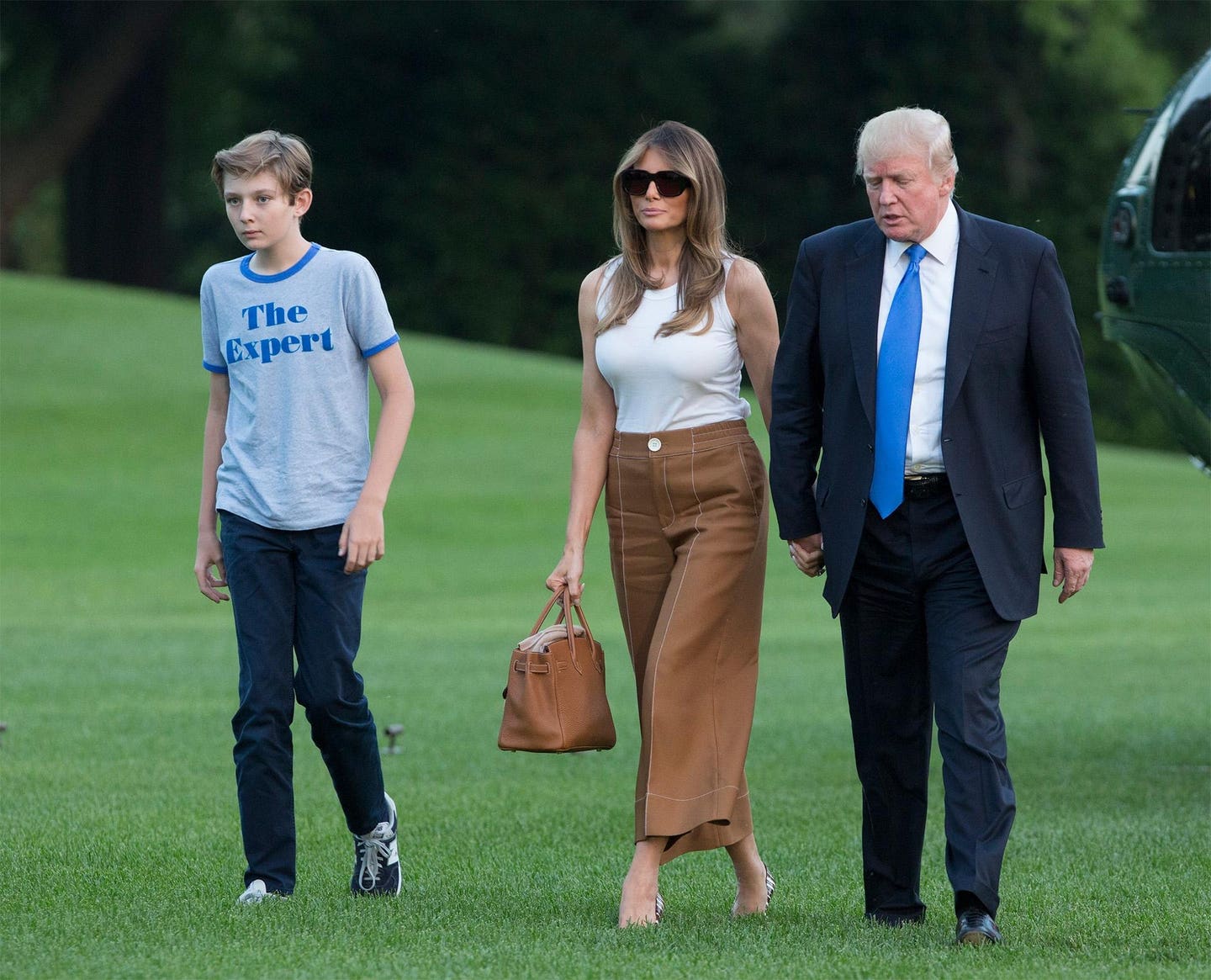
Barron has gotten richer—and taller—since the early days of his father's first presidency.Chris Kleponis/Pool/Getty Images

The company that holds the Trump family’s stakes in World Liberty, DT Marks Defi LLC, received a total of 22.5 billion crypto tokens called $WLFI in September 2024. In exchange for promotion and allowing the project to use Trump’s name, the company also got 75% of the revenues from World Liberty after the first $15 million in earnings. As of the start of this year, Trump owned 70% of Trump Marks Defi LLC, according to financial disclosures he filed as president. His family owned the remaining 30%. Sons Eric, Don Jr., and Barron are all listed as cofounders, so assuming they shared the 30% equally, that would be 10% for each of them. It’s possible that later dealmaking reduced their stakes.

Initially, the 10% didn’t amount to much. World Liberty tokens couldn’t be resold or transferred once purchased, and token sales were middling. But after Trump won the election, crypto entrepreneur and billionaire Justin Sun, who had been under investigation by the Securities and Exchange Commission, announced that he was investing $75 million in the project. (Perhaps not coincidentally, Trump’s SEC paused its probe into Sun in February.) Sales took off almost immediately. By August, World Liberty had sold an estimated $675 million worth of tokens, based on figures released by the company and its customers. Barron’s share, after taxes, comes out to around $38 million.

In March, World Liberty announced another product: a stablecoin, called USD1, pegged to the U.S. dollar. The market cap of the currency is around $2.6 billion, which suggests that the business behind it is worth about $880 million. A Trump family entity appears to own 38% of this venture. Barron’s share could be worth about $34 million.

Then in August, World Liberty struck a deal with a publicly traded healthcare company called Alt5 Sigma, which was seeking to become a cryptocurrency treasury company. As part of the deal, Alt5 essentially traded $750 million of $WLFI tokens for one million shares of its stock, 99 million warrants that are worthless if the stock stays below $7.50 (it’s at $2.78 as of Oct. 2), and 20 million warrants exercisable at even higher prices. Alt5 used a pile of money that it had raised to buy $717 million of World Liberty Financial tokens, routing over $500 million to the Trumps’ company and an estimated $41 million to Barron after taxes.

Barron also received an estimated 2.25 billion World Liberty tokens—10% of that initial 22.5 billion-token haul given to Trump’s company. Originally, Forbes valued these at $0 because they couldn’t be resold. But token holders voted in August to unlock 20% of coins, excepting those owned by the founders; additional votes are expected in the future on whether to unlock the rest and whether to allow the Trumps and their fellow investors to trade their tokens. The limited quantity of tokens on the market sell for about 20 cents each, but Forbes still heavily discounts tokens belonging to Barron—and the other founders—because they remain locked up. Taking all this into account, Barron’s assumed 10% share is worth an estimated $45 million today.

It all adds up to a bit over $150 million, no small chunk of change for a 19-year old college sophomore. Barron, who doesn’t have any additional known assets, could pay his $67,430 NYU Stern School of Business tuition more than 2,200 times with that kind of money.

Additional reporting by Dan Alexander.

Comments

All Comments

Recommended for you

  • U.S. Spot Bitcoin ETF Sees $2.39 Billion Net Inflow in a Week, Highest Since 2026

    On September 26, BeInCrypto reported that the U.S. spot Bitcoin ETF experienced a net inflow of $2.39 billion this week, marking the largest single-week net inflow since 2026. According to SoSoValue data, the week started with an inflow of $998.95 million on September 21, but subsequently declined daily to $134.47 million by Friday, approximately 87% lower than Monday. Nonetheless, funds continued to flow in for the seventh consecutive trading day. The significant inflow on Monday followed a 6.7% surge in Bitcoin, which led to about $262 million in short positions being liquidated within an hour. A global business survey by S&P on September 23 indicated that the U.S. economy is growing at its fastest pace since July 2021, with the 10-year U.S. Treasury yield surpassing 5%, causing Bitcoin to drop below $84,000 within an hour. The total assets of the ETF currently stand at $108.42 billion.

  • Riot Repays Coinbase Loan Early and Terminates $200 Million Bitcoin Collateral Credit Line

    On September 26, according to U.S. SEC filings, Bitcoin mining company Riot Platforms (NASDAQ: RIOT) voluntarily repaid all outstanding loans to Coinbase Credit on September 21 and terminated its $200 million credit line, while also releasing the lender's claim on the collateralized Bitcoin. Riot paid the full principal and accrued interest, incurring no early termination fees or penalties, and Coinbase's subsequent lending commitments were also terminated. The credit line, revised in April 2026, carried a fixed annual interest rate of 6.15% with a maturity date extended to April 20, 2027, and Riot had previously fully drawn the amount. At this rate, the annual interest on the $200 million balance is approximately $12.3 million. As of June 30, Riot had pledged 5,821 Bitcoins as collateral, valued at about $340.7 million, which accounted for approximately 51% of its total holdings of 11,380 Bitcoins at that time; the collateral also included USDC and cash held in Coinbase Custody Trust. This credit line was initially established in April 2025 for $100 million with a variable interest rate; it was doubled to $200 million the following month with a one-time fee of $1 million. Since the window for early termination fees specified in the agreement closed on August 21, no fees were required for the repayment in September. Riot is simultaneously expanding its data center operations, having announced in August a 20-year lease agreement with an unnamed AI developer for 191 megawatts of computing power at its Rockdale facility, which is expected to generate approximately $9.1 billion in initial revenue.

  • Trump: 'Super Intelligence' is a More Fitting Term than 'Artificial Intelligence'

    On September 26, U.S. President Trump stated: 'Super Intelligence' is a more fitting name. This name is more accurate because the term 'Artificial' often implies 'false' or 'not real'; however, it (Artificial Intelligence) is not a false entity, but rather an extremely powerful form of intelligence.

  • US and China Reach Agreement to Cut Tariffs on $30 Billion in Goods

    On September 26, the United States and China reached an agreement to reduce tariffs on $30 billion worth of goods following talks between President Xi Jinping and US President Donald Trump. (Watcher.Guru)

  • BTC Surpasses $84,000

    Market data shows that BTC has surpassed $84,000, currently priced at $84,015.64, with a 24-hour increase of 0.31%. The market is experiencing significant volatility, so please ensure proper risk management.

  • Trump Rejects Iran's Proposal to Reopen the Strait of Hormuz

    On September 26, U.S. President Trump stated that he has rejected Iran's proposal to reopen the Strait of Hormuz. In a media interview, Trump emphasized that the U.S. has complete control over the Strait of Hormuz, through which a significant amount of oil is flowing. Iran seeks to reach an agreement to immediately reopen the Strait, but 'I have rejected their proposal.' (Xinhua News Agency)

  • Iran's Supreme Security Council Denies Plans for Military Action Due to Flight Ban

    According to Iranian state media: Iran's Supreme Security Council has denied plans for military action in response to the ban on Iranian flights.

  • Analysis: Global Debt Continues to Rise, Bitcoin Benefits from Declining Fiat Currency Purchasing Power

    On September 26, Forbes reported that Bitcoin approached $90,000 earlier this month. Meanwhile, global debt continues to rise, and the 'currency devaluation trade' surrounding the decline in fiat currency purchasing power has become one of the factors driving up assets like Bitcoin and gold. According to the Institute of International Finance (IIF), global debt increased by $10 trillion in the first half of this year, surpassing $365 trillion in total. U.S. debt has exceeded $40 trillion, with annual interest payments rising to $1.27 trillion, surpassing defense and Medicare expenditures, and only falling behind Social Security spending. The IIF warns that as benchmark interest rates rise, interest costs will also increase. Nic Puckrin, founder of Coin Bureau and cross-asset analyst, stated that the current environment is favorable for 'currency devaluation assets' like Bitcoin and gold, which is partly why Bitcoin has seen recent gains. The larger the debt scale of major economies, the more likely it is to suppress real borrowing costs and allow inflation to erode the real value of debt, thereby enhancing the attractiveness of such trades. Analysts from The Kobeissi Letter noted that the purchasing power of the dollar has declined by 23% since 2020, and U.S. inflation has been above the Federal Reserve's 2% target for 60 consecutive months.

  • Morgan Stanley Increases Bitcoin Holdings by 42.98 BTC, Total Holdings Reach 9,261 BTC

    On September 26, Morgan Stanley extracted 42.98 BTC, valued at approximately $3.6 million, from the Coinbase Prime hot wallet address through its spot Bitcoin exchange-traded fund MSBT. This brings Morgan Stanley's total Bitcoin holdings to 9,261 BTC, valued at approximately $779 million.

  • Goldman Sachs: Six Tech Giants Need to Generate $1.42 Trillion from 2028 to 2030

    On September 26, Goldman Sachs released a research report on the U.S. technology industry, conducting a quantitative analysis of the return on investment for large cloud providers as they continue to expand their capital expenditures in artificial intelligence (AI). The report focuses on six major U.S. tech companies: Alphabet, Amazon, Microsoft, Meta, Oracle, and SpaceX, and performs a stress test on their computing power investments from 2026 to 2027. Assuming an average upfront investment of approximately $42 billion per gigawatt (GW) of computing power, with 70% of capital expenditures allocated to hardware and 30% to data center construction, while incorporating conservative depreciation rules and ongoing operational costs, Goldman Sachs estimates that these six companies must collectively generate about $1.42 trillion in revenue from 2028 to 2030. This equates to approximately $11.6 billion in annual revenue per GW of computing power to achieve a 15% annualized return on invested capital (ROIC) for this round of AI computing investments. Goldman Sachs believes that the commercial value associated with different tokens varies, and the returns on AI capital expenditures will not be uniform. However, considering the market growth potential over the next 3 to 5 years, the firm still expects that capital invested in the AI sector over the next 18 months will maintain a good overall return on investment.
