

Standing at the industry watershed of 2026, Web3 is undergoing a ruthless value clearing: pure narrative bubbles are bursting, and trillion-dollar real-world commercial adoption has become the only viable path for Layer 1 networks to break through. At this historical juncture of shifting from "geek experiments" to "commercial empires," the loose node architectures of traditional public chains can no longer support the massive real economy. At this moment, ENI emerges as a disruptor. It directly targets the very lifeblood of Web3: resource integration and value distribution. This article deeply deconstructs ENI's recently launched "Super Node × Top 100 Program," revealing how it reconstructsunderlying consensus to forge a globally sweeping commercial resonance flywheel.
Beyond Consensus: Redefining the 'Apex Ecological Niche' in Web3
As Web3 pivots towards trillion-dollar real-world commercial adoption, traditional underlying infrastructures are no longer sufficient to meet massive commercial expansion needs. Recognizing this, ENI has endowed nodes with profound new strategic significance through its 'Super Node × Top 100 Program'. A node in the ENI network is not merely a ledger-keeping protocol; it is the "apex ecological niche," possessing the dual attributes of a foundational security pillar and the highest privileged tier.
From a technical and tokenomic perspective, ENI's Super Nodes act as impenetrable fortresses of computational power. Diverging from the linear staking logic of traditional Layer 1s, ENI introduces an innovative "staking-hashrate multiplier" mechanism. This design creates a powerful flywheel effect: the larger the volume of assets staked by a node, the higher its hashrate multiplier and mining reward efficiency. This non-linear incentive model not only builds an incredibly high security moat for the ENI network in record time but also gives Super Nodes an overwhelming advantage in capital efficiency, ensuring that core builders receive outsized returns commensurate with their contributions.
Yet, ENI’s ambition extends far beyond underlying consensus. From a strategic and commercial perspective, Super Nodes fundamentally represent the highest privileged class within the ENI network. In the grand blueprint of the 'Super Node × Top 100 Program', ENI has precision-targeted its node seats at three tiers of elite players: the "Top 100 Institutions" controlling massive traditional resources and capital, the "Top 100 Ecosystems" bringing high-frequency, real-world business scenarios, and the "Top 100 Exchanges" commanding global liquidity.
This means the "Super Node" label is, in essence, a highly concentrated strategic resource matrix. Here, Web2 titans like NTT stand shoulder-to-shoulder with Web3 native leaders like CertiK. By becoming Super Nodes, they do not merely gain governance voting power; they secure a golden ticket to capture and divide the growth dividends of ENI's future trillion-dollar commercial empire. Occupying this "apex ecological niche" places these elite institutions at the very top of ENI's commercial resonance flywheel, allowing them to monopolize the exponential wealth premiums generated by the ecosystem's massive expansion.
The NTT & CertiK Catalyst: Igniting the Commercial Resonance Flywheel
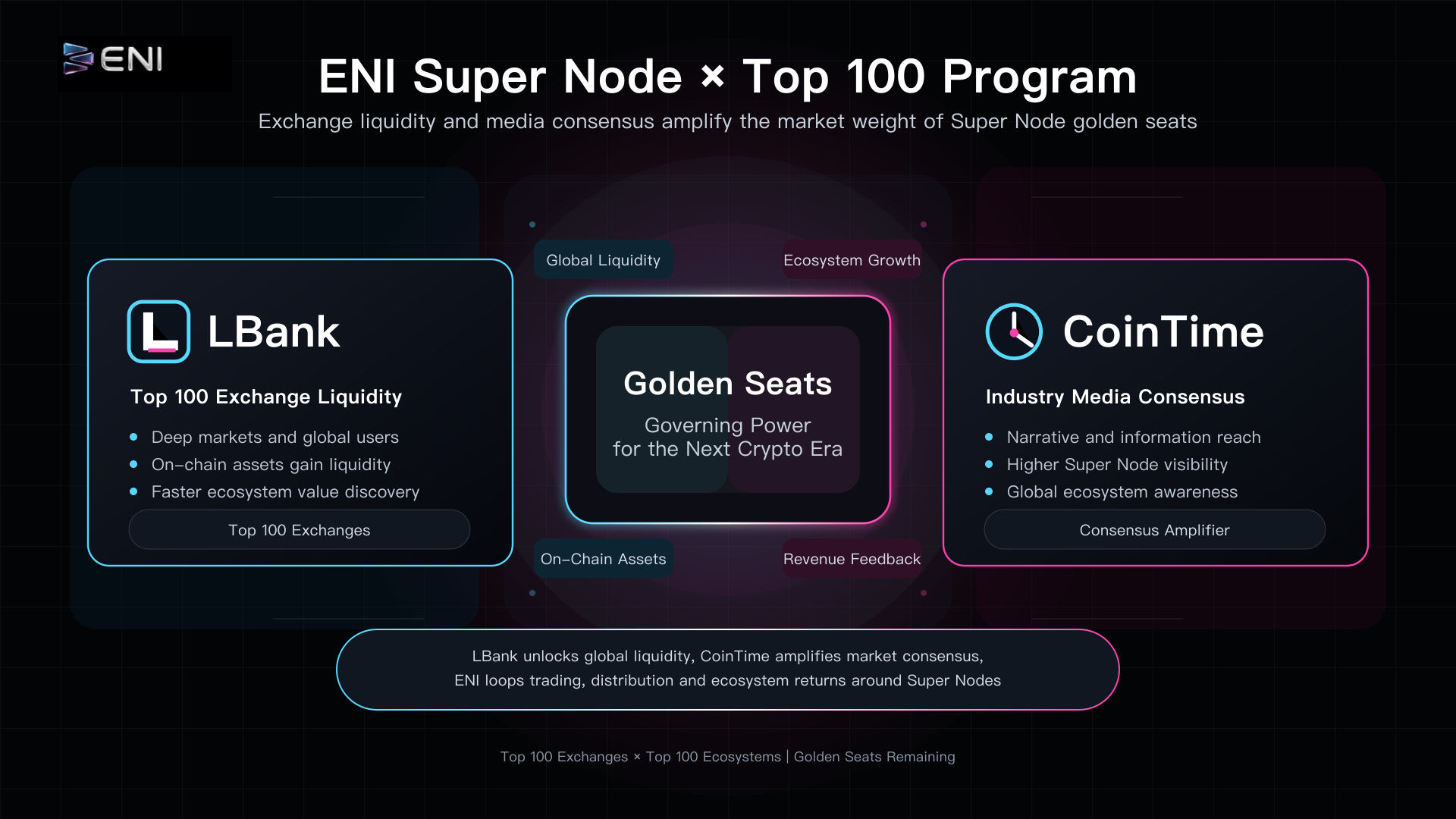
What truly makes ENI's Super Nodes erupt with staggering power is the continuous injection of top-tier institutional resources. Recently, heavyweights like Japanese telecom giant NTT, leading security firm CertiK, and global exchange LBank have successively announced their participation. Rather than simple PR endorsements, these partnerships collectively form the strategic puzzle of ENI’s 'Super Node × Top 100 Program', marking the official ignition of its "Commercial Resonance Flywheel." NTT brings massive Web2 user bases and real-world scenarios, CertiK ensures foundational trust, and platforms like LBank unlock global liquidity. Together, they establish an incredibly high barrier to entry and set the premium value tone for the ecosystem.
This dynamic serves as the core engine of ENI’s commercial resonance flywheel. While traditional Layer 1s often launch tokens first and hunt for use cases later, ENI positions the "Top 100 Institutions" directly as the ultimate source of value. Through these Super Nodes, massive capital, real-world commercial demand, user traffic, and real-world assets (RWA) are injected directly on-chain, providing the network with robust commercial momentum.
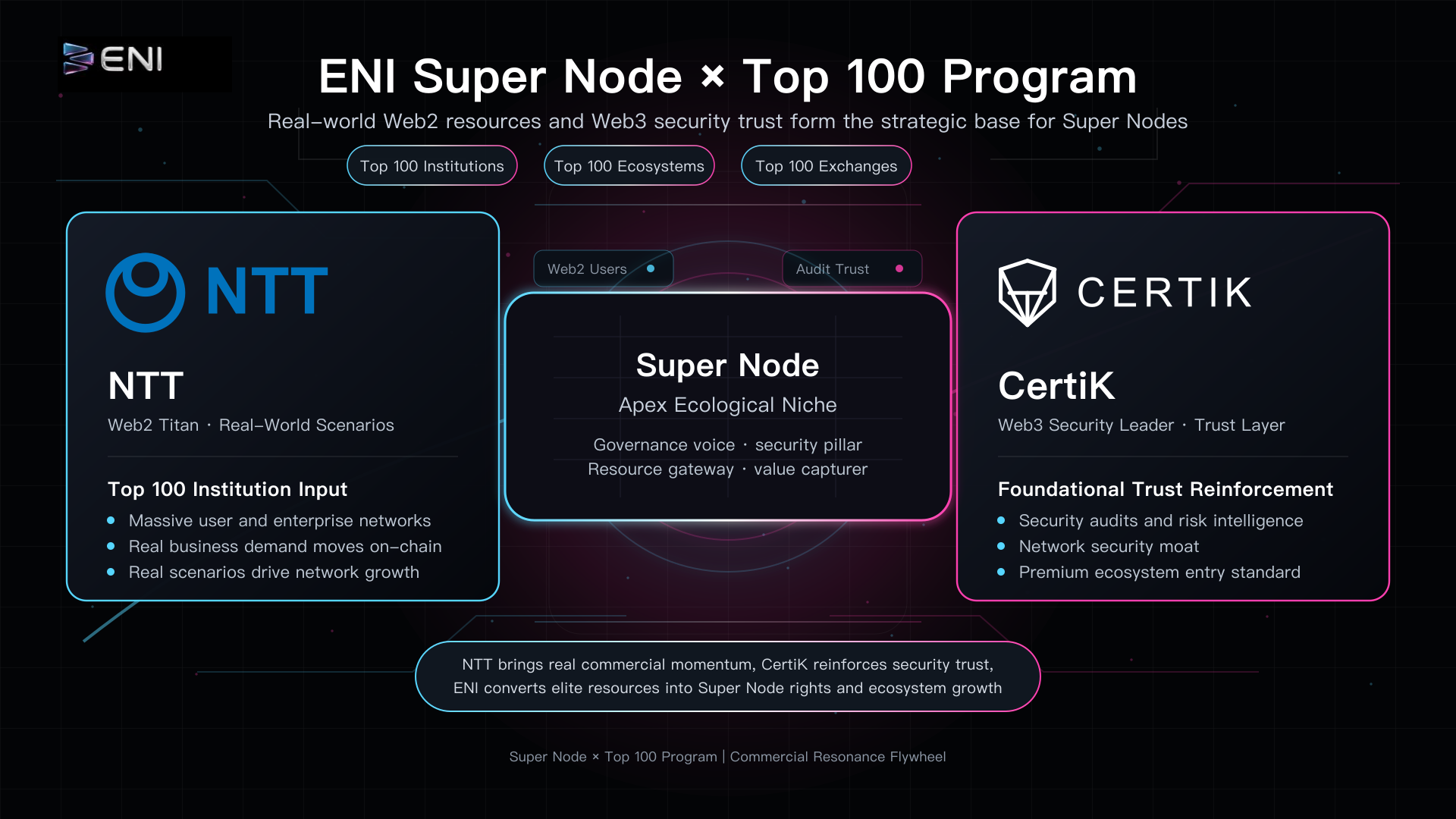
Once this momentum is injected, the closed-loop flywheel spins at high speed. Resources introduced by institutions flow rapidly into the "Top 100 Ecosystems," catalyzing a surge of authentic on-chain transactions and DApp utility. The resulting on-chain assets are then captured by the "Top 100 Exchanges," which provide deep global liquidity.
Institutions inject momentum, ecosystems create demand, and exchanges provide liquidity. These three pillars interlock perfectly to form a self-sustaining loop. All commercial value ultimately solidifies into the network's overall prosperity, feeding directly back to the Super Nodes. Stronger institutions and richer ecosystems directly translate to higher node revenues. This is not just a triumph of business logic, but the ultimate restructuring of wealth generation in Web3.
Locking in the Alpha: The Wealth Effect and Value Distribution of Super Nodes
If the "Commercial Resonance Flywheel" outlines ENI's grand blueprint for value creation, the Super Node mechanism is its ultimate "value capturer." ENI's Super Node mechanism is far from a superficial PR stunt; it is a meticulously calibrated, exponential wealth engine designed to lock in full-lifecycle Alpha.
First is the cross-boundary premium of intangible assets. Becoming an ENI Super Node means plugging directly into a global network of top-tier resources. Through co-branded PR exposure alongside titans like NTT and CertiK, node institutions instantly elevate their industry positioning and brand prestige. Simultaneously, the comprehensive operational and technical support provided by ENI drastically reduces the friction for traditional institutions entering Web3, allowing them to reap ecosystem dividends with maximum efficiency.
However, the true masterstroke lies in its underlying tokenomics. The exclusive privileges of Super Nodes are deeply tethered to the overall scale of the network. As massive capital inflows and real-world applications drive up on-chain activity, the value of these privileges will expand exponentially.
This dictates that the revenue curve for Super Nodes is non-linear. They are not just earning basic staking yields; they are continuously capturing the "tolls" and "ecosystem taxes" generated by the commercial velocity across the entire ENI network. Fundamentally, ENI's Super Node mechanism transforms these elite builders into the "founding shareholders" of the ENI commercial empire. As long as the network expands and real-world transactions occur, Super Nodes leverage a massive multiplier to consistently and stably harvest the immense wealth premiums generated by the ecosystem's explosion, truly locking in the ultimate Alpha of the Web3 era.
LBank & CoinTime Join: ENI Reshapes Crypto's "Governing Power"
The train of an era waits for no one. ENI’s "Super Node × Top 100 Program" is not an ordinary ecosystem recruitment drive; it is a preemptive carving up of the Web3 commercial landscape for the next decade. With titans like NTT and CertiK already making their moves, and as heavyweights like the leading global crypto exchange LBank and the prominent Web3 industry media CoinTime successively join the ranks as Super Nodes, the roar of the commercial flywheel is unmistakable. For top-tier global institutions, exchanges, and ecosystems, the question is no longer "whether to join," but "how to seize" the remaining golden seats in a race against time. In this super-game poised to reshape a trillion-dollar commercial paradigm, securing an ENI Super Node means grasping the scepter to the next crypto epoch.


All Comments