

Cointime

Download App
iOS & Android

Bitcoin institutional buys flip new supply for the first time in 6 weeks

Bitcoin institutional demand is finally outpacing new supply as the market hits a key pivot point.

Key points:

  • Bitcoin institutional demand is now 13% higher than the amount of newly mined BTC on a rolling daily basis.
  • New data shows institution-fueled supply reduction returning for the first time since early November.
  • ETF outflows pass $600 million in just two days this week.

Institutions bounce back with BTC buys

New data from quantitative Bitcoin and digital asset fund Capriole Investments shows that institutions are buying more BTC than miners are adding.

Bitcoin is becoming a target for institutions again as price action seeks a bottom more than 30% below October’s all-time highs.

Capriole reveals that for the past three days, institutional buying has surpassed the newly mined supply.

This is the first time that corporate demand alone has had a net reduction on the BTC supply since the start of November. 

The figure remains modest compared to the peak of the bull market two months ago. Currently, institutions are buying 13% more than the daily mined supply.
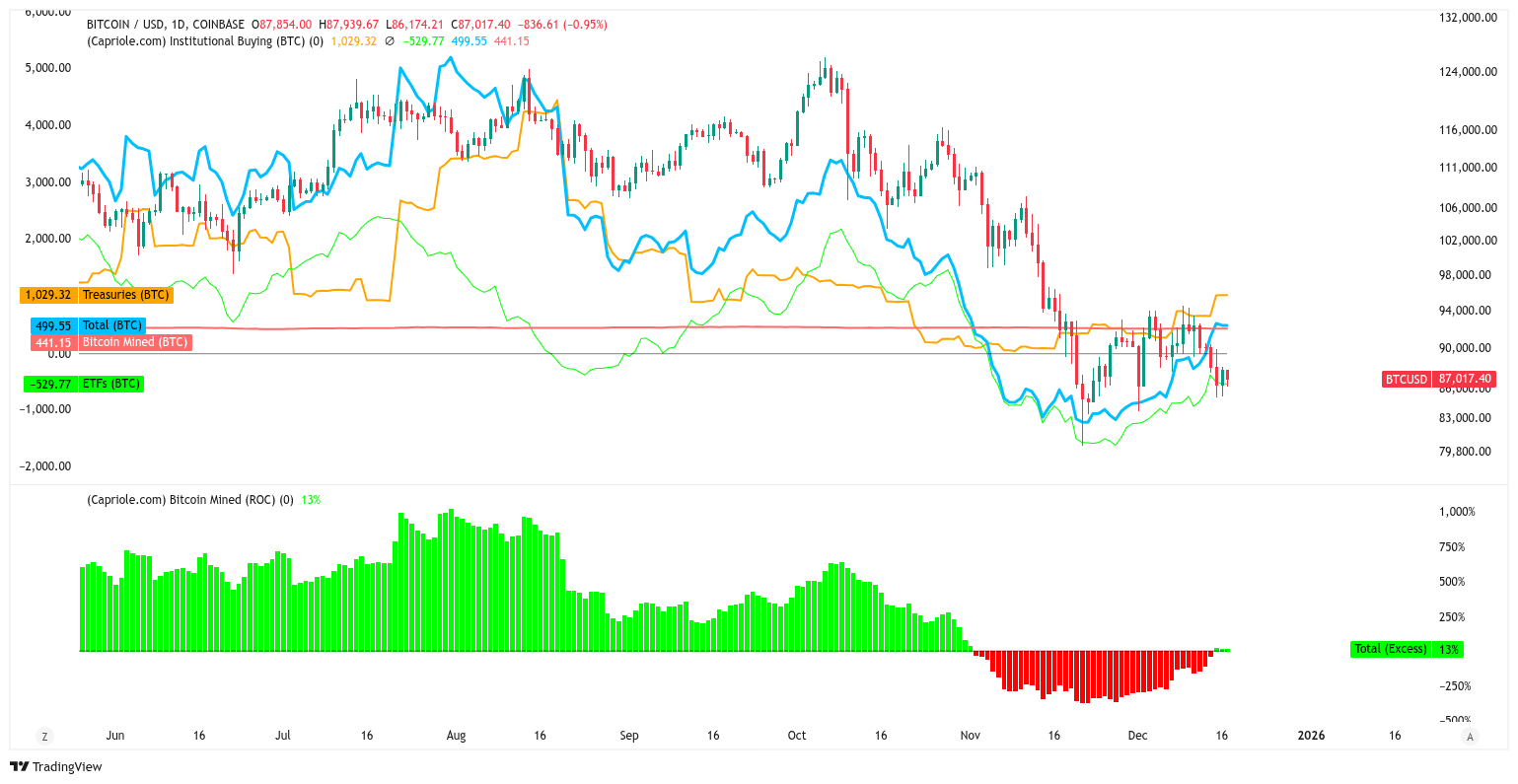
Bitcoin institutional demand vs. mined supply. Source: Capriole Investments


As noted by Capriole founder Charles Edwards earlier this month, the intervening period between the $126,000 highs and recent lows of $80,500 has been marked by significant stress for market players, including businesses opting to create Bitcoin corporate treasuries.

Attention has focused on Strategy, the company with the world’s largest such treasury, which has continued to add to its BTC holdings despite falling prices and stock performance.

Referencing its own AI-based analysis, Capriole’s Edwards this week highlighted a “broken corporate ‘flywheel,' evidenced by record discounts to NAV among treasury companies and rising leverage.”

Despite Bitcoin looking attractive when judged by network fundamentals, the pressure from corporate treasuries could be complicating the “path of least resistance” for price recovery, the analysis added.

Bitcoin ETF outflows meet “strategic accumulation”

Summarizing the status quo Wednesday, onchain analytics platform CryptoQuant described a “market in transition, where short-term pessimism contrasts with strategic accumulation.”

Network fundamentals, it noted, support market entries, even as capital outflows from investment vehicles such as the US spot Bitcoin exchange-traded funds (ETFs).

“This divergence between institutional outflows and the conviction of major players underscores that Bitcoin oscillates between immediate stress and long-term expectations of appreciation,” contributor GugaOnChain concluded in one of CryptoQuant’s Quicktake blog posts.
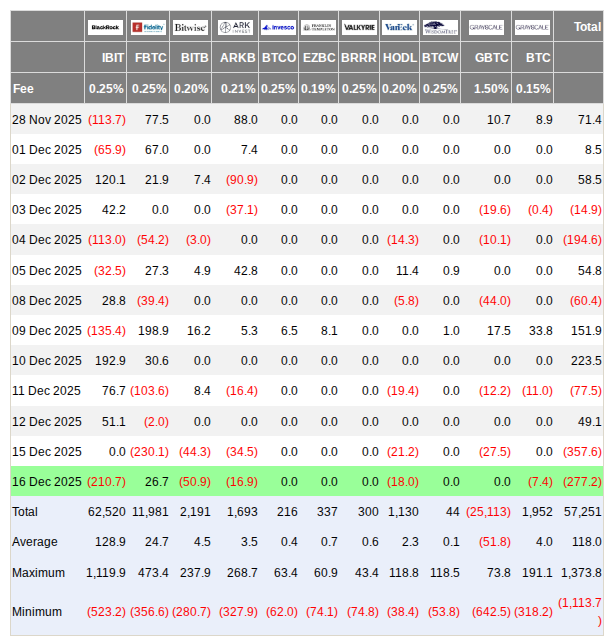
US spot Bitcoin ETF netflows (screenshot). Source: Farside Investors


Data from sources including UK-based investment company Farside Investors put net ETF outflows since Monday at $635 million.

Comments

All Comments

Recommended for you

  • US Spot Ethereum ETFs Saw $16.42 Million Net Outflow Yesterday

    On March 20th, according to data from TraderT, US spot Ethereum ETFs experienced a net outflow of $16.42 million yesterday.

  • US Spot Bitcoin ETFs See $167.46 Million Net Inflow

    According to Trader T monitoring, US spot Bitcoin ETFs experienced a net inflow of $167.46 million yesterday.

  • US and Iran Exchange Conflicting Statements on Negotiations

    On March 24, Iran on Monday denied having held any negotiations with the United States, after U.S. President Trump postponed a threat to bomb Iran's power grid, citing "productive dialogue" with unnamed Iranian officials. The Speaker of the Iranian Parliament called it "fake news." According to CCTV News, a senior Iranian official stated that Trump has no right to set conditions or deadlines for negotiations. The official indicated that messages have been conveyed between Iran and the U.S. through Egypt and Turkey with the aim of easing tensions, but the U.S. has not yet accepted Iran's two core conditions: compensation for damages and acknowledgment of violations against Iran. The official also stated that the issues of closing the Strait of Hormuz and laying mines remain among Iran's prepared options for potential actions. Iranian Foreign Ministry spokesperson Bahaei said on Monday that Iran had received messages from some friendly countries in the past few days regarding the U.S. demand to end the war through negotiations, and had responded appropriately based on its principled stance, without holding any negotiations with the U.S. A European official stated that although no direct negotiations have taken place between the two countries, Egypt, Pakistan, and Gulf states have been relaying messages. A Pakistani official and another source revealed to Reuters that direct negotiations to end the conflict could be held as early as this week in Islamabad. The Pakistani official said that U.S. Vice President JD Vance, along with Vitkov and Kushner, are expected to meet with Iranian officials in Islamabad this week, following a phone call between Trump and Pakistan's Chief of Army Staff Asim Munir. The White House confirmed the call between Trump and Munir. When asked about the potential visit of Vitkov and Kushner to Islamabad, White House spokesperson Karoline Leavitt stated: "These are sensitive diplomatic discussions, and the United States does not negotiate through the media. The situation is still evolving, and speculation about meetings should not be considered final until officially announced by the White House."

  • BTC Surpasses $71,000

    Market data shows that BTC has broken through $71,000, currently trading at $71,018.46. It has seen a 24-hour increase of 4.62%. The market is experiencing significant volatility, so please implement risk control measures.

  • Iran Denies Parliament Speaker Negotiating with US

    On March 23rd, Iranian media outlets including Tasnim News Agency reported today (March 23rd) that Iran has denied that the Speaker of the Iranian Islamic Parliament, Mohammad Bagher Ghalibaf, is engaged in negotiations with the United States. Earlier, according to information revealed by Axios reporter Barak Ravid on social media, US President's Special Representative for Iran, Brian Hook, and President Trump's son-in-law, Jared Kushner, "are in negotiations with Ghalibaf." Israeli media also reported that senior Iranian and US officials would hold talks in Islamabad, the capital of Pakistan, later this week. It was claimed that the US representative "could be Vice President Pence."

  • U.S. Stock Indices All Rise Over 2%

    On March 23, U.S. stocks continued to rise, with the Dow Jones Industrial Average up 2.14%, the Nasdaq up 2.28%, and the S&P 500 index up 2.01%.

  • Dollar Index DXY Falls Below 99

    According to Jjinshi, the Dollar Index DXY has fallen below 99, with a daily decline of 0.51%.

  • Trump: 15 Agreements Reached with Iran

    On March 23, U.S. President Trump stated: We have currently reached 15 agreements with Iran, including that Iran will not possess nuclear weapons. (Jinshi)

  • U.S. Stocks Continue Uptrend, Nasdaq Rises 2%

    Market data shows that U.S. stocks continue their upward trend, with the Nasdaq rising by 2%.

  • Strategy Announces New $21 Billion STRC and MSTR Equity Offering Plans

    On March 23, Strategy announced the launch of new $21 billion equity offering plans for STRC and MSTR. Note: The equity offering plans refer to at-the-market (ATM) programs, which are commonly used incremental financing tools by publicly traded companies to raise funds by issuing shares flexibly based on market prices.
