

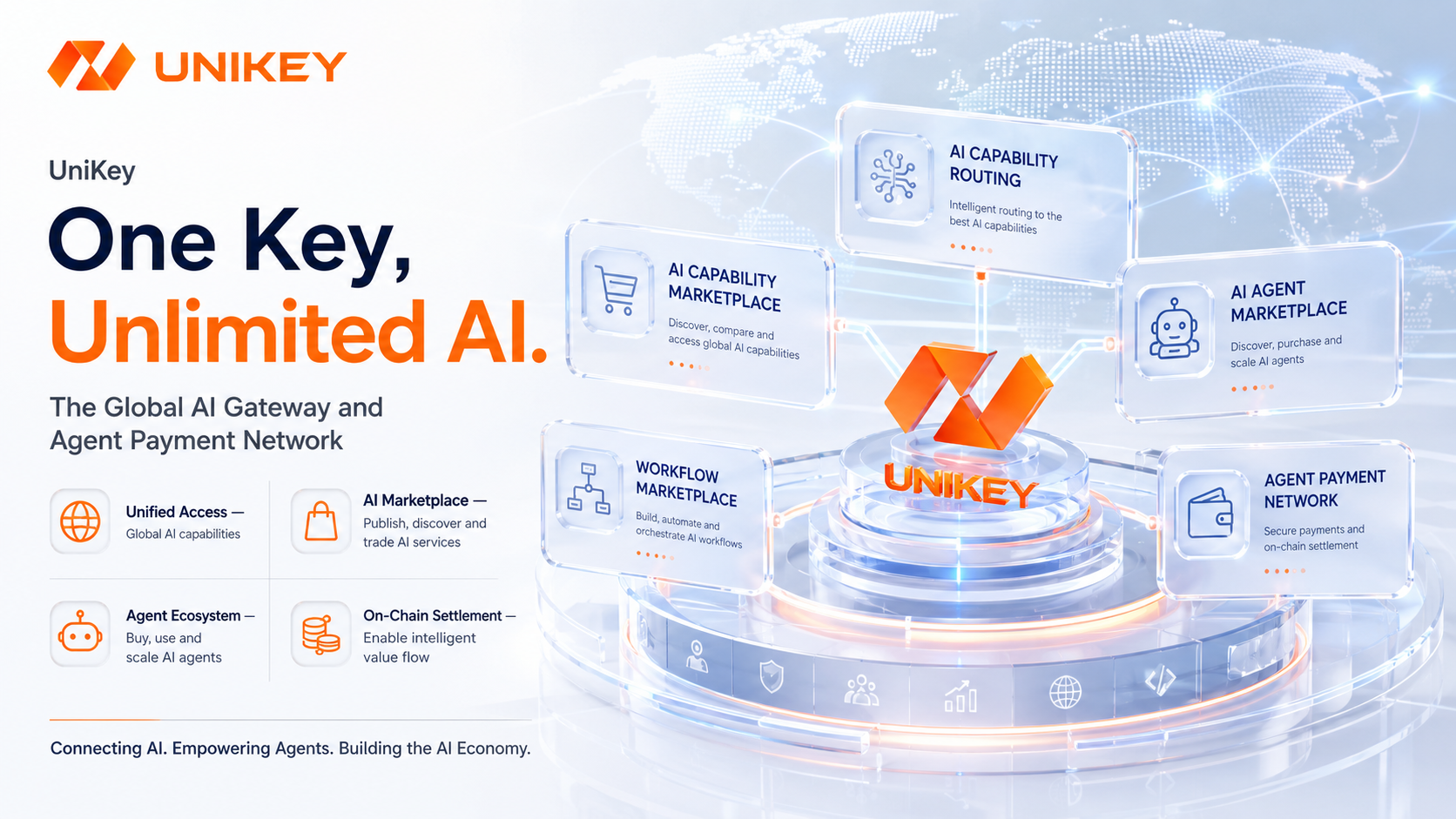
The Core Thesis of UniKey: From Connecting AI to Building an AI Economy Network
If the visual concept of UniKey were to be summarized in one sentence, it would be this: one key to connect global AI. But here, “connection” does not simply mean accessing another model or adding another API. It means integrating global AI capabilities, developer services, agent applications, workflow systems and on-chain settlement into one unified network. What users see is a simple access point; what sits behind it is a full infrastructure logic designed for the AI economy era: capabilities can be called, services can be traded, agents can be used, and value can be settled.
The AI industry today no longer lacks individual capabilities. There are large language models, multimodal tools, image generation systems, video generation platforms, voice synthesis tools, code assistants, office automation products, vertical agents and workflow platforms. The real problem is that these capabilities are scattered across different platforms, accounts, APIs and payment systems. For users, more capabilities often mean more complexity. For developers, more models mean heavier integration costs. For enterprises, multiple vendors, multiple invoices and multiple permission systems create a new layer of operational burden. UniKey is designed to solve this structural fragmentation created by the explosion of AI capabilities.
Therefore, UniKey is not valuable because it creates another isolated AI tool. Its value lies in building a unified AI capability gateway and agent payment settlement network. It connects AI capability routing, AI capability marketplace, AI agent marketplace, workflow marketplace and agent payment network into one coherent system. In doing so, UniKey moves global AI capabilities from a fragmented state into a networked state. From this perspective, UniKey is not just a product. It represents a new way of organizing the AI economy, where models, tools, services, agents and value flows are coordinated through one unified infrastructure layer.
AI Capability Routing: Why Global AI Needs a Unified Gateway
One of the core modules in the UniKey system is AI capability routing. This represents UniKey’s foundational layer: connecting global models and tools, then intelligently routing user requests to the most suitable capability. Today, different models have different strengths. Some are better at complex reasoning, some are stronger in code generation, some perform better in Chinese long-form text, and some are more suitable for multimodal content creation. In real-world use cases, users usually do not care which underlying model is being used. They care whether the task can be completed with the right cost, stable speed and strong output quality.
Under the traditional model, users must decide which platform, model or tool to use, and then create separate accounts and payment relationships with each platform. Developers must also adapt to different APIs, authentication systems, request formats, response structures and error-handling mechanisms. This may be acceptable during the early stage of AI adoption, but once AI becomes an enterprise-grade productivity layer, fragmented access becomes a major efficiency bottleneck. UniKey’s AI capability routing abstracts this complexity into one unified gateway, allowing users and developers to call global AI through a single key instead of managing disconnected platforms.
More importantly, routing is not merely about “accessing more models.” It is about selecting the most suitable capability for each task. UniKey can dynamically match requests based on task type, cost, speed, stability and model performance. If one capability channel becomes congested, rate-limited or unavailable, the system can reduce single-point failure risk through backup routing. This is especially important for high-frequency calls, enterprise applications and long-running AI agents, because the foundation of the AI economy is not a one-time experience. It is stable, continuous and manageable access to AI capabilities.
AI Capability Marketplace: Turning AI Services into Tradable Products
The AI capability marketplace represents UniKey’s second layer of value: moving from an access gateway to a service trading platform. The AI industry is undergoing an important transformation. AI capabilities are no longer only raw API functions. They are becoming service products. In the past, users directly called a model and received a generated result. Today, developers can package model capabilities into standardized services such as content generation, data analysis, marketing automation, customer support, code assistance, image generation and video generation. In the future, these services will evolve further into agents and workflows, becoming reusable, tradable and monetizable digital capability assets.
For developers and service providers, this creates a new commercialization opportunity. Many developers have domain expertise, prompt engineering experience, industry knowledge and workflow design capabilities, but they lack a unified publishing channel, transaction system, payment infrastructure and settlement mechanism. Many valuable AI capabilities remain trapped in small-scale use instead of becoming scalable products. UniKey’s AI capability marketplace provides a standardized marketplace for these capabilities, allowing developers to publish, display, price, trade and settle their AI services.
For users, the AI capability marketplace lowers the barrier to adoption. Users do not necessarily understand model parameters, prompt structures or workflow configuration. What they truly need is a service that solves a specific problem. UniKey shifts the user experience from “Which model should I call?” to “What task do I need to complete?” This turns AI capability from an underlying technology into a consumable, comparable and purchasable service product. This transformation will push AI from the tool era into the service economy era.
AI Agent Marketplace: Turning Agents into a New Form of Digital Labor
The AI agent marketplace is another core module in the UniKey ecosystem. It reflects UniKey’s long-term view of the agent economy. As large models become more powerful, AI will no longer simply answer questions passively. It will increasingly become capable of understanding goals, breaking down tasks, calling tools, processing data and executing workflows continuously. A customer service agent can handle user inquiries. A marketing agent can generate campaign materials. A research agent can analyze information and produce reports. An e-commerce operations agent can support product listing, content creation and customer communication.
The value of an agent is that it is closer to real business outcomes than a single model call. Users do not necessarily need a model API. They need an AI worker that can complete a specific type of task. UniKey’s agent marketplace allows developers to publish these vertical agents, while users can purchase, use and evaluate agent services. The platform provides publishing, calling, metering, settlement, recommendation and quality control mechanisms, allowing agents to evolve from product features into tradable AI services.
The deeper transformation is that agents will not only serve human users. They will also call and collaborate with one another. A marketing agent may call an image agent to generate visuals, a data analysis agent to evaluate performance, and a workflow to complete content distribution. Once agents begin to collaborate with one another, new service calls and payment settlement requirements will emerge. By building the agent marketplace early, UniKey is establishing the supply foundation for future agent-to-agent collaboration networks.
Workflow Marketplace: Turning Complex Tasks into Reusable Assets
The workflow marketplace reflects UniKey’s deeper understanding of how AI applications will be used in real business environments. Most real-world tasks are not completed through one simple model call. They are completed through a sequence of actions. For example, content production may involve topic research, information collection, copy generation, image creation, video scripting, asset generation and multi-platform publishing. Cross-border e-commerce marketing may involve product data extraction, multilingual copywriting, localized descriptions, image prompts, short video scripts and ad asset preparation. A single model cannot cover the entire process. What users truly need is end-to-end process capability.
The purpose of the workflow marketplace is to package these complex processes into reusable templates. Developers can transform their scenario knowledge, model combinations, task sequences, prompt structures and tool configurations into workflow products. Users can purchase and execute them with one click. In this model, a workflow is not merely an automation tool. It becomes a tradable digital asset. It captures a developer’s understanding of a business scenario, as well as the combined capability of models, tools and agents.
For the UniKey ecosystem, the workflow marketplace significantly increases platform depth. The AI capability marketplace solves single-service transactions. The agent marketplace solves ongoing task execution. The workflow marketplace solves complex process automation. When these three layers work together, UniKey is no longer just a model gateway. It becomes an AI production network capable of supporting complete business scenarios. Users purchase outcomes, developers monetize methodologies, agents call processes, and the platform handles unified metering and settlement.
Agent Payment Network: The Settlement Layer That Makes the AI Economy Work
The agent payment network is one of the most important infrastructure modules in UniKey’s long-term vision. As the number of AI agents grows, automated service calls, task collaboration and service purchases between agents will create a new form of machine-driven economic activity. Traditional payment systems are built mainly for humans and enterprises. They are better suited for low-frequency payments, manual confirmation and centralized billing. The agent economy, however, requires high-frequency, micro-scale, automated, multi-party and programmable payment and settlement capabilities.
When an agent completes a task, it may need to call models, purchase AI services, execute workflows, call other agents and distribute fees across multiple service providers. Every call requires metering. Every service requires payment. Every collaboration may require revenue sharing. Without a payment settlement network, agents remain limited to the tool stage. With a payment settlement network, agents can become economic participants capable of autonomously purchasing capabilities, combining services and completing tasks.
UniKey supports this scenario through a dual mechanism of AI Credits and KEY. AI Credits handle high-frequency consumption such as model calls, AI service purchases, agent calls and workflow execution. KEY connects payment discounts, membership rights, developer access, agent publishing, workflow listing, market recommendation, node rights and ecosystem incentives. This design preserves a smooth user experience for consumption while creating a value connection mechanism for ecosystem participants. The ultimate meaning of the agent payment network is that AI capabilities can not only be called, but also metered, traded and settled.
From Unified Access to On-Chain Settlement: UniKey’s Complete Value Loop
The system presented through UniKey’s structure can be understood as a complete value loop: unified access, AI capability marketplace, agent ecosystem and on-chain settlement. Unified access solves the problem of how users enter the network. The AI capability marketplace solves the problem of service supply and transactions. The agent ecosystem solves the problem of automated execution and collaboration. On-chain settlement solves the problem of value flow and trusted settlement. Together, these modules show that UniKey is not merely an entry-point product. It is a network system designed to support AI economic activity.
The growth logic of this loop is clear. More users enter UniKey through the unified gateway, bringing more AI calls and service consumption. More consumption attracts more developers to publish AI services, agents and workflows. More supply improves available use cases and user retention. As more agents join the network, they generate higher-frequency automated calls and service purchases. More transactions and calls eventually increase settlement demand. As a result, UniKey’s value does not come only from individual model calls, but from the growing relationships of capability circulation and value settlement across the entire ecosystem.
In the long run, UniKey’s strategic position is its role between supply and demand. On the supply side are models, tools, developers, service providers, agents and workflow creators. On the demand side are individual users, enterprise clients, developer applications and future autonomous agents. UniKey stands between them, providing unified access, intelligent routing, marketplace transactions and settlement infrastructure. This position gives UniKey the opportunity to become an infrastructure layer for the AI economy, rather than being limited by the life cycle of any single model or tool.
Why UniKey Is Forward-Looking
UniKey is forward-looking not because it follows the AI trend, but because it anticipates the structural needs of the next stage of the AI industry. Today, many still understand AI as a competition between model capabilities. But the deeper trend is this: as more models, tools, agents and workflows emerge, the industry will inevitably need a new connection layer, transaction layer and settlement layer. Without this infrastructure, the AI ecosystem will remain fragmented. Capabilities will be difficult to circulate. Services will be difficult to standardize and trade. Agents will be unable to collaborate autonomously.
UniKey’s architecture is designed around this future. AI capability routing solves global capability access. The AI capability marketplace solves service commercialization. The agent marketplace solves agent monetization. The workflow marketplace solves complex task assetization. The agent payment network solves future value transfer between machines. This is not a random collection of features. It is a natural path from AI access to AI trading, and from AI trading to the agent economy.
Therefore, UniKey’s core competitiveness is not simply “how many models it connects.” It is whether it can organize the flow of global AI capabilities. Models will change. Tools will be updated. Agents will emerge. But the value of infrastructure that connects, routes, trades and settles capabilities will continue to grow. The richer AI capabilities become, the more important unified access becomes. The more common agents become, the more important payment settlement becomes. The more developer services emerge, the more important marketplace networks become. UniKey’s foresight lies in choosing to stand at the infrastructure layer of the AI economy.
Connecting AI, Empowering Agents, Building the AI Economy
The UniKey visual concept communicates more than a design idea. It presents a complete technological and commercial narrative. “One Key, Unlimited AI” represents the simplification of the user experience. The five core modules represent UniKey’s systematic reconstruction of how AI capabilities circulate. The final message, “Connecting AI, Empowering Agents, Building the AI Economy,” represents UniKey’s long-term goal: to allow global AI capabilities to flow freely within one unified network.
Artificial intelligence is moving from tools to an economy. Models are productivity. Agents are executors. Workflows are production processes. Marketplaces are circulation channels. Settlement networks are the value foundation. UniKey’s mission is to connect these elements, making capabilities easier to access, developers easier to monetize, enterprises easier to manage, agents easier to collaborate and payments easier to settle.
When AI is no longer just a single conversation, but a continuously operating production system; when agents are no longer merely software features, but digital labor; when workflows are no longer automation scripts, but tradable assets; when on-chain settlement is no longer only a financial narrative, but a core demand of the agent economy, UniKey’s value becomes clear. One key to connect global AI. One network to power the intelligent economy. This is UniKey’s answer to the future.


All Comments