

Cointime

Download App
iOS & Android

North Korean hackers used AI-enabled social engineering in Zerion attack

Validated Individual Expert

Crypto wallet Zerion revealed that North Korean-affiliated hackers used AI in a long-term social engineering attack to steal about $100,000 from the company’s hot wallets last week. 

The Zerion team released a post-mortem on Wednesday, where it confirmed that no user funds, Zerion apps or infrastructure were affected and that it had proactively disabled the web app as a precaution. 

While the amount was relatively small in crypto hacking terms, it is another incident of a crypto worker being targeted for an “AI-enabled social engineering attack linked to a DPRK threat actor,” Zerion said.

It is the second attack of this nature this month, following the $280 million exploit of the Drift Protocol, which was the victim of a “structured intelligence operation” by DPRK-affiliated hackers. The human layer, not smart contract bugs, has now become North Korea’s primary point of entry into crypto firms.  

AI is changing the way cyber threats work

Zerion said the attacker gained access to some team members’ logged-in sessions and credentials, as well as private keys to company hot wallets. 

“This incident showed that AI is changing the way cyber threats work,” the company said. 

It confirmed that the attack was similar to those that had been investigated by the Security Alliance (SEAL) last week.

SEAL reported that it had tracked and blocked 164 domains linked to the DPRK group UNC1069 in a two-month window from February to April.

It stated that the group operates “multiweek, low-pressure social engineering campaigns” across Telegram, LinkedIn and Slack. Malicious actors impersonate known contacts or credible brands or leverage access to previously compromised company and individual accounts.

“UNC1069’s social engineering methodology is defined by patience, precision, and the deliberate weaponization of existing trust relationships.”

Google’s cybersecurity unit Mandiant detailed in February the group’s use of fake Zoom meetings and a “known use of AI tools by the threat actor for editing images or videos during the social engineering stage.”

DPRK’s social engineering is evolving

Earlier this month, MetaMask developer and security researcher Taylor Monahan said North Korean IT workers have been embedding themselves in crypto companies and decentralized finance projects for at least seven years.

“The evolution of the DPRK’s social engineering techniques, combined with the increasing availability of AI to refine and perfect these methods, means the threat extends well beyond exchanges,” blockchain security firm Elliptic said in a blog post earlier this year. 

“Individual developers, project contributors, and anyone with access to cryptoasset infrastructure is a potential target.”
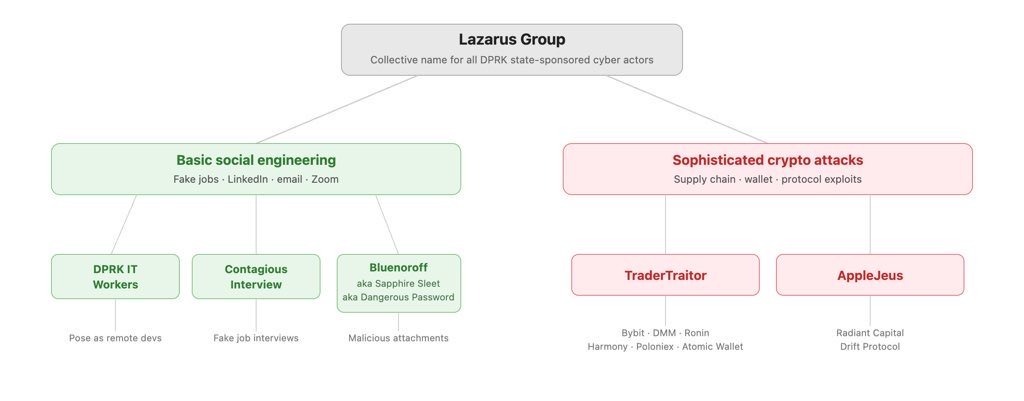
  There are two types of DPRK attack vectors, one more sophisticated than the other. Source: ZachXBT
Comments

All Comments

Recommended for you

  • Russian Foreign Minister Lavrov: Meeting with U.S. Secretary of State Rubio Scheduled for Tomorrow

    On July 22, Russian Foreign Minister Lavrov stated that the meeting with U.S. Secretary of State Rubio has been scheduled for tomorrow.

  • Supermicro Surges Over 14% Pre-Market as Q4 Gross Margin Doubles Guidance, New Orders Exceed $60 Billion

    On July 22, AI server manufacturer Supermicro (SMCI.US) surged over 14% in pre-market trading to $29.17. On the news, the company released preliminary results for the fourth fiscal quarter ended June 30. The company's GAAP and non-GAAP gross margins are expected to be between 15% and 17%, nearly double the previously guided range of 8.2% to 8.4%. Management attributed this better-than-expected performance to favorable customer structure and product mix. Meanwhile, the company's total new orders for the quarter exceeded $60 billion, a record high.

  • US Optical Communication Stocks Fall in Pre-market, Marvell Down Over 2%

    On July 22, US optical communication concept stocks fell collectively in pre-market trading, with Astera Labs, Coherent, Credo Technology, Ciena, AXT Inc, and MaxLinear falling more than 3%, and Fabrinet, Lumentum, Corning, Applied Optoelectronics, Tower Semiconductor, Marvell Technology, POET Technologies, and GlobalFoundries falling more than 2%.

  • US AI chip stocks fall pre-market, Intel down 3%

    On July 22, US stock market AI chip stocks generally fell before the market open, with Intel down 3%, TSMC, AMD, and Qualcomm down over 2%, Broadcom down nearly 2%, and NXP and Nvidia down over 2%.

  • Russia Develops 150nm Lithography Machine, Performance Comparable to Pentium 4 from 20 Years Ago

    On July 22, according to Fast Technology, Russia's Green City Nanotechnology Center (ZNTC) has successfully developed a prototype of an electron beam lithography machine (ELL) with a design standard of 150nm. The project is a key research and development task under the framework of Russia's national plan for scientific and technological development, codenamed Progress ELL 150. This device is mainly used for manufacturing photomasks, and can also directly draw circuit patterns on substrates without using masks. The 150nm process roughly corresponds to the performance level of Intel's Pentium 4 from 20 years ago. In 2025, ZNTC demonstrated a similar device with 350nm resolution, and has now advanced to 90nm and 130nm technology nodes. Industry experts point out that such equipment is only suitable for small batch production of specialized chips in fields such as aerospace and defense.

  • Beijing State-owned Capital: Nearly 10 Billion Yuan Allocated to Stock Market from Own Funds

    On July 22, Beijing State-owned Capital Operation and Management Co., Ltd. announced that, as of now, it has allocated nearly 10 billion yuan from its own funds to invest in the stock market. Going forward, the company will continue to support listed company stocks using its own funds and through its subsidiaries, including securities firms and public funds, while also backing the development of the Beijing Stock Exchange. Rooted in its functional role as a state-owned capital operator, the firm is committed to safeguarding the strategic value of core assets of listed companies and contributing to the stable and healthy growth of the capital market through concrete actions, as a state-owned enterprise based in Beijing. (Beijing State-owned Capital)

  • U.S. Stock Futures Fall, Major Indices Decline

    U.S. stock futures are lower, with Nasdaq 100 futures down 1%, S&P 500 futures down 0.4%, and Dow futures down 0.3%.

  • Japan's Two-Year Government Bond Yield Rises to 1.47%, First Time Since 1995

    Japan's two-year government bond yield rose to 1.47%, the first time since 1995.

  • WTI and Brent Crude Surge Over 4%

    On July 22, international oil prices surged rapidly. WTI crude oil futures rose over 4% to $87.77 per barrel; Brent crude oil futures rose over 4% to $94.71 per barrel.
