


The information, opinions, and judgments regarding markets, projects, and currencies mentioned in this report are for reference only and do not constitute any investment advice.Written by 0xBrooker
The US and Chinese trade delegations held their fifth round of negotiations this year in Malaysia over the weekend, making final preparations for the upcoming talks between the two heads of state at the end of the month.
Previously, with both sides, especially the US, continuously signaling their expectation of reaching an agreement, and with the improvement in short-term liquidity in the US financial market, the Nasdaq had gradually stabilized and rebounded after two weeks of decline and fluctuation, reaching a record high on Friday after the release of the US September CPI data. On Sunday, both sides announced that they had reached a consensus on the "framework of the agreement," stimulating a collective rise in the BTC and cryptocurrency markets.
The US-China trade conflict, short-term financial liquidity, and inflation data—three major market factors that had been suppressing bullish sentiment—all improved, contributing to a new record high for US stocks this week. However, the BTC and crypto market remained weak due to continued suppressed overall risk appetite and the influence of historical cyclical patterns. Although it rebounded weakly after finding support at the 200-day moving average and regaining its footing above the "Trump bottom," it has not yet returned to a bull market. The crypto market still lacks hot topics, and altcoins continue to underperform BTC.
Fund inflows remain weak, failing to offset the market pressure from long-term selling. It remains to be seen whether, with interest rate cuts and the easing of the US-China trade conflict, funds can return to a state of abundant inflows, reverse the downward trend, and even rewrite the old cycle pattern.
Policy, macro-financial and economic data
Two weeks ago, the trade war between the US and China suddenly escalated, causing renewed turmoil in global financial markets. Subsequently, both sides, especially the US, continuously signaled their willingness to reach an agreement, which the market gradually interpreted as a "tactic to force talks," after which the market gradually stabilized.
Delegations from both sides held their fifth round of talks in Malaysia over the weekend. According to a joint statement released Sunday, the two sides conducted "constructive discussions" on issues including export controls, extension of reciprocal tariffs, cooperation on fentanyl and drug control, further expansion of trade, and Section 301 vessel charges, reaching a "preliminary consensus," which will now undergo internal approval procedures. The meeting between the two leaders at the end of the month is highly likely to proceed as scheduled.
Since the US government shutdown, the market has been operating in the absence of economic and employment data, finally receiving its first key data release on October 24th – the CPI. The data showed that the US September CPI rose 3% year-on-year, lower than the expected 3.1% but higher than the previous value of 2.9%. This means that a Fed rate cut in October is almost certain, and the expectation of a rate cut in December has reached 91.1% on the FedWatch app. The continuation of the rate-cutting cycle has alleviated previous market concerns, and all three major stock indices hit record highs after the data release. BTC also continued its weak rebound, but it is still far from its historical high.
The US government shutdown caused short-term liquidity problems. However , this pressure on the market began to ease following Powell's statement that "the Fed will soon stop QT."
US AI and technology stocks have begun releasing their Q3 earnings reports. Tesla's earnings were below expectations, but the stock still closed higher, indicating that AI spending remains a positive factor for the market. Several other bellwether companies will continue to release their earnings reports next week, so close attention is needed.
The US dollar index rebounded 0.39% this week, closing at 98.547, remaining in a mild state. After several weeks of short-covering rallies, gold began a sharp decline on Tuesday and has remained weak since.
Crypto Market
In addition to the impact of macro financial markets, the BTC and crypto market are still affected by historical "cyclical patterns".
This week, exchanges still recorded an inflow of over 130,000 BTC, slightly smaller than last week, but the net outflow decreased to 2,775 BTC, the lowest level in recent times. This shows that the cyclical pattern has a significant impact on the market during the transition between old and new cycles.
Long-term investors reduced their holdings by more than 39,000 units. This kind of continuous selling during a downtrend often occurs during the confirmation phase of a bull market turning into a bear market. At this point, the buying power of short-term investors is insufficient to absorb the selling pressure.
In the new market structure, the main forces absorbing selling pressure, DATs companies and BTC Spot ETF channel funds, also showed weakness this week. According to eMerge Engine statistics, total funds flowing into the crypto market this week amounted to only $943 million, the lowest in several months.
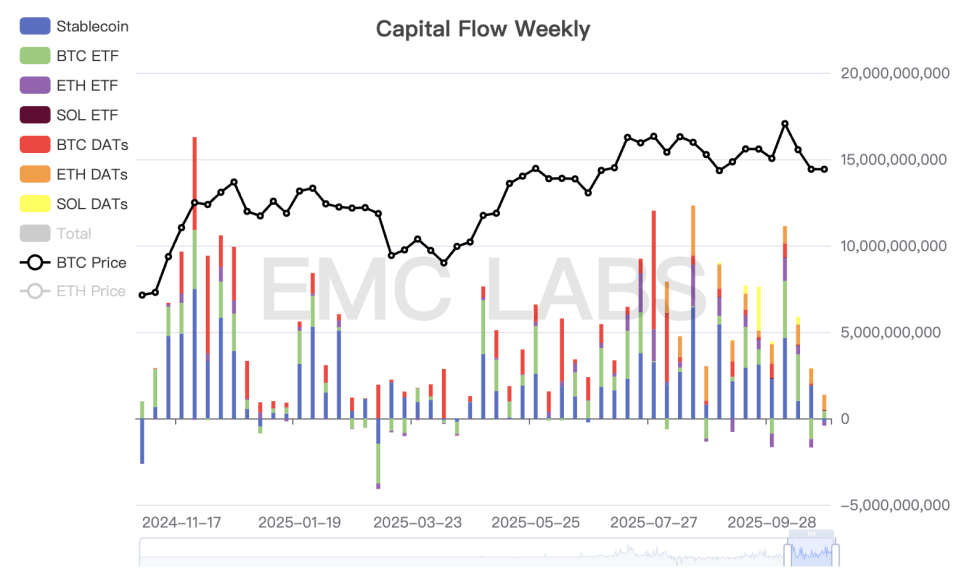
Crypto Market Fund Inflow Weekly Statistics
The weak trading volume reflects the "cyclical pattern" that we have been emphasizing recently, which is suppressing market sentiment. A change in this situation requires either a new structure of buying power actively buying to absorb selling pressure amidst improved global risk appetite, or a relentless sell-off by both long and short positions to confirm a bear market.
Technically, BTC stabilized above the 200-day moving average and the "Trump bottom" (US$90,000-110,000 range) this week and continued its weak rebound, achieving a weekly gain of 5.4%. ETH, on the other hand, stabilized above the 120-day moving average.
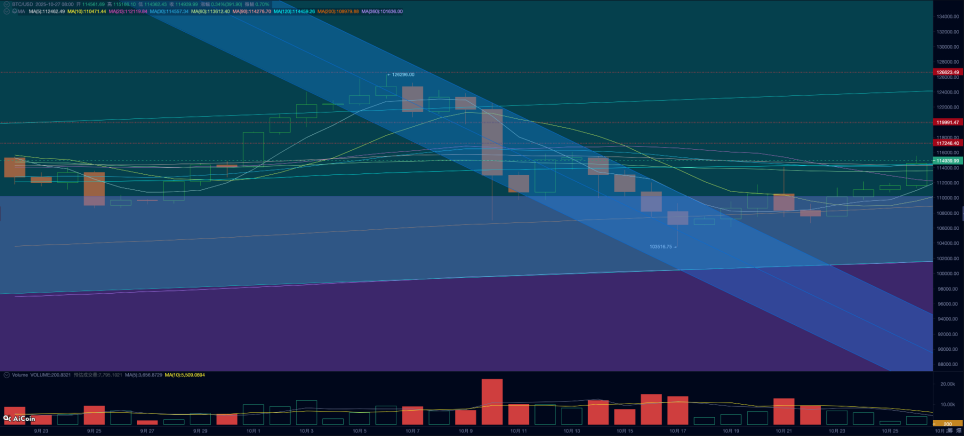
BTC price chart (daily chart)
The renewed conflict between the US and China has triggered ongoing liquidations in the futures market, resulting in a loss of over $20 billion in notional value. Recently, BTC has rebounded along with the weak performance of US stocks, but the total number of open contracts remains low, indicating that leveraged funds are unlikely to be a key driver of the rebound in the short term.
Based on multi-dimensional analysis, we believe that the behavior of DATs and BTC Spot ETF channel funds will remain the only two forces supporting the BTC rebound and even its return to a bull market.
Cyclical Indicators
According to eMerge Engine, the EMC BTC Cycle Metrics is 0, indicating a transition period.
EMC Labs was founded in April 2023 by crypto asset investors and data scientists. Focusing on blockchain industry research and cryptocurrency secondary market investment, EMC Labs leverages industry foresight , insights, and data mining as its core competencies. It is committed to participating in the booming blockchain industry through research and investment, driving the benefits of blockchain and crypto assets to humanity.

For more information, please visit: https://www.emc.fund


All Comments