

Over the past year, the focal point of competition among AI products has shifted noticeably. Users are no longer satisfied with a model simply "answering a question" — they want AI to read files, invoke tools, decompose tasks, execute workflows, and ultimately deliver a result that can be used directly. Tencent's WorkBuddy is a clear representative of this trend: positioned as a full-scenario AI productivity workstation, it understands tasks through natural language, autonomously plans execution steps, and completes work spanning documents, data analysis, presentation decks, code, and local file processing.
More notably, Tencent has also recently released WorkBuddy Bench, which evaluates agents against real engineering, office, web, and security tasks rather than testing whether a model can answer standardized questions. This signals that the evaluation standard for the AI industry is shifting from "does it sound smart" to "can it actually get the job done in a real environment." As more products enter this stage, what the industry truly needs to solve is no longer just model capability, but how models, tools, data, agents, and billing systems get unified and connected.
WorkBuddy Represents Not Just a New Tool, but a New AI Product Form
Traditional AI products are typically chat-box-centric: the user asks a question, the model generates content, and the user copies, organizes, and executes it themselves. Products in the WorkBuddy category, by contrast, are moving directly into the desktop, WeCom, QQ, and live business workflows: the AI not only understands instructions but can decompose tasks, invoke tools, operate on authorized files, and continue executing across multiple steps. WorkBuddy also supports connecting agents into WeCom, QQ, Feishu, and DingTalk, turning the agent from a standalone application into an execution node embedded within enterprise communication and business systems.
This shift means that, going forward, the way enterprises use AI won't simply be "an employee opens a model's website." It's more likely to be: the employee submits a task through a familiar work entry point, and the agent behind it automatically selects the model, calls the relevant data, invokes tools, and returns a result. What the user sees is WorkBuddy, an enterprise chatbot, or some other agent product — but what actually powers task completion behind the scenes may be a combination of multiple models, APIs, skills, MCP services, and enterprise data systems.
So WorkBuddy's value isn't limited to adding one more desktop assistant — it validates a much larger direction: AI is moving from being a model product to becoming an execution network distributed across office entry points, business systems, and end devices.
Open APIs and MCP Are Turning Agents Into "Capability Containers"
A key design choice in WorkBuddy is support for custom models. According to Tencent Cloud's official documentation, users can configure an endpoint URL, API Key, and model name to connect external model services into WorkBuddy; the enterprise edition also supports connecting to third-party models such as OpenAI, Anthropic, and Gemini, as well as local models deployed via Ollama. This means WorkBuddy isn't a closed product locked to a fixed model — it functions more like an execution terminal that can host a range of different intelligent capabilities.
At the same time, WorkBuddy Enterprise connects to external systems through MCP and connectors. Enterprises can let agents access GitHub, Notion, Supabase, Tencent Docs, email, and knowledge bases, and can also build custom connectors to bring their own APIs and business systems into the workflow. The official documentation defines connectors as the bridge between WorkBuddy and external services, used to extend data sources, invoke third-party capabilities, and orchestrate composable workflows.
The industry implication here is significant: future agent platforms won't necessarily need to own every model and tool themselves — what they'll need is a stable, open, extensible capability supply system. WorkBuddy is responsible for understanding requirements and executing tasks; external APIs supply model capability; MCP supplies data and tool connectivity — together, they deliver the outcome.
The Stronger the Agent, the More Complex the Model Calls Behind It
A typical AI conversation usually only requires a single model request. But an agent that actually executes tasks may first need to analyze the requirement, then read reference materials, invoke search, select a model, execute code, generate images, repeatedly verify the results, and finally write the output back to a file or push it to a business system. A single user instruction may correspond to multiple model calls and coordination across multiple services behind the scenes.
WorkBuddy's own team has explicitly emphasized that its agents are capable of task decomposition, multi-tool invocation, closed-loop execution, and multi-agent collaboration. The richer the capability set, the more models, tools, and context a single task can involve — and the more complex the enterprise's exposure becomes across API Keys, token consumption, budget control, permission boundaries, and service billing.
So the real bottleneck of the agent era isn't "whether you can connect to a given model" — it's whether you can switch stably across a large pool of models and services, select based on cost, speed, and task type, unify consumption tracking, and accurately allocate spend across users, departments, projects, and agents.
WorkBuddy Is the Execution Entry Point — UniKey Can Become the Global Intelligence Supply Layer Behind It
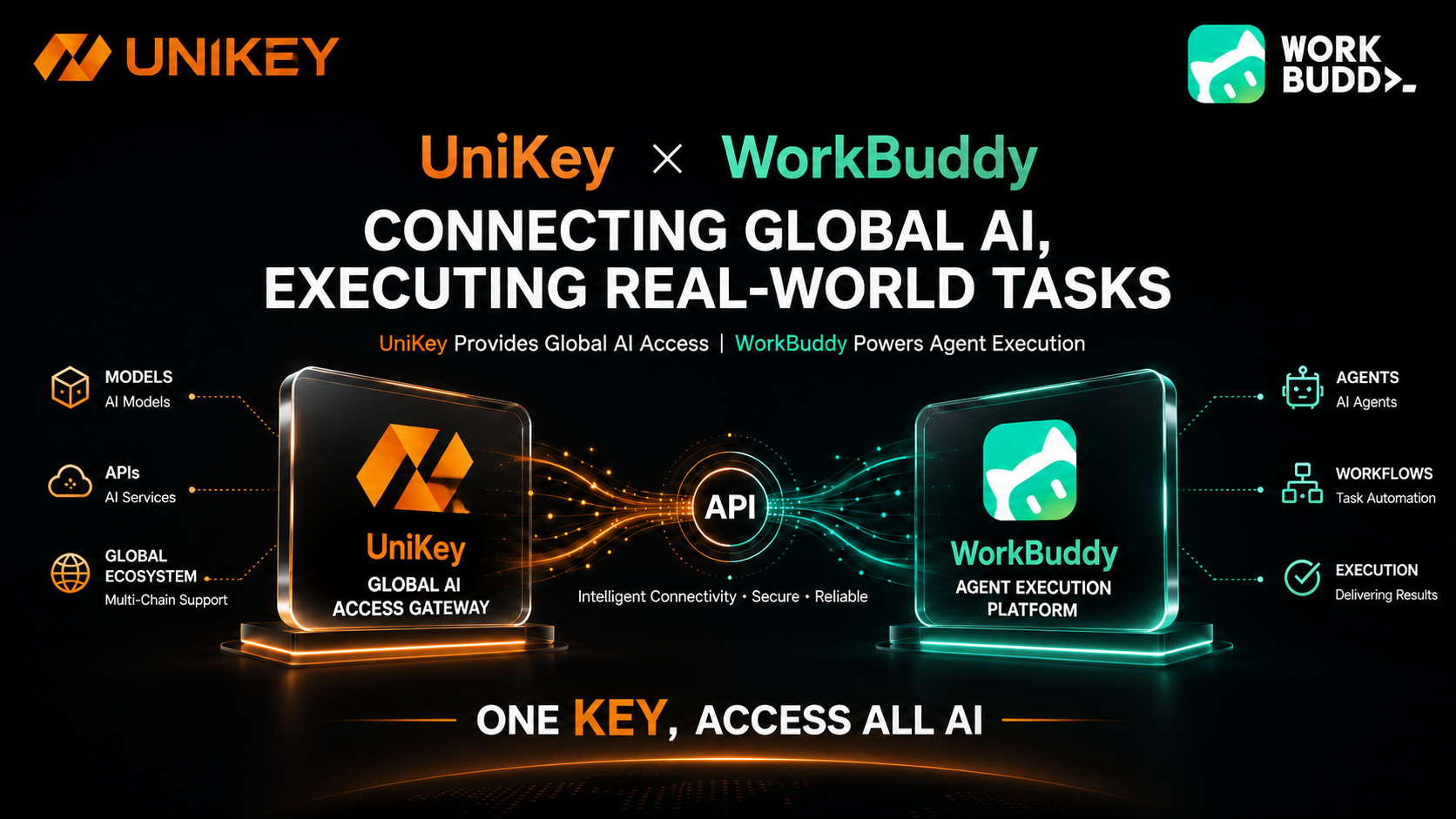
Under UniKey's current product narrative, it isn't just offering users a model chat interface — it uses an AI Gateway, API Keys, and AI Credits to unify access to global models, multimodal tools, skills, agents, and workflows. For an agent product like WorkBuddy that supports custom model APIs, UniKey's value isn't to replace its task-execution capability — it's to supply a more complete upstream layer of intelligence.
From a technical-architecture standpoint, WorkBuddy supports configuring an external endpoint URL, API Key, and model name — so, provided UniKey exposes a compatible interface, WorkBuddy-type products have the technical conditions needed to use UniKey as a unified model service entry point. To be clear: this discussion concerns the connection logic at the product and interface level, and does not imply the two parties have publicly announced a formal partnership.
Once connected, WorkBuddy remains responsible for facing the user, understanding tasks, and operating tools; UniKey, behind the scenes, can handle model access, intelligent routing, unified metering, and call management. Users wouldn't need to separately maintain balances and interfaces across multiple model platforms inside WorkBuddy — instead, a single KEY grants access to a much broader range of model capability.
What Really Matters Isn't Connecting to More Models — It's Routing Each Task to the Right One
Once an agent is free to invoke any model, "more models is better" stops being the answer. Different models have different strengths across reasoning, code, multilingual tasks, long-context handling, image understanding, speed, and price. A complex task isn't necessarily best served by the same model throughout: task planning may call for a strong reasoning model, text cleanup can run on a lower-cost model, code review may benefit from a specialized coding model, and image understanding requires multimodal capability.
This is exactly where UniKey's intelligent routing creates value. The platform can match the appropriate model to a task based on task type, call cost, response speed, and service reliability, and switch to a backup channel automatically if a service becomes unstable. For a WorkBuddy-type agent product, this means it doesn't need to expose the complexity of model selection to the user, nor lock its own capability to a single model provider.
Ultimately, the user only needs to describe the goal. WorkBuddy handles orchestrating execution; UniKey handles supplying the right intelligence for each execution step. Competition among AI products will likewise upgrade — from "which model is used by default" to "who can complete the entire task at lower cost and with higher reliability."
AI Credits Turn Complex Calls Into a Single, Manageable Unit of Consumption
WorkBuddy has already adopted token-quota packages for commercialization, which reflects the fact that agent products need a clear usage-accounting system. An agent doesn't just answer once — it continuously reads context, calls models, and executes tools, so real consumption is typically far more complex than a standard chat interaction.
UniKey's AI Credits can go a step further, unifying token usage across different models, image generation, video generation, skill invocation, agent services, and workflow execution into a single consumption-credit system. For everyday users, this lowers the barrier of having to understand different billing rules across providers; for enterprises, it helps teams centrally manage budget, permissions, call records, and cost attribution; for agents, it enables setting an independent spending allowance so the agent can operate autonomously within a clearly defined risk boundary.
Within this structure, the token remains the underlying unit of usage at the model layer, while AI Credits become the unified consumption credential facing users and business scenarios. Every task an agent completes — and every call and unit of consumption behind it — can be logged, metered, and managed, rather than scattered across multiple vendor invoices.
From One WorkBuddy to Countless Agent Entry Points
WorkBuddy is just one snapshot of the rapid growth of agent products. The future will likely bring a large number of agent products built for office work, programming, e-commerce, marketing, customer service, investment research, and enterprise management. Their interfaces, tasks, and user scenarios will all differ — but at the foundation, they will all need models, APIs, data, tools, budgeting, and settlement capability.
This means UniKey's long-term opportunity isn't limited to acquiring individual users who directly use the platform — it's becoming the capability entry point behind every category of agent application. WorkBuddy, enterprise bots, industry-specific agents, smart hardware, and automation systems could all call the models and services UniKey connects to via API. Every external agent product has the potential to become a usage entry point within the UniKey network.
As the number of entry points keeps growing, UniKey's core metrics will no longer be limited to registered users — they will increasingly become the number of API Keys, AI Credits consumed, agent task volume, number of enterprise accounts, call reliability, and settlement scale. The platform evolves from a user-facing AI product into infrastructure that underpins global intelligence consumption.
From "Owning Models" to "Organizing Global Intelligence"
The emergence of WorkBuddy shows that the AI industry is entering an execution era. Users won't keep paying, long-term, for a model that can only chat — they're willing to pay for getting tasks done, saving time, and obtaining results. Agents are moving ever closer to real work processes, and models are increasingly becoming background infrastructure hidden behind the scenes.
Under this trend, what's genuinely scarce isn't any single model — it's the network capable of connecting models, orchestrating calls, controlling cost, and completing settlement. WorkBuddy solves "how AI gets work done on the desktop and in enterprise scenarios"; what UniKey needs to solve is "where these agents obtain capability, how that capability gets consumed, and how value gets uniformly metered."
Going forward, agents like WorkBuddy can serve as task-execution terminals, while UniKey becomes the intelligence-supply and settlement layer connecting global models, skills, agents, and workflows.
One KEY, access to global AI.
One AI Credits system, powering every unit of intelligent consumption.
One network — where every agent obtains capability, completes tasks, and settles value.


All Comments