

Cointime

Download App
iOS & Android

Whales drive NFT comeback on BNB Chain in Q3: Messari

Cointime Official

From cointelegraph by Brayden Lindrea

Non-fungible tokens trading volumes on the BNB Chain saw a resurgence in the third quarter, increasing 283% to a daily average of $600,400, according to blockchain analytics firm Messari.

The average daily sales also increased, up 47% quarter-on-quarter to 8,900, according to Messari’s Research Manager “AJC.”

“However, average daily buyers were down 53% QoQ to 2,300, signaling that NFT activity in Q3 was driven by ‘whales’ rather than small users,” the Nov. 7 report stated.
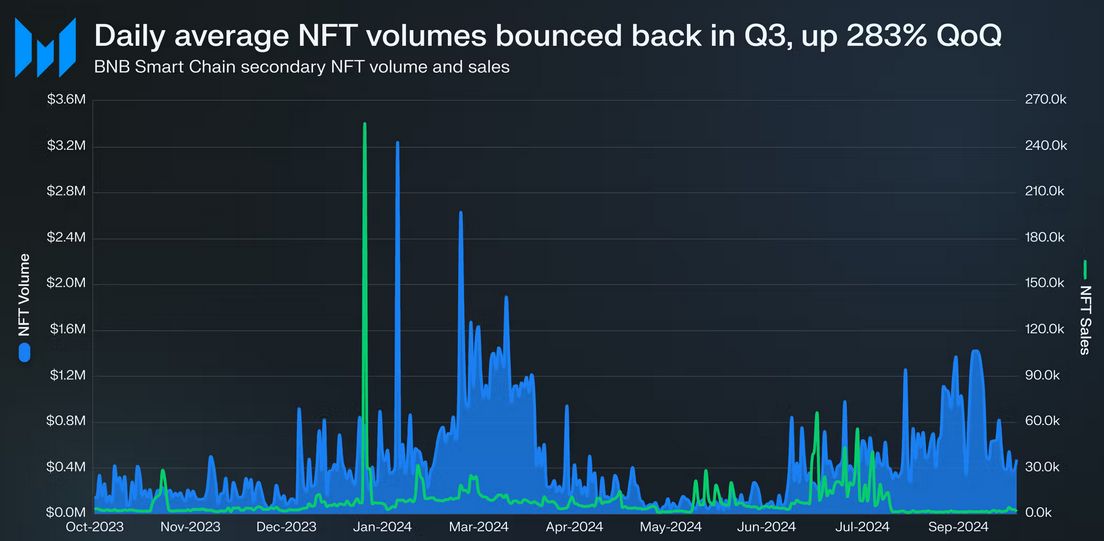
Daily average NFT volume on BNB Chain since Oct. 2023. Source: Messari

BNB Chain’s $55.2 million NFT trading volume (calculated by multiplying the average daily volume by the number of days in Q3) still pales in comparison to the Ethereum and Bitcoin networks, which tallied $120.7 million and $74.6 million in trading volume over the last 30 days alone, CryptoSlam data shows.

Advertisement

Experience the magic of WAGMI Miami on Jan. 21-24 – The Biggest Blockchain Event in America – Get your tickets now!

Ad

Solana, Mythos Chain, Polygon and Immutable have also seen more trading volume than the BNB Chain over the same timeframe.

Other metrics describing BNB Chain’s performance were mixed. 

BNB Chain’s revenue tumbled 27.9% quarter-on-quarter to $34.9 million, which was largely attributed to a 27% fall in gas fees paid on decentralized finance transactions.

BNB Chain’s average daily active address also dropped 19% to 900,000 as average daily transactions fell 8.1%.

Related: Dip in trading at Binance and other major crypto exchanges confounds experts

However, the total value locked on the BNB Chain increased 2.2% to $4.8 billion in Q3, with Algorithmic money market protocol Venus Finance being the biggest contributor to that rise, increasing 13% to $1.79 billion.

MoreBNB$617.00tokens were burned than minted in Q3 — resulting in a deflation rate of 4.5% and contributing to a 2.5% price rise as the broader market slightly regressed, CoinGecko data shows.

Key performance indicators of the BNB Smart Chain in Q3 2024. Source: Messari

Two of the most common use cases for BNB Chain were transacting with the Tether USDT$1.00 stablecoin and interacting with the decentralized exchange PancakeSwap, Messari’s analysis showed.

The BNB Chain was launched by crypto exchange Binance in 2020, initially under the name Binance Smart Chain.

It boasts the fourth largest TVL among layer-1 blockchains, trailing only Ethereum, Solana and Tron, DefiLlama data shows.

Meanwhile, BNB Chain unveiled a new real-world asset tokenization service that provides individuals and businesses with a no-code solution to tokenize real-world assets in “minutes” earlier this week.

Binance team members behind the solution claim it significantly reduces the cost, time and labor needed to tokenize assets, lowering the barrier to entry for everyone.

Magazine: Real life yield farming: How tokenization is transforming lives in Africa

Comments

All Comments

Recommended for you

  • Analyst Andrew Sacher: Waller's Remarks Undermine Market Dovish Expectations

    On August 28, analyst Andrew Sacher stated: "Previously, some believed that Federal Reserve Chairman Waller advocated for using alternative inflation measures to select the one most favorable to him. However, in this speech, his approach was quite the opposite. He dissected PCE inflation and found that 49% of its components had an annualized price increase exceeding 3%, categorizing this level as 'quite high.' His discussion on the labor market was also hawkish, focusing on low unemployment rates and initial jobless claims. The usually closely watched non-farm payroll numbers were only briefly mentioned." (Jinshi)

  • Walsh Emphasizes Anti-Inflation Efforts as U.S. Short-Term Treasury Yields Rise

    On August 28, U.S. short-term Treasury yields increased. Federal Reserve Chairman Walsh, in a highly anticipated speech, emphasized the need for the Fed to curb rising consumer prices, alleviating some market concerns about its ability to combat inflation. During Walsh's speech, short-term U.S. Treasuries were sold off while long-term Treasuries rose. The yield on the two-year Treasury increased by 5 basis points to 4.28%, while the 30-year yield fell by 1 basis point to 5.19%. These changes indicate that the market expects the Fed may need to raise short-term rates. Since Walsh's first press conference in June, bond traders have had doubts about his policy stance. At that time, Walsh stressed the need to lower inflation and displayed a hawkish stance. Since the global economy reopened from the pandemic in 2021, U.S. inflation has remained above the Fed's 2% target. However, in July, the Fed kept rates unchanged, and Walsh did not indicate whether a rate hike might occur this year. Subsequently, long-term Treasury yields rose significantly as traders demanded higher returns to compensate for the risks posed by escalating inflation. On Friday, Walsh warned that inflation had not shown meaningful signs of slowing and stated that policymakers must be confident that inflation is improving; otherwise, the central bank 'has work to do.' He also reiterated that policymakers will bring the inflation rate back to the 2% target, emphasizing that this goal is clear and fixed.

  • Walsh Emphasizes Anti-Inflation Efforts as US Short-Term Bond Yields Rise

    On August 28, US short-term Treasury yields increased. Federal Reserve Chairman Walsh, in a highly anticipated speech, emphasized the need for the Fed to curb rising consumer prices, alleviating some market concerns about its ability to combat inflation. During Walsh's speech, short-term US Treasuries were sold off while long-term Treasuries rose. The yield on the two-year Treasury increased by 5 basis points to 4.28%, while the 30-year yield decreased by 1 basis point to 5.19%. These changes indicate that the market expects the Fed may need to raise short-term rates. Since Walsh held his first press conference in June, bond traders have expressed doubts about his policy stance. At that time, Walsh stressed the need to lower inflation and exhibited a hawkish position. Since the global economy reopened from the pandemic in 2021, US inflation has consistently exceeded the Fed's 2% target. However, in July, the Fed maintained interest rates, and Walsh did not indicate whether a rate hike might occur this year. Subsequently, long-term Treasury yields surged as traders demanded higher returns to compensate for the risks posed by rising inflation. Walsh warned on Friday that inflation has not shown meaningful signs of slowing and stated that policymakers must be confident that inflation is improving; otherwise, the central bank 'has work to do.' He also reiterated that policymakers will bring the inflation rate back to the 2% target, emphasizing that this goal is clear and fixed.

  • ETH Surpasses $2500

    Market data shows that ETH has surpassed $2500, currently priced at $2500.8, with a 24-hour decline of 0.21%. The market is experiencing significant volatility, so please ensure proper risk management.

  • ETH Surpasses $2500

    Market data shows that ETH has surpassed $2500, currently priced at $2500.8, with a 24-hour decline of 0.21%. The market is experiencing significant volatility, so please ensure proper risk management.

  • Waller Signals Hawkish Stance, Sees No Restrictive Financial Conditions

    On August 28, in a speech that was more hawkish than many market participants expected, Federal Reserve Chairman Kevin Waller cited a series of indicators showing a strong economic condition, including high corporate profits, stable consumer spending, and narrowing credit spreads. Waller stated, "In my view, the credit and loan markets show almost no signs that monetary policy is becoming restrictive. Overall, I find it difficult to describe the current overall financial conditions as restrictive." This statement boosted Wall Street's bets on interest rate hikes by the Federal Reserve.

  • Waller Signals Hawkish Stance, Sees No Restrictive Financial Conditions

    On August 28, in a speech that was more hawkish than many market participants expected, Federal Reserve Chairman Kevin Waller cited a series of indicators showing a strong economic condition, including high corporate profits, stable consumer spending, and narrowing credit spreads. Waller stated, "In my view, the credit and loan markets show almost no signs that monetary policy is becoming restrictive. Overall, I find it difficult to describe the current overall financial conditions as restrictive." This statement boosted Wall Street's bets on a rate hike by the Federal Reserve.

  • Spot Gold Falls Below $4,560/Ounce, Daily Decline of 0.91%

    Spot gold has fallen below $4,560 per ounce, with a daily decline of 0.91%.

  • Spot Gold Falls Below $4560/Ounce, Daily Decline of 0.91%

    Spot gold has fallen below $4560 per ounce, with a daily decline of 0.91%.

  • Waller Signals Rate Hike as Fed Focuses on Inflation

    On August 28, Federal Reserve Chairman Waller stated on Friday that if policymakers cannot be confident that inflation is returning to 2% "in a clear and sufficiently rapid manner," the Fed "has work to do." This suggests that if price pressures do not improve, the Fed may consider raising rates in its next move. Waller made it clear that he still supports the Fed's long-standing policy path of managing inflation through interest rate adjustments. This significantly increases the likelihood of a rate hike in the near future, which may put him at odds with President Trump, who has long sought rate cuts. This statement effectively eliminates the ambiguity left previously. At a press conference at the end of July, Waller had refrained from responding extensively to whether a rate hike was necessary to address the inflation issue, which has significantly risen this year and has been above the Fed's target for over five consecutive years.
