

For years, institutions seeking Bitcoin exposure went to Grayscale Investments, with its more than $28 billion in BTC assets under management (AUM) dwarfing its closest competitor several times over.
All that changed on Jan. 11, when 10 firms launched spot Bitcoin exchange-traded funds (ETFs) in the United States for the first time after finally securing approval from the U.S. Securities and Exchange Commission (SEC). The firms included Grayscale, which converted its decade-old Grayscale Bitcoin Trust (GBTC) to an ETF.
Jan. 11 was a singular moment, not only for the crypto world but also for Wall Street. “It’s rare you get a new asset class into the lexicon of ETFs,” Todd Sohn, ETF strategist and managing director at Strategas Asset Management, told Cointelegraph. “We had equities back in 1993, bonds in 2002 and gold in 2004.”
But in addition to opening up a relatively pristine asset category to retail investors, Jan. 11 also set off a race. Which of the new ETFs is likely to prevail?
The Wall Street giants of BlackRock and Fidelity Investments? Or maybe the more crypto-focused asset managers, such as ARK Invest or Bitwise, both of whom gathered more than $500 million in AUM in their first two weeks? Or perhaps incumbent Grayscale, so long unchallenged? It reduced its annual 2% management fee to 1.5% for the ETF launch.
In terms of GBTC versus the others, it has a massive start, noted Sohn, “but if we are to take these first two weeks as any sign, it’s that issuers such as BlackRock and Fidelity are very serious about this product.”
Grayscale experienced sizable outflows in the first two weeks following the launches, but even after losing $5 billion in redemptions, it still retained $20.2 billion in AUM on Jan. 26. By comparison, BlackRock had about $2 billion and Fidelity had $1.75 billion at Friday’s closing, with the other ETFs further back.
Still, is GBTC likely to keep its enormous lead over the TradFi asset managers through the coming year?
And in the longer term, will we look back at Jan. 11 as a sort of changing of the guard, when blockchain startups and crypto-focused firms began to be swallowed up by Wall Street’s leviathans?
An industry hangover?
The Bitcoin price fell in the days following its spot ETF debut — by nearly 20% — and raised questions if the crypto industry had perhaps expected too much from the new investment vehicles.
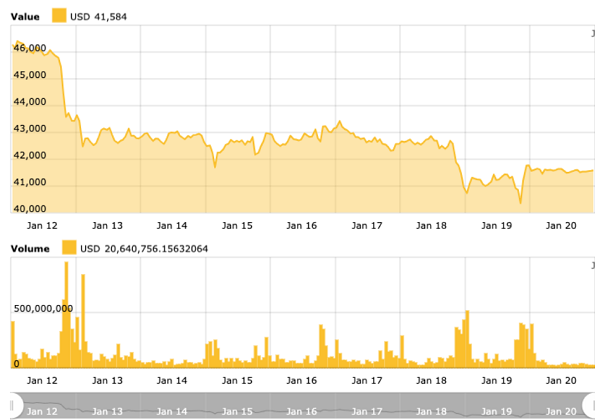
On Jan. 23, for instance, JPMorgan analysts said that the “catalyst in Bitcoin ETFs that has pushed the ecosystem out of its winter will disappoint market participants.”
Was too much being asked from the spot Bitcoin ETFs?
“I would just keep in mind that the underlying Bitcoin had a huge run-up prior to these fund launches,” said Sohn, “so a pause isn’t terribly surprising.” By Jan. 29, Bitcoin had recovered some, nosing above $43,000 in the afternoon.
“Gold [in 2004] traded sideways for a short time frame before lifting off again,” Sohn added.
In fact, the first gold ETF gathered more than $1 billion in assets in its first three days, starting Nov. 18, 2004, “which sealed its place in history as the fastest an ETF has ever attracted that level of assets,” according to Institutional Investor.
The SPDR Gold Trust ETF (GLD) “revolutionized gold trading,” and three years later, it had $10 billion in AUM.
But to Sohn’s point: In the first half year after GLD’s launch, from October 2004 to April 2005, its price barely budged on the New York Stock Exchange.
Depressing the price of BTC?
Returning to the present, overall outflows from GBTC and the other nine ETFs are already ebbing. They were positive on Jan. 26, the first time in seven days.
“The selling pressure/outflows from GBTC from investors taking profits will eventually slow down as selling in the fund subsides with time,” Peter Sin Guili, a Singapore-based financial professional and veteran crypto markets observer, told Cointelegraph.
Some runoff was from one-off events, like “the offloading of 22 million shares of GBTC — $1 billion worth in outflows — by FTX’s bankruptcy estate,” added Guili.
“I’m unfazed by the GBTC outflows and transfers from Grayscale,” Justin d’Anethan, head of business development, APAC, at Keyrock, a cryptocurrency market maker, told Cointelegraph. “Many people will assume those are negative [news] for prices, but I don’t think that’s necessarily the case.”
It’s primarily a result of GBTC’s management fee, higher by several factors than most of the other new spot Bitcoin EFTs, with people “exiting the former to simply cycle to the latter,” said d’Anethan.
The structure or value of the underlying product hasn’t changed, after all. It’s simply cheaper to buy BTC in the BlackRock “store” or the Fidelity Investments “store” than from GBTC for now.
“The key question — which we don’t know the answer to — is how much more AUM will leave,” Sohn added. “Is there a pain point at which Grayscale lowers its 1.5% fee? This may have huge implications for who reigns as the AUM king.”
Will others surpass Grayscale?
It’s worth noting that two weeks after launch, Grayscale “remains the largest AUM spot Bitcoin ETF out there and will probably retain that spot for the foreseeable future,” said d’Anethan. Many holders remain comfortable with Grayscale’s set-up, internal due diligence and business relationships, he suggested.
“They [Grayscale] have a huge first mover advantage,” Seoyoung Kim, associate professor of finance at Santa Clara University’s Leavey School of Business, told Cointelegraph. “Also, there’s a cost of switching. One reason people will still stick with Grayscale despite the high fee is [they may] trigger a tax liability” if they switch.
“Long-term, other ETF providers might eventually overtake Grayscale,” said d’Anethan, “but it’s worth remembering that for now, the lead is absolutely massive with at least $15 billion in AUM more than its closest contender.”
Still, the larger trend over the past 10 years favors low-fee, passively managed index equity ETFs at the expense of actively managed, high-fee equity mutual funds, as Bloomberg analyst Eric Balchunas noted in a recent post. Arguably, this puts the other nine Bitcoin ETFs more in step with prevailing investor preferences than higher-fee GBTC.
Kim also suggested Grayscale has a fee problem. “These outflows from Grayscale are going to create opportunities,” she told Cointelegraph, “especially since BlackRock, Fidelity and the others are going to charge much lower fees.” She added:
“There was a lot of frustration among investors [pre-Jan. 11] because the price of the Grayscale shares was trading far below NAV [net asset value], and there was nothing anybody could do about it because of the way that the redemptions work. There wasn’t a good liquidation and market price discovery mechanism.”
Meanwhile, Grayscale is still charging 150 basis points (bps) after the ETF launch. By comparison, BlackRock was charging 12.5 bps for its ETF, while Fidelity has waived its fee entirely until Aug. 1.
“Investors who allocate to ETFs are very cost-conscious. Every basis point matters,” Ryan Rasmussen, senior crypto research analyst at Bitwise, told Cointelegraph. “That leaves space for a new low-cost leader to emerge in the spot Bitcoin ETF battle.”
“I believe larger ETFs like those from BlackRock and Fidelity will surpass GBTC in prominence and trading volumes,” James Lawrence, CEO of NFTY Labs, told Cointelegraph.
Their “established names” and scale give them an advantage, “especially with Fidelity offering its custodial services. I expect a swift shift in market dominance toward these traditional finance giants.”
“BlackRock’s IBIT will be the closest rival to GBTC,” opined Guili, though he didn’t rule out Fidelity, especially with its path-setting custodian solution, which he considered “a strong selling point.”
Bitwise could also be competitive, given that it focuses primarily on crypto products and “has a huge support base and brand recognition with early adopters of cryptocurrencies within the crypto space.”
A changing of the guard?
If BlackRock, Fidelity and perhaps some other Wall Street firms eventually eclipse Grayscale, would that signal a changing of the guard, i.e., giant traditional finance companies swallowing up or overwhelming crypto startups or crypto-focused firms?
“I think you’ll have one side of the industry using TradFi solutions because they are comfortable with the ETF wrapper and the custodial guardrails around it — and perhaps their parent companies want it that way,” said Sohn.
“But there will always be a need for crypto startups and innovators to push the industry forward,” he said, adding:
“The new kid on the block opens eyes to fresh perspectives and solutions. A large chunk of industry participants will likely want to seek out solutions through that route as opposed to the ETF/TradFi vehicle.”
“I don’t see traditional finance completely swallowing up crypto startups,” said Lawrence. Larger players are often risk-averse, and their regulatory and compliance approvals can take time. Many crypto startups, especially in the decentralized finance subsector, are unlikely to be targeted by large TradFi firms in his view.
Guili agreed that the future direction of cryptocurrencies will be dominated by giant TradFi companies and asset managers like BlackRock and Fidelity, “but smaller crypto startups still have an important role to fill — as the bedrock of crypto and blockchain innovation, and also providing alternative product solutions for a niche market.”
A “milestone” for crypto?
It may take some time to get a grip on what this all means for cryptocurrency adoption. The spot market ETFs remain arguably just another piece in the puzzle, with other key sections still missing. Said d’Anethan:
“While the new ETFs make crypto exposure easier, the actual trading of ‘physical’ Bitcoin remains very difficult thanks to regulatory and fiscal constraints.”
That said, the new spot market ETFs “represent a gigantic milestone in terms of perception of crypto,” d’Anethan continued. Many traditional market makers and funds already have some exposure to crypto, “but now you might see other huge asset managers and pension funds allocate some AUM to crypto-linked ETFs that will bolster the space and prices.”
Recent: Big-tech firms like IBM and Amazon lead generative AI boom with new tools
“This is an all-hands-on-deck move for issuers,” added Sohn, “just given crypto’s popularity, albeit polarizing, and being a provider of a solution.”
“It’s not every day that you see the largest financial institutions in the world and the U.S. government give their stamp of approval on a new asset class,” said analyst Rasmussen, describing Jan. 11 as a “moon landing moment.”
“But the market is big enough for crypto-native firms and traditional financial institutions to coexist.”


All Comments