

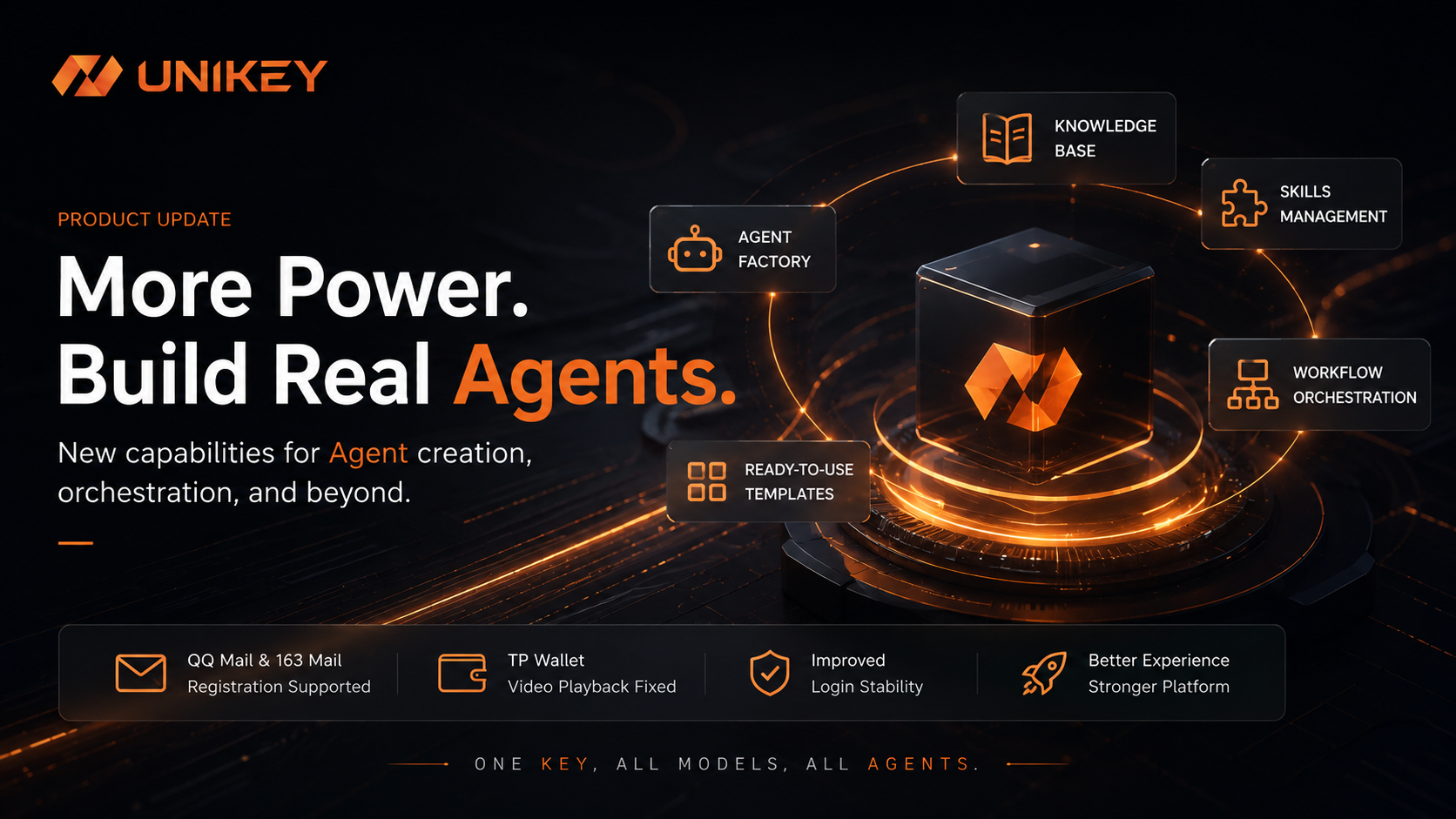
UniKey has completed its latest product update. Compared with previous upgrades focused primarily on model access, image generation, video generation, and unified APIs, this release clearly moves the platform to a higher level of Agent production and task orchestration. UniKey has added Agent Factory, Knowledge Base, Skills Management, and Workflow Orchestration, together with multiple ready-to-use templates, allowing users to move beyond simply “calling a model” and toward combining multiple AI capabilities into an Agent that can continuously perform real tasks.
At the same time, UniKey continues to improve the real user experience. The platform now supports registration with QQ Mail and 163 Mail, further lowering the entry barrier for Chinese-speaking users. It has also fixed the issue that prevented videos from playing inside TP Wallet, as well as the occasional problem that required users to log in again. From capability expansion to infrastructure-level experience optimization, the signal from this update is clear: UniKey is moving from a unified gateway to global AI capabilities toward a new stage centered on Agent creation, capability orchestration, and Workflow execution.
Agent Factory Joins the Product System: UniKey Moves from “Providing AI” to “Producing Agents”
Previously, UniKey had already connected multiple models, image generation, video generation, APIs, and other AI capabilities through a unified entry point. But for truly complex business tasks, simply “having access to many models” is not enough. A complete market research task, content production process, enterprise customer service flow, or data analysis job often requires several models, different tools, and multiple execution steps working together. What users really need is no longer just a chatbot, but an intelligent system that can continuously work toward a specific objective.
The addition of Agent Factory brings this capability directly into the product layer. Users can now create and configure Agents around specific tasks, while further extending their capabilities through Knowledge Bases, Skills, and Workflows. More importantly, UniKey has initialized multiple templates that can be used directly, meaning users no longer need to build everything from a blank page. They can start from an existing structure and customize it according to their own needs, significantly reducing the barrier to configuring and using Agents.
This is a key step in UniKey’s product positioning. If AI Gateway solves the problem of “how to access global AI through one unified layer,” Agent Factory begins to solve “how to organize those AI capabilities to actually complete tasks.” UniKey is no longer just providing access to models. It is increasingly becoming a production platform where users can create, combine, and operate intelligent Agents.
Knowledge Base + Skills + Workflow: Giving Agents Real Working Capabilities
A truly useful Agent cannot rely on a large language model alone. Models provide understanding and reasoning, but real-world tasks also require proprietary knowledge, specialized tools, and continuous execution processes. An enterprise Agent may need to read internal documents, a content Agent may need to call creative tools, and an operations Agent may need to follow a fixed multi-step process. The upper limit of an Agent’s capability therefore depends heavily on whether it can reliably connect knowledge, tools, and Workflows.
This update introduces Knowledge Base, Skills Management, and Workflow Orchestration together, effectively strengthening three core dimensions of an Agent. The Knowledge Base allows an Agent to work from specific materials and business information. Skills package professional capabilities into reusable components. Workflow organizes multiple actions into a continuous task flow. When these three layers work together, an Agent is no longer simply capable of answering questions. It can call different capabilities and execute an entire task chain around a defined goal.
This also makes UniKey’s product architecture much clearer: Models provide foundational intelligence, Knowledge Bases provide proprietary information, Skills provide specialized capabilities, Workflows organize execution, and Agents complete the final task. Once these modules begin operating within the same platform, UniKey is no longer merely connecting global AI models. It is gradually building a complete system for producing and executing intelligent services.
Ready-to-Use Templates: Turning Agents from Developer Tools into Products for Everyone
One of the biggest barriers in today’s Agent market is not that models are not powerful enough, but that the configuration process remains too complex. Developers can use code, APIs, and various frameworks to build Agents, but for ordinary users, content teams, and enterprise operators, building every Agent from scratch—designing prompts, tools, knowledge sources, and execution flows—still creates a significant adoption barrier.
That is why the addition of multiple initialized templates is especially important. These templates shorten the distance between “understanding what an Agent is” and “actually using one.” Users can start from a preconfigured structure and then modify the knowledge, capabilities, and processes according to their own business needs, instead of rebuilding the entire system from the ground up. In the future, content creation, information organization, market research, and enterprise operations can all be gradually transformed into reusable intelligent workflows through templates.
From a product perspective, this means UniKey is trying to turn Agents from a capability used primarily by technical users into a more standardized and productized AI service. Large-scale Agent adoption will not happen by requiring everyone to become a developer. It will happen when users can deploy intelligence as easily as they use SaaS today—through templates, components, and visual configuration. This update moves UniKey further in that direction.
Registration Becomes More Accessible: QQ Mail and 163 Mail Now Supported
Beyond the expansion of AI capabilities, this update also improves the very first step in the UniKey user journey. The platform now supports QQ Mail and 163 Mail registration, covering two of the most commonly used email systems among Chinese internet users. This allows more users to create UniKey accounts directly without needing additional international email services.
The change may appear simple, but it directly affects user growth efficiency. Global AI products often face a common problem: their technical capabilities may be strong, but registration, payments, account verification, and other basic steps are not always adapted to users in different regions. As UniKey continues expanding globally and serving users across multiple markets, the registration layer also needs to reflect real local usage habits.
Adding QQ Mail and 163 Mail is therefore more than a minor login feature. It is part of UniKey’s broader effort to reduce friction at the user entry layer. A global AI gateway should not only connect global models—it should also make it easier for users in different regions to enter the system.
TP Wallet Video Playback Fixed: Further Optimization for Web3 Environments
As a product serving both AI and Web3 users, UniKey is not limited to conventional browser environments. Some users access the platform through built-in browsers inside Web3 wallets such as TP Wallet, which means video playback, page compatibility, and account-state management must work across more complex runtime environments.
This update fixes the issue that previously prevented video playback inside TP Wallet. For UniKey, where text-to-video and multimedia content are already part of the product experience, this is particularly important. Users entering the platform through wallet environments can now access a more complete video experience without losing functionality because of terminal differences.
From a longer-term product perspective, this optimization also fits UniKey’s direction. As AI Credits, KEY, Agent services, and on-chain settlement continue to develop, Web3 wallets could become an important access point to the intelligent service network. Stable wallet compatibility is therefore not a marginal requirement, but a fundamental capability for any platform that aims to connect AI and Web3 in real-world usage scenarios.
Login Stability Improved: Reducing Occasional Forced Re-Authentication
This release also fixes an issue where some users would occasionally be required to log in again. For an ordinary content platform, re-authentication may seem like a minor usability issue. But for an AI platform that is moving toward APIs, Agents, Workflows, and continuously running tasks, account-session stability directly affects whether users are willing to place long-term work processes on the platform.
As users begin storing Knowledge Bases, configuring Agents, running Workflows, and managing Skills inside UniKey, the platform is no longer just an AI tool that users open briefly and leave. It is becoming a persistent intelligent workspace. As a result, account state, task continuity, and reliable multi-device access become increasingly close to core infrastructure capabilities.
Although this login fix is a lower-level experience improvement, when viewed alongside major new features such as Agent Factory, it reveals two parallel product directions. UniKey is continuing to expand upward into more advanced intelligent capabilities while strengthening stability and usability at the foundational layer. AI infrastructure that can scale needs not only stronger capabilities, but also fewer points of friction.
From Model Gateway to Agent Production Platform, UniKey’s Product Path Is Becoming More Complete
From multi-model chat, image generation, and text-to-video, to unified APIs and AI Router, and now to Agent Factory, Knowledge Base, Skills, and Workflow, UniKey’s product capabilities are beginning to form a clear layered structure. The lower layer connects models and AI capabilities, the middle layer manages and orchestrates usage, and the upper layer increasingly supports Agent creation and task execution.
This evolution also changes the level at which UniKey competes. In the future, users will care less about “which platform has more models” and more about whether different models, knowledge sources, tools, and processes can be combined into a system that works continuously. Models will keep changing and may be replaced over time, but if a platform can organize those capabilities into a unified operating layer, users will not need to rebuild their workflows every time the underlying AI landscape changes.
That is why the most important part of this release is not the addition of several new menu items. It is that UniKey is moving closer to completing a full product chain:Connect AI → Organize Capabilities → Create Agents → Orchestrate Workflows → Complete Real Tasks.
This marks another important step in UniKey’s evolution from a global AI Gateway toward next-generation intelligent service infrastructure.
UniKey’s Next Stage: Enabling More People to Own Their Own Agents
AI is moving from the era of “everyone can use models” into an era where “everyone may have their own Agent.” But for Agents to become truly mainstream, users cannot be expected to learn complicated code and frameworks. Platforms must package models, knowledge, Skills, and Workflows into simpler product experiences.
This update is designed to fill exactly that gap. Agent Factory provides the creation layer. Knowledge Base gives Agents proprietary information. Skills expand their capability boundaries. Workflow organizes continuous execution. Initialized templates reduce the barrier to getting started. At the same time, email registration, wallet video compatibility, and login stability improvements make it easier for users to actually use these capabilities in real environments.
From “One KEY, access global AI” to enabling global AI capabilities to be created, combined, and executed, UniKey is extending its positioning from a unified gateway into an Agent production and task execution network.
One KEY connects global AI.One Agent puts global intelligence to work on real tasks.


All Comments