

Ⅰ. Introduction
With the continuous development of blockchain technology, DeFi derivative projects have gradually become the focus of the market. And the innovation of user experience, further financial innovation, the optimization of decentralized governance solutions, the implementation of new liquidity mining and incentive mechanisms have enabled decentralized derivative exchange to enter a period of rapid development. The rapid development of the industry is inseparable from the right opportunity, and it is a mistake to be too early or too late! The improvement of infrastructure is extremely important for the development of a project or even an industry, which can be easily concluded from the development history of dYdX.
In this context, the old derivative protocol Themis officially live on Blast L2 in May 2024, opening a brand new chapter. The economic model, as a core part of DeFi derivative projects, directly affects the success or failure of the project. A reasonable economic model can attract more investors and users and promote the sustainable development of the project. This article will deeply analyze the latest economic model of Themis, discuss its core concepts and mechanisms, advantages and innovations, risks and challenges, whether it can open up a new valuation space with "derivatives" + narrative in the future, and the potential dividends and opportunities behind it.
Ⅱ. The current situation of derivatives exchange
In the field of derivatives contract exchange, centralized exchanges still dominate, but it is undeniable that decentralized derivatives protocols have developed rapidly in the past two years, and the total open interest has achieved nearly a tenfold increase.
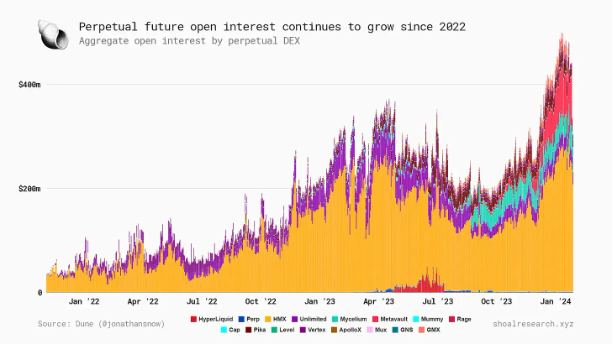
However, on the chain, the spot trading volume of DEX represented by Uniswap still significantly outperforms the trading volume of top decentralized derivatives trading protocols such as dYdX and GMX. In the final analysis, the development of on-chain derivatives protocols such as GMX, dYdX, and Drift, which have long been in the leading position, is far from keeping up with the narrative changes. According to the statistical data of DeFiLlama, as of April 15, 2024, the total scale of DeFi on the entire network is 86 billion USD, but the total TVL of derivatives protocols is only 3 billion USD, and the proportion of TVL of decentralized derivatives exchanges is only 3.48%.
Therefore, the derivatives market, as the most imaginative narrative in the on-chain DeFi track, urgently needs new breakthrough ideas.
Blast, as a new Ethereum Layer 2 network, aims to provide higher transaction throughput and lower transaction costs to solve the congestion and high Gas fees problem of the Ethereum network. Currently, Blast has been successfully launched, with its main network TVL approaching 2.5 billion USD and a total of 860,000 users. It is expected that in May, Blast will conduct an airdrop activity to distribute tokens to users participating in the network. With the performance and cost advantages of Blast L2, coupled with the traffic effect of Blast itself, many use cases of derivatives that are limited by the Ethereum main chain can be gradually implemented. This may be the reason why Themis Protocol takes action again after two years and deploys to Blast L2.
Ⅲ. Project overview
Themis Protocol is a decentralized derivatives exchange platform built on Blast L2, aiming to provide users with efficient, safe and transparent derivatives trading services.
From the perspective of the project and the team's experience, Themis Protocol has always been a time-tested and market-tested veteran protocol in the DeFi field. It even deployed the derivatives trading sector as early as September 2023. Its products include: Themis Swap, THS Pool, ETH Pool, tbTrade, etc.
May 2022
Deployed on BSC Chain for testing;
May 2023
Deployed on Filecoin (FEVM) for official operation;
Sep 2023
ETH bonds went online, the treasury construction plan was officially launched, the internal test version of the decentralized derivatives exchange went online, providing up to 50 times leverage trading;
April 2024
As of April 2024, the treasury ETH assets exceed 1,200 ETH;
May 2024
The protocol was deployed on Blast L2, the treasury ETH assets were migrated to Blast, and the ETH staked in the protocol became the first asset of the ETH Pool.
Ⅳ. Product & Model Introduction.
The importance of the economic model for DeFi derivatives projects is self-evident. A reasonable economic model can attract more investors and users and promote the sustainable development of the project. The economic model of Themis Protocol has fully considered the characteristics and market needs of the project in the design, and achieved the economic sustainable development of the project through innovative mechanisms and strategies.
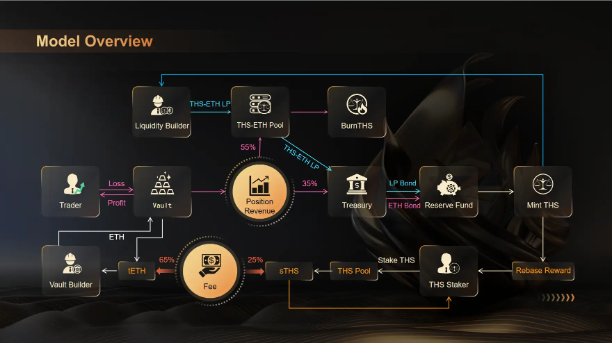
Themis organically integrates the construction incentives of the treasury, the minting, staking, and liquidity construction of the governance token, the user growth incentives, and transactions through five identities.
Vault builder
The vault builder stake ETH in Themis Vault and enters the ETH Pool to obtain tETH, which is the proof of the vault builder's holding share in the vault. tETH is not tradable and can be redeemed for ETH. Holding tETH can obtain a 65% share of the trading fee in the derivatives exchange, as well as an annualized coin-based income of about 4%. Early vault builders can also receive double rewards of Blast points and Themis points.
THS-ETH Liquidity Builder
After the THS-ETH liquidity builder adds liquidity, he obtains the THS-ETH LP, and then uses the LP to buy the LP bond , and mints the governance token THS. The price of the LP bond has a discount relative to the trading price of THS, and the LP is managed by the Themis treasury.
THS Staker
THS stakers can obtain the right to stake THS by minting SC. After staking THS, THS enters the THS Pool, and the staker obtains sTHS. The number of sTHS increases compoundly according to the rebase cycle, with a rebase cycle of 8 hours and a compound interest rate of 0.2%. The staker will obtain a relatively high annualized return (APY = 792%). sTHS holders will also receive a 25% share of the trading fee in the derivatives exchange.
Inviting THS stakers
SC is the scale code of Themis. SC is an indicator that reflects the contribution of users to the growth of users of the protocol. THS stakers need to spend an additional 20% of the value of staked THS in USDB to mint the SC token to obtain high returns (0.2%-8h). Inviting THS stakers and node users who have a greater contribution to the growth of protocol users can all receive SC token rewards. Burning SC can increase the release speed of THS staking returns. The price of the SC token keeps rising unilaterally, and the earlier it is obtained, the greater the profit space.
Derivatives traders
Derivatives traders earn ETH from the vault by shorting or longing a certain underlying asset, or lose their position ETH and enter the vault. In the long run, traders will lose their positions, and at this time, the vault will be over-collateralized. When the over-collateralization reaches 20%, 55% of the excess part is used to repurchase and burn THS in the THS-ETH Pool, and 35% enters the treasury as the THS mint reserve, and at the same time, the THS support price is increased.
tbTrade: Perpetual exchange that realizes interval liquidity based on the vault's fund pool
tbTrade is a decentralized perpetual exchange built by Themis Protocol based on Blast. As an established DeFi protocol, Themis previously launched the V1 version of derivatives exchange on Filecoin (FEVM) and has carried out multiple iterations and updates in nearly one year. After being polished and undergoing security audits, the latest tbTrade version has finally been launched and put into Blast.
The new version of tbTrade takes into account the advantages of both the limit order book (LOB) and the AMM, which can control risks while maximizing the utilization rate of the vault's funds and providing a better trading experience. To safeguard the interests of the vault builders, tbTrade has set up four protection mechanisms.
- Treasury reserve fund
In extreme cases, the Themis treasury contract is activated, and the reserve fund is used to mint THS and sell it to replenish the deficit in the vault.
- Dynamic spread rate
Through the automatic adjustment of the dynamic spread rate, arbitrage funds are attracted to balance long/short positions.
- Funding rate
Through the automatic adjustment of the funding rate, the funding rate is transferred between the long and short sides to balance the long and short positions.
- Profit capping mechanism
The maximum profit is 800%, and a single transaction can earn at most 800%, and it will be automatically closed when 800% profit is obtained.
Early users can provide ETH to the vault as liquidity. The ETH in the vault acts as the counterparty of traders on tbTrade. Users deposit ETH collateral to open long or short positions, and can provide up to 50 times leverage trading for users. Subsequently, synthetic asset classes will also be added, such as the price index of mainstream crypto assets such as ETH/USDT, BTC/USDT, etc. against the USD, foreign exchange, bulk commodities, etc.
Ⅴ. Summary
As an established DeFi protocol, we can look forward to the future performance of Themis after it live on Blast L2. At the same time, Themis community management has also revealed that a new Token and points reward will be launched during this migration and deployment on the Blast L2. Users can obtain potential airdrop opportunities while enjoying derivative exchange services. It is believed that with the efforts of the team and the support of the community, Themis will achieve greater success in the DeFi field.


All Comments