

The intertwined narratives of Web3 and AI are moving from early-stage conceptual speculation toward a profound restructuring of underlying productivity.
According to a recent global AI infrastructure research report released by Morgan Stanley, the AI capital expenditures of global hyperscale cloud providers (Meta, Amazon, Google, etc.) are moving toward an unprecedented digital monopoly black hole. It is estimated that by 2028, the total capital expenditure of the five largest platforms will surge to $1.4 trillion, while total global investment related to AI infrastructure will approach $3 trillion.
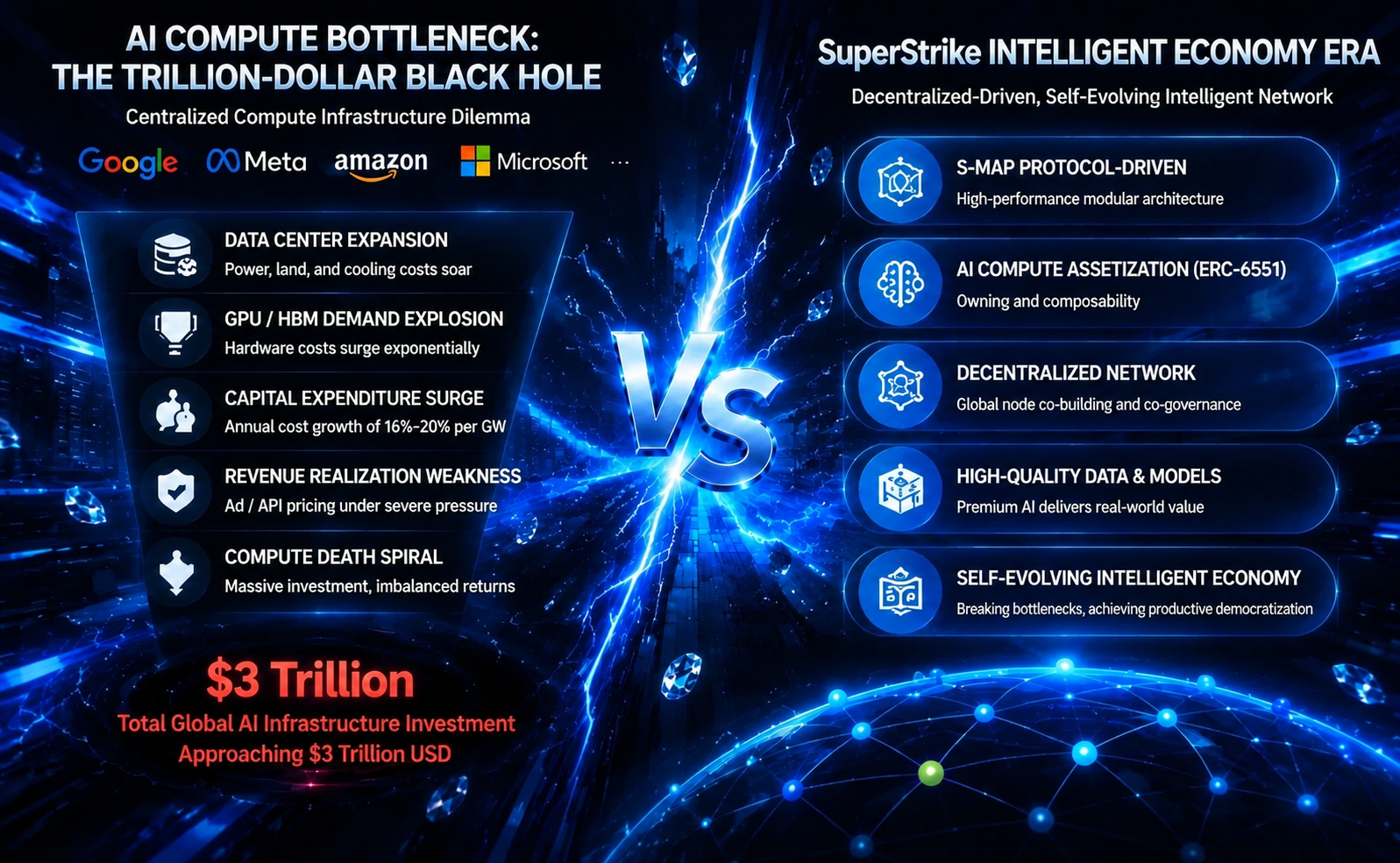
In this trillion-dollar gamble, driven by increasing HBM memory requirements, surging electricity costs, and rising land expenses, technology giants are facing a shared dilemma: the construction cost per GW of available computing capacity is rising rapidly at a rate of 16% to 20%, while revenue realization remains extremely fragile.
Whether shifting toward advertising upgrades or struggling in the low-price competitive API market, the Web2 traffic-based business model is becoming increasingly passive in the face of a “hash power death spiral” involving trillions of dollars.
The entire industry is asking:
How can silicon-based productivity break the monopoly of centralized giants and achieve autonomous value generation?
Breakthrough moments often emerge from the cracks of old systems. While traditional technology giants are still struggling with the commercialization of computing resources, the decentralized finance world has already begun a technological expedition toward the creation of an “intelligent economy.”
The emergence of SuperStrike is providing a completely different solution to the trillion-dollar hash power dilemma.
Paradigm Shift: From “Modular Tools” to an “Autonomous Financial Lifeform”
As a next-generation AI-native financial infrastructure evolved from the StrikeBit AI Modular Agent Protocol (MAP), SuperStrike was born with a mission to completely redefine the traditional nature of AI tools.
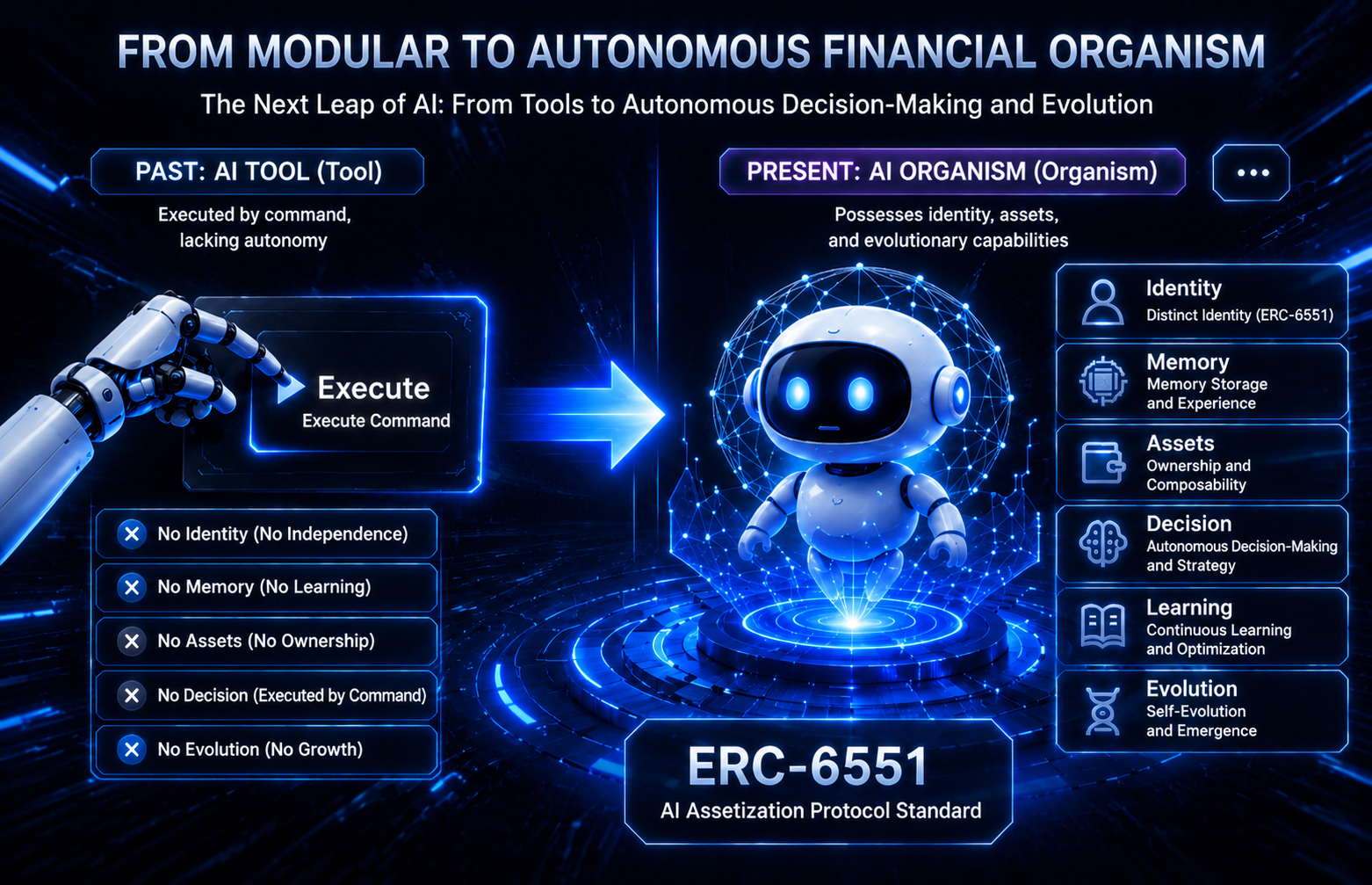
After StrikeBit AI established standards for modular collaboration, SuperStrike utilizes S-MAP (High-Performance Super Modular Architecture) to achieve a paradigm shift in AI computing power — transforming it from a “passive tool” into an “autonomous asset.”
Traditional AI quantitative or analytical tools are merely passive systems executing commands. In contrast, SuperStrike tokenizes AI computing power assets through ERC-6551, granting silicon-based intelligence independent “ownership” and “composability,” allowing every user to truly own a private hedge fund powered and operated autonomously by AI.
However, this is only the beginning of this technological expedition.
SuperStrike’s ultimate vision is to utilize the S-MAP protocol to build the world’s first blockchain network fully powered by AI — a decentralized “Super Agent Intent Network.”
The core mission of this network is to generate and train high-quality data and models genuinely required by leading global AI companies such as Google, Grok, and others.
Within this ecosystem, SuperStrike automatically generates, deploys, and incubates external projects through the network’s native mechanisms.
Countless AI computing resources generate “emergent effects” within real financial and data environments. Individual success experiences are fed back to the protocol in real time, driving the system to evolve into an always-operating “super brain.”
This collective evolution breaks the monopoly of centralized giants over advanced algorithms, achieving the democratization of AI productivity and data ownership.
Asset Gravity: $STRIKE as the Value Anchor of “Digital Oil”
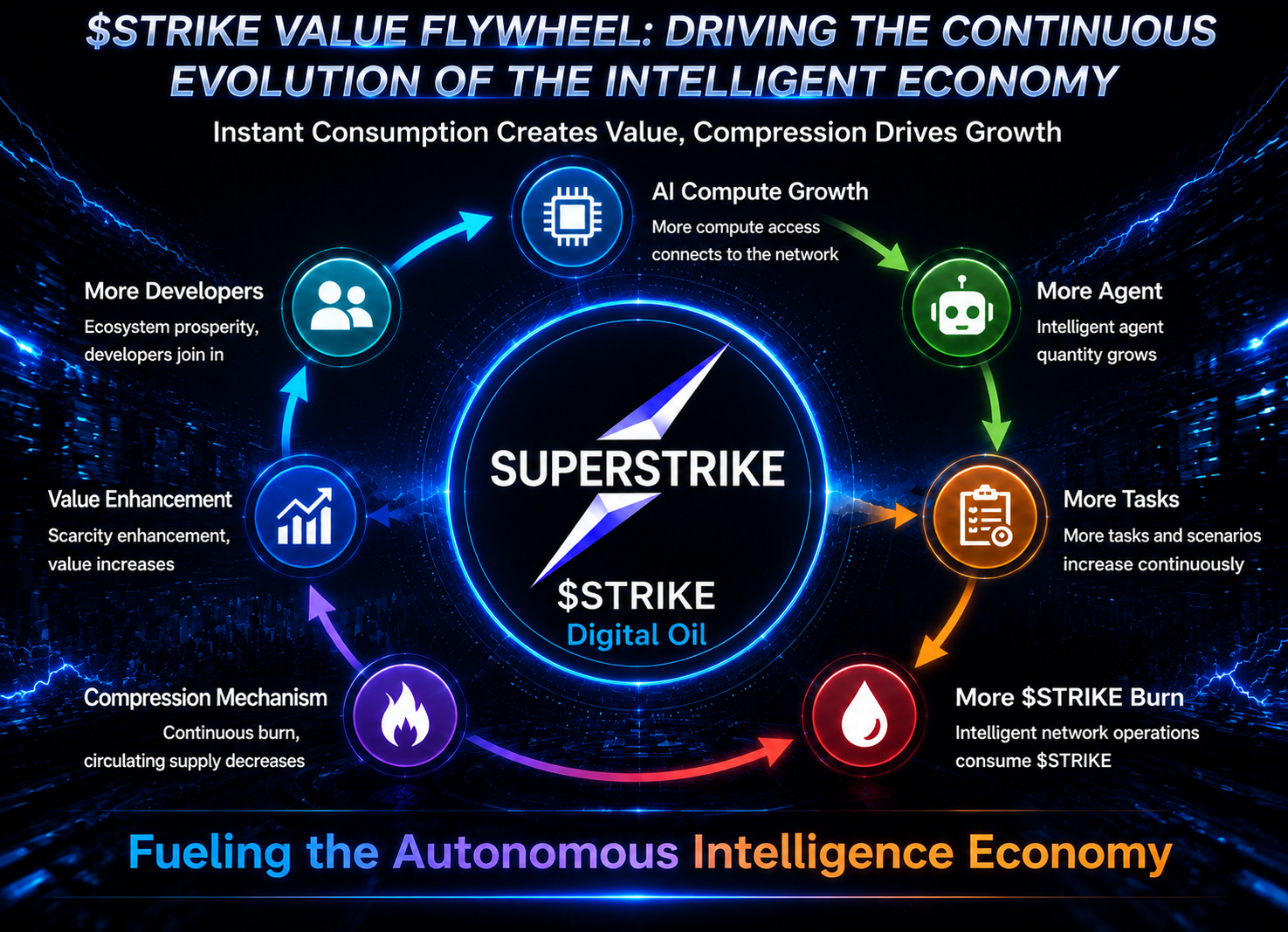
Within this autonomously operating super intelligent economy, the native token $STRIKE is given a completely new historical definition — it is not an attachment to speculative sentiment, but the “digital oil” powering the entire intelligent network.
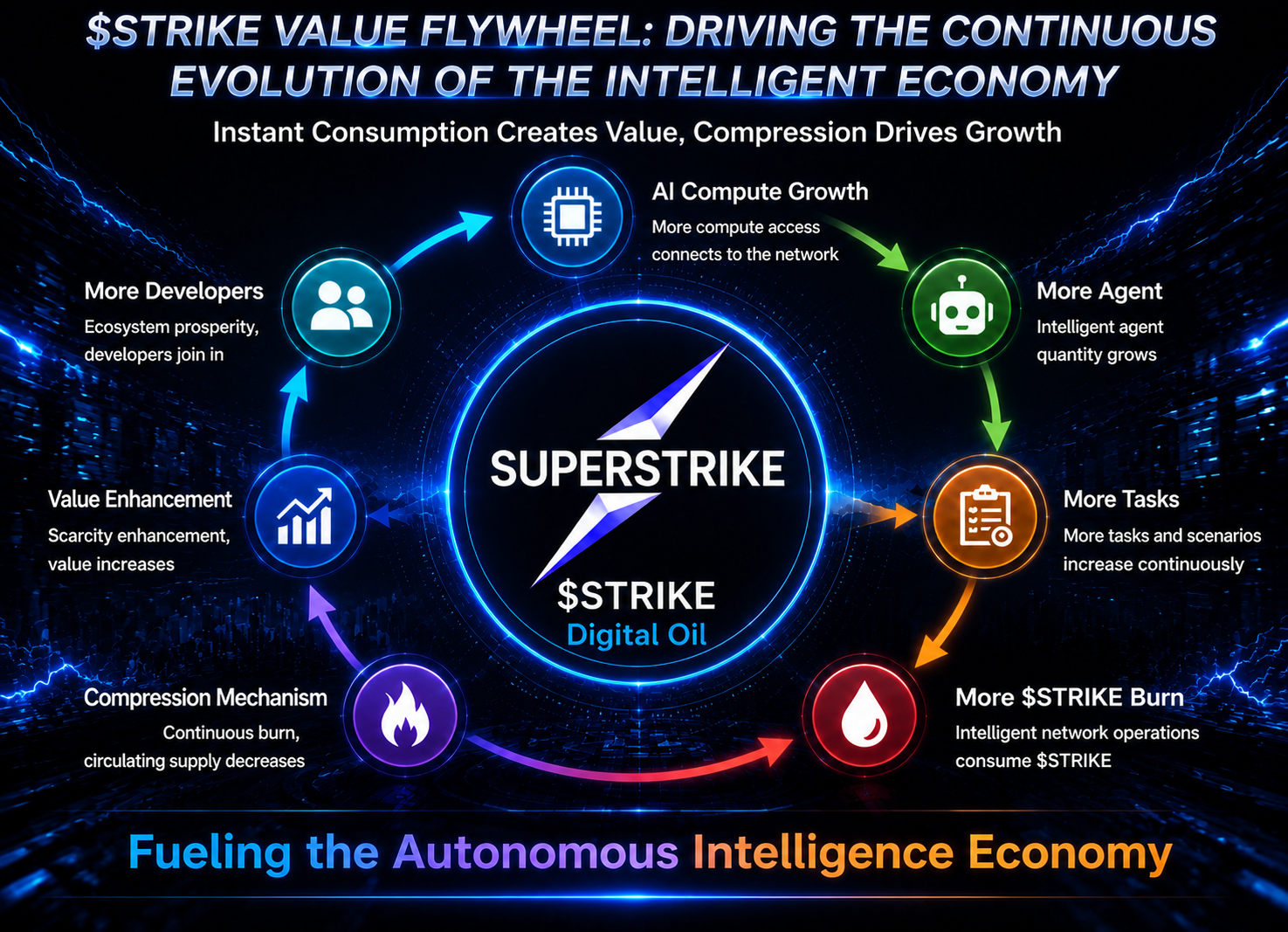
As the fundamental asset standard of the AI-native era, the logical operation, arbitrage, and deep execution of the entire AI computing ecosystem require the mandatory consumption of $STRIKE.
This “consumption equals value” energy attribute completely separates it from the empty narratives of traditional altcoins, making it an indispensable underlying fuel within the intelligent network.
Every computing consumption event within the network and ecosystem will be transformed into rigid token deflation and become the absolute driving force behind ecosystem evolution.
The market’s real capital flows have already provided technical validation for the control logic and risk-resistant foundation of this “digital oil.”
Previously, the STRIKE token experienced continuous growth from its former low level of 0.06 USDT, steadily breaking through resistance levels and directly reaching 0.13 USDT.
The strong upward momentum demonstrated within just a few days represents a high-level validation from real market capital regarding SuperStrike’s underlying liquidity model.
Following this pulse-driven rise, the short-term correction and consolidation recently observed in the market are not viewed by mature capital as the beginning of a downward trend. Instead, they represent a process where major capital cleanses excess positions and consolidates floating supply before initiating the next stronger long-term upward movement.
This strengthens market depth and becomes precisely the rare golden positioning opportunity before market consensus gathers again.
Productivity Restructuring: Breaking Centralized Black Boxes Through Ecosystem Co-Growth
Morgan Stanley’s research indicates that traditional AI giants struggle to achieve returns primarily because they lack reasonable asset protection, sovereignty alignment, and cross-boundary circulation mechanisms.
The confidence behind SuperStrike’s ability to break the traditional financial death spiral comes from its creation of a physical “value gravity field.”
Through the Genesis Node model and exit compensation mechanism, SuperStrike guides capital away from short-term speculation toward ecosystem co-growth while designing a scientific liquidity protection framework.
The system requires assets to undergo a 24-hour (T+1) unlocking verification cycle during circulation, smoothing daily liquidity behaviors and objectively transforming them into stable support for market structure.
This design is not only a “super protection shield” for retail participants, but also allows large capital releases from whales to be reasonably diluted through time and algorithms, creating an absolutely fair, secure, and long-term compounding environment for everyone.
As co-founder Dubey emphasized:
“We respect the efficiency of large capital and scientists, but we value the participation of the broader user community even more. Only when you gain value can the entire SuperStrike ecosystem fulfill its mission.”
With the official launch of the SuperStrike DApp, this productivity experiment designed to break centralized black boxes has entered its decisive stage of full-scale expansion.
On August 10, international market teams from different countries will officially join, marking the official launch of SuperStrike’s international market expansion.
The gathering of global participants will bring broader worldwide liquidity and data sources, accelerating the evolution of this super brain.
For sharp long-term observers, this golden window before global forces join contains an extremely rare valuation opportunity for silicon-based productivity:
The expected international market opening staking price is locked at 0.03 USDT, while the current STRIKE participation price is approximately 0.008 USDT.
From the current approximately 0.008 USDT to the expected 0.03 USDT on August 10, early consensus participants who position ahead are expected to secure at least 300%+ potential return space.
This is not only a deterministic premium brought by the combination of global expansion benefits, but also the greatest sincerity from the founding team toward all early supporters.
Combined with the healthy correction and renewed momentum of the STRIKE token after rising from 0.06 to 0.13, the current golden opportunity window represents a unique moment.
While the spending machines of traditional AI giants may still be running endlessly, SuperStrike has already used advanced algorithms and an international market vision to create a brand-new value gravity field at the intersection of digital civilization.
Do not become a late-stage observer — become an early frontier participant.
Stake now and wait for the full-scale global expansion.


All Comments