

Cointime

Download App
iOS & Android

SuperStrike 3D Node Matrix Officially Opens: Seize the Web3 + AI Ecosystem Opportunity

SuperStrike: Web3 + AI Super Agent Financial Infrastructure

SuperStrike is a next-generation intelligent financial ecosystem built for the Web3 + AI era. It is positioned as a super agent financial infrastructure centered around the concept of an AI autonomous economy. Evolved from the StrikeBit AI Modular Agent Protocol S-MAP, SuperStrike aims to push AI agents beyond simple tools and transform them into autonomous assets capable of carrying value, coordinating resources, and participating in ecosystem growth.

Within the SuperStrike ecosystem, users are not merely joining a single product. They are entering a network powered by AI strategies, on-chain assets, node consensus, platform tokens, and global community expansion. SuperStrike is designed to help every user access an AI-driven intelligent financial gateway, allowing them to secure an early position in the emerging convergence of Web3 and AI.

3D Node Matrix: Genesis, Global, and Consensus Nodes

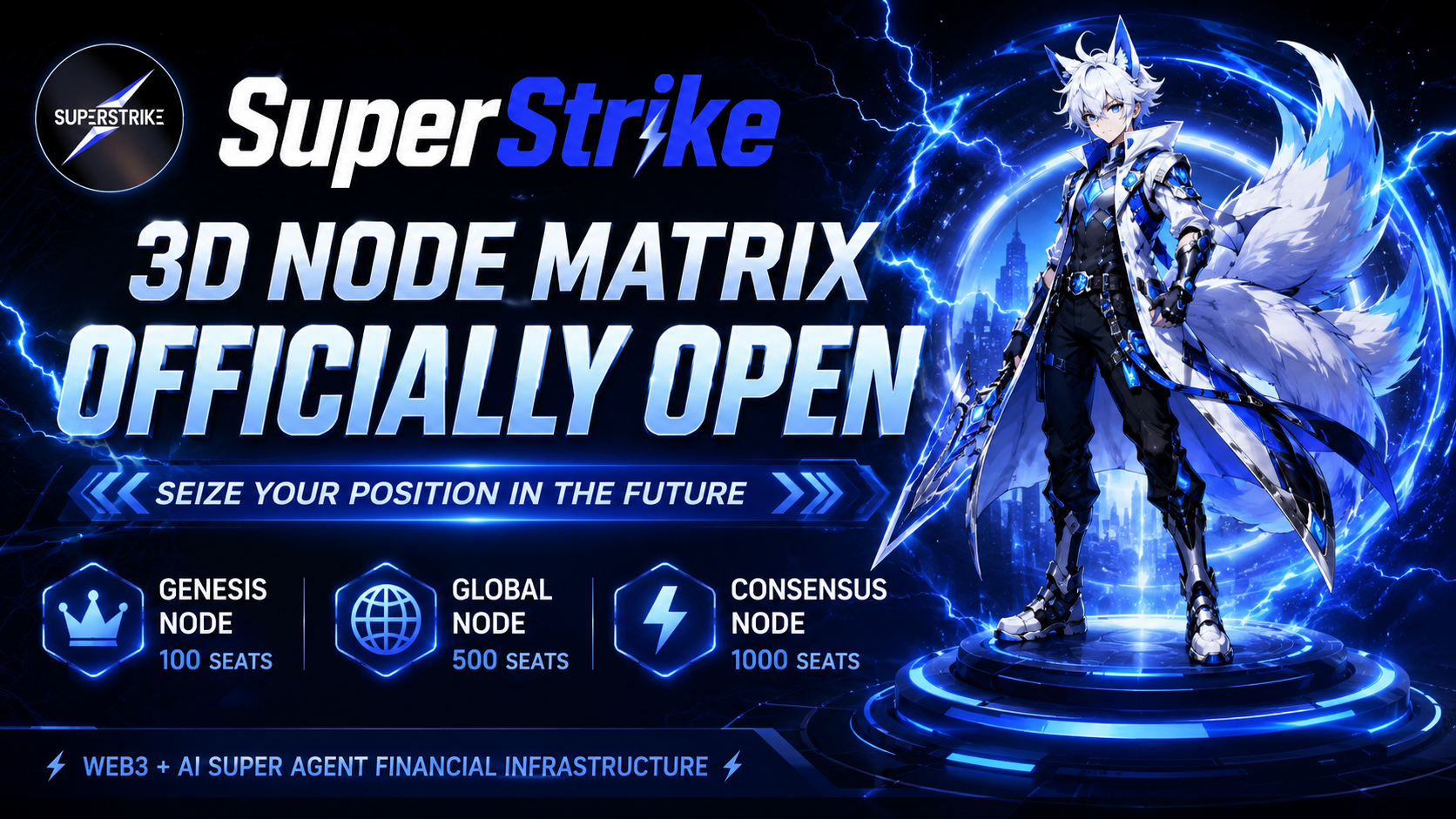
The SuperStrike 3D Node Matrix is now officially open, featuring three major node categories: Genesis Nodes, Global Nodes, and Consensus Nodes. Each node type carries a different participation threshold and ecosystem value, forming a layered structure that connects core builders, global contributors, and consensus participants.

Genesis Nodes are limited to 100 seats and represent the early core positions within the ecosystem. They are designed for participants with strong community-building capabilities and long-term conviction. Global Nodes are limited to 500 seats, serving as a broader gateway for ecosystem builders who support global expansion and community growth. Consensus Nodes are limited to 1,000 seats, providing more users with access to ecosystem rewards and long-term participation. Together, these three node types form SuperStrike’s global node network, supporting ecosystem traffic, consensus, governance, and value circulation.

Ecosystem Feedback: A Node Is More Than an Identity

The core value of the SuperStrike node matrix is not only its scarcity, but also its deep connection with ecosystem growth. Node participants may access corresponding level benefits, order-cycle rewards, fee-sharing mechanisms, and long-term links to the expansion of the global community, the development of the AI autonomous economy, and the utility of the $STRIKE ecosystem.

In the ecosystem feedback model, node participants act as key connectors for consensus building, community growth, ecosystem collaboration, and value distribution. As the SuperStrike global community continues to expand, node seats may become important bridges connecting users, assets, AI strategies, and on-chain finance. The earlier users enter the node matrix, the greater the opportunity to secure a stronger position in the future ecosystem map and participate in SuperStrike’s journey from early launch to global consensus expansion.

AI Autonomous Economy: From Asset Deposit to Intelligent Strategy Participation

The SuperStrike user participation path is built around asset deposits, AI staking-cycle selection, settlement mechanisms, and ecosystem withdrawal rules. Users participate through a 50% USDT + 50% STRIKE asset structure and may select different AI staking cycles based on their own needs, including 10 days, 30 days, 90 days, 180 days, and 360 days.

The key point is that SuperStrike is not a simple single-point yield model. Instead, it forms a complete ecosystem loop through AI strategies, platform token utility, node rewards, VIP computing-power levels, and ecosystem fee mechanisms. As the platform token, $STRIKE is used not only for VIP level upgrades, but also for yield withdrawal, ecosystem governance, and dividend rights, further strengthening the value alignment between users, nodes, and the platform.

Why Pay Attention to the SuperStrike Node Matrix Now

The convergence of Web3 and AI is pushing financial ecosystems from manual operation toward intelligent agent collaboration. SuperStrike aims to build an ecosystem infrastructure powered by AI agents, on-chain assets, node networks, and global communities. The opening of the 3D Node Matrix gives users a clear early-stage entry point and allows them to join SuperStrike’s global consensus network through node participation.

For those who believe in AI autonomous economies and Web3 financial infrastructure, the SuperStrike node matrix is not just a seat offering. It is an early positioning opportunity within a growing ecosystem. Genesis Nodes, Global Nodes, and Consensus Nodes together form SuperStrike’s growth engine, giving participants the chance to grow alongside global community expansion and witness the next stage of AI-native financial evolution.

Conclusion: Follow SuperStrike and Activate Global Consensus Growth

The key words behind SuperStrike are Web3, AI, nodes, consensus, and ecosystem feedback. Powered by the S-MAP protocol, supported by the $STRIKE ecosystem token, and expanded through the 3D Node Matrix, SuperStrike is building a super agent infrastructure for the era of AI autonomous finance.

Scarcity comes first, and value follows early positioning. SuperStrike is more than lightning; it is a long-term energy source connecting global users, AI agents, and on-chain financial ecosystems. Now that the 3D Node Matrix is officially open, early participants have the opportunity to join the global community and take part in the Web3 + AI consensus expansion.


Comments

All Comments

Recommended for you

  • BTC Breaks Above $64,000

    Market data shows BTC has broken through $64,000 and is currently reported at $64,000.33, with a 24-hour decline of 1.53%. Market volatility is high, so please exercise caution and manage risks accordingly.

  • BTC Falls Below $64,000

    Market data shows BTC has fallen below $64,000, currently at $63,999.77, with a 24-hour decline of 1.89%. Market volatility is significant; please exercise risk control.

  • Vitalik Updates Ethereum Roadmap: Privacy, Post-Quantum Scaling, and Native Rollups Become New Priorities

    On August 10, Vitalik Buterin stated that he had compared the 2023 Ethereum roadmap with the current Strawmap. The overall direction still overlaps considerably, but some priorities and technical paths have been clearly adjusted, including raising the priority of quantum safety, downweighting VDF and some EVM improvements, and replacing old designs with solutions such as a unified binary tree, PBT, and new state types. He noted that the most notable change in the current Strawmap is the emergence of several new topics not included in the 2023 roadmap, reflecting a shift in Ethereum's R&D focus. These new priorities include: stronger native privacy support, aggressive scaling in a post-quantum context, specification streamlining for formal verification, Blob and Gas futures, native Rollups, and a more open design space for the future shape of the EVM. Vitalik also emphasized that Ethereum's scaling approach is shifting from 'expanding all activities comprehensively' to 'designing more scalable dedicated mechanisms for specific high-load scenarios,' and he regards STARK proofs and AI-accelerated formal verification as important foundations for the protocol's future. Overall, this update shows that the Ethereum roadmap is evolving toward quantum safety, privacy-first, censorship resistance, high performance, and simpler protocol design.

  • ETH Falls Below $1900

    Market数据显示,ETH has fallen below $1900, currently reported at $1899.19, with a 24-hour decline of 1.28%. The market is highly volatile. Please exercise risk control.

  • Microsoft Plans to Release Next-Gen MAIA 300 AI Chip in September

    On August 10, according to reports, Microsoft plans to release its next-generation MAIA 300 AI chip in September.

  • BitMine Adds 7,391 ETH and Buys Back 3 Million Shares Last Week

    As of August 9, Eastern Time, BitMine's total cryptocurrency + cash holdings + "Moonshot" initiative amounted to $11.6 billion. BitMine held 5,805,238 ETH (up 7,391 ETH from last week), representing 4.8% of the total Ethereum supply (120.7 million ETH). It also held 209 BTC, $180 million in Beast Industries shares, $69 million in Eightco Holdings (NASDAQ: ORBS) shares, and $104 million in unsecured cash. BitMine repurchased 3 million common shares last week, bringing the total common shares repurchased since early July to over 19 million. As of August 9, 2026, BitMine's total staked ETH was 5,067,309 (worth approximately $9.8 billion at $1,928 per ETH).

  • Strategy Sells 1,691 BTC in Past Week

    Regulatory filings show that Strategy sold 1,691 BTC over the past week, increasing its dollar reserves by $650 million.

  • Unitree Technology: Final Online Issuance Winning Rate 0.0181%

    On August 10, Unitree Technology (688836.SH) announced that the company's initial public offering of shares and the online issuance subscription status and winning rate on the Sci-Tech Innovation Board were disclosed. The issuing price was RMB 150.80 per share, with a total of 40,446,434 shares issued. After the activation of the clawback mechanism, the final online issuance was 9,707,000 shares, accounting for approximately 30.00% of the total shares issued after deducting the final strategic placement, and the final online issuance winning rate was 0.01809759%.

  • BTC Breaks Through $65,000

    Market data shows that BTC has broken through $65,000, currently reporting at $65,001.99, with a 24-hour increase of 0.19%. The market is highly volatile; please exercise risk control.

  • RMB Spot Exchange Rate Against USD Hits 42-Month High

    On August 10, the onshore spot exchange rate of the RMB against the U.S. dollar rose to as high as 6.7439 during trading, marking a new high in more than three years since February 6, 2023. ICBC Asia, in its outlook on the RMB trend for the second half of the year, believes that the RMB exchange rate is likely to continue a gradual upward trend amid volatility. The main influencing factors include: first, exports are expected to maintain resilient growth in the second half of the year, with attention on the impact of geopolitical risks and tariff policies on the differentiation of export products, regional structure, and price-volume relationships; second, international capital is increasing its allocation to RMB assets, with net capital inflows supporting a stronger RMB central tendency; third, the central parity rate of the RMB against the U.S. dollar will be adjusted as circumstances dictate. The chief economist team of China Minsheng Bank pointed out that since the beginning of this year, the main factor supporting the strength of the RMB exchange rate has been the high prosperity of exports. At present, with the continuous optimization of the trade structure, the high growth rate of exports is expected to continue, and the trade surplus is also expected to remain at a high level. Overall, China's economy has demonstrated strong resilience in an environment of complex and volatile external conditions and the transition of domestic growth drivers, while the foreign exchange market operates steadily, laying a solid foundation for the RMB exchange rate to remain basically stable at a reasonable and balanced level. It is expected that in August, the RMB exchange rate will maintain a stable two-way fluctuation pattern around 6.75. (The Paper)