

Cointime

Download App
iOS & Android

Strategy accumulates over 22,000 Bitcoin, RWAs top $19 billion: December in Charts

Bitcoin’s price continued to fall as 2025 neared its end, declining 4% in December.

Despite a slump in markets, Strategy capped off the year with massive Bitcoin buys. In December alone, the software company turned Bitcoin investment vehicle picked up over 22,000 Bitcoin .

In the US, prediction markets are inking deals with major media outlets and scoring approvals from major federal agencies. However, in 11 states, gambling and gaming regulators are taking legal action against platforms like Kalshi and Polymarket. Watchdogs state that such markets constitute a form of gambling, a claim the companies themselves dispute.

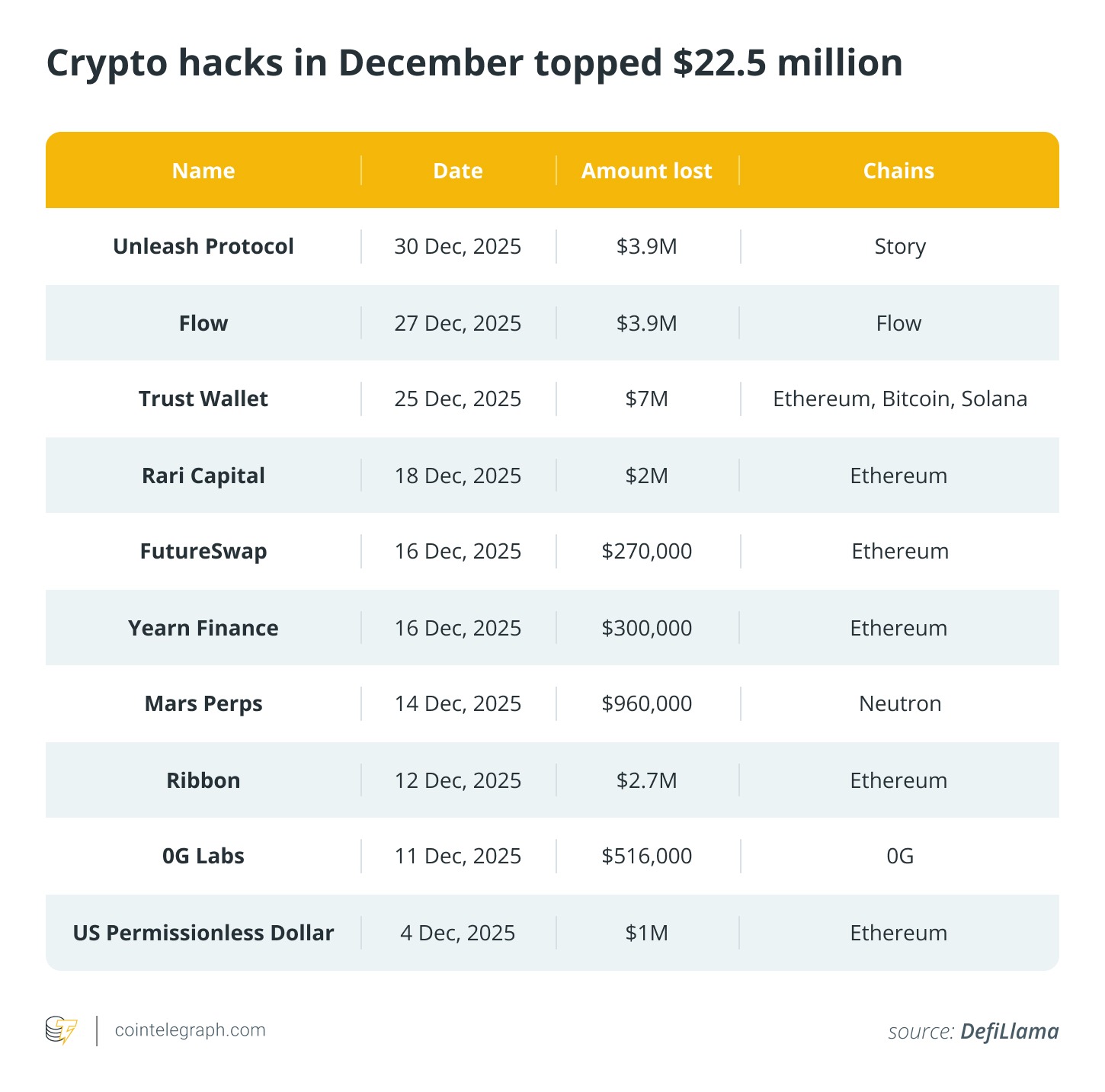
As crypto grows more mainstream, hackers and scammers are increasingly targeting investors and protocols. In December, crypto exploits topped $22.5 million. Chainalysis also released its annual scam report, stating that crypto thefts hit $3.4 billion in 2025.

Here’s December by the numbers:

Strategy accumulates over 22,000 Bitcoin

Michael Saylor’s Bitcoin investment vehicle, Strategy, picked up another stack of Bitcoin in December. The publicly traded company bought 22,628 BTC this month, according to Strategy’s Bitcoin purchase disclosures.
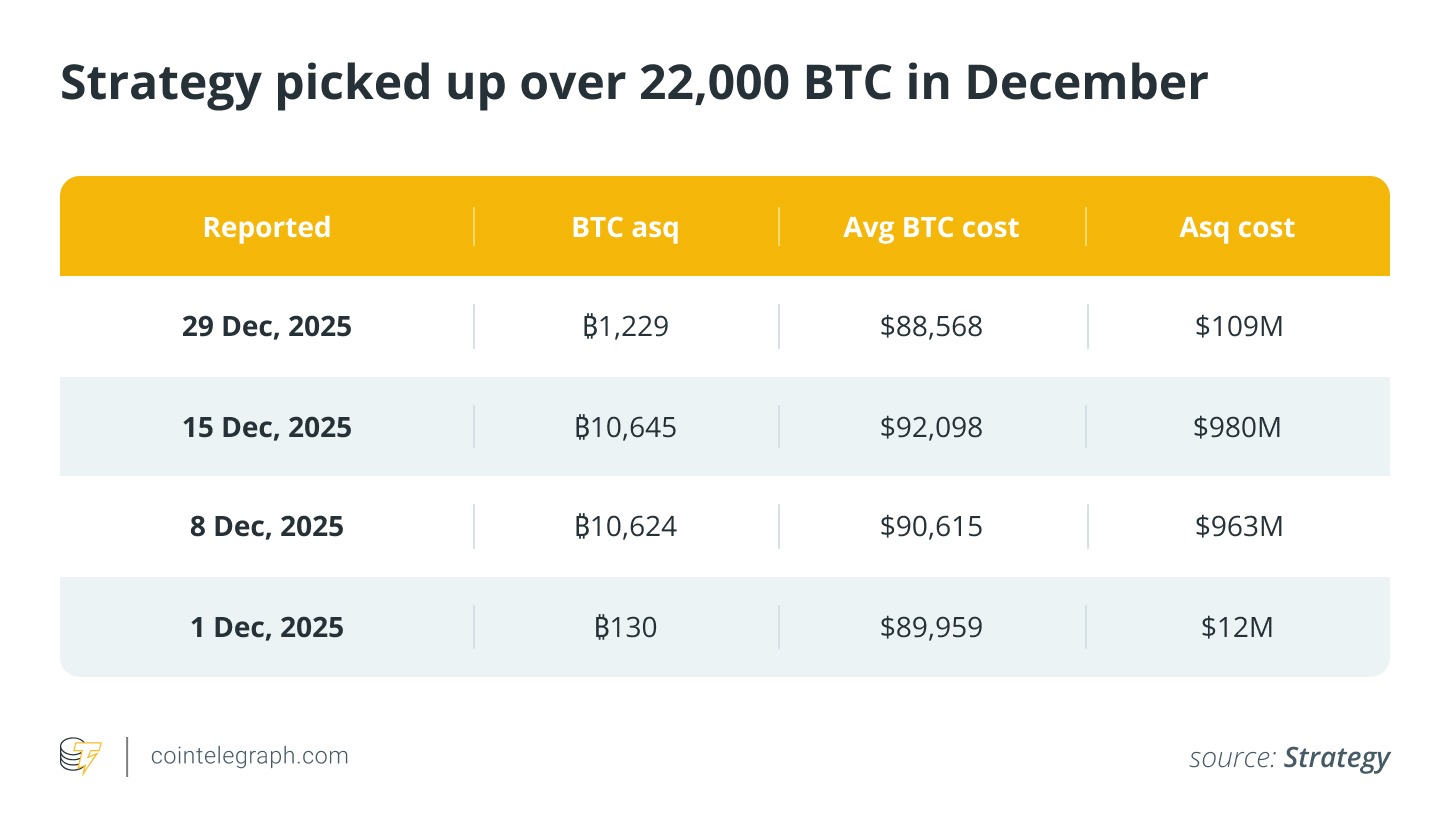
This brings the company’s total Bitcoin holdings to 672,497 BTC, or roughly 3.3% of the 19.9 million Bitcoin currently in circulation.

The purchases in December capped off a year of aggressive accumulation by Strategy. The company disclosed Bitcoin purchases in 41 separate weeks of 2025. That’s a marked increase from 18 weeks in 2024 and just eight in 2023.

Strategy’s success in offering debt to fund new Bitcoin purchases has inspired other companies to become “Bitcoin treasury firms” — i.e., companies that hold Bitcoin on their balance sheets. According to BitcoinTreasuries.net, 192 public companies hold almost 1.1 million BTC in their treasuries.

Bitcoin price slumps 4%

Bitcoin’s price fell over 4% this month and is trading at $88,000 at publishing time. The asset is slated to end the year down below where it started, around $94,000, and well below its all-time high of $126,000 set in October.
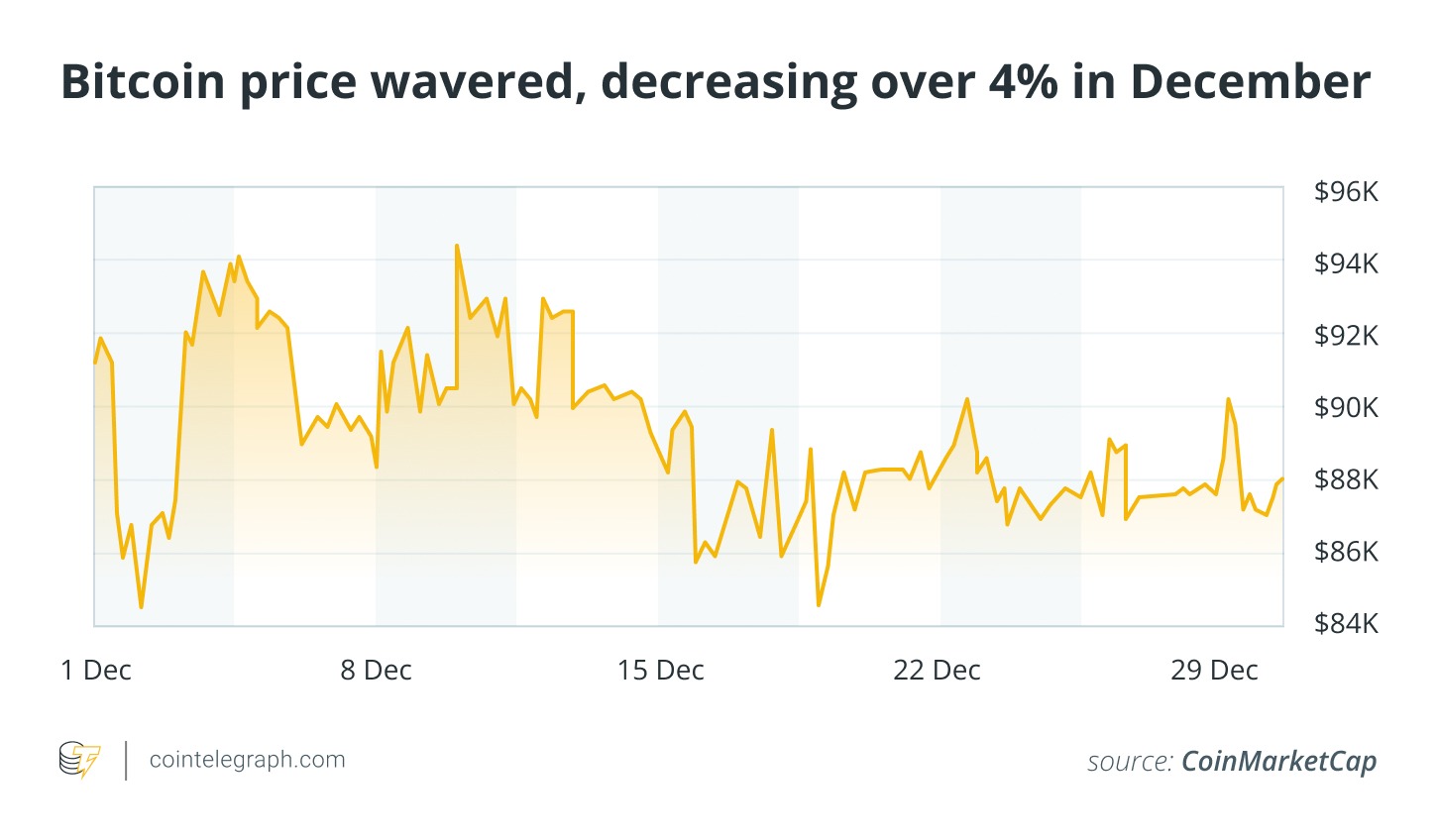
Date as collected and current as of Dec. 30.

Some traders say that Bitcoin is set for further losses, possibly down to $40,000; that is, if the traditionally understood four-year boom-and-bust cycle is still intact.

Not everyone is convinced, though. Nick Ruck, director of LVRG Research, previously told Cointelegraph that institutional demand through things like exchange-traded funds (ETFs) and corporate treasuries has softened the blow.

“While the bull market may face near-term consolidation amid macroeconomic pressures, we anticipate it will extend into 2026 with support from ongoing structural inflows and evolving market dynamics,” he said.

Betting markets face legal battles in 11 states

Betting markets are making headway in the US. On Dec. 4, CNBC signed a contract with Kalshi to integrate real-time forecasting data from the betting market on CNBC’s TV, digital and subscription platforms.

But state regulators are not pleased. That same week, Connecticut’s Department of Consumer Protection sent letters to Kalshi, Crypto.com and Robinhood, ordering them to cease operations in the state. There are now 11 states in which prediction markets are facing legal action from regulators.

Kalshi similarly received cease-and-desist letters in Ohio, Illinois, Arizona, Montana and New York. Regulators in those states cited that the market was offering unlicensed gambling, a claim that Kalshi rejects.

In Massachusetts, state prosecutors claim that Kalshi has disguised sports betting as “event contracts.” Kalshi said the state is “trying to block Kalshi’s innovations by relying on outdated laws and ideas.”

A spokesperson for the company previously told Cointelegraph, “It’s very different from what state-regulated sportsbooks and casinos offer their customers. We are confident in our legal arguments and have filed suit in federal court.”

Scammers stole $22.5 million in crypto in December

In December, hackers made away with $22.5 million across 10 incidents, according to data from DefiLlama, a drop in the bucket compared with other months this year.
In February, hackers stole $1.4 billion in assets from the crypto exchange Bybit. Blockchain analytics firm Chainalysis said in its annual crypto hack report that this year’s crypto thefts totaled $3.4 billion. It added that personal wallet attacks have “grown substantially, increasing from just 7.3% of total stolen value in 2022 to 44% in 2024. In 2025, the share would have been 37% if it weren’t for the outsized impact of the Bybit attack.”

Sophisticated attacks from state-sponsored actors have been a particular problem for large, centralized organizations like crypto exchanges. Cybercriminals associated with the government of North Korea reportedly stole $2.02 billion in cryptocurrency this year.

RWAs overtook DEXs with $19 billion in distributed asset value

The total distributed asset value of real-world assets (RWAs) rose 3% in December, surpassing $19 billion. The largest section of these assets is tokenized US Treasurys at $8.7 billion, followed by commodities at $3.5 billion.
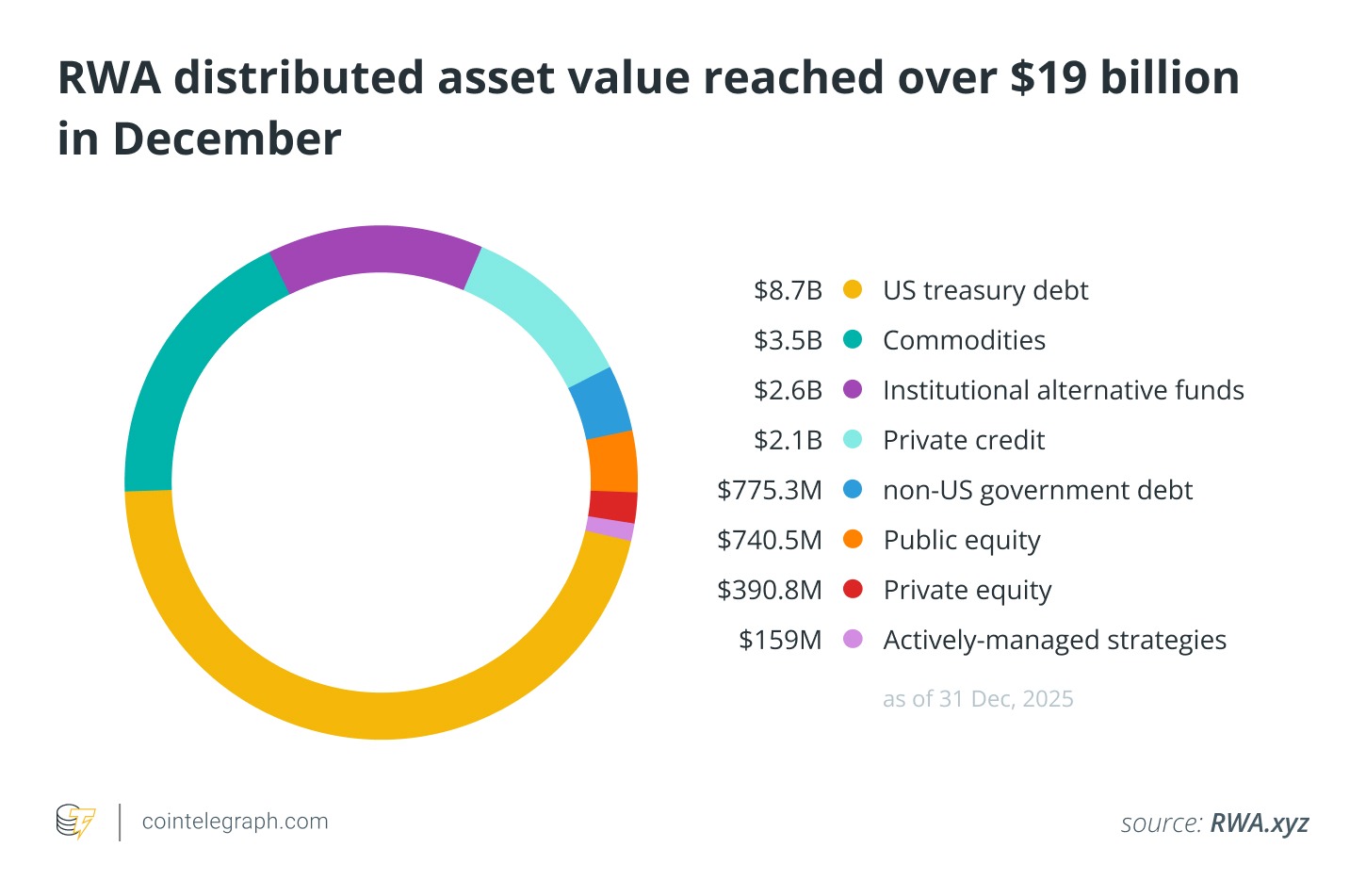
This places RWAs as the fifth-largest asset category in decentralized finance by total value locked, according to DefiLlama, overtaking decentralized exchanges (DEXs).

“At the start of this year, they weren’t even in the top 10 categories,” DeFiLlama noted.

A number of tokenized fund products like the BlackRock USD Institutional Digital Liquidity Fund (BUIDL), Circle’s USYC, Franklin Templeton’s BENJI and Ondo’s OUSG are driving increased valuation with tokenized Treasurys.

Vincent Liu, chief investment officer of Kronos Research, previously told Cointelegraph that for further growth in RWAs, “the constraint is no longer tokenization itself, but liquidity and integration into TradFi.”


Comments

All Comments

Recommended for you

  • Iranian Official: US Provocation on Strait of Hormuz is a Reactive Response

    According to IRNA, Hussein Nushabadi, the Director General of the Iranian Foreign Ministry's Parliamentary and Legal Affairs Department, stated in an interview that Washington's controversial claims regarding control over the Strait of Hormuz are primarily driven by domestic political needs and are a reactive response to Iran's demonstrated strength and strategic actions in this waterway. He noted that the baseless assertions made by the US President regarding the Strait of Hormuz do not align with international shipping regulations or the relevant provisions of the United Nations Convention on the Law of the Sea. Nushabadi also pointed out that Iran possesses political and military dominance over the Strait of Hormuz, a vital lifeline for global energy and economy, making it a powerful lever and strategic trump card in responding to external threats.

  • Jensen Huang Collaborates with Wall Street Giants to Support AI Computing Market

    On August 15, a rare scene unfolded as Jensen Huang joined forces with six major Wall Street asset management giants to endorse the idea of establishing AI computing as an independent asset class. Analysts believe this reflects Huang's commitment to the concept of token economics, marking a shift in the AI boom from a technological competition to a capital competition. However, the latest plan has raised concerns among investors regarding 'circular financing' and debt risks. In response to these doubts, Huang personally stepped in to reassure the market, stating that Nvidia may provide a residual value support mechanism of up to 25% for individual investment projects and will carefully evaluate each project. Following this, market sentiment showed slight improvement. (CCTV Finance)

  • DJI Added to 'Blacklist', US Court Orders Rehearing

    On August 15, according to the Russian Satellite News Agency, the U.S. Court of Appeals recently ruled that a lower court must rehear the case regarding the inclusion of Chinese drone manufacturer DJI on the Pentagon's 'Chinese Military Industrial Enterprises' blacklist, stating that the previous ruling was based on non-confidential information and contained flaws. The report indicated that the D.C. Circuit Court of Appeals pointed out that the lower court's conclusion that DJI 'contributes to China's defense industrial base' was erroneous, as it relied solely on publicly available information. The court has mandated that during the rehearing, the lower court may review classified documents and decide whether to uphold the Department of Defense's designation based on that information.

  • Iran Claims Undisputed Ownership of Strait of Hormuz

    On August 15, according to CCTV International News, Iran's Chief Justice Ejei stated today that the absurd remarks made by the U.S. President regarding the Strait of Hormuz are entirely based on his personal delusions. In the real world, the true owner and dominant power of this important international waterway is Iran. Ejei emphasized that Iran has proven militarily that the Strait of Hormuz is an inseparable part of Iranian territory and sovereignty.

  • US Spot Bitcoin ETF Sees Net Outflow of $56.2 Million Yesterday

    On August 15, according to data monitored by Farside Investors, the US spot Bitcoin ETF experienced a net outflow of $56.2 million yesterday.

  • No Net Inflow or Outflow for US Spot Ethereum ETF Yesterday

    On August 15, according to monitoring data from Farside Investors, there was no net inflow or outflow for the US spot Ethereum ETF yesterday.

  • Charles Schwab: Low Probability of CLARITY Act Passing Before U.S. Midterm Elections

    On August 15, Charles Schwab stated in its 'Weekly Trader Market Outlook' that as of the time of writing, the Bitwise Top 10 Large Cap Crypto Index has fallen 3% since last Friday; Bitcoin has dropped 3% during the same period, while Ethereum is down 2%. Bitcoin continues to exhibit characteristics of a low-correlation asset, with limited impact on its price from the CPI and PPI data released this week. Last week, the U.S. Senate entered its summer recess without voting on the CLARITY Act. Although the final debate vote for the bill is scheduled for September 14, the probability of it passing before the midterm elections remains low.

  • Sources: Trump to Attend Closed-Door Meeting with Crypto Executives at the White House

    On August 15, sources revealed that U.S. President Trump is expected to attend a White House meeting held by the newly established Innovation Committee on Wednesday. The committee consists of executives from the crypto industry as well as leaders from prediction markets and artificial intelligence companies. Sources indicated that the CEOs of companies such as Coinbase, Ripple, Gemini, Robinhood, Polymarket, and Kalshi are members of the U.S. CFTC Innovation Advisory Committee. Before attending the committee's first official meeting on Thursday, these crypto industry CEOs will gather at the White House for the meeting on Wednesday. Attendees learned that Trump plans to participate in this meeting. The meeting is expected to take place at the Eisenhower Executive Office Building next to the White House, aiming to initiate policy discussions on several key directions in the U.S. innovation sector. Sources also stated that CFTC Chairman Mike Selig and other policy advisors are expected to attend the meeting. One source further revealed that U.S. Treasury Secretary Scott Bessent and Commerce Secretary Howard Lutnick may also be present. The White House spokesperson has not yet responded to requests for comments regarding the meeting arrangements.

  • U.S. Optical Communication Stocks Rise, Lumentum Up Over 6%

    On August 14, U.S. optical communication stocks collectively rose, with Applied Optoelectronics increasing by over 14%, AXT Inc and MaxLinear rising by over 7%, POET Technologies and Lumentum up by over 6%, and Lightwave Logic increasing by over 5%. Corning and Tower Semiconductor also saw gains of over 4%.

  • Dunamu Reports 73% Decrease in Q2 Operating Profit to 23.5 Billion Won

    On August 14, Upbit operator Dunamu announced its Q2 2026 performance, reporting quarterly revenue of 173.5 billion won (approximately 123 million USD) and an operating profit of 23.5 billion won (approximately 16.65 million USD), representing declines of about 26% and 73% respectively compared to Q1. In the first quarter, Dunamu's revenue was 234.6 billion won (approximately 166 million USD) with an operating profit of 88 billion won (approximately 62.34 million USD). Dunamu stated that the decline in performance this quarter was primarily influenced by the overall contraction in liquidity in the global digital asset market, which weakened investor sentiment.