

Cointime

Download App
iOS & Android

Stablecoins Can Help Fix the Current Lending Market

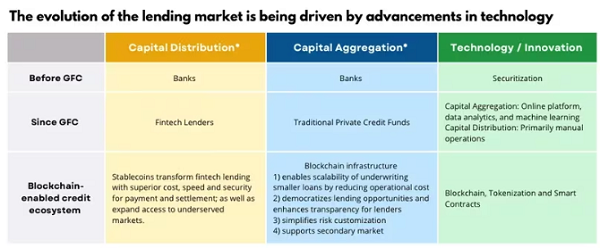
Lending markets are evolving, transitioning from a traditional, bank-centric framework to a more diverse and technologically advanced ecosystem. This evolution is particularly evident since the Global Financial Crisis (GFC) and is fundamentally reshaping the landscape of capital aggregation and distribution.

However, the current market structure still faces considerable friction. We believe, integrating blockchain into the existing financial tech stack will improve the efficiency of capital flows and expand access.

The diminishing role of traditional banks in capital distribution post-GFC has paved the way for fintech lending companies like SoFi and Ramp. These firms are filling the void with innovative solutions such as buy now pay later (BNPL) options by leveraging online platforms, data analytics and machine learning.

Despite advancements, issues like archaic payment systems and SME funding gaps persist. Stablecoins can help overcome these challenges by revolutionizing fund disbursement with superior cost and speed. By leveraging stablecoins, fintechs can tap into new markets with limited access to conventional banking services, offering more accessible and efficient financial solutions at a global scale.
The $150 trillion opportunity

Private credit has flourished post-GFC, growing to $1.6 trillion and becoming a competitive source of large scale financing. However, compared with the state of innovation in capital distribution, capital aggregation’s growth historically was hindered by its manual processes and too many intermediaries, which made onboarding large numbers of smaller ticket LPs uneconomical.

Tokenization can streamline and automate these intensive operational processes. Such efficiency brings two major advantages. Firstly, it is now more economically viable to underwrite smaller loans. Secondly, it democratizes investment opportunities, lowering barriers to entry for a broader spectrum of lenders, including those with smaller capital contributions often overlooked today. Other benefits include improved transparency, secondary liquidity, and simplified risk customization enabled by the programmability of smart contracts.

According to recent research by Bain & Co, alternative investments are underrepresented in individuals' portfolios (individuals own 50% of global wealth but only 5% allocated to alternatives, while public pensions allocate about 25% to the same asset class). And while disparate liquidity demands and the highly manual nature of the alternative fund industry are barriers, Bain presents a clear case that tokenization can help the private markets industry tap into the $150 trillion individual investor segment, “unlocking.. potentially $400 billion in additional annual revenue for the alternatives industry.”


Comments

All Comments

Recommended for you

  • A Total of 37,212.18 DMD Permanently Burned Over the Past 7 Days

    July 9, 2026 — According to the latest on-chain data released by DMDAO, a total of 37,212.18 DMD has been permanently burned over the past seven calendar days through the protocol's predefined trading and wealth management burn mechanisms.

  • Whale Transfers 1,133 BTC to Coinbase Prime, Valued at $71.48 Million

    According to Onchain Lens monitoring, a whale transferred 1,133 BTC from Coinbase to Coinbase Prime through an intermediary wallet, valued at $71.48 million.

  • U.S. AI Chip Stocks Decline Before Market Open, Intel Falls Over 3%

    On July 7, U.S. AI chip stocks experienced widespread declines before the market opened. Intel dropped over 3%, while AMD, Qualcomm, and NXP fell more than 2%. TSMC, Broadcom, and Tesla decreased by over 1%, and NVIDIA declined by 0.7%.

  • China's Central Bank Increases Gold Reserves for the 20th Consecutive Month

    As of the end of June, China's gold reserves stood at 75.44 million ounces (approximately 2,346.446 tons), an increase of 480,000 ounces (about 14.93 tons) from the end of May, which reported 74.96 million ounces (approximately 2,331.52 tons). This marks the 20th consecutive month of gold accumulation.

  • China's Foreign Exchange Reserves in June at $341.6262 Billion

    On July 7, China's foreign exchange reserves for June stood at $341.6262 billion, a decrease of $26 billion from the end of May, representing a decline of 0.75%, with expectations set at $343.2 billion.

  • U.S. Storage Stocks Drop Pre-Market, SanDisk and Micron Down Over 4%

    On July 7, U.S. storage concept stocks collectively fell in pre-market trading. Western Digital dropped over 5%, SanDisk and Micron Technology fell over 4%, Seagate Technology declined over 3%, Rambus fell over 2%, and SMI fell over 1%.

  • U.S. Stocks in Optical Communication Sector Drop Pre-Market

    On July 7, stocks in the optical communication sector of the U.S. market collectively fell pre-market. Astera Labs dropped over 4%, while Marvell Technology, Credo Technology, and AXT Inc. fell more than 3%. Tower Semiconductor, MaxLinear, Corning, Applied Optoelectronics, GlobalFoundries, Lumentum, and Qorvo all declined by more than 2%. Coherent, Nokia, Amphenol, and Broadcom dropped over 1%.

  • Pre-market Decline in U.S. Storage Stocks

    In pre-market trading, U.S. storage concept stocks experienced a widespread decline, with Micron Technology falling by 4.8%, SanDisk dropping over 4%, Corning down more than 2%, and Intel decreasing by over 3%.

  • Two Departments: Support for Reinsurance Institutions to Increase Capital and Issue Supplementary Capital Tools

    On July 7, the National Financial Supervision and Administration Bureau and the Shanghai Municipal Government released several measures to accelerate the construction of the Shanghai International Reinsurance Center. Among these measures, they proposed to enhance the quality and efficiency of the reinsurance industry, support reinsurance institutions in increasing capital and expanding shares, and issuing supplementary capital tools to improve the capacity for internal capital accumulation and external capital supplementation, thereby strengthening the reinsurance industry's capabilities. The initiative aims to guide the insurance industry to focus on major national projects, strategic emerging industries, and livelihood security, consolidating insurance and reinsurance underwriting capabilities to enhance risk protection levels. It also supports reinsurance institutions in leveraging their professional technical advantages to assist the insurance industry in reducing risk.