

The cryptocurrency payments market is experiencing a historic inflection point. The latest industry data shows that cumulative stablecoin top-ups on global crypto spending cards have surpassed $13.8 billion, achieving rapid growth over the past year. Assets represented by compliant stablecoins are accelerating their departure from the single attribute of an investment tool and becoming a universal currency for everyday consumer payments in the digital age.
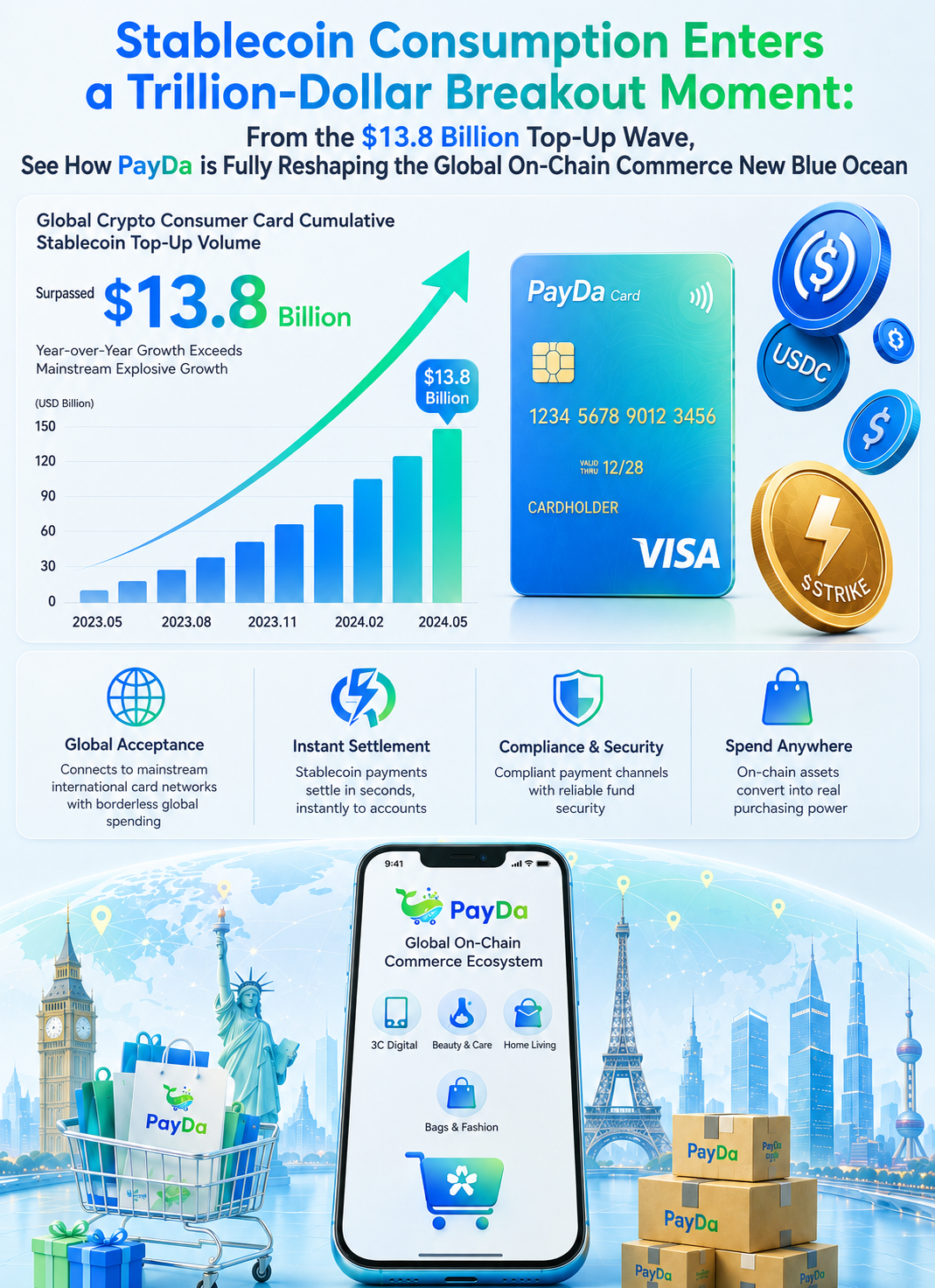
This macroeconomic trend sends a strong signal: digital assets are moving from pure online speculation toward deep penetration into the real economy and everyday consumption scenarios. The market no longer needs castle-in-the-air concepts; it urgently needs practical tools that can efficiently connect on-chain assets with real offline physical consumption.
It is precisely against the backdrop of this surging global payments wave that the next-generation global on-chain commerce platform PayDa Mall, together with its core settlement asset $STRIKE, has made a strong entrance. Rooted in real-world commercial value creation and using compliant payment channels as a bridge, PayDa seamlessly introduces vast on-chain assets into everyday shopping scenarios, opening a path to the new blue ocean of on-chain commerce for merchants and users worldwide.
I. Trend Insight: What Market Demand Does the Popularization of Stablecoin Spending Confirm?
In the past, the application of crypto assets faced numerous constraints: either price volatility made them unsuitable as a daily unit of account, or blocked channels prevented funds from landing in the real world. The large-scale adoption of crypto spending cards has shattered external skepticism.
● Users’ demand for asset utility continues to upgrade: An increasing number of users worldwide are no longer satisfied with leaving assets idle; they want to use digital assets at any time for buying coffee, booking flights, and purchasing daily groceries—just like using a traditional bank card.
● Perfect alignment between payment channels and consumption scenarios: When payment cards can seamlessly connect to major international networks, stablecoins truly possess the advantages of global convertibility and second-level settlement.
PayDa has followed this demand of the times. Inside PayDa Mall, $STRIKE is not only the core circulation tool connecting merchants and consumers, but also opens access to mainstream international payment channels. Points and earnings users obtain in the mall can be used at any time for everyday spending and cash withdrawals through compliant cards, truly realizing the conversion of digital assets into real-world purchasing power.
II. Real-Economy Value Creation: How Does PayDa Break Industry Bubbles with Dual Engines?
Many similar projects often lack real-world support and rely entirely on token inflation to sustain themselves, making them difficult to last. From its inception, PayDa chose a robust path rooted in the real economy and driven by genuine commercial profits.
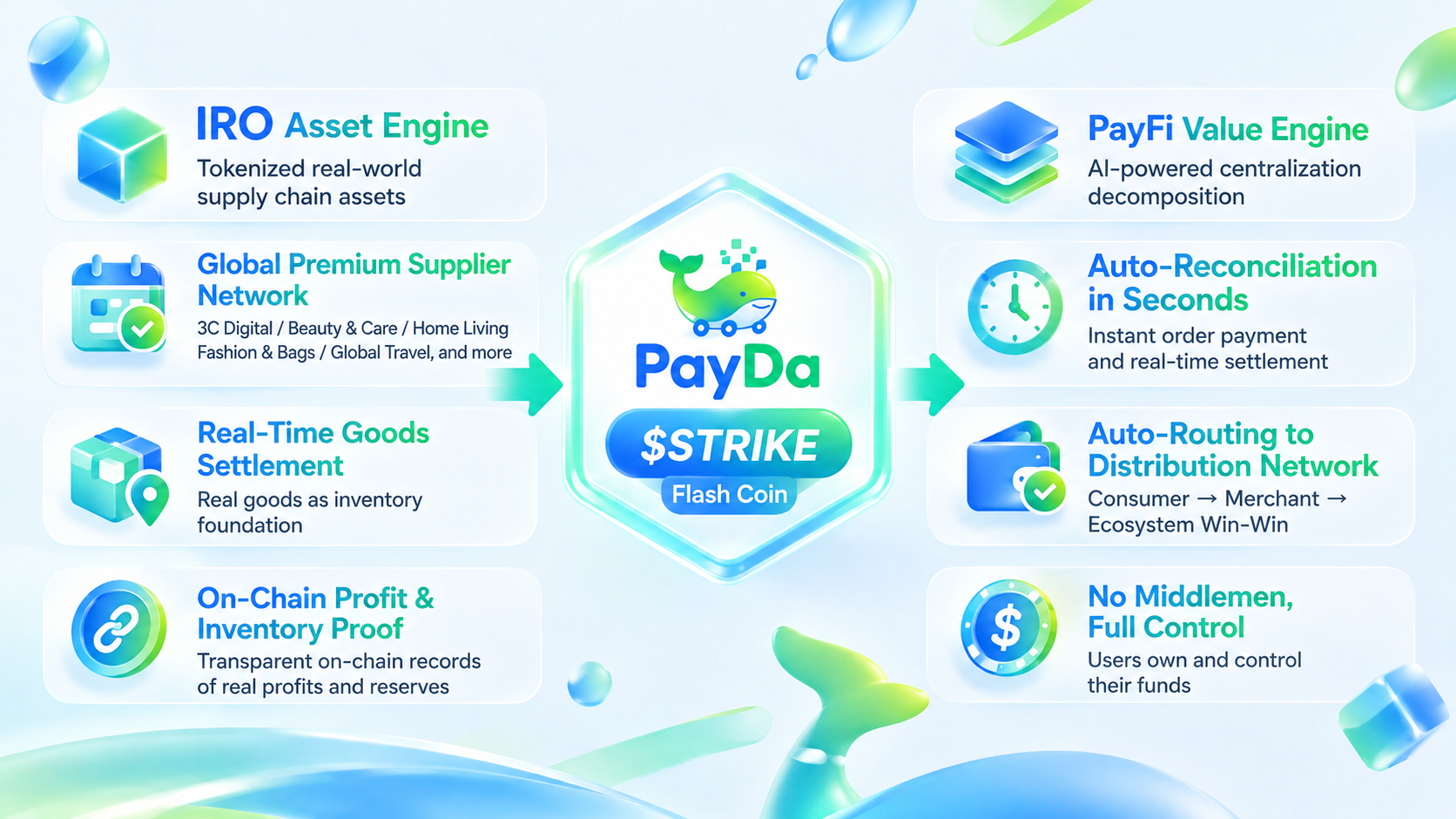
PayDa has built a dual underlying architecture:
1. Assetization of physical supply chains: PayDa aggregates high-quality global supply chains covering digital appliances, beauty and personal care, quality home goods, apparel and luggage, and travel services. All listed products are backed by real logistics delivery and physical goods, safely and transparently putting the genuine profits of real enterprises on-chain and ensuring the entire ecosystem possesses strong self-sustaining capacity.
2. Intelligent automated settlement: Traditional e-commerce payment cycles lasting tens of days often leave small and medium merchants short of cash. PayDa uses smart contracts to achieve second-level automatic settlement of order payments. The moment a consumer pays, funds are transferred in real time to the merchant, while the platform’s share is automatically injected into the distribution network. This eliminates lengthy waiting through intermediate links and gives merchants genuine control over their funds.
Driven by these dual engines, every real transaction that occurs in the mall injects healthy cash flow into the entire ecosystem and eliminates the hidden risk of idle capital circulation.
III. Rigid Deflation: Tightly Anchoring $STRIKE Value to the Mall’s Real Commercial Turnover
In token design, PayDa has abandoned the model of disorderly issuance and constructed a rigorous three-layer deflationary closed loop for the core circulating asset $STRIKE, tightly linking token value to the prosperity of the mall:
● 15% of technical service fees directly burned: Of the technical service fee automatically extracted by the system on every order flow, 15% is publicly burned.
● 10% of supply-chain profits used for open-market buybacks: A fixed 10% of the platform’s genuine net profits from physical supply-chain operations is used for real-money buybacks and burns on the open market.
● 50% of quarterly excess profits specially reserved for burns: Of the platform’s excess commercial profits each quarter, 50% is set aside as special funds for forceful burns, driving a steady annual reduction in total token supply.
This mechanism makes $STRIKE a scarce deflationary asset. As the number of participating merchants and consumers grows, circulating supply will continue to contract, allowing long-term, committed ecosystem co-builders to share in the dividends of platform development.
IV. Shared Dividends: The V1–V7 Differential Matrix and Cross-Category Customer Locking Usher in an Era of Universal Partnership
Facing the pressure that high commissions and traffic restrictions on traditional e-commerce platforms place on merchants, PayDa has launched a full-domain profit-sharing plan that returns operational sovereignty to the public.
● Buying products grants membership privileges: When consumers purchase selected physical products from the mall, they simultaneously unlock corresponding multiples of asset amplification rights and daily smooth-release eligibility.
● V1–V7 team profit-sharing system: Starts with zero threshold and automatically upgrades based on cumulative consumption volume in a small commercial circle. From V1 to the highest V7 cap on profit sharing, performance accumulates permanently and never resets, allowing every promoter to build their own commercial circle and enjoy a continuous stream of pipeline income.
● Lifetime cross-category customer-locking mechanism: When a referred customer later makes a purchase at any cross-category store in the mall, the original referrer can still enjoy profit sharing on a long-term basis. This mechanism solves the pain point of traditional e-commerce whereby customer repeat purchases have nothing to do with the original referrer.
Conclusion: Embrace the New Future of Digital Commerce
From the growth in payment-card top-up scale to the demand of physical merchants for transformation channels, the times are pointing the way: the old centralized model is changing, and a new on-chain commerce ecosystem of shared profits and transparent assets is arriving at an accelerating pace.
PayDa Mall is built on a global framework, uses quality physical goods as its foundation, dual engines as its drive, and $STRIKE as its bond, connecting the closed-loop ecosystem of consumption, payments, and profit sharing.
Whether you are a physical merchant seeking digital transformation or a co-builder hoping to achieve steady asset appreciation, PayDa has already paved the road to the future for you.
Join PayDa now, break free from platform constraints, and let every everyday purchase accumulate into long-term assets that belong to you.



All Comments