

Throughout the evolution of decentralized finance (DeFi), impermanent loss (IL) and low capital utilization have remained among the most persistent challenges facing liquidity providers (LPs). From the automated market maker (AMM) model of DeFi 1.0 to the era of concentrated liquidity market makers (CLMMs), capital efficiency has improved significantly on the surface. However, liquidity provision still relies heavily on manually adjusting liquidity ranges. During one-sided market movements or periods of extreme volatility, ordinary LPs often face severe one-sided asset exposure, substantial impermanent losses, and high on-chain rebalancing costs. An industry research paper titled DeFi AI Dynamic Market Making and Impermanent Loss Mitigation identifies AI-adaptive algorithms based on deep reinforcement learning (RL) as a fundamental approach to addressing the capital efficiency limitations and strategic challenges of traditional DeFi.
In response to the growing convergence of technology and finance, the decentralized market-making protocol DMDAI has completed a strategic transformation of its underlying architecture, integrating deep reinforcement learning, high-frequency data prediction models, and a distributed hash power network into its on-chain market-making ecosystem.
I. AI-Powered Computational Intelligence and Scheduling: Capturing Price Spreads in Milliseconds and Dynamically Rebalancing Positions

DMDAI moves beyond the inherent limitations of static liquidity provisioning and manual rebalancing by traditional LPs, building a decentralized AI-powered computational intelligence and strategy engine designed to operate autonomously around the clock, 24 hours a day, 7 days a week.
Through millisecond-level scheduling of distributed TOPS hash power allocations, the system is designed to continuously monitor on-chain and off-chain order flow across the broader market, together with high-frequency volatility characteristics.
During market-making operations, the AI strategy engine adaptively adjusts liquidity distribution and market-making ranges based on order book depth, real-time bid–ask spreads, and inventory risk indicators. This enables high-frequency dynamic range allocation and multi-path hedging.
These capabilities are designed not only to significantly improve the immediate utilization efficiency and turnover rate of every unit of capital, but also to mitigate impermanent loss risks arising from sharp, one-sided market declines at the algorithmic level.
In addition, the system incorporates intelligent gas fee prediction and transaction-batching optimization to further reduce on-chain execution costs associated with hedging and rebalancing. This is intended to provide on-chain traders with superior order book depth and an exceptionally low-slippage trading experience.
II. Real-Asset Anchoring: Multi-Dimensional Asset Hedging and Endogenous Cash Flow
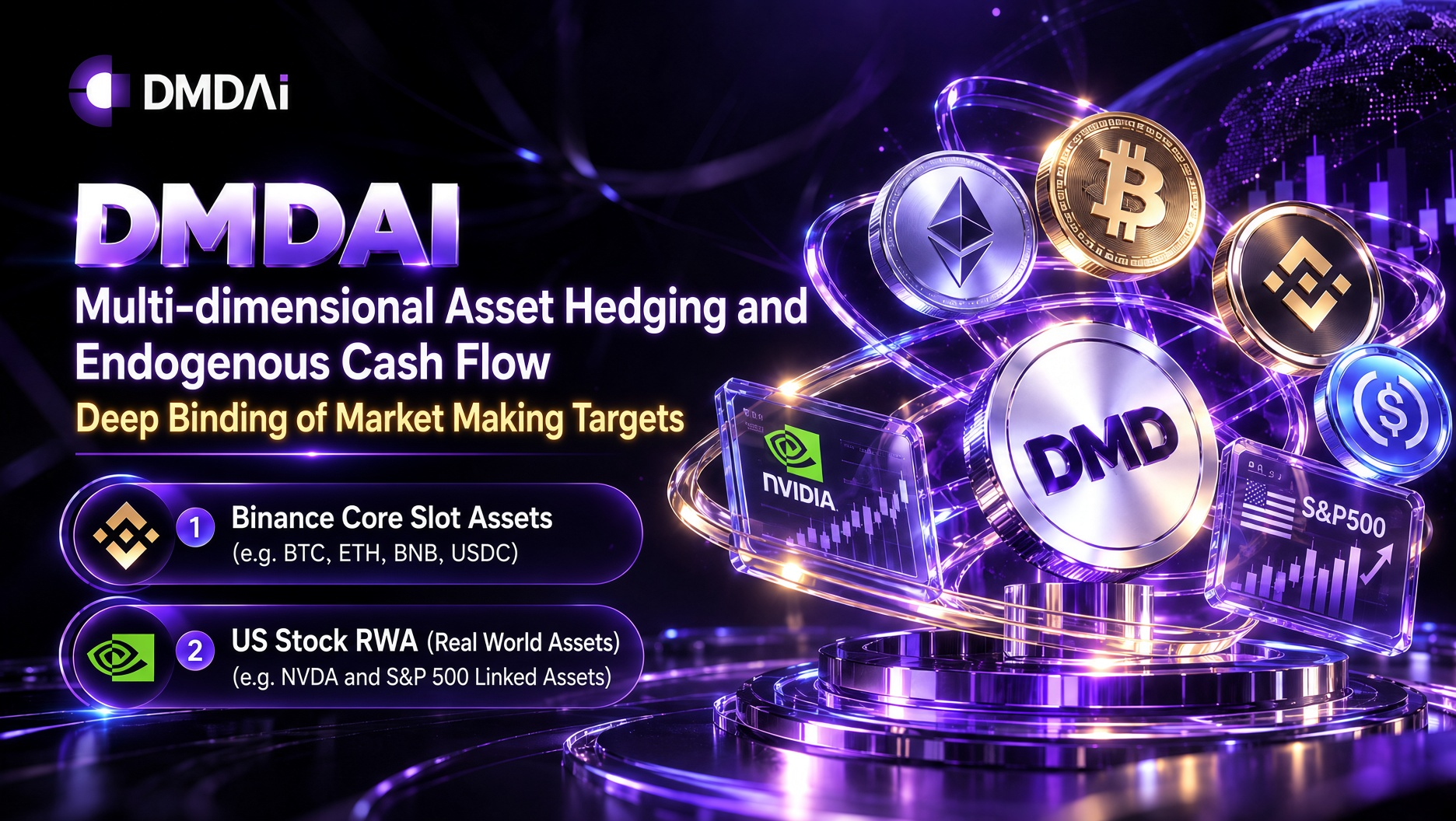
Unlike purely narrative-driven projects that lack underlying real-asset exposure and rely excessively on token issuance, DMDAI links its market-making strategies to Binance-listed blue-chip crypto assets, including BTC, ETH, BNB, and USDC, as well as U.S. equity-related real-world assets (RWAs), such as NVDA and assets linked to the S&P indices.
By integrating highly liquid blue-chip crypto assets with real-world asset exposures, DMDAI aims to introduce recurring and relatively resilient cash flows generated through market-making activities.
The system adopts a structured allocation model of “20% Value Mapping + 80% Risk Reserves.” Under this framework, 80% of treasury earnings are retained over the long term as a risk-hedging reserve within a multisignature insurance pool. In the event of extreme market conditions, a cross-market circuit-breaker mechanism is designed to activate rapidly.
This combination of real-asset exposure, quantitative market making, and systematic risk management is intended to substantially reduce systemic risks associated with volatility in any single crypto asset, establishing a more resilient value foundation for the long-term operation of the broader ecosystem.
III. Activating Hash Power Allocations and Building a Rule-Based Deflationary Flywheel

In its tokenomics and capital circulation architecture, DMDAI's governance token, DMD, follows a clearly defined, rule-based deflationary roadmap, with its total supply designed to decrease progressively from 21 million tokens to an extremely scarce supply of 1 million tokens.
The core liquidity pool is designed to execute an automated daily burn of 0.5%. In addition, 100% of the USDC funds used by users to configure hash power allocations are directed back into the liquidity pool, where they are intended to support market-making depth and the protocol's risk reserve capacity.
By subscribing to and activating “intelligent hash power allocations,” users can connect their on-chain capital to a global AI-powered quantitative network and participate in the potential benefits generated by market-making spreads.
At the same time, the protocol's intelligent yield vault supports automatic compounding of earnings. The fund allocation rules triggered when hash power participation ends or users withdraw funds are designed to maintain a 100% internal ecosystem circulation mechanism, with funds allocated to automatic compounding, community profit sharing, and the ecosystem fund.
This mechanism is intended to convert potential market selling pressure into structural buying support within the ecosystem.
IV. 100% Smart-Contract-Based Execution and a Globally Co-Built Ecosystem
All market-making profit distributions, hash power allocation scheduling, token burns, and treasury risk management processes within DMDAI are designed to be executed automatically by smart contracts, with publicly verifiable and traceable on-chain records.
Combined with the D1–D9 tiered quantitative matrix and peer-level support mechanism, DMDAI aims to strengthen ecosystem coordination while reducing exposure to speculative market dynamics.
With the official platform, dmdai.net, now launched and global computational intelligence nodes and community studios progressively being established, DMDAI is leveraging decentralized technology to transform institutional-grade, high-frequency quantitative market-making tools into accessible financial infrastructure designed for broader participation.
Aayush, CMO of the DMDAO Foundation, stated:
“The higher the velocity of market trading, the more pronounced the contraction of DMD's token supply and the convergence of its value become. Through the closed-loop framework of ‘algorithmic scheduling – real market making – rule-based deflation,’ we aim to convert institutional-grade quantitative trading returns into sustainable, long-term compounding opportunities for community builders around the world.
This approach is designed to address a longstanding challenge faced by traditional DeFi liquidity providers: earning rewards in tokens while losing principal value. DMDAI's vision is to build one of the most resilient decentralized market-making engines of the Web4.0 era, enabling every community builder worldwide to participate more easily in sophisticated digital market-making strategies and take control of their own market-making opportunities.”


All Comments