

Cointime

Download App
iOS & Android

Samourai Wallet co-founders to now plead guilty to US charges

Samourai Wallet co-founders Keonne Rodriguez and William Lonergan Hill have said that they now wish to plead guilty to charges stemming from their involvement in the crypto mixing protocol.

Separate filings on behalf of Rodriguez and Hill were made in a New York federal court on Tuesday, which said the duo would change their pleas before the court on Wednesday morning.

The pair pleaded not guilty to charges in April 2024 for running what prosecutors alleged to be an unlicensed money-transmitting business that processed over $2 billion worth of unlawful transactions, including some tied to illicit online marketplaces like Silk Road.
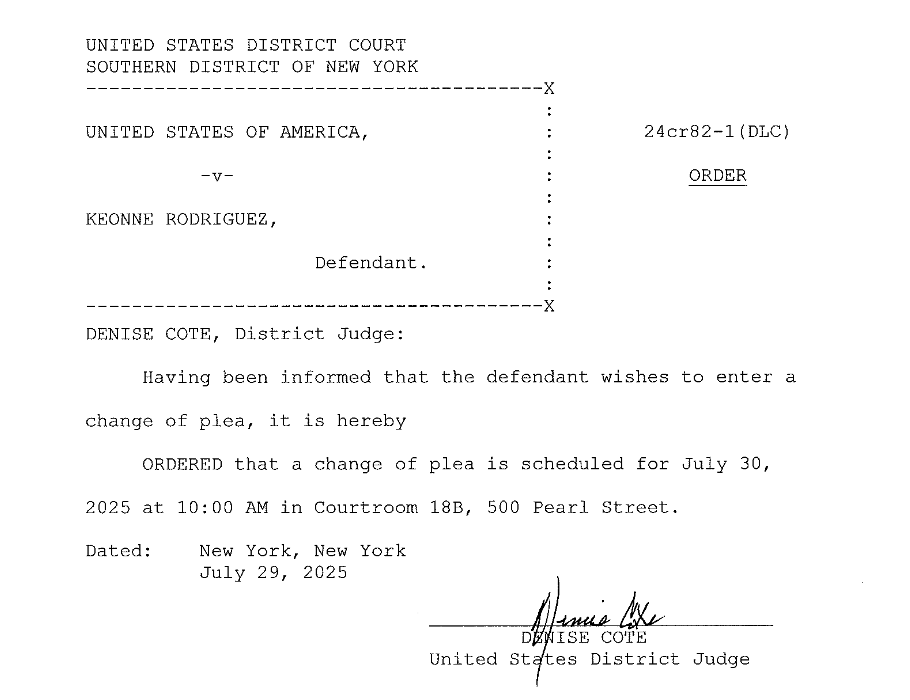
Document on behalf of Keonne Rodriguez reflecting his change in plea. Source: CourtListener

Samourai co-founders face 25-year prison sentence

Rodriguez, Samourai’s CEO, and Hill, its chief technology officer, were charged with conspiracy to commit money laundering, which carries a maximum prison sentence of 20 years.

The pair were also charged with operating an unlicensed money-transmitting business, which carries a sentence of five years, meaning they could face a maximum of up to 25 years behind bars.

Judge Denise Cote scheduled hearings to discuss the change in pleas for Wednesday morning. The document didn’t provide additional details on how the plea change may impact their sentences.

A trial for the pair was set to start on Nov. 3.

Samourai co-founders tried to toss the case

The change in pleas came nearly four months after the pair tried to dismiss the case in early April, pointing to an April 7 memo from Deputy Attorney General Todd Blanche that said the Department of Justice wouldn’t prosecute those behind crypto mixers for “unwitting violations of regulations.”

A month later, Samourai’s lawyers alleged that federal prosecutors suppressed advice that the company didn’t need a money transmitting license six months before the founders were eventually charged.

Neither attempt to sway the prosecutor’s case was effective.

Samourai worked similarly to other crypto mixer protocols, taking funds from multiple users and blending them to hide their origins.

Guilty pleas come amid Roman Storm’s trial

Another crypto mixer under the spotlight is Tornado Cash, with one of its creators, Roman Storm, currently being tried before a jury. 

Storm’s backers say an unfavorable outcome in the case could establish a precedent for criminalizing open-source privacy tools, posing a serious risk to decentralized finance innovation while significantly restricting privacy rights.

Storm was charged with conspiracy to commit money laundering and sanctions violations in 2023. If convicted on all counts, Storm could face up to 45 years behind bars.


Comments

All Comments

Recommended for you

  • BTC Surpasses $79,000

    Market data shows that BTC has surpassed $79,000, currently priced at $79,007.9, with a 24-hour increase of 2.2%. The market is experiencing significant volatility, so please ensure proper risk management.

  • Nasdaq Golden Dragon China Index Rises Over 0.5%

    On September 14, the Nasdaq Golden Dragon China Index rose over 0.5%. Tianyan Pharmaceutical increased by 3.82%, Li Auto by 3.77%, iQIYI by 2.90%, Dingdong Maicai by 2.57%, and Lufax Holding by 2.48%.

  • Amundi Purchases 2-Year U.S. Treasury Bonds, Bets on High Oil Prices and Financing Costs Weighing on U.S. Economy

    Amundi, with assets under management of $2.8 trillion, has begun purchasing 2-year U.S. Treasury bonds and has closed its short positions on U.S. short-term interest rates. Portfolio manager Nicolas Dahan believes that rising oil prices to $100 per barrel and soaring financing costs increase the risk of a slowdown in the U.S. economy. As the yield on 2-year U.S. Treasury bonds rises above 4.50%, their appeal as a safe-haven asset increases. Amundi is reallocating its bond investments in the U.S., Europe, and the UK while extending the duration of its portfolio.

  • Pinterest Partners with NVIDIA to Build New AI Capability Module

    On September 14, Pinterest announced its collaboration with NVIDIA to develop a new AI capability module.

  • Coinbase CEO: Tokenized Stocks Set Industry Standard, Global Investors Access $70 Trillion US Stock Market

    On September 14, Coinbase CEO Brian Armstrong posted on the X platform with a video stating that Coinbase's tokenized stocks have set the industry standard. He emphasized that this product does not involve synthetic products or debt instruments, but rather represents fully-backed securities that can be redeemed for underlying shares, with dividends integrated and voting rights soon to be introduced. Armstrong pointed out that this means global investors and institutions can access the US stock market valued at over $70 trillion, built on a solid foundation.

  • Trump Family Transfers Over 20 Billion WLFI Tokens to New Ownership Contract to Facilitate Future Sales

    On September 14, according to the Washington Sun, President Trump and other founders of World Liberty Financial have transferred over 20 billion WLFI tokens into a new ownership contract, clarifying the path to future liquidity, replacing the previous indefinite lock-up. On May 19, four wallets simultaneously transferred their holdings into this contract, with one allocation matching Trump's disclosed holdings and the other three believed to correspond to allocations held by family members. According to governance rules approved in May, founders can choose an indefinite lock-up or a new timeline—destroying 10% of the allocation and gradually unlocking the remaining tokens over three years after a two-year cliff period. These tokens are currently not available for sale. World Liberty Financial denies that this move is preparing for a sale, while critics argue that the founders voluntarily chose the only option that ultimately allows token liquidity. Reports indicate that retail investors have lost over $1 billion.

  • Trump: Russia and Ukraine Agree Not to Strike Each Other's Energy Targets

    On September 14, U.S. President Trump stated that Ukraine has agreed not to strike Russian energy facilities, and Russia has also agreed to take similar measures. If these arrangements are implemented, attacks on energy infrastructure by both Russia and Ukraine may be alleviated. Trump also noted that the recent rise in global diesel prices is primarily caused by the Russia-Ukraine war, rather than the situation in Iran.

  • U.S. and Brent Crude Oil Prices Drop by $1.4

    U.S. and Brent crude oil prices have dropped by $1.4, currently reported at $98.749 per barrel and $104.29 per barrel, respectively. Trump stated that Russia and Ukraine have agreed not to target each other's energy facilities.

  • Fed's Rate Hike in September Almost Certain, Analysts Say Current Conditions Resemble the 1990s Rather Than 2022

    On September 14, news emerged that following a rise in the U.S. core CPI in August, expectations for a Federal Reserve rate hike in September have surged, making an increase this week a high-probability event. LPL Financial's analysis of six tightening cycles since 1994 shows that the S&P 500 has averaged negative returns in the first four months after the initial rate hike, with an average increase of 6.7% over 12 months and a median of 10.7%. Notably, after the rate hike in March 1997, the S&P 500 rose by 42% over the year, while after the March 2022 hike, the maximum drawdown was approximately 25%. LPL believes the current macroeconomic environment is more akin to the late 1990s: the economy remains resilient, inflation is below the peak levels of 2022, and the starting interest rates are already relatively high. The AI investment boom may support capital expenditures. However, the firm does not expect a simple replication of the 42% increase seen in 1997, and the scale of this tightening cycle is unlikely to approach the cumulative 5.25 percentage points seen from 2022 to 2023.

  • U.S. 10-Year Treasury Yield Rises to 5%, First Time in Nearly Three Years

    On September 14, the yield on U.S. 10-year Treasury bonds rose to 5%, marking the first time in nearly three years.