

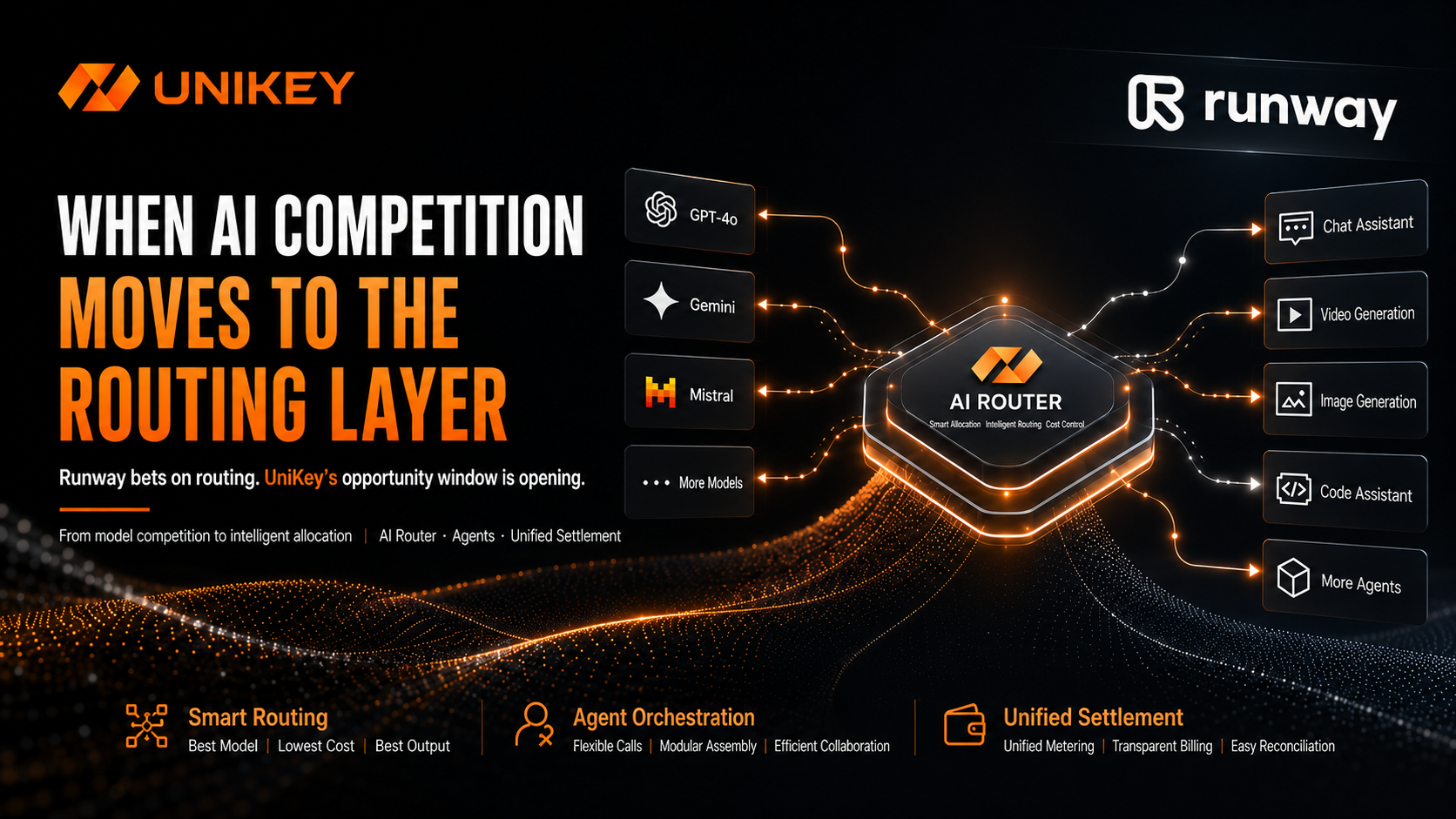
The AI industry in 2026 is witnessing a shift that deserves far more attention than the release of yet another new model: a growing number of model companies are moving upward to compete for the unified access layer, intelligent routing, and task orchestration.
Recently, Runway officially launched Runway Media Router. Instead of requiring developers to manually select a specific image, video, or audio model, the system automatically chooses the most suitable model based on task requirements and preferences such as quality, cost, and response speed. Runway has also brought its proprietary models together with third-party capabilities such as Seedance, GPT Image 2, and ElevenLabs on a single development platform, allowing developers to access, switch between, and manage usage across multiple models through one API.
The significance of this move is not that Runway has simply added another feature. Rather, a company best known for video generation models is actively expanding its competitive boundary from “building stronger models” to “organizing more models.” TechCrunch summarized this shift by noting that Runway no longer wants to be merely an AI model company, but aims to become the infrastructure layer for generative media.
This also sends a very clear industry signal for the direction UniKey is pursuing through AI Gateway, AI Router, AI Credits, Agent Factory, and Settlement Network: in the next stage of AI, the most important advantage may not be owning the strongest model, but owning the gateway that allocates intelligence.
As Models Multiply, “Choosing the Right Model” Is Becoming a New System Cost
In the past, choosing an AI product was relatively simple. Users relied on one large language model for writing, one image platform for visual creation, and another video tool for video generation. Each platform had a relatively clear capability boundary, and remembering a handful of brands was enough to complete most tasks.
Today, the situation has changed completely. Large language models now combine reasoning, coding, multimodal capabilities, and tool use. Image platforms are expanding into video and editing. Video platforms are integrating third-party models, Agents, and Workflows. Different models are also developing distinct advantages in speed, price, long-context processing, coding, visual consistency, character performance, audio, and multilingual capabilities. Users are no longer asking whether a model exists, but rather which model should be used for a particular task.
The more difficult issue is that the answer is not fixed. In the concept-validation stage of a video project, speed and cost may matter most, while final delivery may prioritize visual quality. Within the same Agent workflow, task planning, document analysis, code execution, and result verification may each require a different model. Runway Media Router allows enterprises to set price ceilings, model allowlists, and blocklists, and then score available models based on cost, quality, and latency. In essence, it upgrades constantly changing model selection from a manual judgment into a system-level decision.
Therefore, a larger number of models does not automatically make AI easier to use. On the contrary, as the supply of intelligence becomes more abundant, the costs of selecting, integrating, switching, metering, and managing models rise rapidly. This is why the routing layer is becoming infrastructure.
Routing Is Not “Model Navigation,” but the Intelligent Control Center of the AI Era
Many people think of model routing as a simple price-comparison function: send the request to whichever model is cheaper. But a mature AI Router is far more sophisticated than that.
A routing system designed for production environments must first understand what capabilities a task requires, then exclude models that fail to meet modality, permission, budget, or compliance requirements. It must then score the remaining models according to price, speed, reliability, and output quality, while switching to backup routes when a model times out, reaches a rate limit, or returns an error. Once the task is complete, the system must also record which model was used, how much was consumed, the response status, and the generated result, providing the basis for subsequent optimization and settlement.
Runway’s routing logic already reflects this direction. Developers can save routing configurations for different business scenarios, such as low-cost previews and high-quality final exports. The system first filters models according to hard constraints, then scores eligible models based on user preferences, and finally returns the selected model together with the reason for that selection.
This means the routing layer is effectively becoming the “control plane” of the AI system. Models produce intelligence, while the routing system determines when that intelligence is used, at what cost, and through which path. For enterprises, this does not merely determine whether a single answer is more intelligent; it determines whether the entire AI system can operate reliably, remain within budget, and continue scaling.
From Language Model Routing to Full-Modality Routing, Industry Boundaries Are Being Redefined
Model routing first emerged primarily in the large language model market, because the cost and capability differences between text models were relatively easy to compare. Runway’s expansion of routing into image, video, and audio generation shows that unified orchestration is moving beyond text and into the broader generative AI market.
Multimodal routing is more complex than language model routing. Text responses can often be evaluated by accuracy, length, and response time, while images and videos must also be judged on composition, motion, stylistic consistency, character stability, audio synchronization, and camera control. Runway has stated that its routing layer matches models based on both model capabilities and user preferences around quality, cost, and latency. This is also a way of turning Runway’s accumulated creative expertise into a platform-level product.
More importantly, Runway has not isolated routing as a single feature. It also provides Models, Recipes, Workflows, and Characters. Developers can call models directly or combine multiple models and tasks into reusable workflows that can be repeatedly executed through APIs. Runway also uses MCP to connect image and video capabilities with compatible Agent environments such as Claude, ChatGPT, and Cursor, allowing generative capabilities to enter external Agent workspaces directly.
This shows that competition among AI gateways is evolving beyond the question of how many models a platform aggregates. It is moving toward three higher-level questions: can the platform automatically select the right capability, can it organize complex tasks, and can it enter more Agents and business interfaces?
In the Agent Era, Routing Will Evolve from a “Single Selection” into “End-to-End Orchestration”
A normal AI conversation may involve only one or a few model calls, but an Agent completing a real task may need to understand requirements, break down the task, search for information, execute code, generate images, verify results, and deliver the final output. Each step may require a different model, and failed steps may trigger a new route.
Google recently expanded Managed Agents in the Gemini API with background asynchronous tasks, remote MCP servers, custom function calling, and credential refresh. Through a single interface, an Agent can perform reasoning, execute code, manage files, and call external tools. This shows that Agents are moving beyond one-off conversations and into long-running, multi-step, cross-system execution.
OpenAI has also stated, in its introduction of the enterprise Agent product Presence, that the challenge for enterprises is no longer proving that Agents can work, but making them reliable enough for production. That requires more than models; it also requires systems, evaluation, permissions, operating rules, and continuous deployment.
Recent research on Agentic Routing further argues that model selection within an Agent should not be treated as a one-time cost-optimization decision. Instead, routing should occur step by step based on task state, execution trajectory, intermediate failures, and validation results. The model choices, results, costs, and feedback generated during each task can then be used to train better routing systems.
Therefore, what the Agent era truly needs is not a static “model list,” but an intelligent control center capable of continuously understanding task state, orchestrating capabilities, and controlling cost.
Runway’s Strategic Shift Validates the Market Direction of UniKey AI Router
Based on UniKey’s current product progress, the platform has already completed unified adaptation across differences in model response formats, billing standards, timeout policies, and rate-limit strategies, normalizing connected models into a standard calling protocol. The routing layer dynamically scores available options based on cost, latency, and output quality, automatically triggering circuit breaking and switching to backup routes when a single model fails. Its external interface is also compatible with the OpenAI standard SDK.
This capability closely aligns with the direction now being validated by Runway Media Router: users do not want to manually choose from dozens of models. They want to submit a task through one interface and let the system handle matching and orchestration.
However, UniKey is targeting a broader scope than generative media alone. Runway currently focuses primarily on image, video, audio, and real-time character capabilities, while UniKey’s product architecture is expanding across text models, image generation, video generation, code, APIs, Skills, Agents, and Workflows. What it is building is not simply a media-routing layer, but something closer to a unified AI Gateway covering multiple forms of intelligent resources.
UniKey is not simply putting models in one place. It is transforming global AI capabilities into intelligent supply that can be uniformly called and managed.
After AI Router, Unified Metering and Settlement Will Become the Second Layer of Differentiation
Model routing answers the question of which capability should handle a call, but it does not answer how much the call cost, who should pay for it, or how the consumption should be managed.
Language models usually charge by input and output Tokens. Image models may charge according to resolution and the number of generated images. Video models may charge according to the model used, duration, resolution, and generation mode. When an Agent completes a task, it may repeatedly call models, Skills, APIs, and Workflows. The more complex the underlying pricing rules become, the harder it is for users and enterprises to establish unified budgets.
Runway Dev has already begun providing unified billing and usage management across models, while allowing developers to set price ceilings and cost preferences. According to its official materials, enterprises can access proprietary and third-party models through one platform and track spending across different models from a unified control panel.
This is where UniKey AI Credits and Settlement Network can establish further differentiation. AI Credits are not simply another name for Tokens. They translate model Tokens, image generation, video tasks, Skill calls, Agent services, and Workflow execution into a unified AI usage allowance that users can understand and manage.
Within this structure, AI Router allocates capabilities, AI Credits carry consumption, and the settlement network records calls, costs, and service contributions. Together, these three layers allow UniKey to move beyond a model aggregation gateway and become genuine infrastructure for AI usage and settlement.
The Real Moat Is Not the Number of Models, but Routing Data
Connecting more models does not create a durable competitive advantage on its own, because competitors can continuously add more providers as well. The real advantage that is difficult to replicate is the routing data accumulated through real usage.
Every call can generate a structured record: what task the user submitted, which model the system selected, how long it took, how much it cost, whether the result was accepted, whether a retry occurred, and whether the task was ultimately completed. As this data accumulates, the platform becomes better at determining which model is best suited to a particular task and can identify the optimal combinations for different users, industries, and scenarios.
Recent Agentic Routing research describes this mechanism as a data flywheel: execution trajectories continuously train better routing strategies, while better routing produces more high-quality tasks and more useful data within the same budget.
Based on this logic, UniKey’s most valuable future asset will not simply be the number of models it has connected, but the volume and quality of real calls, task outcomes, cost-performance records, and user feedback it has accumulated. Individual models may be replaced, but the platform’s knowledge of how to allocate intelligence will continue to compound over time.
From “Who Owns the Strongest Model?” to “Who Controls the Flow of Intelligence?”
Over the past two years, most of the value in the AI market has been concentrated at the model-training layer. Parameter scale, benchmark performance, and computing investment determined where industry attention flowed.
But as models multiply and capabilities become increasingly specialized, value is beginning to move upward. Users will not always care which model is running in the background. They care whether the task is completed, whether the cost is controllable, and whether the result is reliable. Developers will not want to maintain ten or twenty separate interfaces indefinitely. They need a standard that can continuously absorb new capabilities.
By launching Media Router, Runway is effectively acknowledging a new industry reality: no single model can remain the leader forever, but a routing platform can continue connecting every generation of leading models. For UniKey, this is the window worth capturing. It does not need to compete with OpenAI, Google, Anthropic, or Runway to train the strongest model. Its opportunity is to become the unified gateway through which these capabilities reach users, enterprises, Agents, and Workflows.
Models produce intelligence, and Agents execute tasks. UniKey’s role is to connect, orchestrate, meter, and settle the value flowing between them. As AI moves from isolated tools into large-scale production systems, the value may not belong only to those who manufacture intelligence, but also to those who can allocate intelligence most efficiently.


All Comments