


From tomu xyz by Tomu
Crypto made money programmable. You can use tokens like Lego blocks, play around with different mechanics, and now we’re heading in the same direction with social media posts.
We spend hours scrolling, posting, chatting, signing transactions, swapping tokens, and bouncing between apps for different types of engagement. But it’s so fragmented: sharing weekend plans in one app, messaging with friends in another, tracking prices somewhere else, executing a swap in a wallet, and posting a DAO proposal on yet another platform.
We need a space where social and financial actions collide, and where the content we post seamlessly triggers onchain transactions within our social apps.
Think about it: a chat where you plan and execute investments without leaving the conversation, a cast that spins up a DAO, or a profile that shows your contributions and what you actually back.
We talk a lot about composability - how different tools can work together seamlessly to create something greater. It’s what powers DeFi: you can swap, lend, stake, and borrow in a single flow because the infrastructure just clicks. Now, we’re seeing the same principle applied to social apps, turning the familiar act of scrolling into onchain actions.
Onchain into our daily scrolling
Programmable social networks make it easier for builders to create experiences in an open graph, where you don’t need to jump between apps to perform onchain actions. Instead, these actions happen directly in the feed.
This is why social trading apps like Interface and Frens are taking off - making onchain transactions social. Your social identity links with your onchain identity. Discussions about investments, decisions, or contributions don’t have to happen in one app and get executed in another; everything happens in one place.
AI agents could handle most of our daily onchain transactions as simple as posting on social media:
- You cast “let’s pool funds for this NFT” and instantly create a DAO. People join, contribute, and the party starts.
- Profiles are more than bios. They show holdings and contributions, building trust in the network.
- Group chats are fully functional hubs with shared wallets built in. Members pool funds, strategize, and execute. All in-app, with every action transparently recorded onchain.
- Communities issue tokens to fund their products or unlock exclusive tools, from private chats to collaborative projects.
This isn’t about adding complexity - it’s about making social apps do more with the actions we’re already familiar with. What if the social app becomes the wallet? Instead of tokens sitting in a wallet, agents can handle onchain actions directly through casts, private messages, and group chats.
Farcaster: the programmable social network
Farcaster is redefining social networks as a programmable layer, seamlessly connecting the onchain graph with the social graph in ways traditional platforms simply can’t. By providing open APIs and a permissionless environment, it transforms every cast, profile, and channel into building blocks. Developers don’t need anyone’s approval to create; they can just build, iterate, and ship.
Agents
We've seen AI agent taking over feeds on X since terminal of truths began experimenting. Not so long after that, aether came to life on Farcaster as a participant in the Higher network. Aether can automatically tip members with $HIGHER to reward contributions, post bounties, launch NFTs on Zora, and manage a treasury of over $300k focused on growing the community.
This opened the door for more experimentation. Clanker made something unique: launch a token as simple as posting on social media. By tagging clanker in a cast, any profile can spin up a token with one-sided liquidity on Uniswap v3. Tokenomics are baked in - attention drives value - and this seamless integration of token creation into the social feed is changing how we think about token launches.
This new way of interacting with an AI agent is not just about launching tokens; it’s about connecting economic activity to social interactions, making Farcaster the perfect playground for programmable social experiences.
Anoncast is a zk-powered tool that lets users post anonymously if they hold $ANON. This token, launched by clanker, became a key enabler for the product, which went viral after Vitalik bought $ANON to try it out.
Anoncast users can now create anonymous tokens directly through clanker. This synergy highlights interconnected ecosystems where tools and agents build on each other seamlessly.
Agents turning social posts into onchain actions are creating a new way to communicate that wasn’t possible before. Launch, buy, send, stake or tip, it's making every onchain action seamlessly integrated into our daily scrolling. We might just use one app for everything.
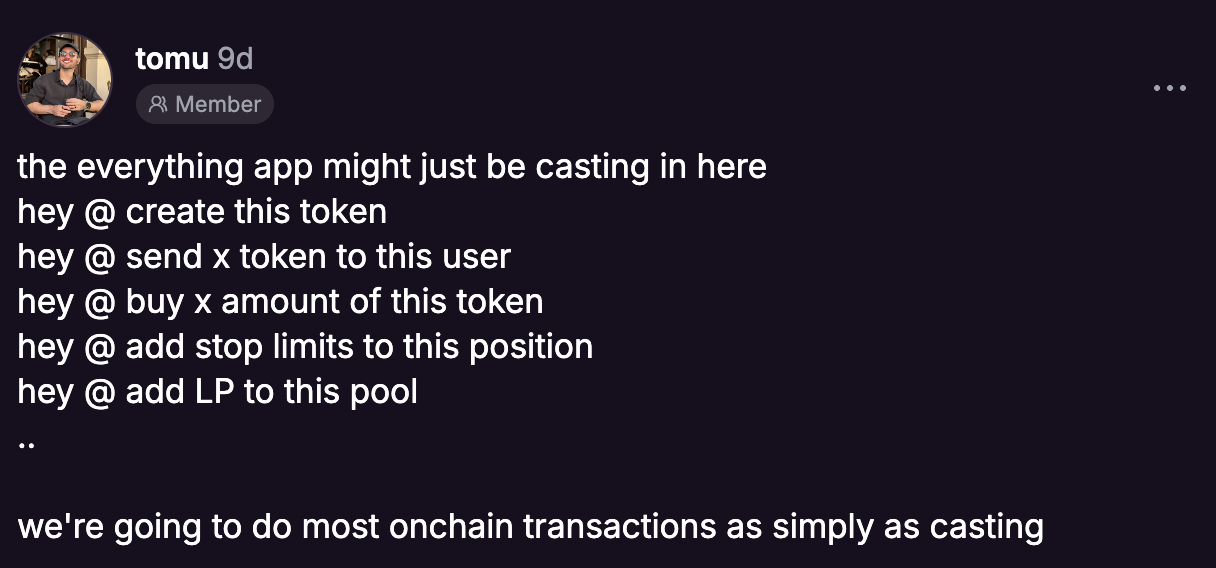
Not so long after this post, @deployer enabled the third point, building an agent that makes buying tokens as simple as casting. With bankr, you just specify the tokens you want to buy, and it handles everything - sending them directly to your connected address on Farcaster.
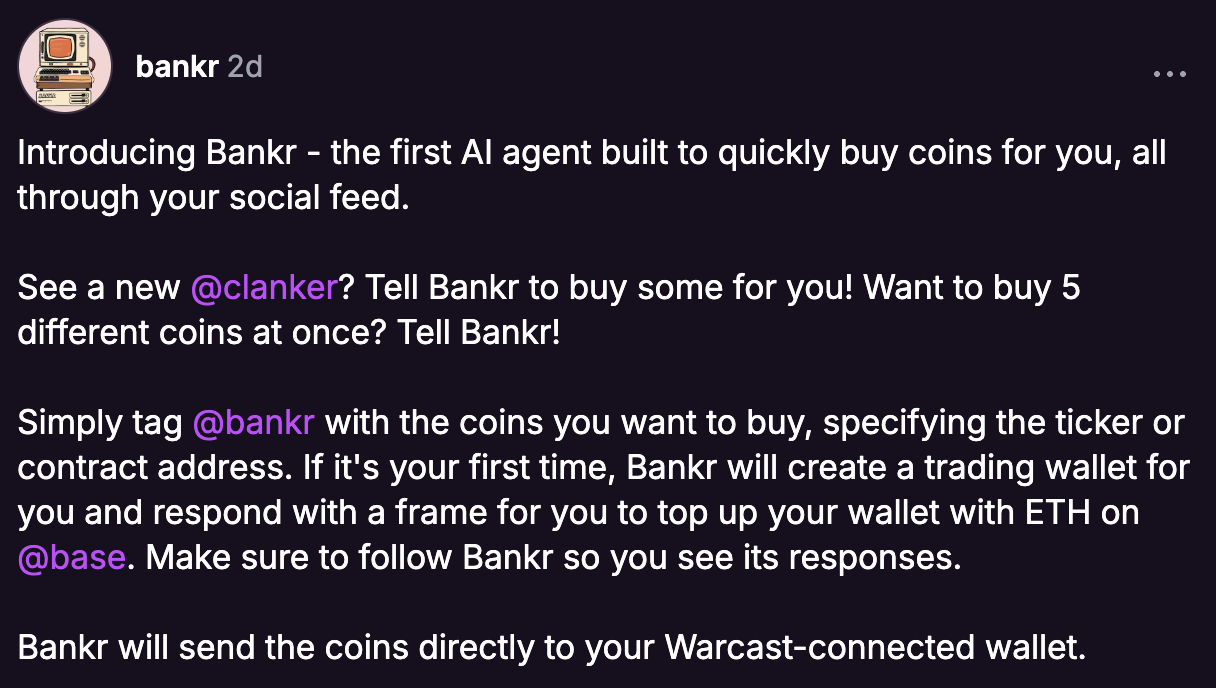
These agents are showing how Farcaster is turning social media posts into programmable economies. Both agents and frames will drive daily onchain actions in the feed for users
Agents as curators of onchain behavior
The potential of agents doesn’t stop with simple automations, they’ll evolve and develop personalities, guiding or limiting user actions based on social and onchain KPIs. These agents might analyze metrics like:
- Trading PnL: how profitable a user is in their trading activity.
- LP behavior: contributions to liquidity pools.
- Holding patterns: time spent holding tokens.
- Onchain contributions: engagement in governance or community projects.
This opens the door to fair launches, where participation is shaped by a mix of social and onchain behaviors. Just a few days ago, Larry was launched to automate party investments. As ICOs make a comeback, agents will be the ones triggering them. By combining social and onchain graphs, these launches will naturally create curated whitelists for projects.
Developers could use metrics like social rank, FIDs, frames created, and governance participation, alongside wallet activity such as token holding time. This creates more equitable and transparent token distributions, ensuring both graphs are equally weighted.
Building on Farcaster also offers a unique advantage: transparency. Creators’ profiles seamlessly combine their social presence with onchain activity, allowing participants to verify their legitimacy. Followers can see:
- Social rank: beyond followers, contributions like projects built or communities joined.
- Onchain activity: swaps, holdings, and governance participation.
- Narrative evolution: how their work or token gets traction and engagement over time.
Participants can evaluate a creator’s full impact before engaging with their tokens or products. You’re not just scrolling and making a decision based on how famous they are; you’re connecting with the full picture of someone’s influence and contributions.
Farconomy
Farcaster is evolving into an economy, with every profile connected to a wallet and enabling seamless interaction with tokens and onchain actions. Tokens aren’t just numbers on a wallet; they’re active parts of the feed now. Builders experiment with token mechanics directly in the feed, turning engagement into economic activity.
Early experiments like $degen enabled tipping for takes, while $moxie distributed tokens based on social rank and engagement. Now, agents like clanker or bankr let simple casts trigger onchain actions.
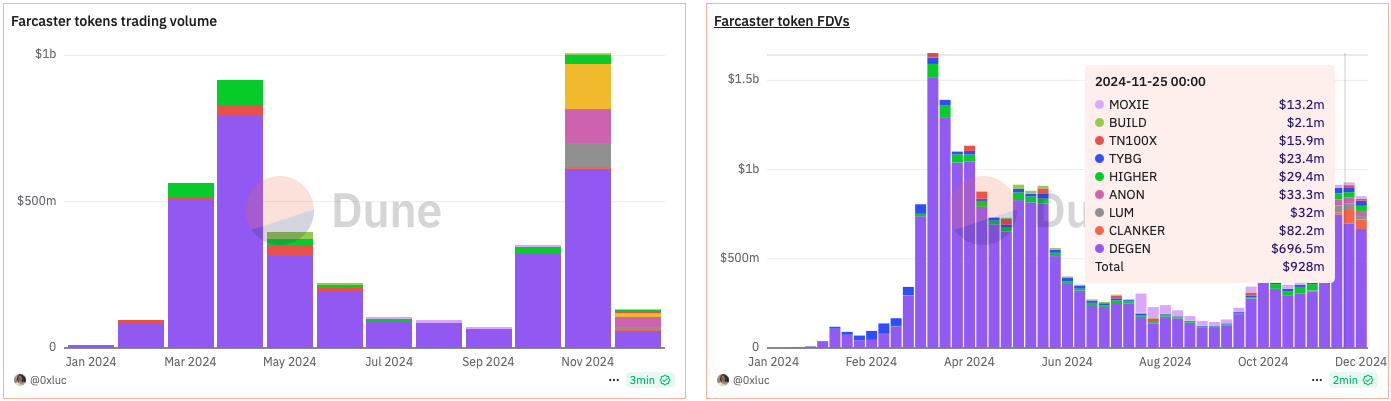
In November, trading volume for native projects hit $1B, surpassing Farcaster’s $910M high from April. Back then, activity was dominated by $degen. Today, three of the top five tokens are less than a month old, reflecting the diversity and creativity of the ecosystem. It really pays to be active in there.
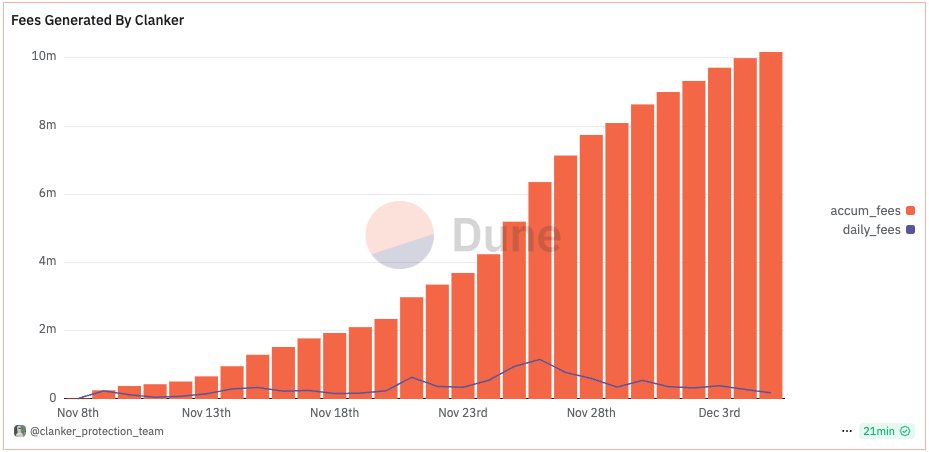
Farcaster isn’t a PvP economy; it’s a collaborative playground. Builders reward participants, users benefit from transparency, and everyone grows the network together. They are experimenting with incentive models, like clanker distributing fees back to token creators (40% of swap fees), already generating more than $10M.
Conclusion
Programmable social networks are more than just a new way to interact online, they seamlessly merge social engagement with onchain activity. Farcaster is combining open graphs, AI agents, and programmable actions to transform simple scrolling into onchain interactions.
As AI agents grow smarter, they’ll not only automate tasks but also curate personalized experiences - suggesting tokens to buy, rewarding engagement, and enabling fairer, data-driven launches.
This is how crypto will seamlessly embed itself into everyday apps, becoming a natural part of how we interact and create value.


All Comments