

Cointime

Download App
iOS & Android

Myanmar Leader’s X Account Potentially Hacked to Promote Fake Crypto

Cointime Official

From beincrypto by Oluwapelumi Adejumo

Hackers potentially took control of the official X account of Myanmar’s military junta leader on Saturday, using it to promote a fraudulent cryptocurrency.

This incident could be the part of a growing trend where scammers exploit high-profile political figures to add credibility to scam tokens, deceiving unsuspecting investors.

Another Political Crypto Scam Now Targeting the Myanmar Government

On February 22, the X (formerly Twitter) account belonging to Myanmar’s junta leader, Min Aung Hlaing, began posting about a so-called national cryptocurrency launch.

The posts described it as “Myanmar first national crypto,” attempting to present it as an official digital asset.
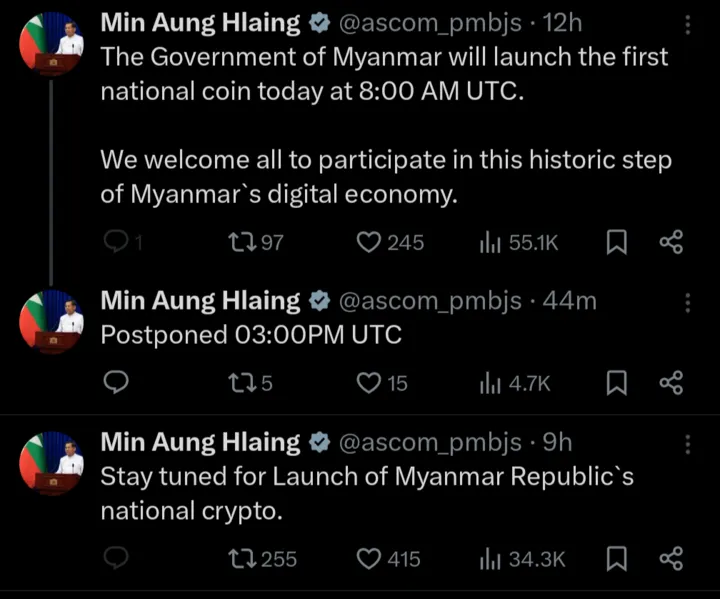
  Myanmar’s Junta Leader Promotion of Meme Coin. Source: X/Min Aung Hlaing

Crypto users on X quickly noticed irregularities. The hackers initially shared multiple cryptocurrency wallet addresses before deleting them.

Soon after, they claimed the launch was postponed and provided a new wallet address, raising further suspicion.

“This account from the government of Myanmar has been hacked . Dropped several CAs and deleted, as well as announcing a space then deleted 3 minutes later,” one user wrote on X.

Meanwhile, market observers questioned whether a military-led government could successfully launch a cryptocurrency. They noted that such an initiative contradicts the principles of decentralization.

One user pointed out that state-backed digital assets often serve as a tool for financial control rather than innovation. The analyst also speculated that countries under economic sanctions might explore cryptocurrency as a way to bypass traditional financial systems.

“Signals a shift: more nations exploring state-backed crypto to sidestep sanctions & SWIFT dependence Geopolitically, it’s a test case If it works, expect more isolated regimes to follow This isn’t about innovation but it’s about sovereignty vs financial gatekeeping,” Cedric Beau stated.

Meanwhile, this attack on Myanmar’s junta leader follows a broader pattern of cyber threats targeting political figures.

Earlier this month, the Central African Republic’s President, Faustin-Archange Touadéra, introduced an official meme coin called CAR. The token was meant to highlight the country’s confidence in blockchain technology.

While that initiative was legitimate, hackers have used similar tactics to deceive users by falsely linking government officials to fake token launches.

Just days ago, scammers impersonated Saudi Arabia’s Crown Prince Mohammed bin Salman to promote a fraudulent cryptocurrency.

In another case, anonymous hackers took over the X account of former Malaysian Prime Minister Mahathir Mohamad to push a fake meme coin.

These incidents reveal a troubling pattern of hackers hijacking political figures’ social media accounts to promote fraudulent cryptocurrency schemes. By exploiting their identities, scammers create a false sense of legitimacy for fake tokens.

As these scams become more common, users must stay vigilant and verify sources before engaging with any token promotions linked to public figures.


Comments

All Comments

Recommended for you

  • Whale Transfers 1,133 BTC to Coinbase Prime, Valued at $71.48 Million

    According to Onchain Lens monitoring, a whale transferred 1,133 BTC from Coinbase to Coinbase Prime through an intermediary wallet, valued at $71.48 million.

  • U.S. AI Chip Stocks Decline Before Market Open, Intel Falls Over 3%

    On July 7, U.S. AI chip stocks experienced widespread declines before the market opened. Intel dropped over 3%, while AMD, Qualcomm, and NXP fell more than 2%. TSMC, Broadcom, and Tesla decreased by over 1%, and NVIDIA declined by 0.7%.

  • China's Central Bank Increases Gold Reserves for the 20th Consecutive Month

    As of the end of June, China's gold reserves stood at 75.44 million ounces (approximately 2,346.446 tons), an increase of 480,000 ounces (about 14.93 tons) from the end of May, which reported 74.96 million ounces (approximately 2,331.52 tons). This marks the 20th consecutive month of gold accumulation.

  • China's Foreign Exchange Reserves in June at $341.6262 Billion

    On July 7, China's foreign exchange reserves for June stood at $341.6262 billion, a decrease of $26 billion from the end of May, representing a decline of 0.75%, with expectations set at $343.2 billion.

  • U.S. Storage Stocks Drop Pre-Market, SanDisk and Micron Down Over 4%

    On July 7, U.S. storage concept stocks collectively fell in pre-market trading. Western Digital dropped over 5%, SanDisk and Micron Technology fell over 4%, Seagate Technology declined over 3%, Rambus fell over 2%, and SMI fell over 1%.

  • U.S. Stocks in Optical Communication Sector Drop Pre-Market

    On July 7, stocks in the optical communication sector of the U.S. market collectively fell pre-market. Astera Labs dropped over 4%, while Marvell Technology, Credo Technology, and AXT Inc. fell more than 3%. Tower Semiconductor, MaxLinear, Corning, Applied Optoelectronics, GlobalFoundries, Lumentum, and Qorvo all declined by more than 2%. Coherent, Nokia, Amphenol, and Broadcom dropped over 1%.

  • Pre-market Decline in U.S. Storage Stocks

    In pre-market trading, U.S. storage concept stocks experienced a widespread decline, with Micron Technology falling by 4.8%, SanDisk dropping over 4%, Corning down more than 2%, and Intel decreasing by over 3%.

  • Two Departments: Support for Reinsurance Institutions to Increase Capital and Issue Supplementary Capital Tools

    On July 7, the National Financial Supervision and Administration Bureau and the Shanghai Municipal Government released several measures to accelerate the construction of the Shanghai International Reinsurance Center. Among these measures, they proposed to enhance the quality and efficiency of the reinsurance industry, support reinsurance institutions in increasing capital and expanding shares, and issuing supplementary capital tools to improve the capacity for internal capital accumulation and external capital supplementation, thereby strengthening the reinsurance industry's capabilities. The initiative aims to guide the insurance industry to focus on major national projects, strategic emerging industries, and livelihood security, consolidating insurance and reinsurance underwriting capabilities to enhance risk protection levels. It also supports reinsurance institutions in leveraging their professional technical advantages to assist the insurance industry in reducing risk.

  • Sources: Saudi Arabia Plans to Expand Oil Pipeline to Red Sea, Increasing Capacity by 2 Million Barrels Daily to Bypass Strait of Hormuz

    On July 7, five informed sources revealed that Saudi Arabia is considering expanding the crude oil pipeline capacity to its western coast on the Red Sea, allowing Saudi Arabia and its neighbors to transport more oil without passing through the Strait of Hormuz. This east-west pipeline, built in the early 1980s, has gained strategic importance since the outbreak of the Iran war in February and the disruption of shipping in the Strait of Hormuz. The pipeline can deliver up to 7 million barrels of crude oil per day to the Red Sea port. The CEO of Saudi Aramco stated in May that approximately 2 million barrels are supplied to west coast refineries, while about 5 million barrels are for export. Sources indicate that Saudi Arabia is in preliminary discussions with some neighboring countries regarding the pipeline expansion, aiming to add about 2 million barrels of pipeline capacity per day. It remains unclear whether Aramco's planned expansion involves upgrading existing infrastructure or constructing new pipelines. One source mentioned that the expansion plan also includes a smaller refined oil pipeline. Two sources indicated that the expansion scale could range from 1 million to 2 million barrels per day, with refined oil also being considered. Another source stated that the project would take several years and cost billions of dollars, requiring adjustments to Saudi crude pricing mechanisms.