

As the market returns to AI, RWA, stablecoins, onchain finance, and real world applications, public blockchain ecosystems are entering a stage where concepts alone are no longer enough.
In the past, a chain could attract attention through higher TPS, lower gas fees, or a dense list of ecosystem partnerships. Today, the question is more practical: can these resources remain in the network and create new connections, liquidity, and ongoing demand?
The industry is moving from announcing partnerships to proving collaboration.
ENI’s Top 100 Supernode Program sits at the center of this shift. On the surface, it is an expansion of ENI’s node network across institutions, projects, platforms, and communities. But its partner mix points to a broader goal. ENI is not building a simple set of validator nodes. It is building a collaborative network supported by security, liquidity, technology, data, applications, and real world resources.
The role of a node is changing with it.
A Partner List Does Not Build an Ecosystem
“Ecosystem” may be one of the most frequently used words in crypto. Yet an ecosystem is not a collage of project logos or a rapid stream of partnership announcements.
A real ecosystem enables continuous exchange. Users can enter. Assets can move. Developers can deploy. Applications can find demand. Partners can gain tangible value from the network.
Expectations for infrastructure are becoming more grounded. A chain’s potential is no longer measured by technical specifications alone. It also depends on whether it has enough meaningful entry points.
Exchanges bring users and assets. Security firms create a trusted environment. Media and data platforms help the market follow network progress. Vertical applications generate new onchain activity. Without any of these layers, an ecosystem can easily end up with technology but no usage, projects but no liquidity, or a narrative but no coordination.
This is where ENI’s Top 100 Supernode Program stands out. It does not confine nodes to a purely technical role.
Based on ENI’s announced partnerships, the supernode network includes institutional and security participants such as NTT and CertiK, exchanges including LBank, CoinW, and CoinChief, as well as media and data platforms such as CoinTime and Feixiaohao. It also includes ecosystem projects across AI, RWA, DeSci, and other application areas, including XDGAI, Soly Chain, NanoVita, ANOME, YOMIRGO, and NerveNetwork.
The point is not the number of partners. It is the structure of their capabilities.
ENI is bringing resources from different sectors into a network designed for greater coordination.
Supernodes Are Becoming Resource Connectors
Traditionally, nodes are responsible for validation, consensus, data synchronization, and network maintenance. These functions remain essential to decentralized infrastructure. But as public blockchain competition deepens, the value of a node extends beyond the technical layer.
A supernode can be a gateway for users and assets. It can connect external resources with the onchain economy. It can also help coordinate applications, communities, developers, and markets.
In other words, nodes are no longer only responsible for keeping a network running. They can also help a network grow.
Viewed this way, ENI’s Top 100 Supernode Program is a resource coordination mechanism. It seeks to bring institutional reach, onchain trust, liquidity access, and application demand into a more connected environment.
ENI is not simply recruiting nodes. It is building an ecosystem connection layer.
Each supernode is both a participant and a connector. Depending on its position in the market, a supernode can bring users, technical capabilities, application demand, market information, or external resources into the ENI ecosystem. As the network becomes more diverse, it gains more than new partners. It gains more capabilities that can work together.
That is what gives the program more potential than a conventional expansion of node capacity.
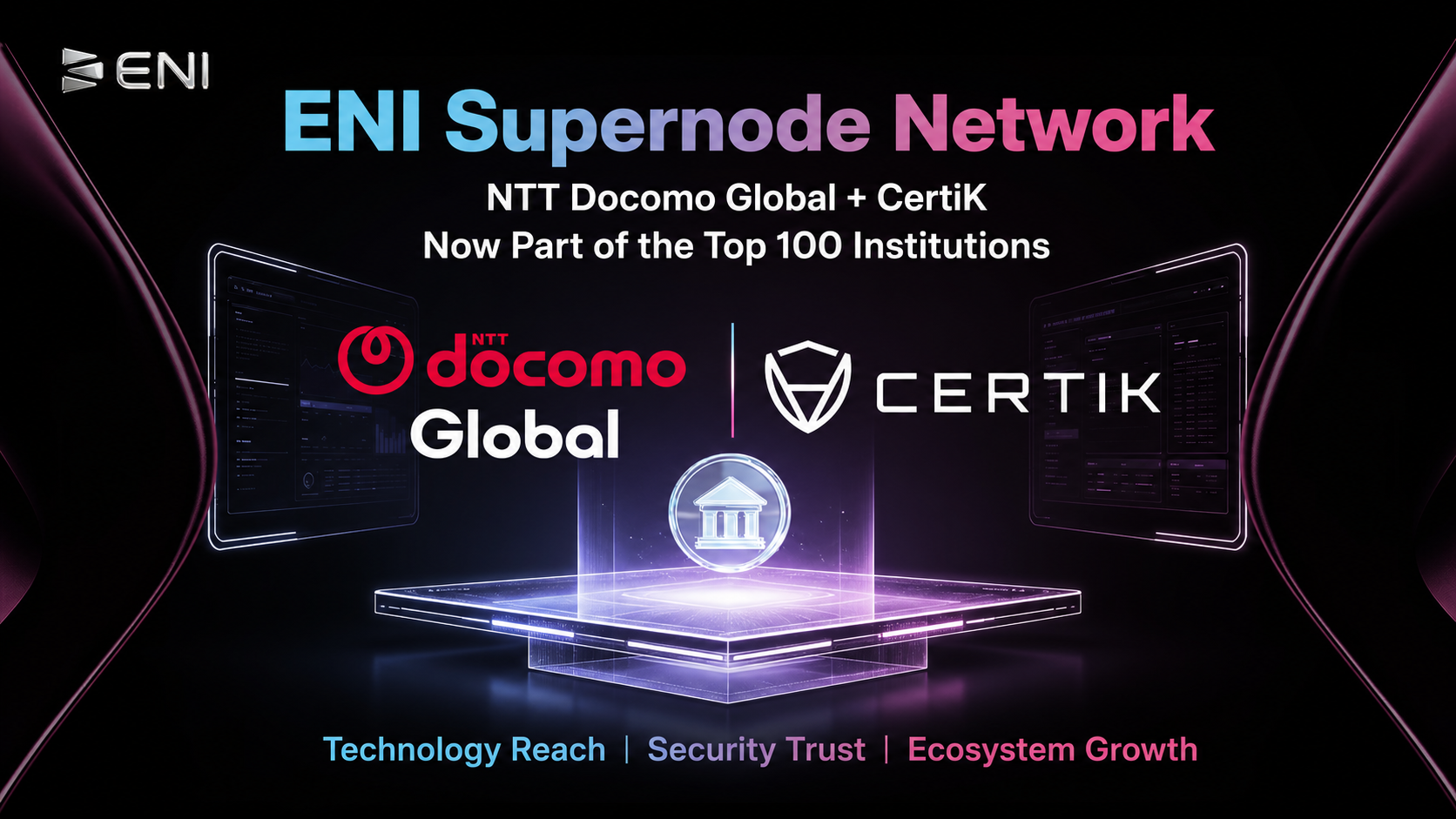
NTT and CertiK: Building Reach and Trust
Every ecosystem needs two basic conditions to grow: resources and trust.
NTT brings the possibility of deeper connections with the technology sector and real world commercial resources. For projects that have operated mainly within crypto native circles, connecting with enterprise resources, broader technology networks, and real use cases has always been a challenge.
The next stage of Web3 is not simply about bringing more assets onchain. It is also about helping real demand recognize the value of onchain technology. Whether in data collaboration, digital identity, intelligent business, or more complex infrastructure services, public blockchains need the ability to connect with real industries.
NTT’s participation signals that ENI is looking beyond onchain projects and trading users. It is also seeking connections with broader technology and industry resources.
CertiK adds another critical layer: security.
As DeFi, RWA, and AI agent use cases become more complex, security is no longer an optional feature. The more sophisticated the relationships between assets, data, smart contracts, and users become, the greater the need for a trusted environment.
Without security, liquidity is difficult to retain. Without trust, applications struggle to attract long term users.
Together, NTT and CertiK represent two complementary foundations for ENI. One expands the network’s access to external resources and real world use cases. The other strengthens the trust needed for onchain activity and user participation.
Liquidity and Distribution Determine Whether an Ecosystem Can Move
Institutional resources and security may form a network’s foundation, but liquidity and distribution determine whether it can enter a sustainable cycle.
The participation of LBank, CoinW, and CoinChief shows that ENI is connecting with a broader base of market participants. Exchanges are more than trading venues. They connect users, communities, assets, and market activity across regions.
For a network seeking to expand its global participant base, the role of exchanges goes beyond listings or trading volume. They provide user reach, asset circulation, and market access.

Crypto does not lack new projects. What it lacks are networks that can consistently bring users in, give them a reason to stay, and create paths for meaningful participation.
As an ecosystem adds applications and activity, practical questions become more important. Where do users enter? How do assets find smoother liquidity routes? How can different markets connect more efficiently?
CoinTime and Feixiaohao address the information layer of this equation.
In a fast moving market, visibility matters. Participants need to see ecosystem progress, understand new developments, and make informed judgments. Media and data platforms are not simply channels for short term attention. They help ensure that network development can be tracked, discussed, and evaluated over time.
Exchanges connect liquidity. Media and data platforms connect information flow. Together, they give ENI an important ability: to build an ecosystem that can be joined, not merely announced.
Connecting Multiple Sources of Demand
The market’s most visible narratives may change quickly, but sources of onchain demand are becoming increasingly diverse.
AI is still looking for truly composable onchain use cases. RWA is moving from broad concepts toward concrete questions around assets, structure, and liquidity. DeSci is exploring new models for scientific collaboration and knowledge value. GameFi, SocialFi, and AI agents continue to seek more natural ways to engage users.
For an underlying network, the challenge is not to chase every narrative. It is to remain capable of supporting demand as narratives rotate.
ENI’s supernode network reflects this multi sector approach through partners such as XDGAI, Soly Chain, NanoVita, ANOME, YOMIRGO, and NerveNetwork.
These projects may follow different growth paths, but together they represent a broader range of potential demand. AI infrastructure, RWA, DeSci, digital communities, gaming, social interaction, and intelligent agents each bring different possibilities to an ecosystem.
For ENI, the value of the Top 100 Supernode Program may lie in refusing to place the future on a single narrative. Instead, it is building a network open enough for different forms of innovation to find an entry point.
One Hundred Is Not the Goal. Coordination Is.
The ultimate value of the Top 100 Supernode Program will depend on a more important question: will the supernodes actually collaborate?
One hundred supernodes as a static list have limited meaning. But if security, trading, data, technology, applications, and communities can create ongoing interaction, the network can evolve from a collection of participants into an ecosystem mechanism.
How will supernodes participate in network development? How will different supernodes find clear paths to collaborate? Can security capabilities, liquidity resources, and application projects form more verifiable links? Can external resources translate into real growth among developers, users, and applications?
These questions cannot be answered by partnership announcements alone. They require continuous building.
Still, the current structure of ENI’s partnerships suggests that it is moving beyond the conventional single chain narrative. It is assembling a network in which institutions provide reach, security creates trust, exchanges bring liquidity and user access, information platforms improve market visibility, and applications expand onchain demand.
When nodes become more than nodes, a network becomes more than a chain.
The real measure of ENI’s Top 100 Supernode Program will not be how many names eventually appear on the list. It will be whether the capabilities behind those names can help form a more resilient, connected, and collaborative global ecosystem.


All Comments