


Main Takeaways
- The risk team at Binance has identified and compiled 12 of the most widely used crypto scams, including romance scams, impersonation scams, and fake giveaways, to name a few.
- Every week, we’ll dig into a different type of scam — including the methodology behind it — as well as provide users with general guidelines on how to spot and avoid the scam.
It might be a Telegram message from a supposed "Binance employee," an urgent phone call from a distant relative needing money, or a charming swindler professing their love for a costly price. Scams come in all shapes and sizes, but they all have one common goal: stealing your money.
A high-pressure text demanding money or a phony bitcoin giveaway can be enough to manipulate users and gain their trust, especially ones caught out in a vulnerable moment.
This article serves as an introduction to a broader anti-scam blog series that will introduce the most prevalent scams in the crypto industry and the best practices to avoid them. We share this information to ensure our users are equipped with the latest security tips and advice because ultimately, you play the largest role in protecting your funds.
An Introduction to 12 Types of Scams
Below, our risk team has identified and grouped the most popular crypto scams into 12 categories, along with a summary of how each one tends to work.
Every week, we’ll dig into a different scam — including its methodology — and provide users with general guidelines on spotting and avoiding the scam. Let’s take a look at the 12 categories.
1. Investment scam
Investment scams involve a fraudster promising high returns if you invest your money through a "highly-recommended" website, app, or crypto broker. The criminal may even claim to be an expert who will multiply your funds tenfold.
2. Employment scam
The job posting may look real. The income is well above the industry average. However, there’s a catch: Employment scammers will send out a rewarding job listing that requires applicants to pay a deposit fee if they want the job.
3. Impersonating an authority figure
Impersonator scammers will attempt to gain your trust by posing as someone important, such as a police officer, a government official, or someone from the tax bureau.
4. Impersonating Binance Support
Impersonating a Binance Support employee is, unfortunately, a popular attack vector for crypto fraudsters. Scammers often attempt to manipulate users by exploiting the trust our company has established in the space over the years.
Note that Binance employees will never contact you directly and ask for sensitive information. If you receive a message from someone claiming to work for Binance, block the contact and file a report to Binance Support immediately.
5. Romance scams
A romance scam involves a love interest attempting to start an online relationship with you in the hope of stealing your money. These scams can sometimes take years to develop, as the swindler will start by requesting small loans before escalating to your entire life savings.
6. Fake giveaway
Scammers will invite you into a Telegram group or Discord server to participate in a bogus crypto giveaway or airdrop. The scammer will typically ask for a deposit fee, or they'll attempt to trick you into revealing sensitive information in exchange for your "winnings."
7. Ponzi scheme
Ponzi schemes are a type of scam that pays early investors with funds and commissions collected from new investors. There is no real investment. The fraudster essentially takes money from one investor to pay the other investor. People in a Ponzi scheme are often encouraged to invite their friends and family to join.
8. Fake shopping site
Fake shopping sites are designed to mimic a legitimate e-commerce website, going as far as allowing users to sign up as a merchant or a customer. The fake site may entice you to buy their goods using prices significantly lower than the average market rate. The fake site, however, will not be willing to offer delivery or will send you worthless items instead of the goods listed.
9. Money transfer fraud
Money transfer fraud can occur in two different scenarios.
First, as an innocent peer-to-peer transaction. The scammer sends money to the victim, who then transfers the equivalement amount of crypto back. This would be considered a normal P2P transaction if it ended here. Instead, after receiving their crypto, the scammer will issue a chargeback or cancel the bank transfer.
The other scenario involves a scammer using fake receipts to claim they sent money to your bank account. The scammer will then demand you send back the funds in crypto. Victims will believe the receipt is real and withdraw crypto to the scammer’s address.
Money transfer fraud starts with the scammer sending money to the victimThe scammer will then provide transaction documents before recalling the transaction, issuing a chargeback, or claiming the documentary proof was tampered with.
10. Acquaintance fraud
Not all scammers are strangers. The scammer could be a relative, a close friend, or an acquaintance introduced by your friend. Scams can and often do occur in familiar circumstances.
11. Rug pulls
In the crypto industry, a rug pull is when a crypto project team raises investor money before suddenly abandoning the project and removing all its liquidity. The rug pull typically happens when the investor hype is at its peak.
12. Others
This category is reserved for unique cases where a scam is taking place, but the circumstances don't match any of our existing categories listed above.
See Three Examples in Action
Here are a few examples of how a scammer might target you.
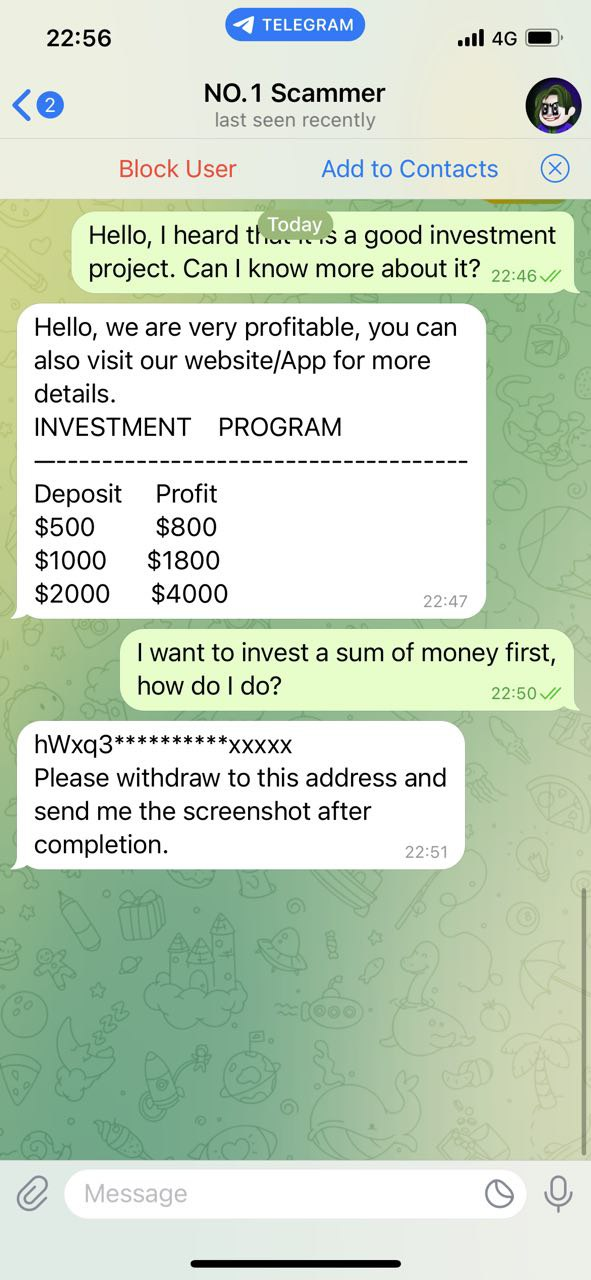
Example 1: Fake investment
The user, who we’ll call Jack, sends the first message to the scammer. Jack likely found the contact through another social media channel. The scammer advertises a highly-profitable investment program that guarantees high returns.
Jack agrees to invest money but will discover later the contact has stolen his money.
Example 2: Employment scam
The user, who we’ll call Mike, is contacted for a vague job with attractive pay. The scammer promises the company will pay Mike after completing a set of tasks. There is no company, and the scammer will ask Mike to send a deposit fee as part of the task requirements.

Example 3: Impersonating Binance Support
The user, who we’ll call Lily, enters a Telegram group with fake "Binance employees" offering unique services with high returns. After making multiple deposits to the wallet addresses listed in the group, Lily has yet to receive a response from the group.

Conclusion
We hope users can use this knowledge to make better decisions when navigating the crypto ecosystem. If you believe you're currently the target of a scammer — even a sliver of doubt — stop responding, stop any pending transfers, and file a report to Binance Support immediately. We'll do our best to provide assistance based on the evidence and materials you provide.
Disclaimer and Risk Warning: This content is presented to you on an “as is” basis for general information and educational purposes only, without representation or warranty of any kind. It should not be construed as financial advice, nor is it intended to recommend the purchase of any specific product or service. Digital asset prices can be volatile. The value of your investment may go down or up and you may not get back the amount invested. You are solely responsible for your investment decisions and Binance is not liable for any losses you may incur. Not financial advice. For more information, see our Terms of Use and Risk Warning.
Get the latest news here: Cointime channel — https://t.me/cointime_en


All Comments