

— Built on the UniKey AI infrastructure, KeyFlow introduces the “Early-Bird Discount + 360-Day AI Computing LP Order” mechanism, establishing an ecosystem liquidity treasury.
With the rapid adoption of global large-scale models and AI Agents, computing power and AI access rights have become core resources in daily development and production. However, the high cost of computing resources makes it difficult for ordinary users and small-to-medium developers to directly participate in the growth opportunities of the AI market.
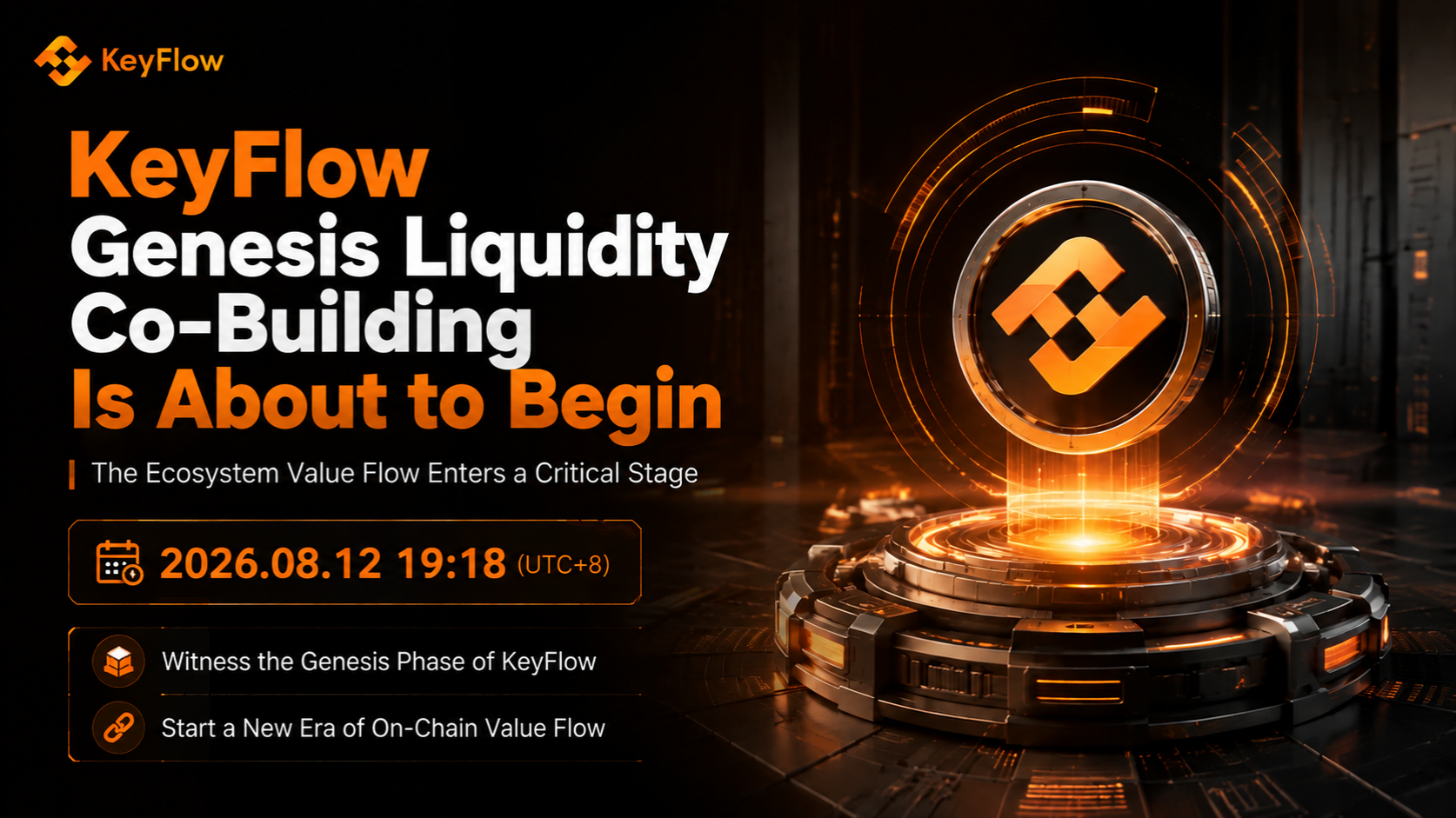
To lower the barriers to AI value circulation and build a decentralized computing power settlement network, KeyFlow officially announces that its self-developed value circulation and settlement platform will launch Genesis Liquidity Pool Co-Building on August 12, 2026, at 19:18 (UTC+8).
This launch marks KeyFlow’s integration of one-stop AI capability access into its own settlement system, transforming intangible “AI capability utilization” into tangible “business settlement and revenue circulation,” enabling ordinary participants to access the growth opportunities of the AI Agent economy with a lower entry barrier.
Dual-Core Architecture: Anchoring the Capability Layer, Building a Settlement Hub
In KeyFlow’s envisioned ecosystem architecture, a clear “capability and value” dual-core decoupled structure is established:
UniKey (Capability Layer): As a one-stop AI infrastructure for the Agent era, UniKey integrates global mainstream AI computing resources and large-scale model resources, providing a unified AI usage network and workflow tools, enabling users and developers to access various AI capabilities at lower costs.
KeyFlow (Value Hub): As a settlement network deeply anchored to and serving the UniKey AI ecosystem, KeyFlow builds a circulation mechanism around the KEY token: “Fund Pool Entry ➔ Token Issuance ➔ Business Revenue Burn ➔ Market Circulation Regulation.” AI service fees, API usage fees, and computing resource leasing revenues generated within the ecosystem will all be used for KEY buybacks and burns, providing fundamental demand support for the token.
Genesis Early-Bird Program: Establishing 360-Day AI Computing LP Orders and a Declining Conversion Mechanism
To establish a stable and sustainable initial liquidity treasury for the settlement network, KeyFlow Genesis Liquidity Pool introduces the “Early-Bird Declining Conversion” and scheduled settlement mechanism:
Fund Conversion and Locking: Funds participating in the Genesis Liquidity Pool will be automatically converted by smart contracts into 360-day “AI Computing LP Orders”, fully deposited into the liquidity treasury to ensure the project’s stable long-term operation.
Real-Time Settlement by Block: Revenue settlement is directly linked to the on-chain block ledger (1.5 seconds/block), with linear and high-frequency release based on the timeline. The generated principal and earnings support daily withdrawals and can also be reinvested at any time.
Early-Bird Discount Rules:
1. First-Day Participation Privilege: Participants joining on the first day will enjoy a 35% discount on the settlement price. This means that with an investment of $100 USDT, participants can receive approximately $100 ÷ 0.65 ≈ $153.8 worth of KEY allocation.
2. Discount Increment Mechanism: Afterwards, the discount rate will increase by 0.005 every 24 hours (meaning the settlement cost increases by 0.005 discount factor per day). The earlier the participation, the lower the settlement cost and the greater the token allocation received.
Open Routing Nodes, Providing 20% SWAP Fee Revenue Sharing
To rapidly expand the decentralized routing network, an account only needs to contribute 100 USDT to activate as an active routing node and gain access to up to 10-level USDT referral rewards (5% for Level 1, 3% for Level 2, and 1% for Levels 3-10).
At the same time, for capital partners and core ecosystem contributors, KeyFlow establishes three different tiered benefit configurations:
1,000 USDT Tier Configuration (Upgrade Directly to A1 Route):Participants with a contribution of 1,000 USDT can directly secure the A1 routing rank, while obtaining basic service provider node qualifications and enjoying revenue sharing from global basic node referral incentives.
5,000 USDT Tier Configuration (Upgrade Directly to A2 Route):Participants with a contribution of 5,000 USDT can directly advance to the A2 routing rank, unlocking the agency and distribution support privileges for computing power tokens, and directly connecting with the underlying computing power resource monetization channel.
10,000 USDT Tier Configuration (Upgrade Directly to A3 Route):Participants with a contribution of 10,000 USDT can directly advance to the highest A3 routing rank. In addition to obtaining computing power token agency rights with higher discount benefits, participants will exclusively enjoy a long-term super revenue-sharing right of 20% of global SWAP transaction fees, deeply sharing the ecosystem’s overall transaction flow.
UniKey is a one-stop AI infrastructure designed for the Agent era; KeyFlow is a value settlement platform anchored to its AI ecosystem, providing continuous liquidity support and business infrastructure for the AI economy through transaction networks and deflationary mechanisms.
KeyFlow stated: “KEY serves as the bridge connecting global AI computing power with application services. The launch of the Genesis Liquidity Pool aims to enable more early participants to access the AI Agent economy with a lower entry barrier and share the real utilization benefits of the computing power market.”
KeyFlow will officially launch on the official DApp (https://www.getkeyflow.ai) at 19:18 (UTC+8) on August 12, 2026. We sincerely invite you to join us on August 12 to witness the official launch of KeyFlow and jointly open a new chapter of value settlement in the AI economy.


All Comments