

Cointime

Download App
iOS & Android

Jack Dorsey tests Bitchat — decentralized messaging without internet

Validated Individual Expert

Block CEO and Twitter co-founder Jack Dorsey has launched the beta version of a new decentralized peer-to-peer messaging service that runs entirely over Bluetooth. 

Jack Dorsey said his weekend was spent learning about “Bluetooth mesh networks, relays, store and forward models, message encryption models, and a few other things” as he introduced Bitchat on X on Sunday. 

The “Bluetooth mesh chat” system has “IRC [Internet Relay Chat] vibes,” Dorsey added, harking back to the early days of web-based messaging systems in the late 1990s. 

His white paper goes into more detail about Bitchat, which is a decentralized messaging application that operates over Bluetooth Low Energy (BLE) mesh networks.

“It provides ephemeral, encrypted communication without relying on internet infrastructure, making it resilient to network outages and censorship.”
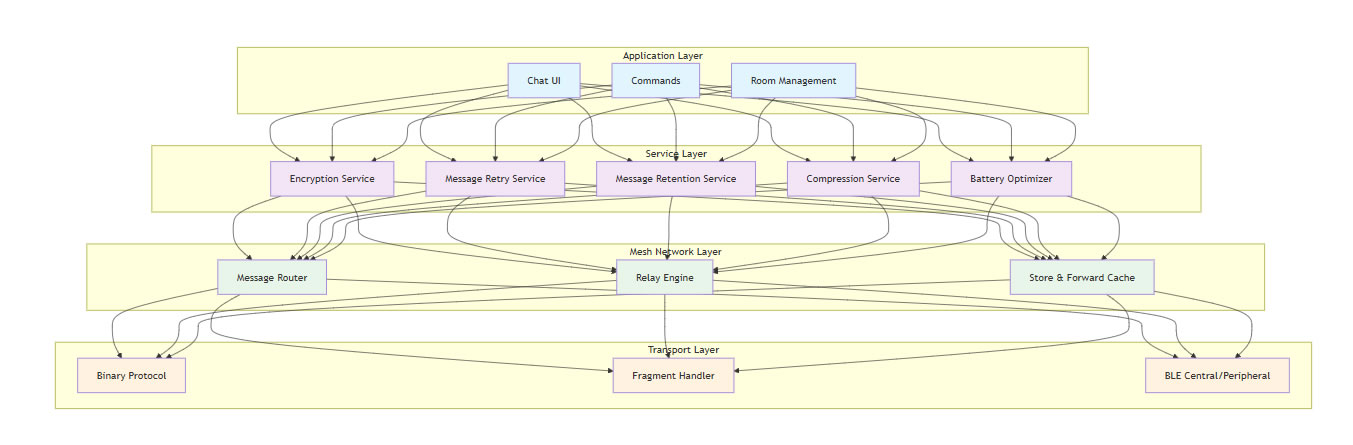
  Bitchat architecture overview. Source: Github

Completely decentralized and private

According to the white paper, the network would be fully decentralized with no central servers, accounts, email addresses, phone numbers to register, or infrastructure dependencies. 

It provides “ephemeral messaging,” whereby messages exist only in device memory by default and are not stored on a central database. There is also end-to-end encryption for an extra layer of security. 

Current popular messaging applications such as WhatsApp and Messenger are run by social media giants such as Meta, which are centralized, profit-driven corporations that use personal and message data as a product. 

Meanwhile, mesh networking enables automatic multi-hop message relaying, and room-based chat can be set up with hashtag-named group chats and optional password protection. A “store-and-forward” system caches messages for offline peers for set time periods. 

In April, Cointelegraph reported that some popular social messaging apps could be spying on users, hoovering up personal information and messages. 

Bluetooth relays to hop messages 

Each device acts as both client and peripheral, creating a self-organizing mesh where messages can hop between devices to reach distant peers. The system uses a 30-meter Bluetooth range with bridge nodes connecting separate clusters.
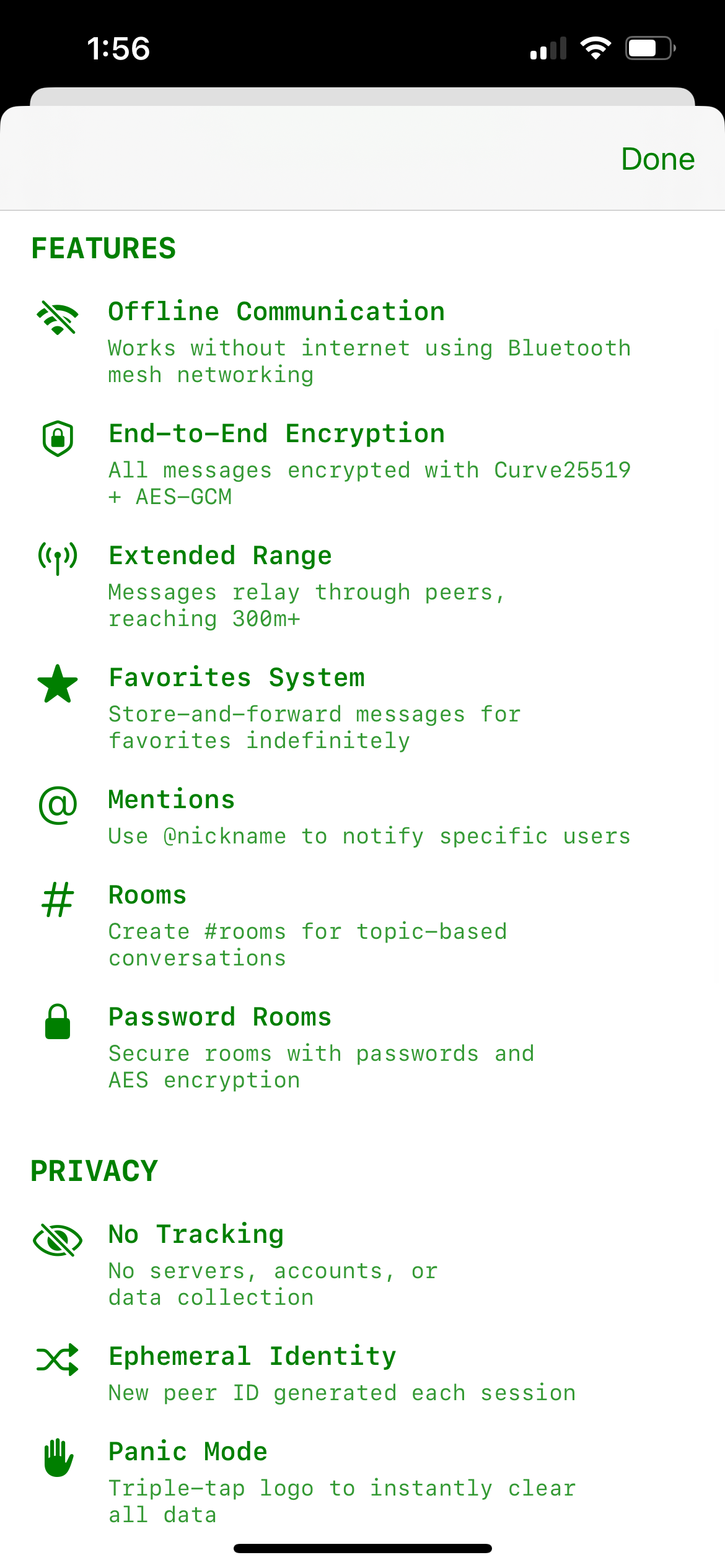
Screenshot of Bitchat’s features as shown in version 1.0 of the TestFlight app. Source: Cointelegraph


Messages are encrypted based on whether they are private, in a room, or broadcast, and large messages are fragmented into smaller 500-byte chunks. 

There are future plans to enable messaging over WiFi, which will increase the bandwidth for large messages. 

Multiple use cases 

The system has several use cases, such as conferences, protests, disaster areas, or any scenario where internet infrastructure is unavailable, unreliable, or untrusted.

The paper concluded that Bitchat demonstrates that secure, private messaging is possible without centralized infrastructure, and stated: 

“By combining Bluetooth mesh networking, end-to-end encryption, and privacy-preserving protocols, Bitchat provides resilient communication that works anywhere people gather, regardless of internet availability.”

Dorsey is no stranger to messaging protocols, having served as the CEO of Twitter while founding the decentralized social messaging platform Bluesky in 2019. He left the Bluesky board without explanation in May 2024. 

Comments

All Comments

Recommended for you

  • Trump Evacuated from White House Correspondents' Dinner Due to Security Incident

    On April 26, local time April 25, U.S. President Trump was urgently evacuated from the White House Correspondents' Dinner due to a security incident. (CCTV News)

  • Shooting Incident at White House Correspondents' Dinner; Gunman Dead

    On April 26, local time on April 25, a shooting incident occurred in the hall of the White House Correspondents' Dinner, and the gunman is now deceased. (CCTV News)

  • Trump States He Will Not Allow Banks to Undermine Cryptocurrency Market Legislation

    On April 26, CoinDesk reported, citing attendees at a Trump cryptocurrency event, that Trump stated he would not allow banks to undermine cryptocurrency market legislation.

  • Iranian Officials to Depart Pakistan Without Meeting U.S. Representatives

    On April 25, according to a reporter from the New York Post: The Iranian delegation is set to leave Islamabad, the capital of Pakistan, and has consistently emphasized that they did not meet with U.S. officials during their brief visit.

  • Foreign Media: Second Round of Iran-U.S. Talks Scheduled for April 27

    On April 25, according to New Delhi Television: The second round of talks between Iran and the United States is scheduled to take place on April 27.

  • Iranian Lawmaker: Comprehensive Plan for Managing the Strait of Hormuz Formed

    On April 25, according to a report by Iran's Mehr News Agency, Iranian Islamic Parliament member Behnam Saidi stated that Iran has developed a comprehensive plan for managing the Strait of Hormuz. In an interview with Mehr News Agency, Saidi mentioned that an important aspect of this plan is the exclusive recognition of the name 'Persian Gulf' in all correspondence and commercial documents, rejecting any other names. Vessels and ships navigating in the region must obtain permission from Iran. Sovereignty over the Strait of Hormuz will be entirely under Iran's control. He also stated that vessels identified as hostile by the Supreme National Security Council or the General Staff of the Armed Forces of Iran are not allowed to pass through the Strait of Hormuz, and Israeli vessels are absolutely prohibited from entering the area. Ships passing through the region must pay relevant fees concerning safety, environmental protection, shipping management, and licensing, with priority given to payments in rials.

  • DeepSeek Plans to Raise $1.8 Billion with a Valuation of Approximately $20 Billion

    Sources reveal that the main reason for DeepSeek's current fundraising effort is the significant recent talent loss. Several core researchers have left the company to join ByteDance, Tencent, Xiaomi, and autonomous driving company Yuanrong Qihang. Meanwhile, competitors Zhiyu Technology and MiniMax have listed on the Hong Kong Stock Exchange, and the company Dark Side of the Moon has completed three rounds of financing in the first three months of this year, with a valuation more than quadrupling since the end of last year.

  • Iran Warns U.S. Against Continuing Piracy Actions

    On April 25, according to CCTV International News, Iran's Khatam al-Anbia Central Command issued a statement today warning that if U.S. forces continue to implement 'blockades, maritime interceptions, and piracy actions' in the region, they will face a strong counterattack from the Iranian armed forces. The statement emphasized that the U.S. should recognize that Iran's military capabilities and preparedness in safeguarding national sovereignty, territorial integrity, and national interests are stronger than ever, as demonstrated in previous conflicts. The statement also noted that Iran will continue to monitor enemy actions and movements and maintain control over the Strait of Hormuz. Should the enemy take further actions, Iran will respond with even harsher strikes.

  • Sources: Iran's Stance is Tougher than in First Round of Negotiations

    On April 25, official sources from Pakistan stated that Iran has adopted a tougher position compared to the first round of negotiations, emphasizing that any plan to end the war must be implemented according to Iran's conditions, rather than those proposed by U.S. President Trump. (Xinhua News Agency)

  • Iran Open to Negotiations with the U.S. but Will Not Abandon Uranium Enrichment

    On April 25, the Wall Street Journal reported that a senior Iranian diplomat stated Iran is open to negotiations with the United States but will not abandon its uranium enrichment activities. Iran's ambassador to India, Mohammad Fathali, posted on social media on Saturday, saying, 'Negotiations can yield appropriate results only when our opponents recognize our country's right to peacefully utilize nuclear energy.' The report indicates that the U.S. is currently seeking to have Iran suspend its uranium enrichment program for up to 20 years.
