

Cointime

Download App
iOS & Android

How To Choose a Data Provider for a web3 Project?

Validated Individual Expert

Summary of the live stream where Boris Godlin explains what to consider when working with historical data, how to move from raw data to abstractions and what are the ways of API integrations.

He also explains the approach Footprint Analytics offers to connect web applications and APIs and the project’s mission in blockchain analytics.

Requirements

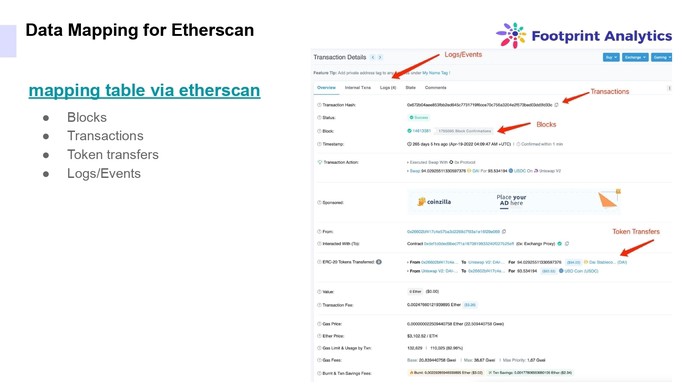
It is expensive to store historical blockchain data in the blockchain itself, so there is a need for indexers. For example, a cross-chain NFT gallery wants to work with many chains and sectionally show its statistics and analytics at different levels (from the whole market overview to a specific collection), so this is the best case for an example. Such a Dapp project has a lot of criteria that would be interesting to consider:

  1. the data must meet your goals and objectives;
  2. the data must be of good quality;
  3. the number of networks supported should be appropriate for your cases;
  4. you should have easy ways to integrate with the indexer so you can easily fetch that data. You probably don’t want to have a lot of infrastructure costs, you’ll want support and, of course, legal complince.
Indexing Pipeline

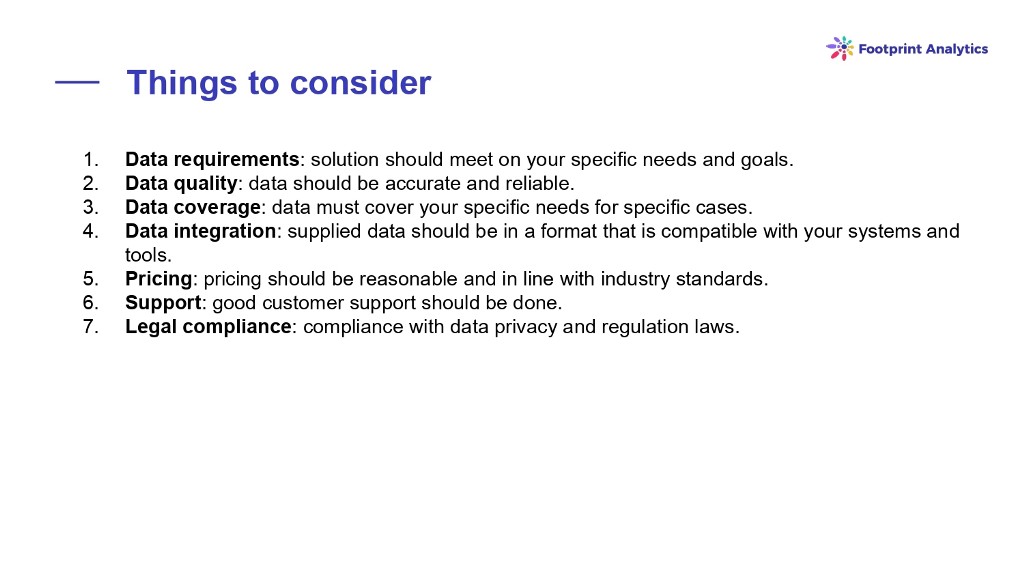
There are a lot of blockchains, which means a lot of raw data. Once the raw data is obtained, most usecases will require an abstraction. The indexing process involves trivial processes: you take the data from somewhere, transform it, store it. There are many ways to store data, different kinds of databases. But once you’ve stored it, you want to be able to provide different interfaces with the workings of that data.
Types of RPC Nodes

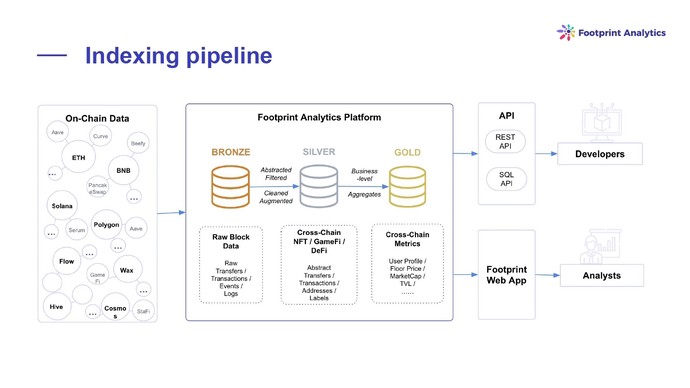
There are many different types of nodes which store different sets of data. If you want to retrieve historical data from the blockchain, you have to work with archive nodes.
Data mapping for Etherscan

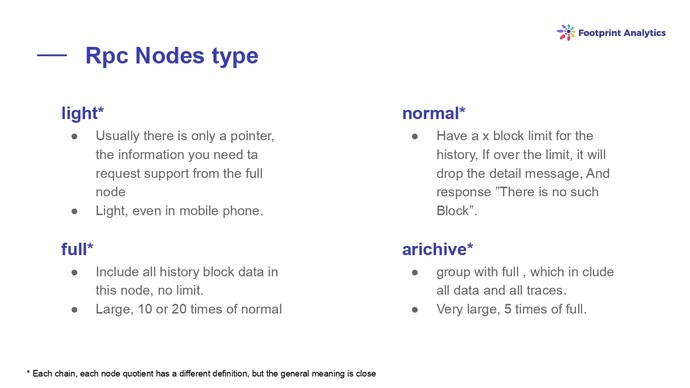
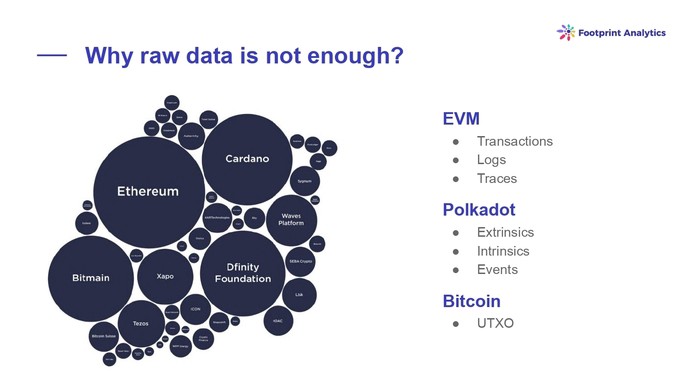
Doing a reference on EVM (since it’s popular and many people know how it works) there are 4 primitives. These are blocks, transactions, logs and traces — the raw data that can be retrieved from the blockchain. If you’ve ever worked with Etherscan or written smart contracts, you should know how it works.
Why raw data is not enough

Raw data may not be enough. If you are an NFT gallery that wants to work with several networks besides EVM: Polkadot or Solana, you need to understand that these are architecturally completely different networks. Since there are different raw data, and you would like to be able to get it across different networks at the same time within one query, you have to abstract away that raw data. So there are abstractions.
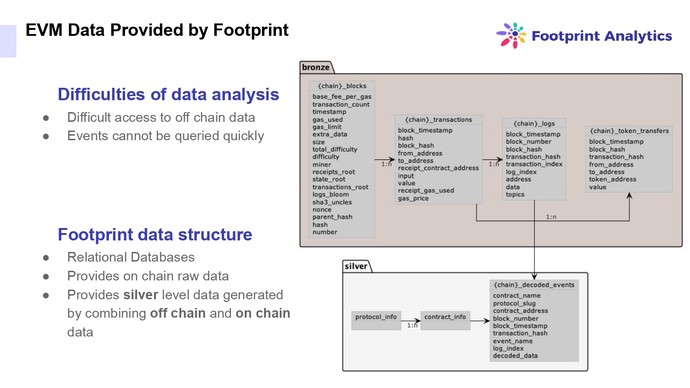
EVM data provided by Footprint

Footprint Analytics aggregates raw data and if it conforms to some rules (e.g., the transaction is executed within a smart contract, which is ERC-721 or ERC-1155 standards, that is, implement methods), then it is considered an NFT transaction. Footprint Analytics has a lot of rules that vary from EVM to Solana. They aggregate this under “bronze stable” to the “silver stable” level, where everything across all networks is already in place.
What are the options?

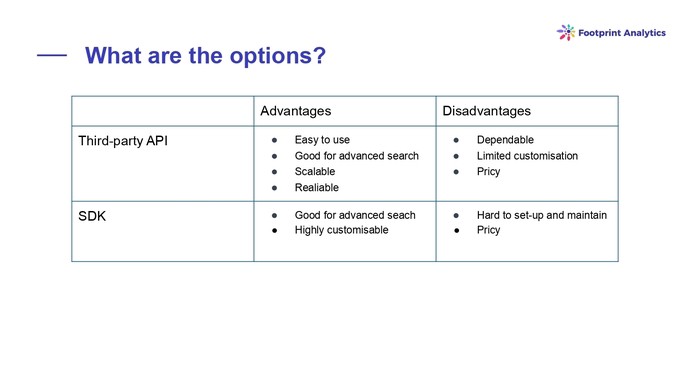
There are two options: either you trust someone and get the data, or you are the indexer.

Third-party products are much easier to use, because the infrastructure has already been built for you. The company that develops this API often has high computing power and employs professionals. However, you are dependent on the indexer, you have less customization and it may not be cheap.

With SDK, it’s all in your hands and you build all the abstraction and triggers yourself. It’s easy to customize but hard to install and maintain, which means more resources.
REST API

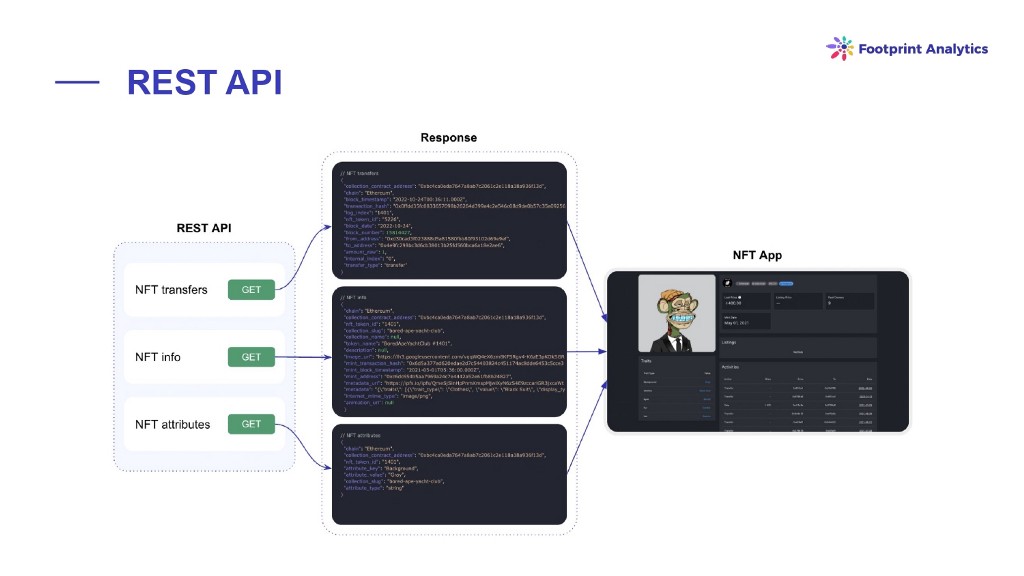
Footprint Analytics has two interfaces for different segments: for developers and analysts. Ultimately the data set is the only one. This means that anything you can get through the web application, you can then get through the API.

Footprint Analytics has several ways of API integrations. One of them is REST. This is when some trivial comand scenarios are chosen that you can get data from.
SQL API

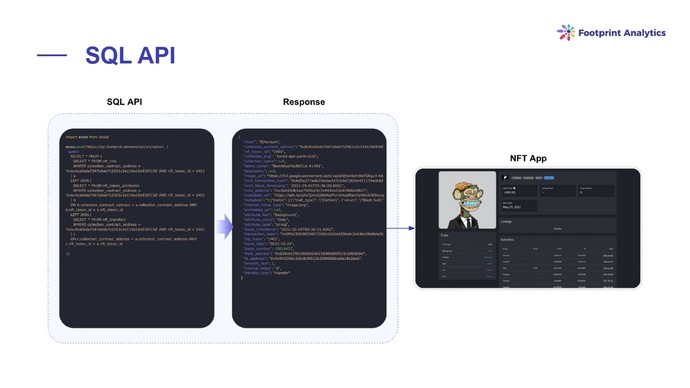
At the core of everything, Footprint Analytics has a relational database, because the number of tools and cases that work with relational databases is universal. And you have to understand that our data uses SQL.This is a very interesting thing for the reason that any query that you execute through a browser and you get a nice chart or table, you can validate. You can make sure that you’re getting what you want to get and that the data is coming in correctly. Then just copy the SQL code you get and paste it into the API, and use it within the API. Footprint Analytics promotes an ecosystem approach of connecting the web application and the API.

Footprint Analytics’ mission is to lower the barrier of entry for blockchain analytics, the project team does abstraction over SQL as a construct building and therefore they have the same approach with APIs.
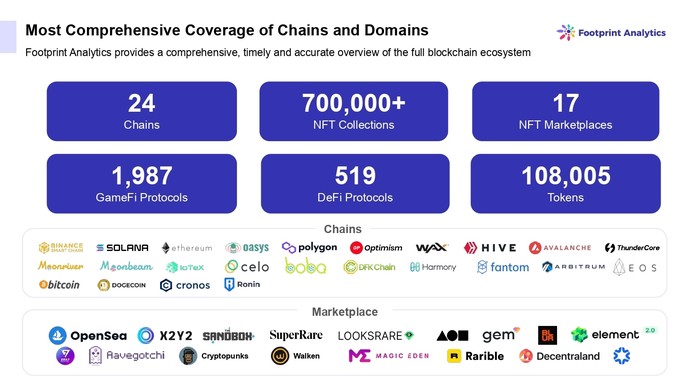
Supported networks.

Footprint Analytics supports 24 networks, over 700,000 NFT collections, 17 NFT marketplaces, and 519 DeFi protocalls.
Comments

All Comments

Recommended for you

  • BTC Falls Below $78,000

    Market data shows that BTC has fallen below $78,000, currently priced at $77,993.28, with a 24-hour increase of 1.09%. The market is experiencing significant volatility, so please ensure proper risk management.

  • U.S. Storage Stocks Weaken, SanDisk and Seagate Drop Over 4%

    On September 11, U.S. storage stocks weakened, with SanDisk and Seagate dropping over 4%. Western Digital fell by more than 2%, while Micron Technology and SK Hynix saw declines of less than 1%.

  • US Crypto Stocks Surge, Strategy Up 5.71%

    On September 11, during intraday trading, US crypto-related stocks saw widespread gains, with Strategy (MSTR) rising 5.71%; Coinbase (COIN) up 5.34%; Circle (CRCL) increasing by 5.23%; SharpLink Gaming (SBET) climbing 10.32%; MARA Holdings (MARA) up 6.69%; and BitMine Immersion (BMNR) rising 9.01%.

  • Grayscale: Zcash Mining Profits 2-4 Times Higher than Bitcoin with Hashrate Growth Exceeding 2.5 Times This Year

    According to Grayscale's research director Zach Pandl, Zcash mining profits have surged significantly due to the strong performance of ZEC prices. Data shows that the total daily miner rewards on the Bitcoin network are approximately $35 million, while for Zcash, it is about $2 million. However, the daily earnings per mining machine for Zcash are about twice that of Bitcoin, with earnings per megawatt-hour being approximately four times higher, even surpassing some AI/high-performance computing cloud services. The high profits have driven an increase in mining activities, with Zcash's total hashrate growing over 2.5 times this year, creating a virtuous cycle of 'rising coin prices → increased mining → enhanced network security → supporting coin prices.' The calculations are based on an electricity price of $0.05 per kilowatt-hour and the Bitmain Z15 Pro mining machine operating at full capacity, with data as of September 9.

  • ETH Surpasses $2600

    Market data shows that ETH has surpassed $2600, currently priced at $2601.32, with a 24-hour increase of 7.27%. The market is experiencing significant volatility, so please ensure proper risk management.

  • BTC Surpasses $79,100

    Market data shows that BTC has surpassed $79,100, currently priced at $79,150, with a 24-hour increase of 2.53%. The market is experiencing significant volatility, so please ensure proper risk management.

  • BTC Surpasses $79,000

    Market data shows that BTC has surpassed $79,000, currently priced at $79,012, with a 24-hour increase of 2.37%. Due to significant market fluctuations, please ensure proper risk management.

  • U.S. Optical Communication Stocks Surge, Coherent Rises Over 3%

    On September 11, U.S. optical communication stocks collectively surged, with Viavi Solutions, Amphenol, Coherent, AXT Inc, and Lumen Technologies rising over 3%. Additionally, Qioptiq, Applied Optoelectronics, and Ciena increased by more than 2%, while MaxLinear and Corning saw gains of over 1%.

  • Canadian MP Urges Trump: Relax Tariffs to Help U.S. Combat Inflation with Canadian Oil and Minerals

    On September 11, Pierre Poilievre, leader of the Conservative Party of Canada, stated that Canada possesses abundant oil and mineral resources that could help alleviate inflationary pressures in the United States, but the Trump administration needs to relax its tariff policies against Canada. Poilievre strongly promoted Canada's 'affordable energy' and mentioned that he has discussed establishing a 'strategic mineral and oil national reserve' with Canadian Prime Minister Mark Carney for allies to use in times of need. Poilievre said, 'By strengthening trade with Canada, we can lower your cost of living. We can ensure that in the event of future conflicts—hopefully never occurring—we have ample supplies while also restoring the industrial base across the North American continent. But this must be achieved through cooperation.'

  • Iran's Foreign Ministry: Regional Meeting of Gulf Countries Scheduled for Next Monday

    On September 11, Iranian Foreign Ministry spokesman Baghaei announced plans for a regional meeting involving Gulf coastal countries. This meeting represents a significant development, with hopes that it will enhance mutual understanding among regional nations and contribute to strengthening regional security. Iran, Iraq, and other Gulf coastal countries will participate in this meeting, which will take place next Monday in Oman. In addition to other regional issues, the participants will discuss the outcomes of negotiations between Iran and Oman regarding the establishment of a safe commercial shipping corridor in the Strait of Hormuz. The Iranian Foreign Ministry spokesman also mentioned a previous agreement between Iran and Oman on a temporary shipping corridor in the Strait of Hormuz, emphasizing Iran's commitment to taking action to ensure the safety of shipping in the Strait. However, he stated that as long as the U.S. acts aggressively and interferes illegally, including through maritime blockades and economic warfare, the safety of shipping in the Strait of Hormuz cannot be guaranteed.
