

From Ethresearch by daniejjimenez
One of SafeStake’s great strengths in the last two years has undoubtedly been the hard work at the development level to deliver a highly resilient and decentralized staking framework and protocol, facilitating the onboarding of thousands of users to the fascinating world of ETH staking with DVT technology.
After the successful and stable Galileo Testnet launch to the public on February 25, 2023, a key moment has arrived for SafeStake in its definitive step towards releasing its long-awaited public mainnet: Holesky Safestake Testnet!
The Holesky Safestake Testnet is the final step before deploying the DVT-based protocol on the Ethereum mainnet in the first quarter of this year, as indicated in their “SafeStake Annual Review and 2024 OKR Outline.” It is a fundamental part of achieving the short-term goals and key results outlined for the project.
The deployment of Holesky Safestake Testnet over a month aims to ensure a minimum of 20 professional node operators with a minimum performance rating of 98%+, enabling the service of over 2,000 Ethereum mainnet validators when the protocol is launched on the main network at the end of February.

Advantages of Holesky Safestake Testnet
One of the main questions the average user may address is why another month of testing in Holesky should be deployed. The reasons are straightforward: Holesky has been launched as a critical test environment for Ethereum developers to experiment with ambitious updates to enhance Ethereum’s scalability and performance.
The Holesky Ethereum testnet allows for faster block times and greater stability, enabling the testing of large-scale features that the Safestake protocol will have in the future, such as liquid staking and the creation of validators with a low limit of only 4 ETH.
The generation of 4 ETH mini-pools in Safestake is undoubtedly one of the most critical milestones in the project’s roadmap. Therefore, subjecting the protocol to the necessary stress tests in Holesky before its deployment on the mainnet is crucial to ensure that this functionality performs without any issues.

720×405 120 KB
Holesky Safestake Testnet will allow SafeStake operators and validators to activate a node and perform their functions similarly to Goerli but in a more scalable and secure environment, enabling the participation of a larger number of validators in running more comprehensive and rigorous tests, such as the generation of distributed keys (DKG), before they are implemented on the main network.
This new testing phase is also designed to simulate the performance of Safestake in line with upcoming updates that will be implemented in Ethereum to improve the scalability of the main network.
Why Participate in Holesky Safestake Testnet
With the successful launch of Safestake on Holesky, the protocol development team will be able to test the ambitious features of the protocol in a more realistic environment as it approaches the achievement of short-term goals, measuring the scalability and performance of the cutting-edge SafeStake Operator Node.
Participating in the Holesky Safestake Testnet will, in the first instance, allow testing the capabilities of a unique protocol based on Distributed Validator Technology (DVT), aiming to become one of the leading DVT infrastructure providers for the Lido DAO and its operators in the short term.
As is publicly known, the staking industry is one of the fastest-growing sectors projected for the next half of this decade. According to Staking Rewards data, the staking Industry MarketCap is currently around $273.99b, and Ethereum’s staking participation rate (26.3% of the total supply staked) still significantly lags behind other PoS networks such as Solana (71% staked) or Cardano (62% staked).
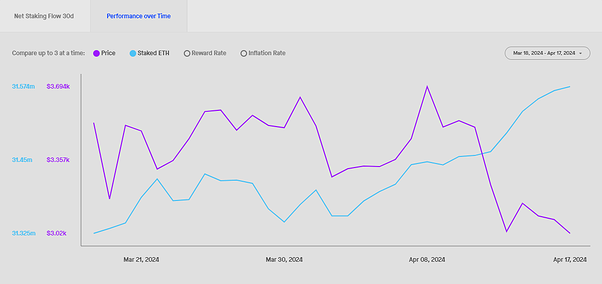
1189×561 36.2 KB *Source: Staking Rewards*
Within the ETH staking market, it is important to provide a protocol with a DVT-based infrastructure to reduce risks of centralization.
Safestake is working diligently to ensure that a portion of the Ops base on Ethereum joins our mainnet to achieve the goal of a more resilient, secure, and decentralized Ethereum.
On the other hand, becoming a Node Operator in Holesky Safestake Testnet can represent a historic opportunity in the mission to help make Ethereum more decentralized with a distributed base of validators.
Additionally, it is also an opportunity to become one of the Top 20 Operators with excellent performance, who will be incorporated into Safestake Mainnet Private in 2024, and start earning rewards (ETH) for keeping validators secure and online to perform Ethereum Proof-of-Stake consensus duties.
How to join Holesky Safestake Testnet
In case you want to become a node operator on Holesky Safetake Testnet, you can find an excellent instructional video on how to join at this link:
How to run an Operator Node on SafeStake Testnet v2.0 -Version 2 (Holesky)
In case you have already joined, you can expand the information in this instruction manual to upgrade to the last version:
SafeStakeOperator/docs/safestake-running-an-operator-node-on-going.md at main
On the other hand, if you are a validator, you must obtain 32 HolETH via the Holesky testnet PoW faucet, which is free. In addition, you will require 120 test $DVT to run a validator on Testnet v2.0.
Go to Holesky.SafeStake.xyz and connect your wallet. Then click Run Validator and Visit Ethereum Launchpad to create a new validator. Wait for your new Validator to become active on Holesky before importing it to SafeStake.
Then Import Existing to import your keystore file using the drag-and-drop interface. Choose the operators you want to run your validator, approve the $DVT transaction, and wait for your validator to become active on SafeStake (~15 min)
SafeStake on Holesky marks a major milestone and the beginning of the final 30 days of testing before SafeStake launches on the Ethereum mainnet.
Benefits of Joining Holesky Safestake Testnet and Private Mainnet
In addition to the advantages of promoting the adoption of Distributed Validator Technology (DVT) among stakers and node operators, joining our test network has substantial economic benefits through our Mainnet Validator Incentive Pool.
There will be 1.4 million $DVT tokens as an incentive to distribute to ETH holders who decide to run an Ethereum mainnet validator on the Safestake mainnet. Additionally, there will be an extra incentive based on a points system for early birds.
1140×599 85.6 KB
As mentioned earlier, being an independent node operator or a validator in Holesky Safestake Testnet will allow you to familiarize yourself with the protocol and opt for one of the first 20 spots available for our upcoming Safestake Mainnet Private to be deployed on Ethereum by the end of February.
Operators will need to spin up a new node on Holesky and keep it active for 60 days, followed by running a node on the Safestake mainnet that remains active for 60 days post-mainnet launch.
Validators must join SafeStake mainnet to be eligible for rewards.
Safestake: The Path to Efficient Staking
If you love financial freedom and resonate with the decentralized spirit that Ethereum embodied at its inception, the SafeStake Testnet and Mainnet Private are the ideal places to put your ideals into practice.
Safestake, based on DVT, is emerging as a more efficient and decentralized staking solution, offering various advantages over traditional single-node staking solutions, allowing it to be at the forefront of the mission to achieve a more decentralized Ethereum.
The DVT functionality in SafeStake is powered by three key components: Shamir Secret Sharing for BLS Signatures, Multi-Party Computation (MPC), and the BFT (Byzantine Fault Tolerance) consensus layer (HotStuff). The result is a validator that uses a ‘3 out of 4’ threshold signature scheme, where only three out of four operators are needed to attest on a validator’s behalf and where no single entity can ever gain control or recreate the private key.
Safestake infrastructure is written in Rust for increased performance and security for the smart contracts that power its Ethereum staking. Nodes are managed by independent, decentralized operators on a permissionless network, creating a highly decentralized, ultra-secure, fault-tolerant environment.
Furthermore, the protocol aims to cover all narratives around Ethereum staking, such as LSDfi, when it incorporates the ability to run validators through mini-pools of just 4 ETH in its final stage, seeking to diversify the offering of staking pools in the rapidly growing sector currently dominated by a few actors.
We invite all those interested in testing the capabilities of our Testnet to actively participate as validators and ops.
We value objective criticism and community input on the protocol, as the path to a sustainable Ethereum is decentralization, and Safestake based on DVT provides a way to achieve it.


All Comments