

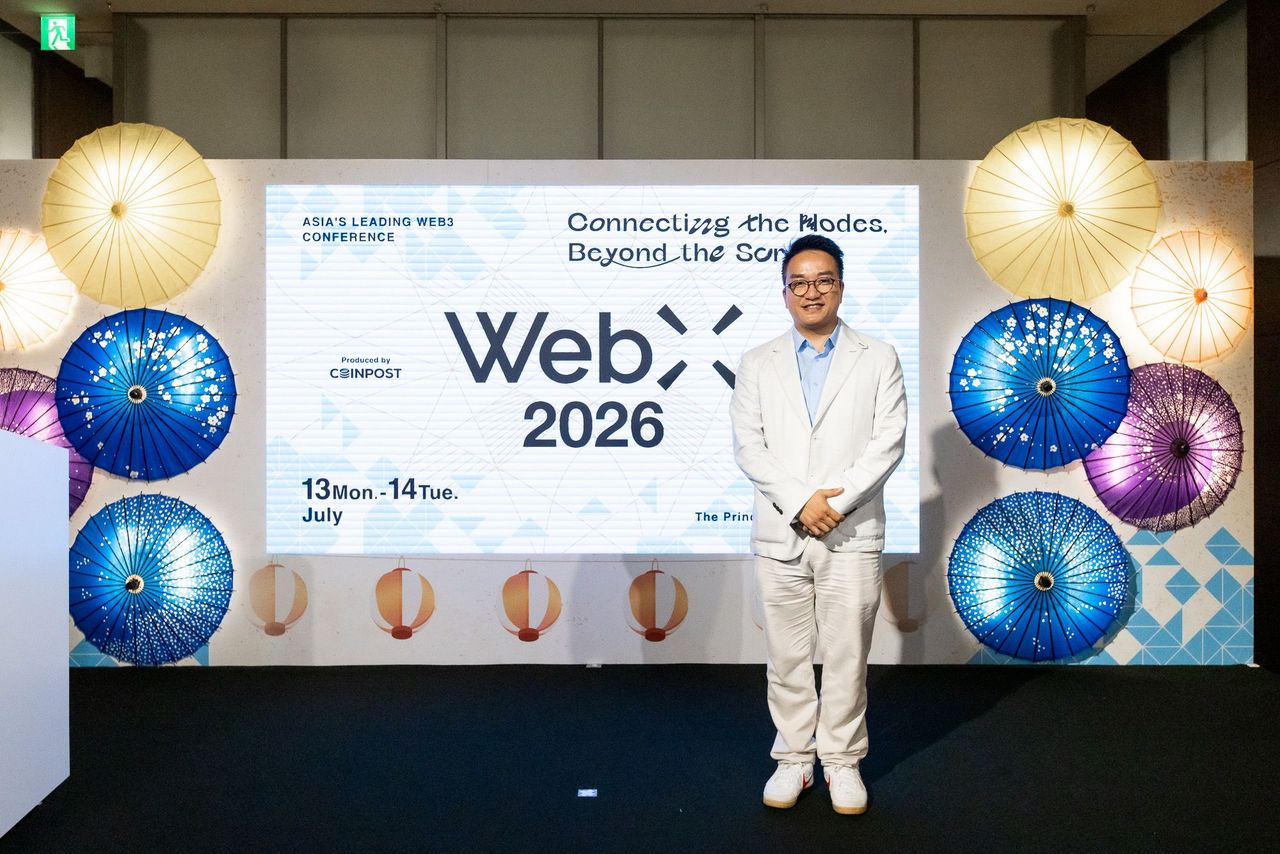
After WebX 2026 in July, ENI noticeably accelerated its expansion in Japan.
During WebX, ENI Founder and CEO Arion Ho delivered a keynote titled “Tomorrow Runs on ENI – The Bridge Between Traditional Capital and the Future Economy,” focusing on enterprise-grade infrastructure, pathways for traditional capital to enter Web3, and ENI’s Super Node Network. ENI then joined ENI Community Night and an NTT-related event, building more direct connections with Japanese companies, industry institutions, and local communities.
A month later, the same trajectory continued.
On August 7, ENI Japan’s official X account went live as a dedicated local channel for partnerships, ecosystem developments, and community updates. Soon after, Takashi Shimizu, who has nearly 18 years of corporate management and investment experience in Japan, was appointed CEO of ENI Japan, taking charge of market strategy, ecosystem partnerships, and local business development.
WebX, NTT, a dedicated local account, and a Japan CEO now form a coherent strategy: ENI is moving from entering the Japanese market to operating in it for the long term.
After WebX ENI Moves Deeper Into Japan’s Enterprise Market
Japan is becoming an increasingly distinctive market within Asia’s Web3 landscape.
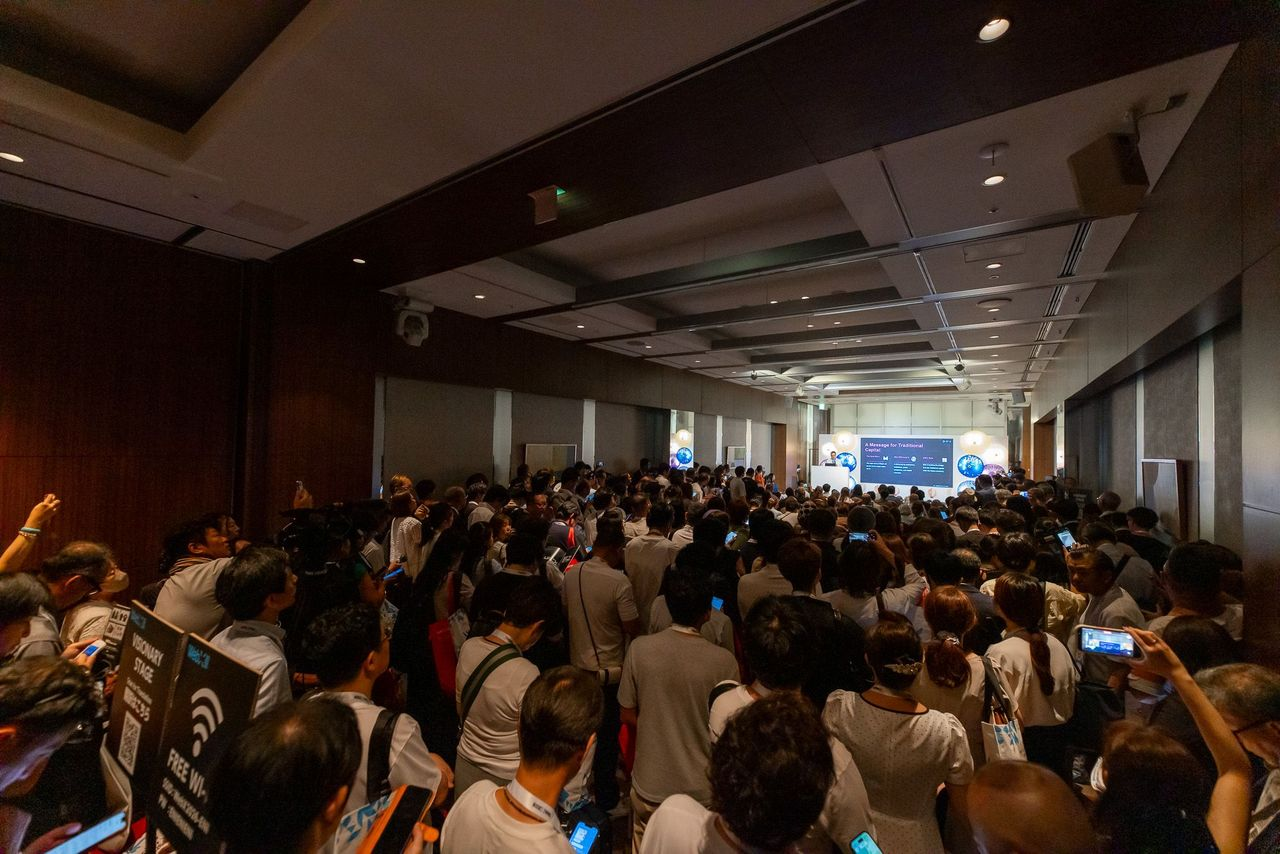
WebX 2026 reflected this shift. The event brought together major Japanese corporations, financial institutions, investors, and technology companies, with discussions spanning blockchain infrastructure, stablecoins, tokenization, AI, and the entry of traditional finance into Web3. In Japan, Web3 is increasingly being discussed through the lens of enterprise adoption and real commercial use cases.
That direction closely matches ENI’s positioning over the past year.
ENI is an enterprise-grade modular L1 built for large-scale commercial use. Through its Mainnet+Hub+AppChain ENI Matrix architecture, enterprises can operate in dedicated business environments while sharing the settlement, security, and ecosystem capabilities of the mainnet. Rather than focusing only on on-chain transactions, ENI is designed around how enterprise assets, workflows, and business systems can actually move into Web3.
That is why ENI’s WebX message about becoming a “bridge between traditional capital and the future economy” points to a concrete enterprise path.
Listed companies, financial institutions, and traditional enterprises do not need to relearn an entire Crypto-native operating model. They need infrastructure that can connect with existing business systems while meeting requirements for privacy, auditability, compliance, and operational stability.
Japan is well suited to testing that model.
ENI had already begun working with NTT Digital to advance the use of high-performance blockchain infrastructure in Japan’s enterprise market. NTT provides an entry point into Japan’s major corporate and traditional technology sectors, while WebX broadened ENI’s exposure to Japanese enterprises, capital, and the local Web3 ecosystem.
After WebX, the question changed: how could those connections be converted into long-term partnerships?
Localization became the next step.
From Official X to a Japan CEO ENI Builds Local Execution Capacity
The launch of ENI Japan’s official X account on August 7 was a small but clear signal.
ENI positioned it as the official local community and information channel for Japan, with future content focused on local partnerships, ecosystem development, and community activities.
This means ENI is no longer relying entirely on its global channels to cover Japan. It is beginning to build an independent local brand and communications system.
Takashi Shimizu’s appointment adds the more important commercial execution layer.
Shimizu brings nearly 18 years of corporate management and investment experience. He previously worked at Hitachi, Hitachi Research Institute, IGPI, and Universal Materials Incubator, and currently serves as Founder and Representative Director of Human Capital. His work spans AI, Web3, RWA, Deep Tech, venture investment, and cross-border business, supported by networks across major Japanese corporations, startups, investment institutions, and industrial ecosystems. As CEO of ENI Japan, he will directly oversee market strategy, ecosystem partnerships, and local business development.
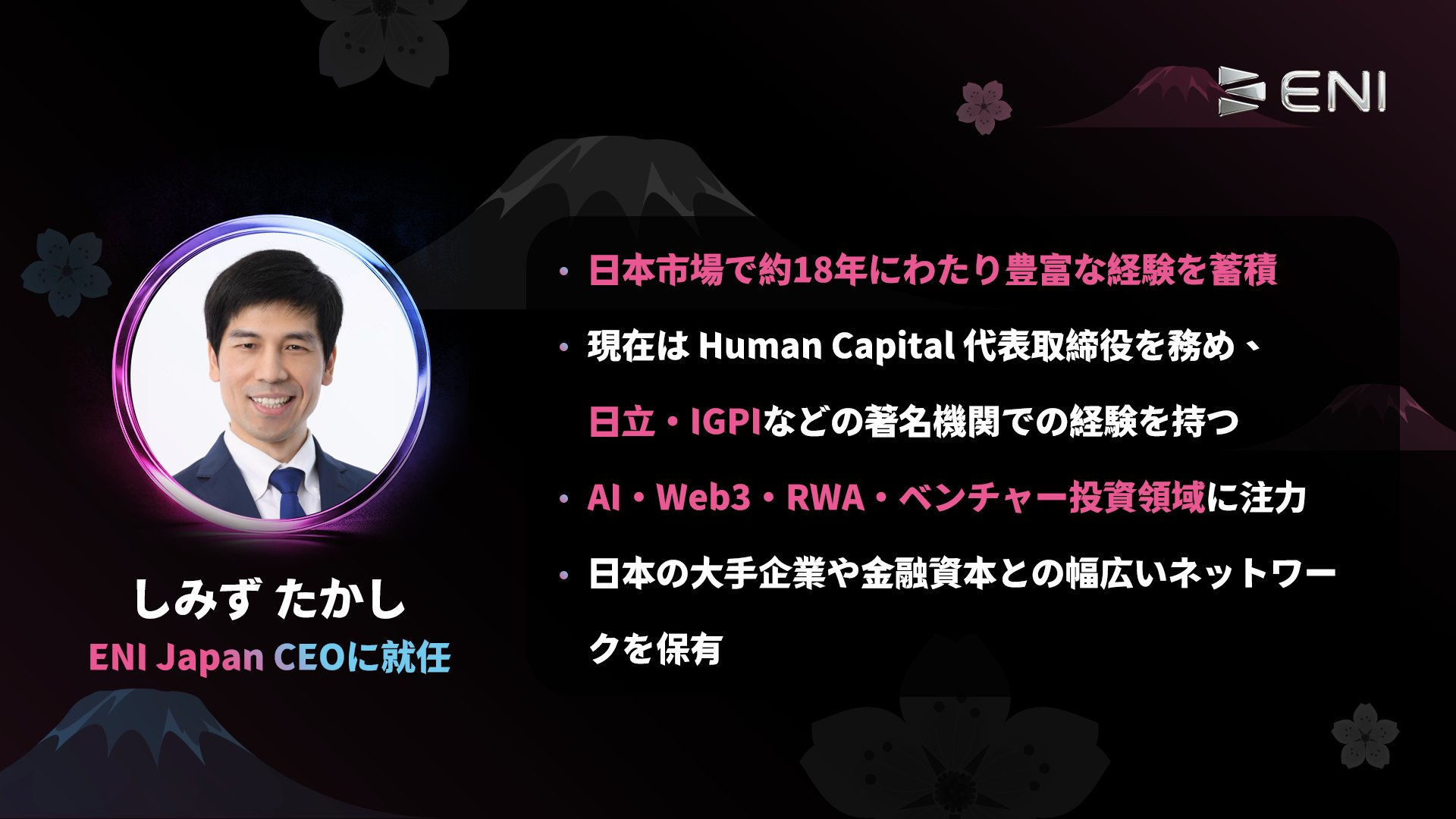
The significance of the appointment is that ENI is shifting Japan from global-team coverage to locally led operations.
For enterprise blockchain, this step matters.
Large Japanese corporations operate mature procurement, audit, legal, and information-security systems. Entering this market requires far more than strong technical specifications or a global brand. From first contact and requirements discovery to technical testing, internal approval, and final deployment, companies need a long-term local commercial and service framework.
Arion Ho brings traditional finance, compliance, and global Web3 experience. Shimizu brings Japanese corporate networks and local execution. Together with industrial relationships already established through partners such as NTT, these capabilities are beginning to form a more complete operating structure for ENI in Japan.
ENI Japan’s official X account adds the local layer for brand, community, and market communications.
The post-WebX moves therefore form a clear loop: WebX builds visibility, NTT provides an industrial entry point, local channels maintain continuous market engagement, and the Japan CEO is responsible for converting those resources into enterprise partnerships.
Japan Is Becoming ENI’s Localization Model for Global Expansion
ENI has consistently emphasized enterprise Web3. The real test ultimately comes down to one question: will enterprises place real business operations on this infrastructure?
Japan offers strong validation value.
The country has a vast traditional corporate base and high requirements for stability, security, privacy, and compliance. If ENI can move from infrastructure partnerships to enterprise adoption in Japan and build sustainable AppChain or BaaS deployments, the significance will extend well beyond the Japanese market.
In its cooperation plans with NTT, ENI has already proposed using Japan’s demanding commercial environment to refine enterprise on-chain benchmarks and then replicate mature models in other markets.
That path is now gaining a more complete execution framework.
NTT provides industrial connectivity, WebX delivers market exposure and resource aggregation, ENI Japan creates a continuous local communications channel, and Takashi Shimizu is responsible for corporate networks and commercial implementation.
This also reflects a broader shift in how ENI is expanding globally.
Public chains have traditionally entered new markets through communities, developers, and liquidity. Enterprise Web3 requires a different growth model. Every market has its own regulatory system, corporate structure, and business relationships, so global expansion ultimately depends on local teams, local partnerships, and local use cases.
With a Japan CEO in place, ENI has completed a key transition from market entry to local operation.
The next indicators to watch are no longer how many events ENI attends in Japan, but whether more major Japanese corporate partnerships emerge after NTT, whether ENI Matrix and AppChain enter real enterprise workflows, and whether the Japanese model becomes a reusable blueprint for enterprise on-chain adoption elsewhere.
If those paths continue to develop, Japan will be more than an additional market for ENI.
It will become a proving ground for ENI’s enterprise Web3 globalization model: technology can be deployed globally, but enterprise adoption must take root in each local market.
From the WebX stage to the appointment of a Japan CEO and the buildout of a local team, ENI is pushing “Tomorrow Runs on ENI” from a global narrative into local business systems.
For an enterprise-focused public chain, that is where real globalization begins.


All Comments